5 rupees 1937
Market Prices
2 salesAbout This Note
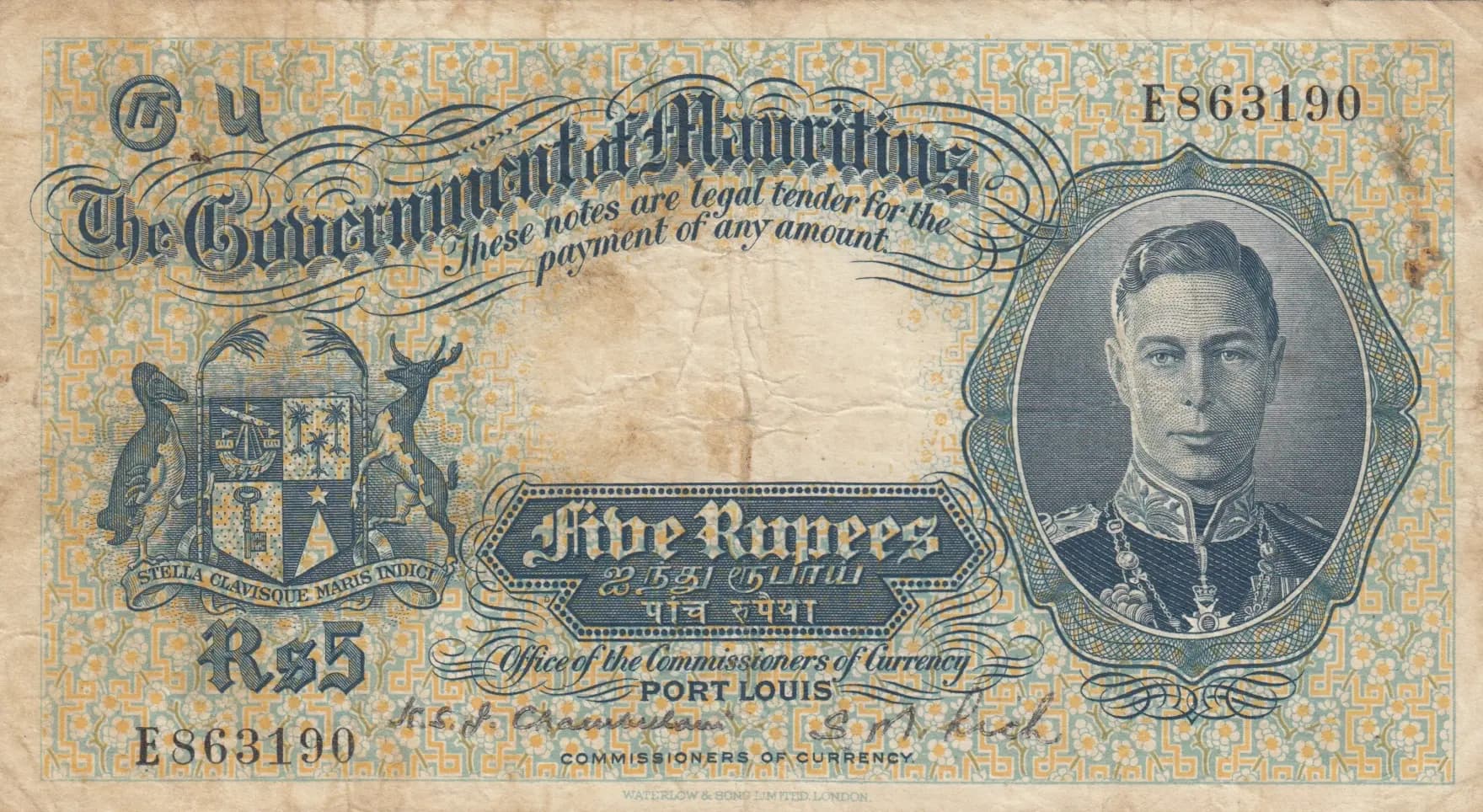
This is a Government of Mauritius 5 Rupees note from 1937, printed by Waterlow & Sons in London. The note displays the formal portrait of King George VI in military dress on the obverse, accompanied by Mauritius's iconic coat of arms featuring a dodo bird and antelope. In Fair condition, this historical note shows expected aging with creasing, foxing, and discoloration consistent with circulation and over 85 years of storage.
Common. Based on eBay market data provided, Fair condition examples have sold for approximately $153.50, and catalog values (2016) assess Fair condition at $50. These market prices indicate this is a widely available note among collectors. No specific information suggests a limited print run or short-lived issue. The 1937 Government of Mauritius 5 Rupees (Pick 22) is a standard regular issue with substantial circulation history.
Issued during the reign of King George VI (1936-1952), this banknote represents Mauritius's monetary system during the late colonial period under British governance. The heraldic imagery—particularly the dodo bird and antelope on the coat of arms—reflects Mauritius's unique natural heritage, while the Latin motto 'Stella Clavisque Maris Indicis' (Star and Key of the Indian Ocean) emphasizes the island's strategic geographic and commercial importance. The multilingual inscriptions in English, Tamil, and Hindi reflect Mauritius's diverse population during this era.
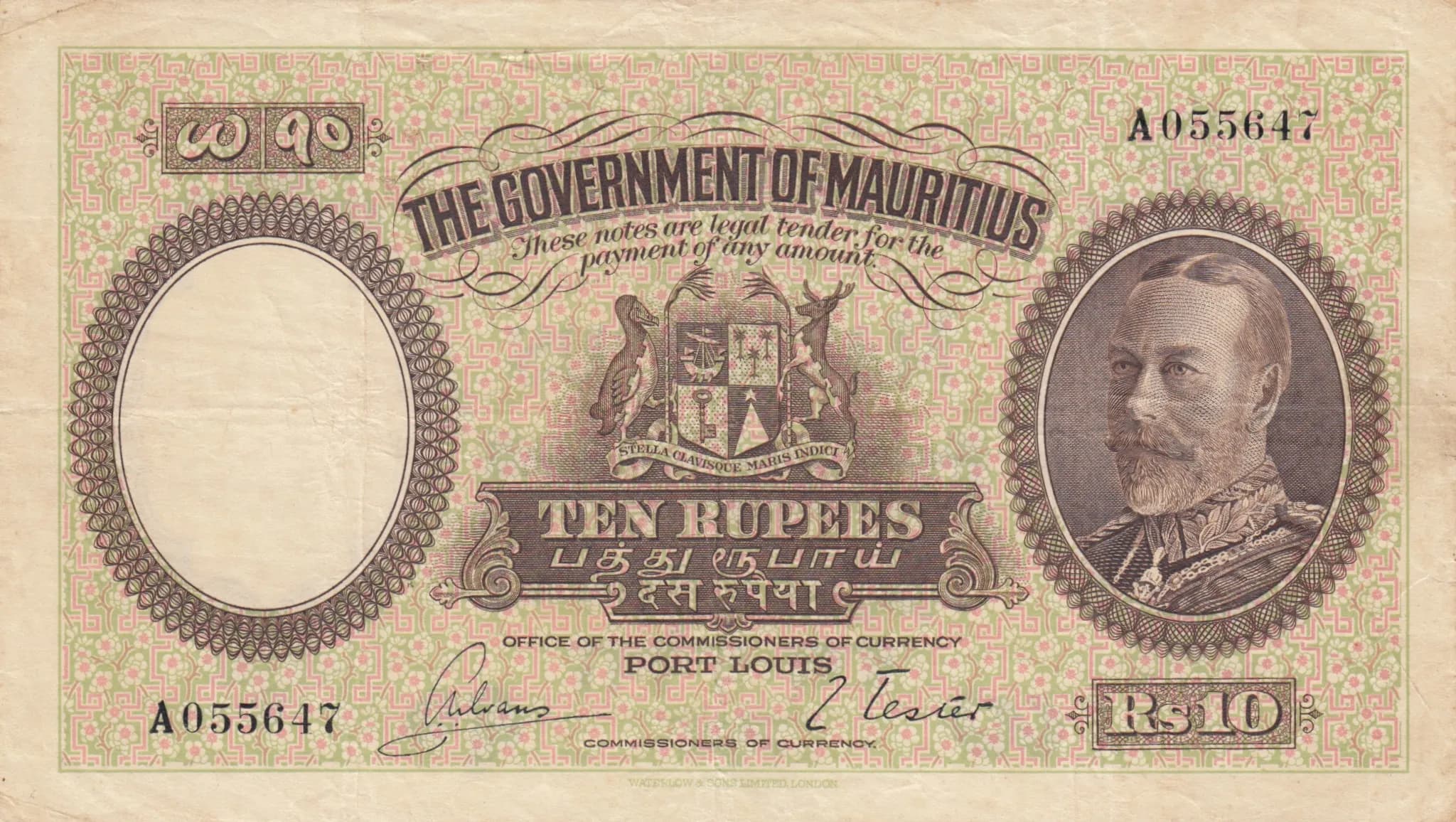
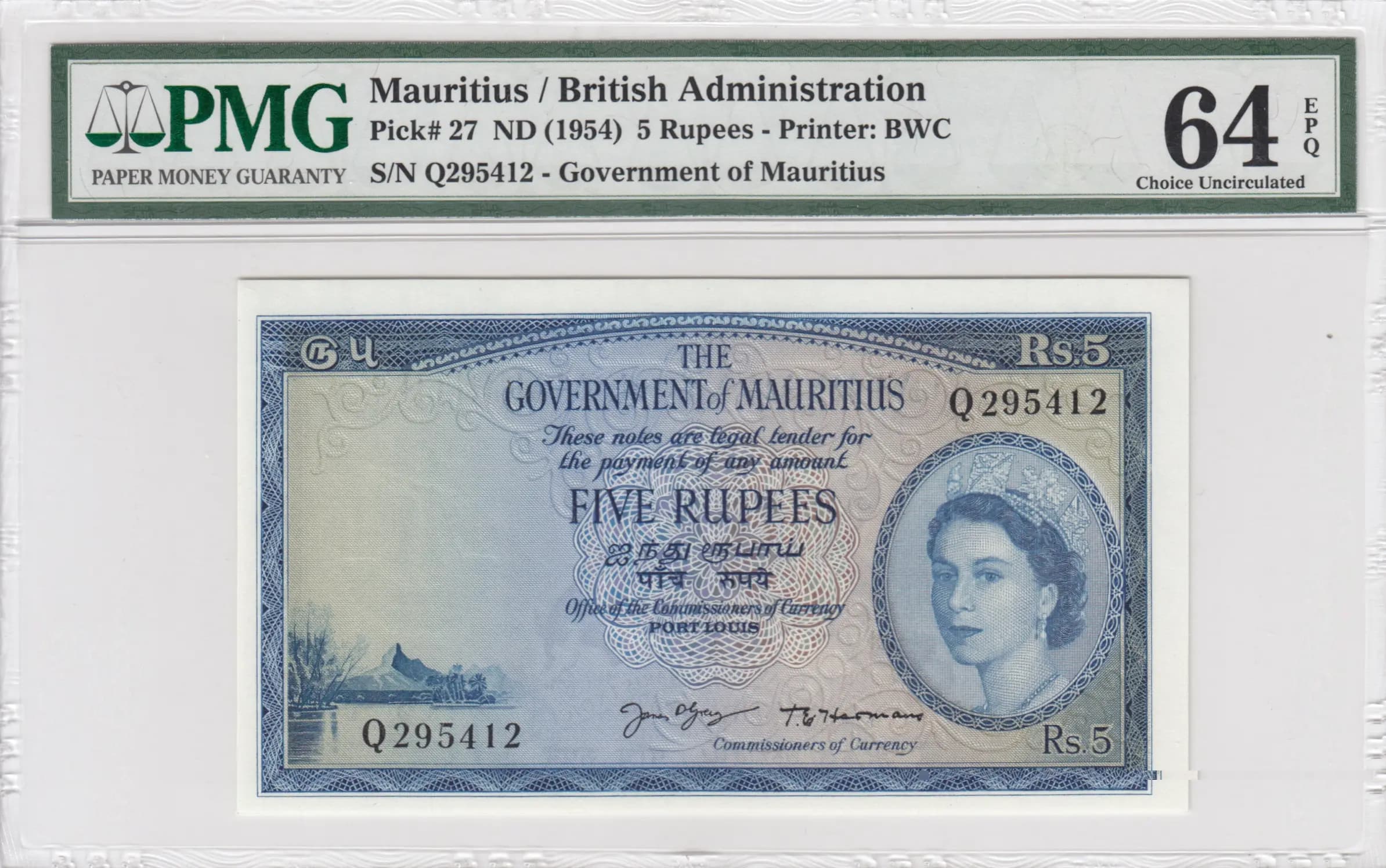
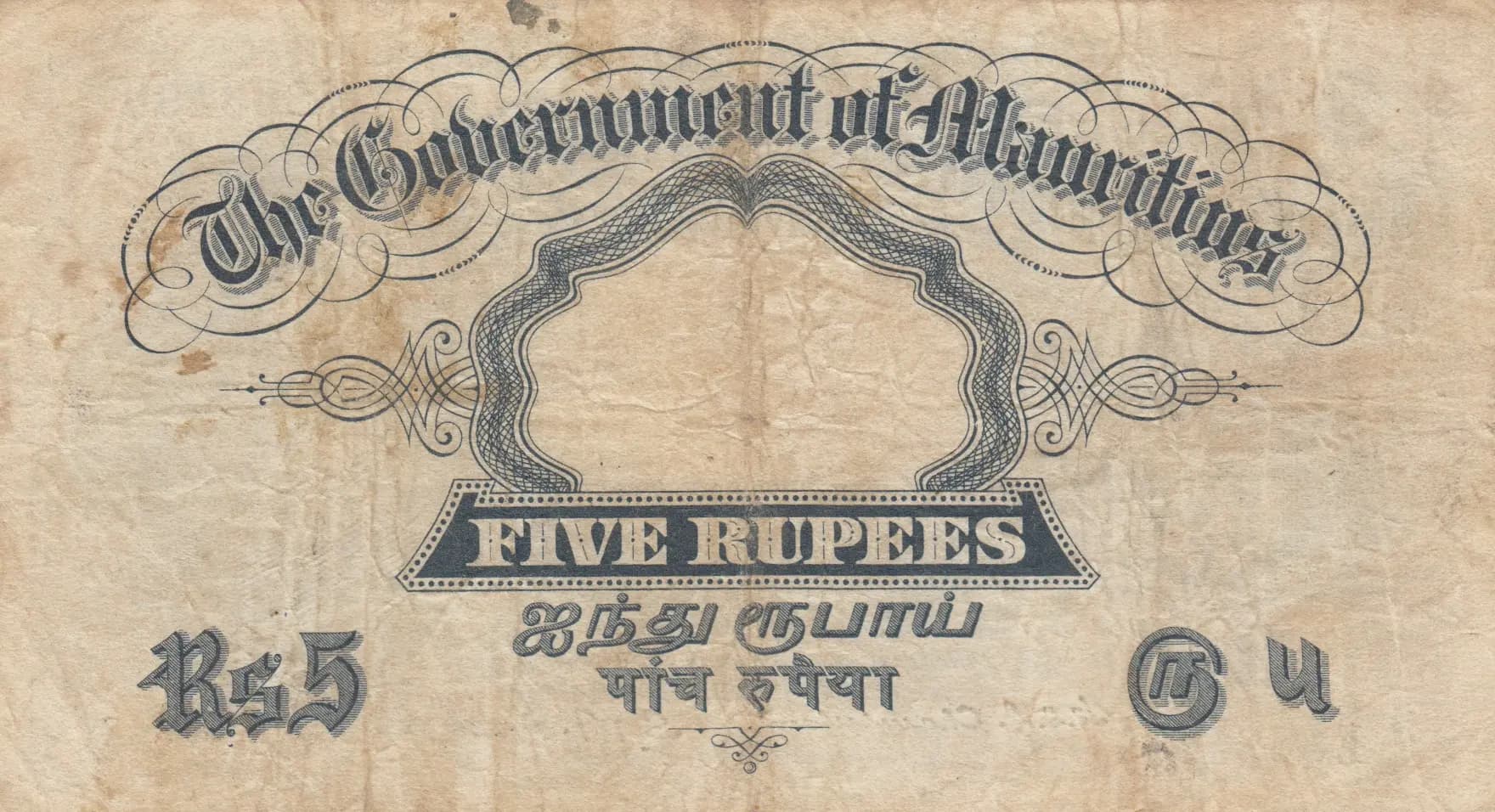
The obverse features a formal right-facing profile portrait of King George VI in military dress uniform with decorative collar or orders, enclosed in an ornate oval frame with intricate geometric borders. Dominating the left side is the coat of arms of Mauritius, featuring a heraldic shield with the dodo bird (representing the extinct endemic species) on the left and an antelope/deer on the right, mounted above a banner containing the national motto. The denomination 'Five Rupees' appears in an ornamental cartouche in the center. The reverse displays a large decorative cartouche at the top with symmetrical ornamental scrollwork, with the denomination repeated in English (FIVE RUPEES, R£5) and in two Indian scripts (Tamil and Hindi), reflecting Mauritius's multicultural composition. Fine line engraving patterns and geometric background designs throughout provide security features and aesthetic refinement.
Front Side: 'The Government of Mauritius' (issuing authority); 'These notes are legal tender for the payment of any amount' (legal tender declaration); 'Five Rupees' and 'R£5' (denomination); 'Office of the Commissioners of Currency' and 'PORT LOUIS' (issuing location); 'COMMISSIONERS OF CURRENCY' (authority); 'STELLA CLAVISQUE MARIS INDICIS' (Latin: 'Star and Key of the Indian Ocean' - national motto); 'E863190' (serial number); 'WATERLOW & SONS LIMITED LONDON' (printer). Back Side: 'The Government of Mauritius' (issuing authority); 'FIVE RUPEES' (denomination in English); 'இந்து ரூபாய்' (Tamil: 'Five Rupees'); 'पाँच रुपया' (Hindi: 'Five Rupees'); 'R£5' (denomination symbol); 'G U' (likely currency or denomination markers).
Intaglio engraving, executed by Waterlow & Sons Limited of London. The note demonstrates the characteristic fine line work, intricate decorative borders, and geometric pattern backgrounds typical of high-security banknote production of the 1930s. The multi-colored underprint (blue-grey, tan/beige, yellow/gold) was achieved through traditional multi-plate printing methods standard for banknote production of this era.
Pick catalog lists P-22 and P-22s as catalogued variants for this base number, both printed by W&S (Waterlow & Sons). The observed specimen carries serial number E863190. Without additional reference materials distinguishing between the base and specimen variants, the specific variety cannot be definitively determined from visual inspection alone. Further numismatic research would be required to identify whether this note represents the standard P-22 issue or the P-22s variant.