5 rupees 1967
Market Prices
18 salesAbout This Note
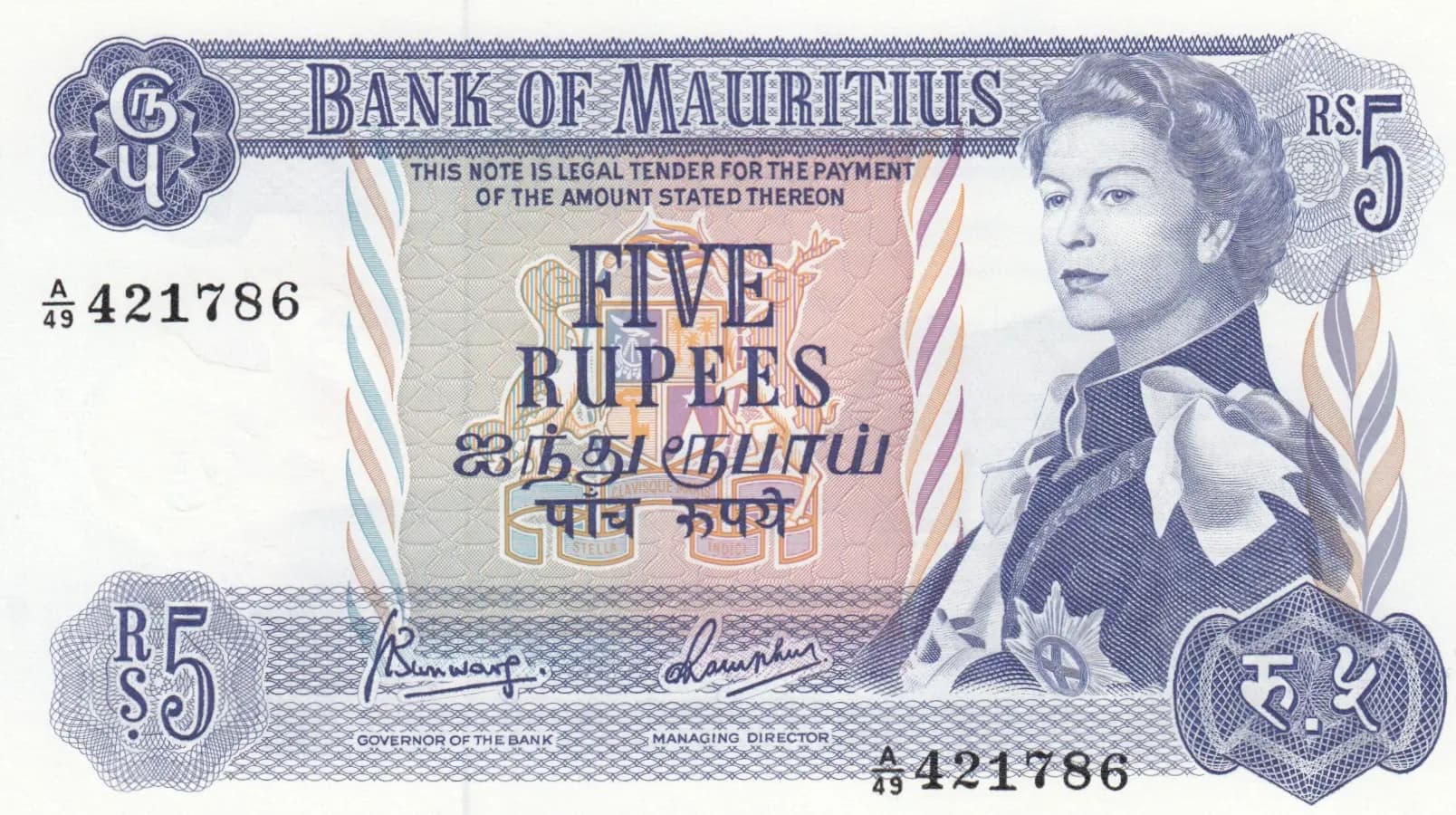
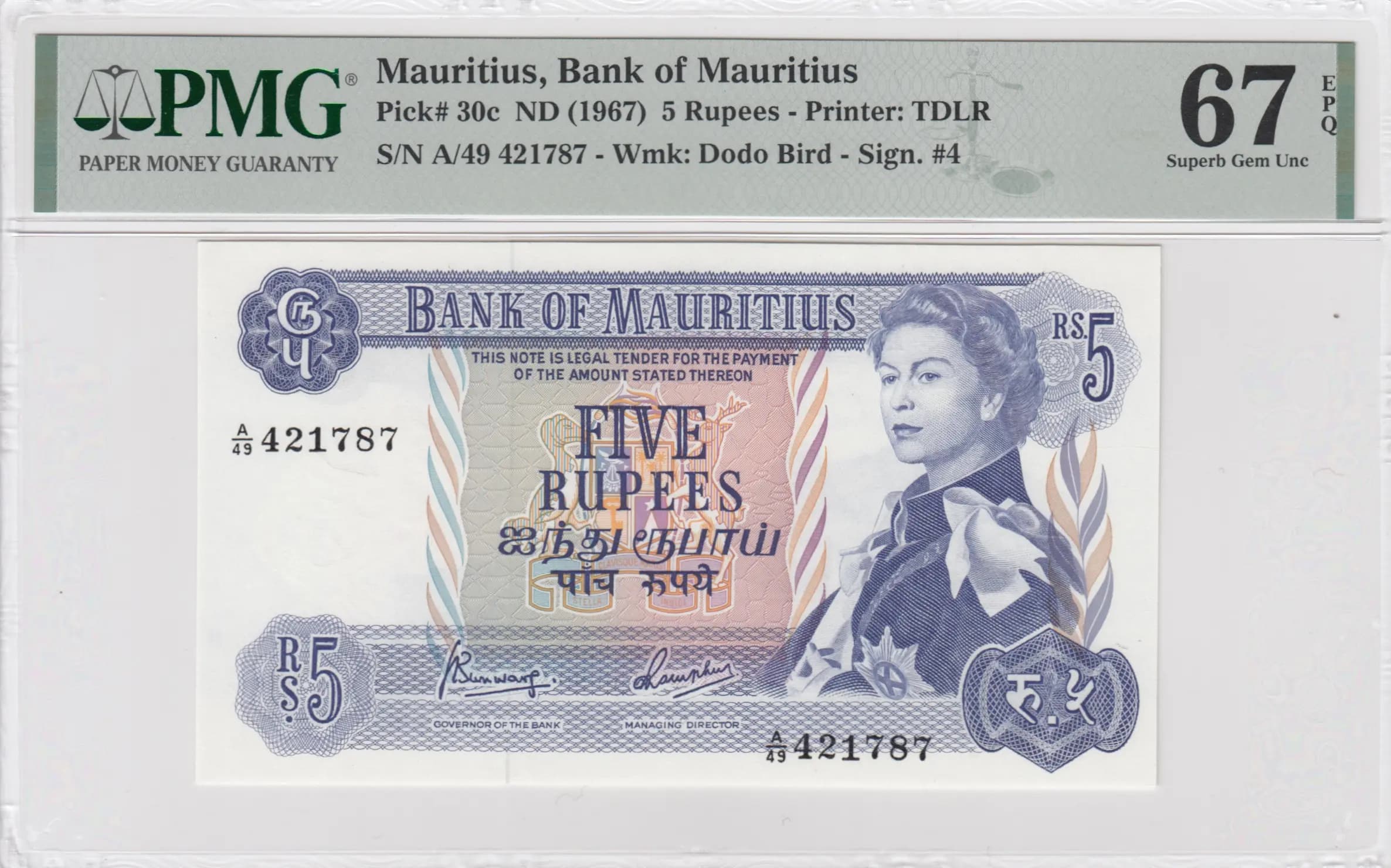
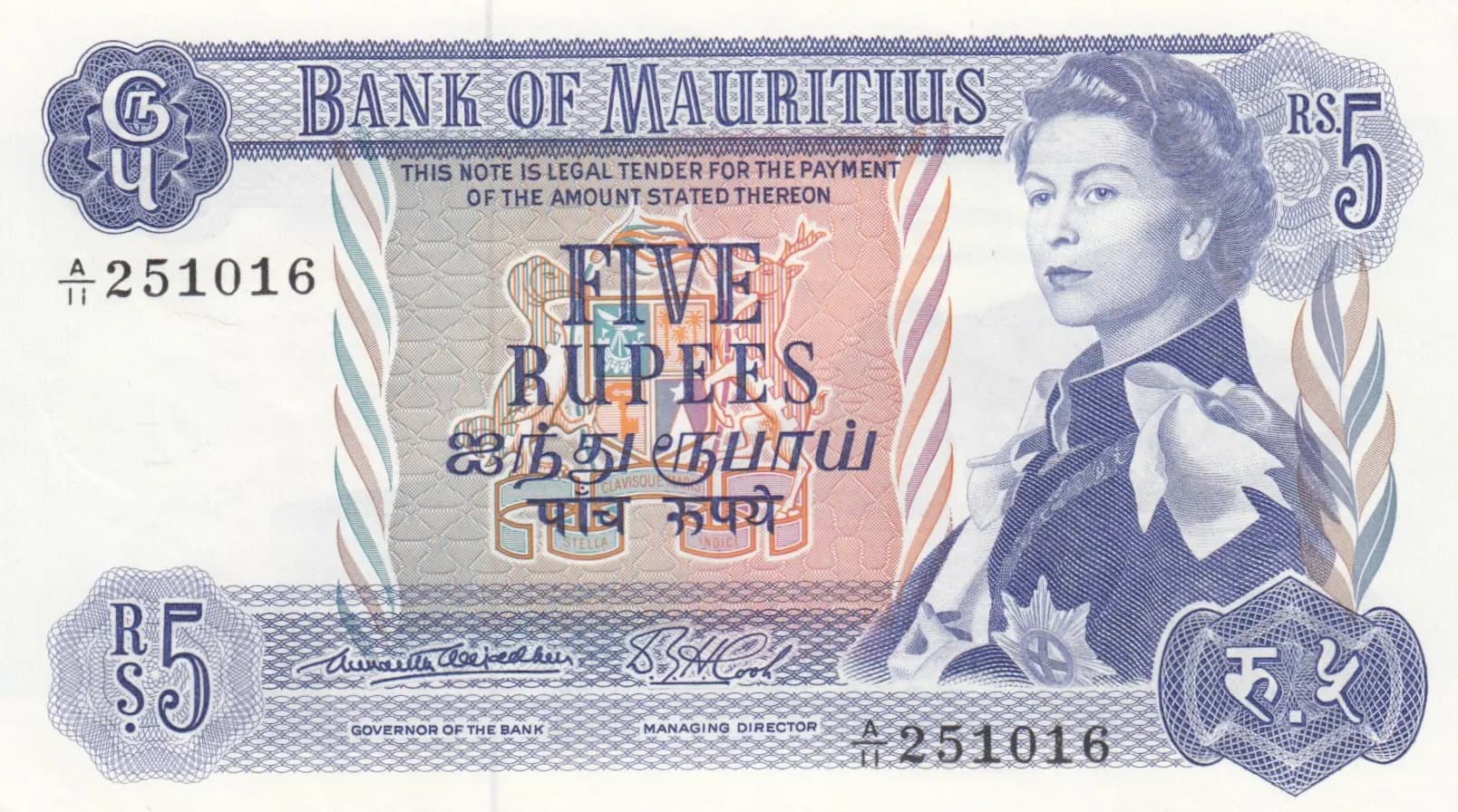
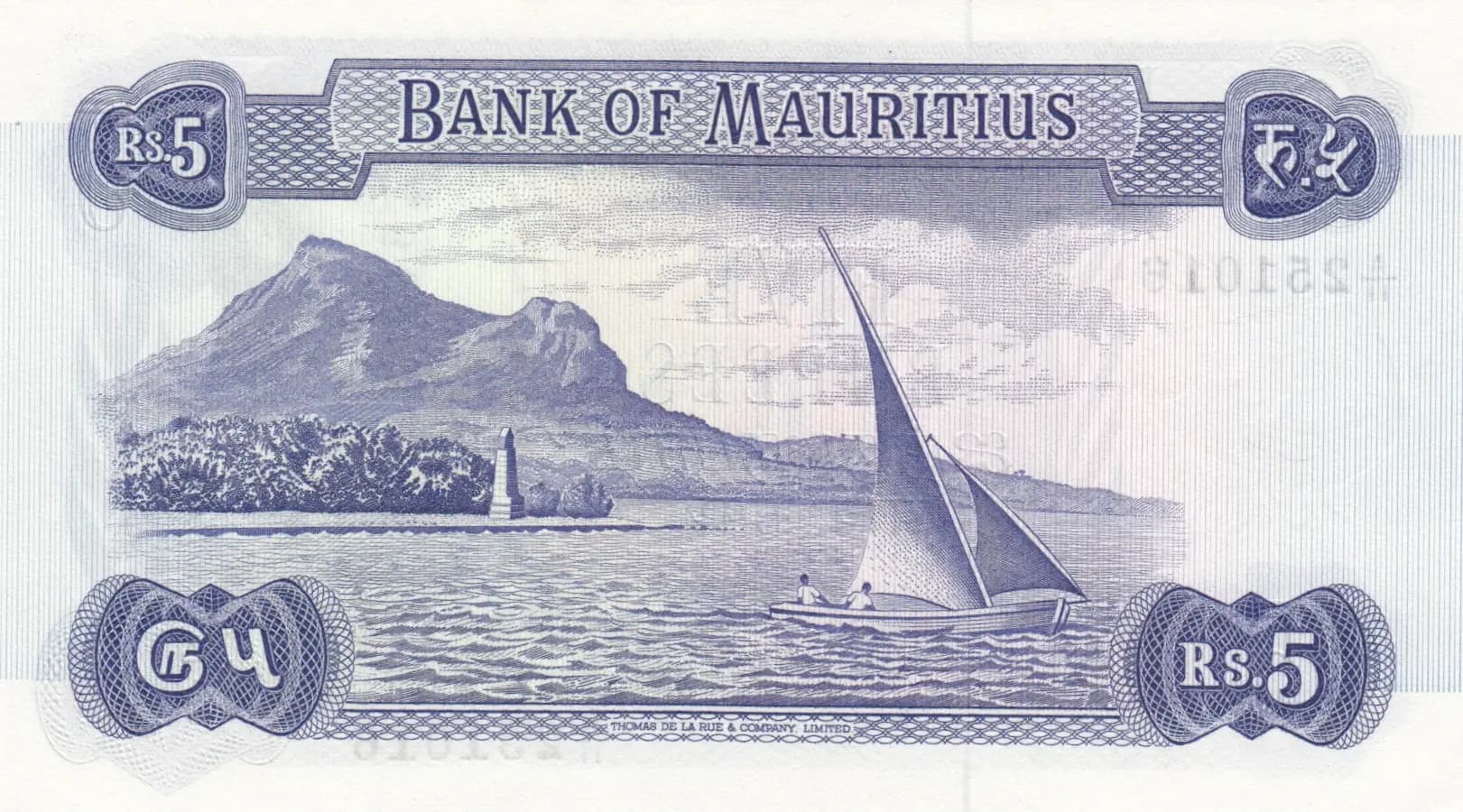
This is an exceptional uncirculated example of the Mauritius Bank of Mauritius 5 Rupees from 1967, featuring a striking portrait of Queen Elizabeth II on the obverse and a scenic landscape with sailboat on the reverse. The note displays museum-quality preservation with vibrant blue and purple tones, crisp engraving detail, and no signs of wear or circulation, making it a desirable specimen for British Commonwealth banknote collectors.
Common. Secondary market data shows this note in UNC condition selling for $29-$61 on eBay over the past decade, with most UNC/AUNC examples realizing $25-$61. The 2019 catalog value of $45 UNC and consistent sales volume at modest prices indicate this is a regularly traded note with reasonable availability in the market. No evidence of a restricted print run or short circulation period supports a common classification.
Issued in 1967 as part of the Bank of Mauritius's first series following the country's path toward independence (achieved in 1968), this note represents a transitional period in Mauritian currency design. The reverse features Montagne de Lion (Lion Mountain) and a monument commemorating the Dutch first landing in 1598, reflecting the island's colonial heritage and serving as a symbolic representation of national landmarks during the post-colonial era.
The obverse features a formal right-facing portrait of Queen Elizabeth II wearing a dark jacket with white collar and formal attire, positioned on the right side of the note. The design incorporates intricate guilloche patterns and ornamental rosette designs in the corners as security elements. The reverse depicts a scenic waterfront landscape with a prominent sailboat in the foreground, Montagne de Lion (Lion Mountain) in the background, and a monument or memorial structure on the shoreline commemorating the Dutch landing of 1598. The entire design is rendered in fine line engraving technique with a blue and purple color scheme on a cream background.
Front: 'BANK OF MAURITIUS' (issuing authority); 'THIS NOTE IS LEGAL TENDER FOR THE PAYMENT OF THE AMOUNT STATED THEREON' (legal tender declaration); 'FIVE RUPEES' and 'RS 5' / 'R.S 5' (denomination); 'A/II 251016' (serial number); 'GOVERNOR OF THE BANK' and 'MANAGING DIRECTOR' (authorized signatories). Back: 'BANK OF MAURITIUS' (issuing authority); 'R.S 5' and 'RS 5' (denomination in corner ornaments); 'THOMAS DE LA RUE & COMPANY, LIMITED' (printer attribution). All inscriptions are in English.
Intaglio engraving (line engraving) printed by Thomas de la Rue & Company Limited, London. The note demonstrates the characteristic fine line work and detailed guilloche security patterns typical of TDLR's banknote production. The complex geometric designs, ornamental borders, and landscape details all employ traditional engraving techniques with multiple color printing to create the multicolored security underprint visible on both sides.
This example is cataloged as Pick P-30a, printed by Thomas de la Rue (TDLR). The PMG population report identifies at least nine variants of this base Pick number (P-30a through P-30c with various star and specimen designations). The serial number observed is 'A/II 251016'. This appears to be a regular issue note (not a specimen or presentation piece) from the standard circulation printing. Additional variety classification would require comparison of signature blocks, serial number prefixes, and paper stock characteristics across the known variants.