10 rupees 1930
Market Prices
1 saleAbout This Note
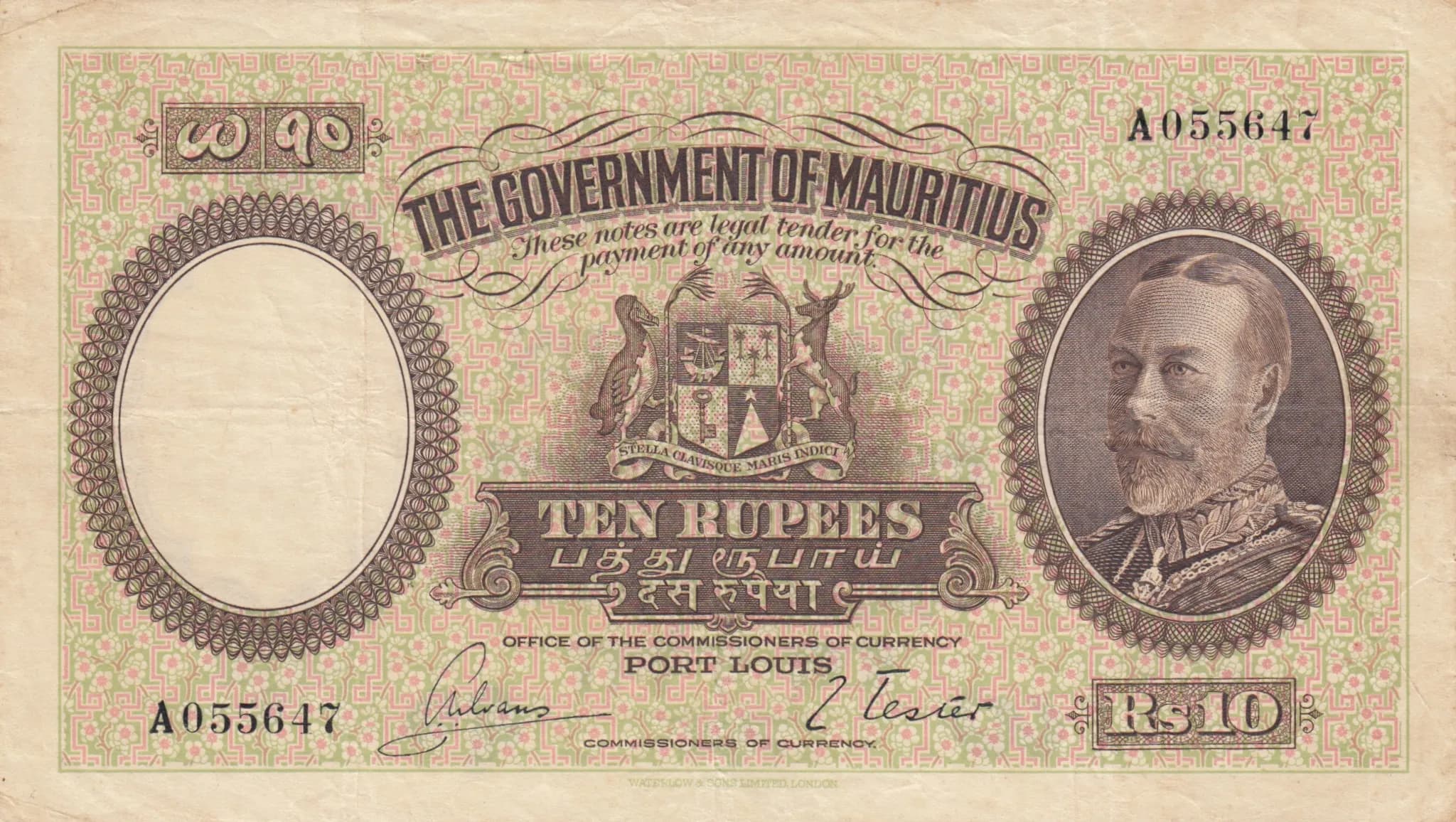
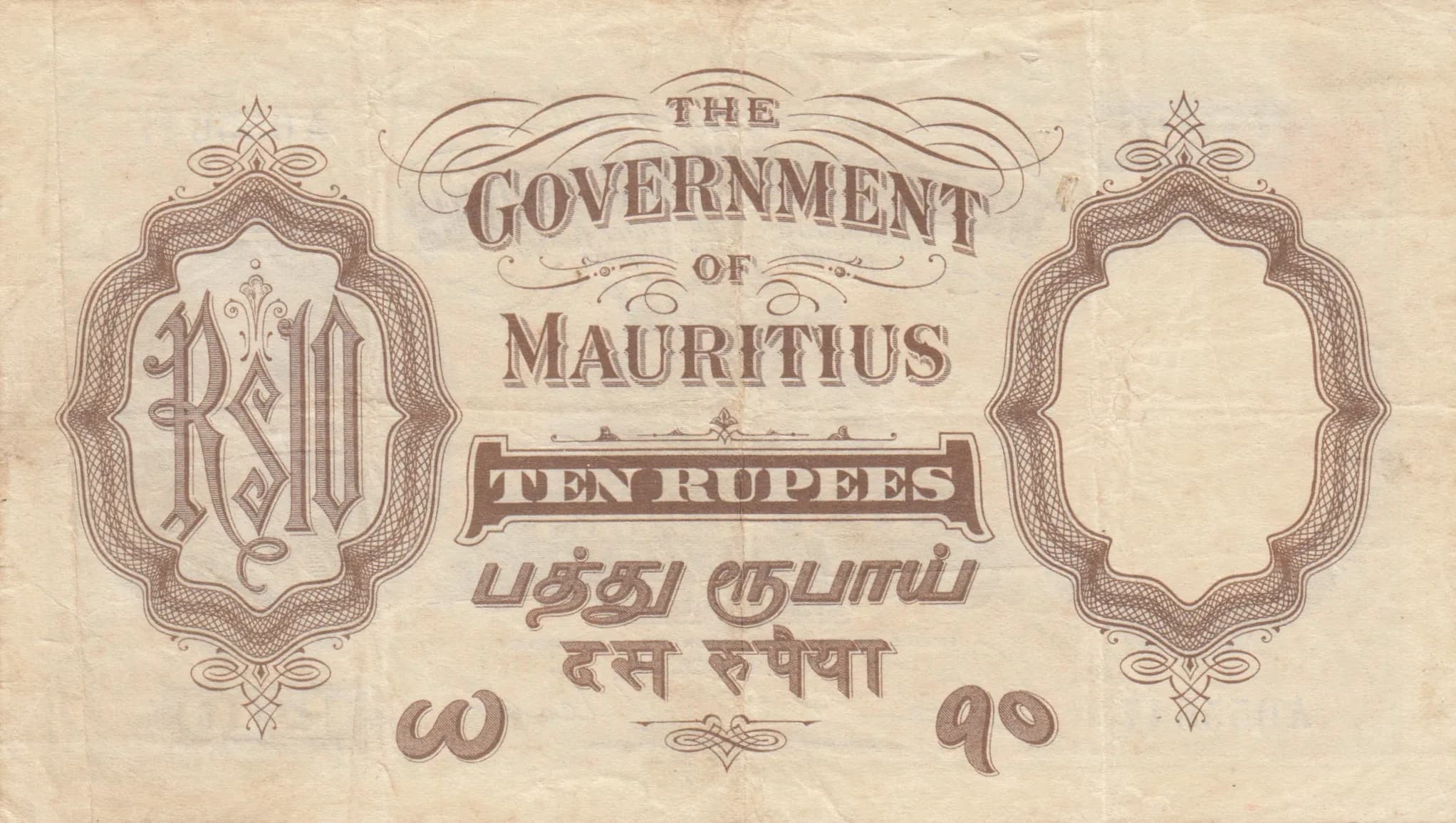
This is a Government of Mauritius 10 rupees banknote from 1930 (Pick P-21), presented in Very Fine condition with visible signs of age and historical circulation. The note features an ornate design with a bearded male portrait in an elaborate circular frame on the right obverse, complemented by the government coat of arms at center and intricate geometric patterning in pink and green tones. The reverse displays minimalist ornamentation with decorative monogram panels, and the entire note demonstrates the sophisticated engraving techniques characteristic of early 20th-century colonial currency, making it an important example of Mauritian numismatic history.
Common. The 10 rupees denomination from the 1930 Government of Mauritius issue is a standard colonial currency note with substantial print runs typical of circulating denominations. While the note is now 90+ years old and shows appropriate wear for its age, early Mauritian notes from this period circulated widely and examples survive in reasonable numbers in the collector market. Very Fine condition specimens are regularly available to collectors at modest price points, consistent with common historical currency rather than scarce or rare issues. No evidence of restricted print runs, emergency issues, or recall status applies to this Pick number.
This banknote was issued during the period when Mauritius was under British colonial administration, as evidenced by the English-language designation 'The Government of Mauritius' and the 'Office of the Commissioners of Currency' in Port Louis. The trilingual inscriptions in English, Tamil, and Hindi reflect Mauritius's diverse population and colonial trade networks with the Indian subcontinent. The Latin motto 'Stella Clavisque Maris Indici' (Star and Key of the Indian Ocean) on the coat of arms emphasizes Mauritius's strategic maritime importance during this era of colonial dominance.
The obverse features a formal bearded male portrait, likely a colonial official or monarch, positioned within an ornate circular frame with detailed beaded borders on the right side of the note. The left side contains a complementary empty oval frame, creating symmetrical design balance. At the center-top is the Government of Mauritius coat of arms depicting two deer or similar heraldic creatures flanking a shield with a central star, symbolizing the colony's maritime heritage. The entire note is dominated by intricate geometric and floral patterning in pink, green, brown, and beige tones. The reverse is notably more austere, featuring two decorative rectangular panels with elaborate intertwined monogram designs (possibly 'RI' for Regnum Indicum or similar colonial cipher) flanked by ornamental scrollwork, with minimal text and a plain cream background. The design exemplifies the formal colonial aesthetic of 1930s currency production.
FRONT SIDE: 'THE GOVERNMENT OF MAURITIUS' (English) - governing authority; 'These notes are legal tender for the payment of any amount' (English) - legal tender declaration; 'TEN RUPEES' (English), 'பத்து ரூபாய்' (Tamil), 'दस रुपया' (Hindi) - denomination in three languages; 'STELLA CLAVISQUE MARIS INDICI' (Latin) - 'Star and Key of the Indian Ocean'; 'OFFICE OF THE COMMISSIONERS OF CURRENCY' (English); 'PORT LOUIS' (English) - issuing location; 'COMMISSIONERS OF CURRENCY' (English); Serial number 'A055647'; 'Rs 10' (abbreviation); '90' (unclear reference, possibly check digit or year marker). BACK SIDE: 'THE GOVERNMENT OF MAURITIUS' (English); 'TEN RUPEES' (English), 'பத்து ரூபாய்' (Tamil), 'दस रुपया' (Hindi) - repeated denomination; '90' (numeric marker).
Intaglio engraving (line engraving and steel plate printing), the standard security printing method for currency of this period. The detailed oval frames, portraits, scrollwork, and geometric patterns show the characteristic fine line work and depth of intaglio production. The note was likely produced by a specialized security printer serving the British colonial administration; for Pick P-21 Mauritius notes, this was typically a London-based printer such as Waterlow & Sons or similar Crown agents' contractors. The multiple colors (pink, green, brown) suggest multi-pass printing, with the complex background patterns achieved through careful registration of engraved plates.
Serial number A055647 observed on this example. The 1930 Government of Mauritius 10 rupees (Pick P-21) may exist with different serial number prefixes and ranges, which would constitute minor varieties but do not significantly affect value or rarity. No major varieties such as overprints, signature variations, or watermark differences are known to distinguish this pick number into separate cataloged varieties. The '90' marking observed on both obverse and reverse may indicate a check digit, batch number, or archival reference but does not constitute a recognized variety designation in standard catalogs.