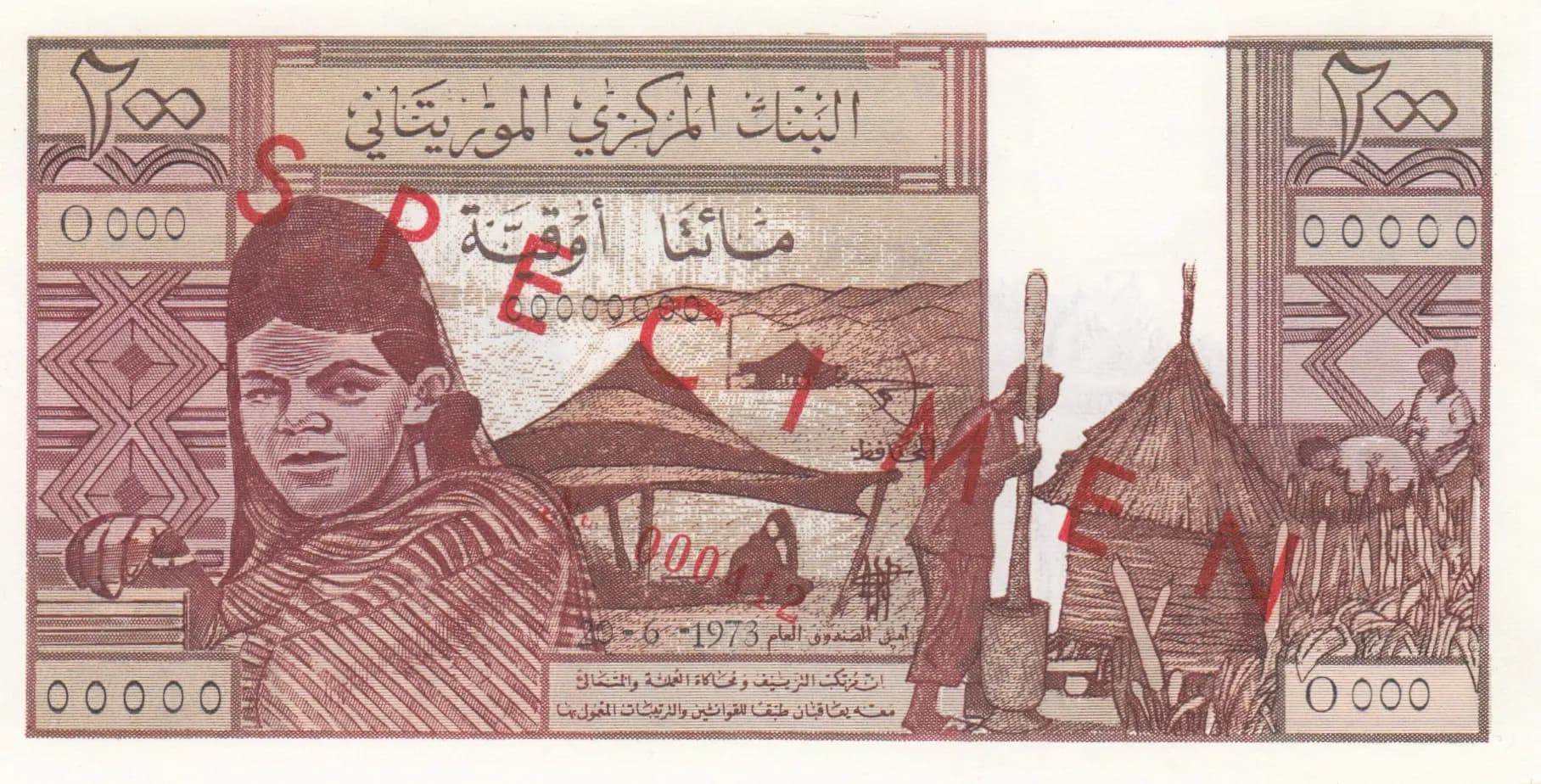
200 ouguiya 1973 specimen
Market Prices
2 salesAbout This Note
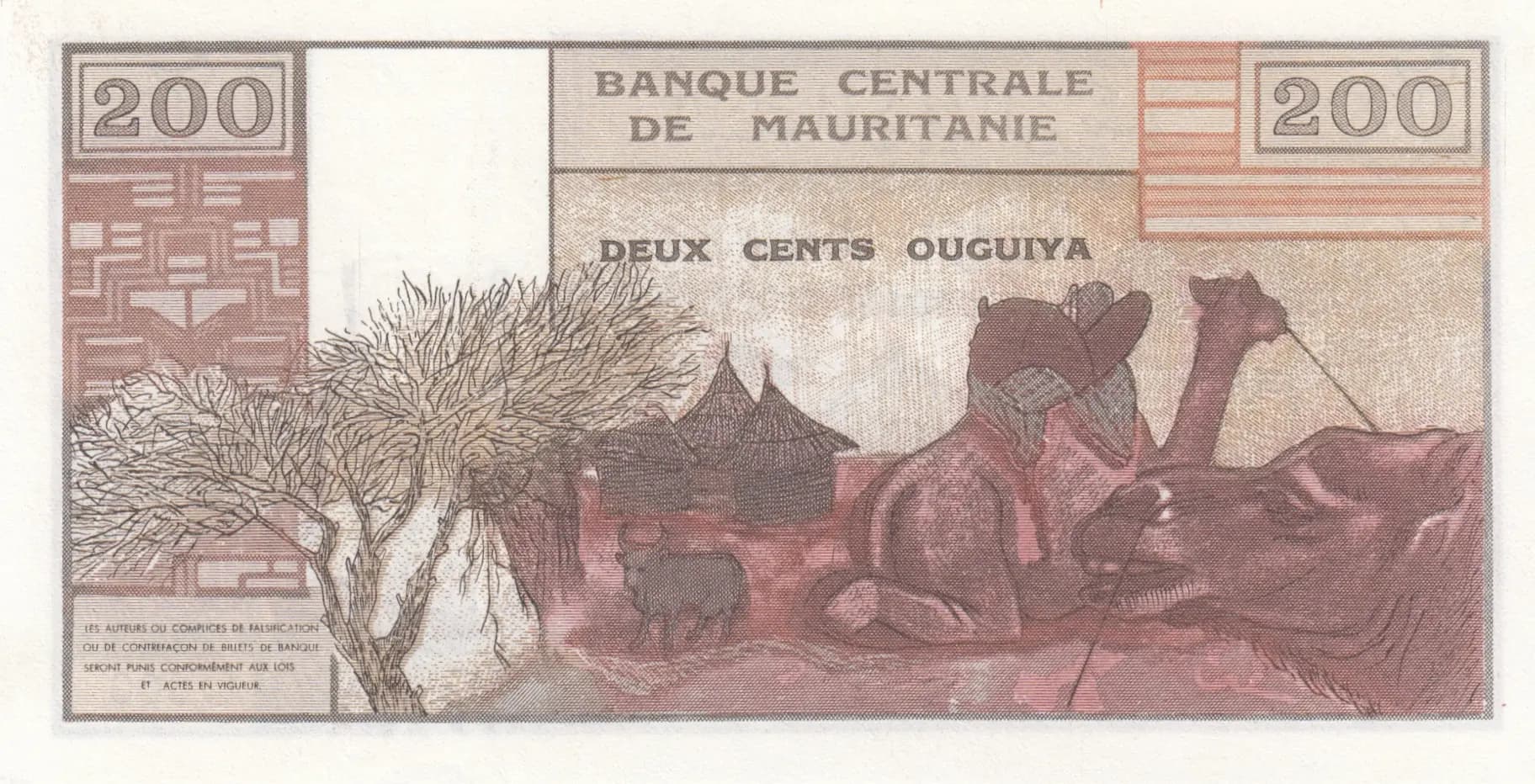
This is an uncirculated 1973 Mauritanian 200 ouguiya specimen note from the Banque Centrale de Mauritanie, rendered in warm earth tones with burgundy and brown dominating the palette. The obverse features a portrait of a man in traditional Moorish headwear on the left, with a detailed scene of nomadic encampments and desert architecture, while the reverse depicts a dromedary camel and fortified kasbah structure characteristic of Saharan settlements. As a specimen note with visible red overprints and serial number placeholders (0000), this example represents an institutional or collector's sample rather than circulating currency, maintaining pristine condition with no wear.
Common. While specimen notes command a modest premium over standard circulation issues, this denomination in UNC condition shows documented eBay sales at $102.50–$117.55 (2016–2021), indicating active collector demand at modest price points consistent with common-to-uncommon classification. The Banque Centrale de Mauritanie produced specimen sets for distribution and archival purposes in reasonable quantities. Print runs for the 200 ouguiya were not exceptionally limited, and no evidence suggests this note was recalled or is from a short-lived authority. The steady supply in the secondary market confirms broad availability.
The 200 ouguiya denomination was part of Mauritania's early post-independence currency system, issued in 1973 during the early years of the Islamic Republic following the 1971 monetary reform. The iconography—nomadic tents, desert architecture, camels, and fortified structures—reflects the nation's profound Bedouin and Saharan heritage, celebrating the traditional way of life and trade routes that defined the region. The bilingual presentation (Arabic and French) underscores Mauritania's post-colonial identity, balancing its Arab-Islamic character with French administrative legacy.
The obverse presents a left-facing profile portrait of a Moorish man wearing a traditional wrapped indigo tagelmust (head cloth), positioned on the left third of the note. The background depicts a settlement scene with traditional nomadic tents (kheimas) and mud-brick dwellings set in an arid desert landscape, with small figures in traditional dress engaged in daily activities. Ornamental geometric patterns and decorative medallions frame the composition in the top corners. The reverse depicts a naturalistic Saharan landscape centered on a single-humped dromedary camel on the right side, a gnarled and twisted acacia or date palm tree on the left, and a fortified kasbah or traditional fortress structure in the middle distance, representing the architectural heritage of the region. Both sides employ fine geometric border ornamentation typical of Islamic numismatic design principles.
FRONT: 'البنك المركزي الموريتاني' (Central Bank of Mauritania), 'مائتا أوقية' (Two Hundred Ouguiya), 'SPECIMEN' (Specimen - English overprint), '0000' (serial number placeholder), '1973' (year of issue). BACK: 'BANQUE CENTRALE DE MAURITANIE' (Central Bank of Mauritania), 'DEUX CENTS OUGUIYA' (Two Hundred Ouguiya), '200' (numerical denomination), 'LES AUTEURS OU COMPLICES DE FALSIFICATION OU DE CONTREFAÇON DE BILLETS DE BANQUE SERONT PUNIS CONFORMÉMENT AUX LOIS ET ACTES EN VIGUEUR.' (The authors or accomplices of the falsification or counterfeiting of banknotes will be punished in accordance with applicable laws and regulations in force.)
Intaglio engraving (steel engraving) with fine line work throughout, evidenced by the sharp detail visible in the portraiture, landscape elements, and geometric patterns. The specimen markings (red overprints and numerical stamps) appear to be applied separately from the main printing pass, consistent with specimen note production protocols. The multi-color underprinting visible on the obverse (described as multicolored) suggests the use of multiple printing plates typical of currency production in the 1970s by a European security printer, likely De La Rue or similar firm common for African central banks of that era.
This note is cataloged as Pick P-2s, identifying it as a specimen variant of the 200 ouguiya issue (P-2). The 's' suffix denotes specimen status. Variants for this base Pick number include P-2a (standard issue) and P-2s (specimen), with the specimen variant distinguished by the visible red 'SPECIMEN' overprints, serial number placeholders ('0000'), and absence of actual serial number sequences. The visual analysis confirms the characteristic specimen markings and numerical stamps typical of P-2s exemplars. No signature varieties or date variations are apparent from the described inscriptions; the date is standardized as 20.06.1973 per catalog data.