100 ouguiya 1973 specimen
Market Prices
3 salesAbout This Note
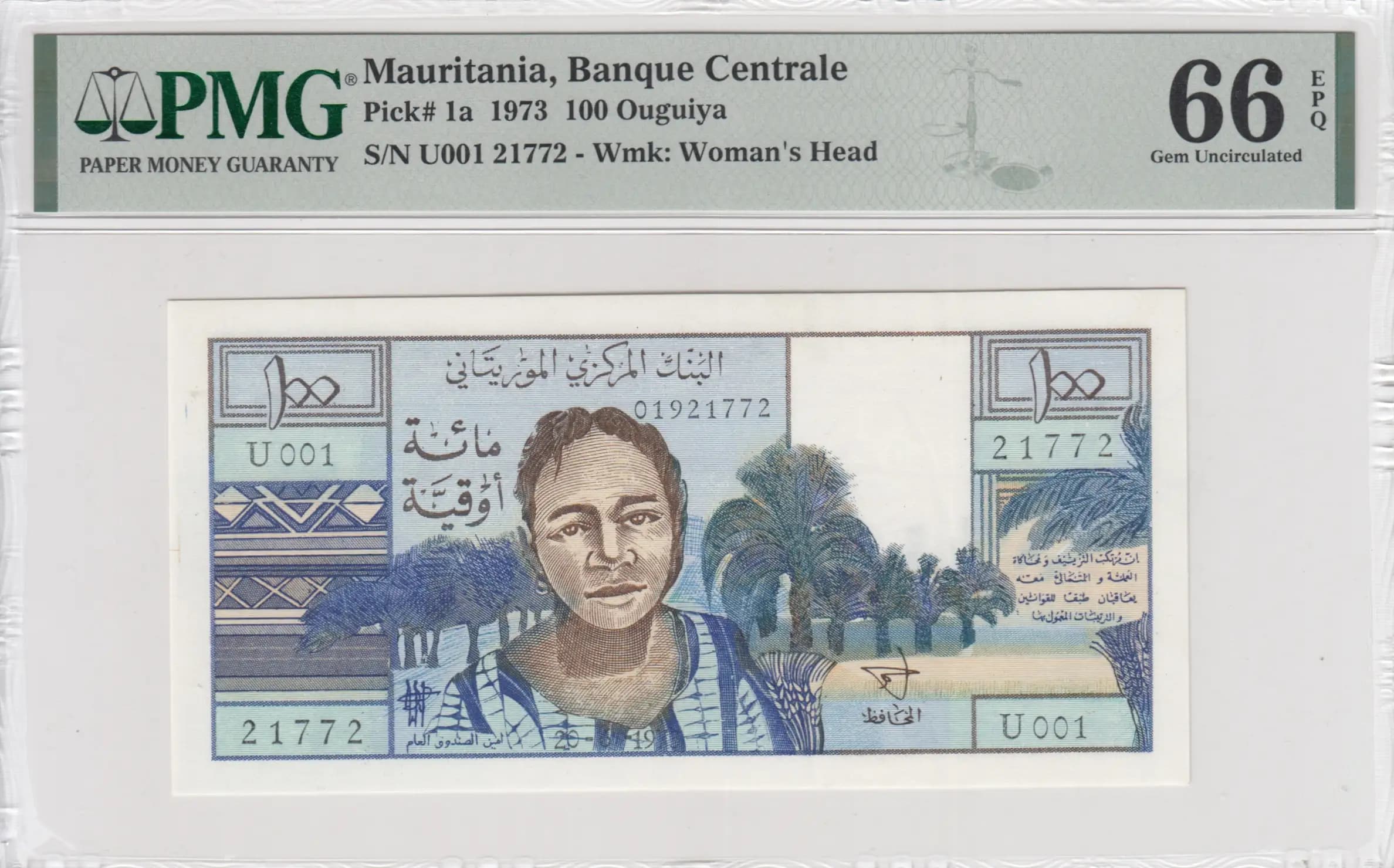
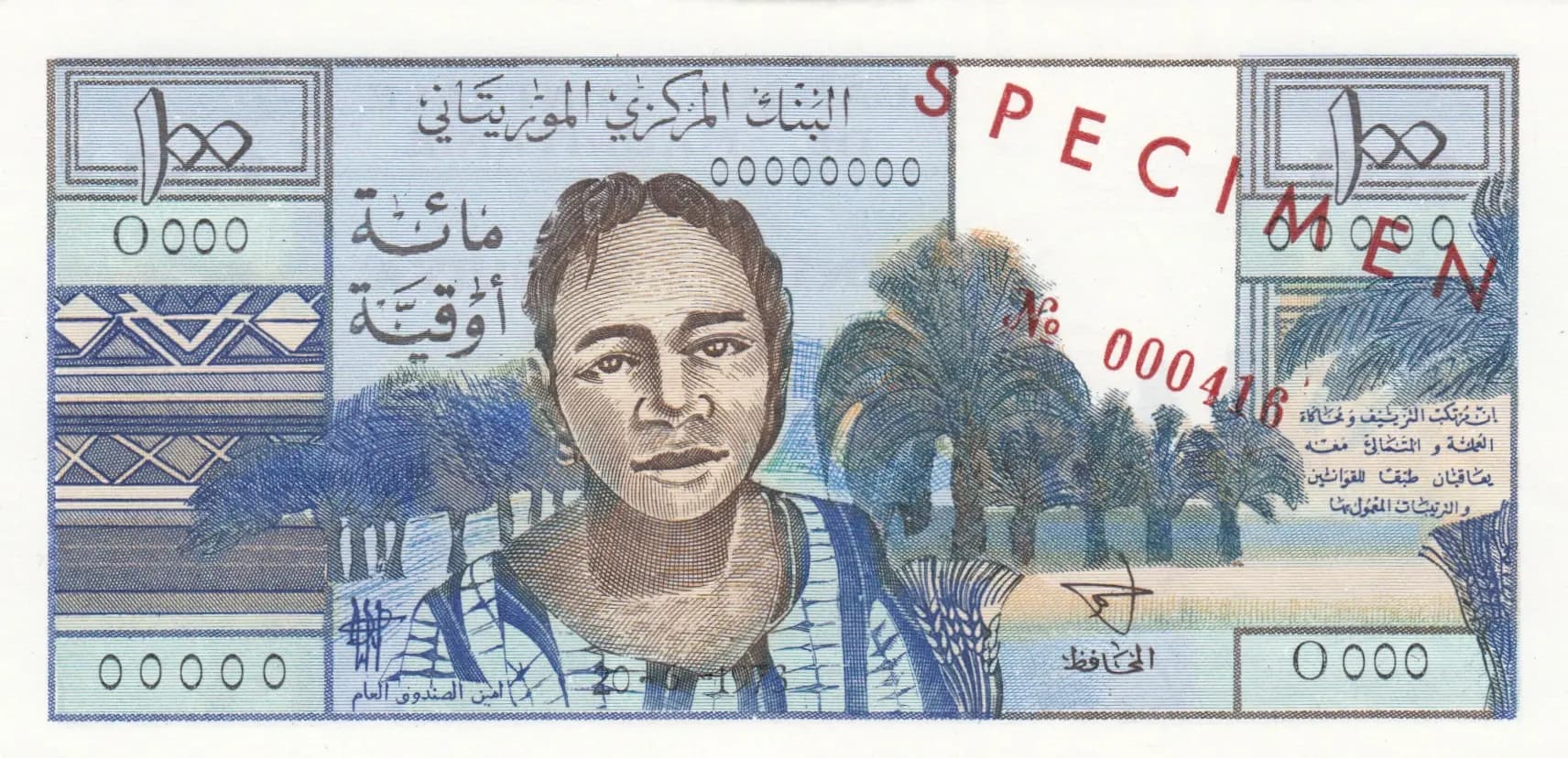
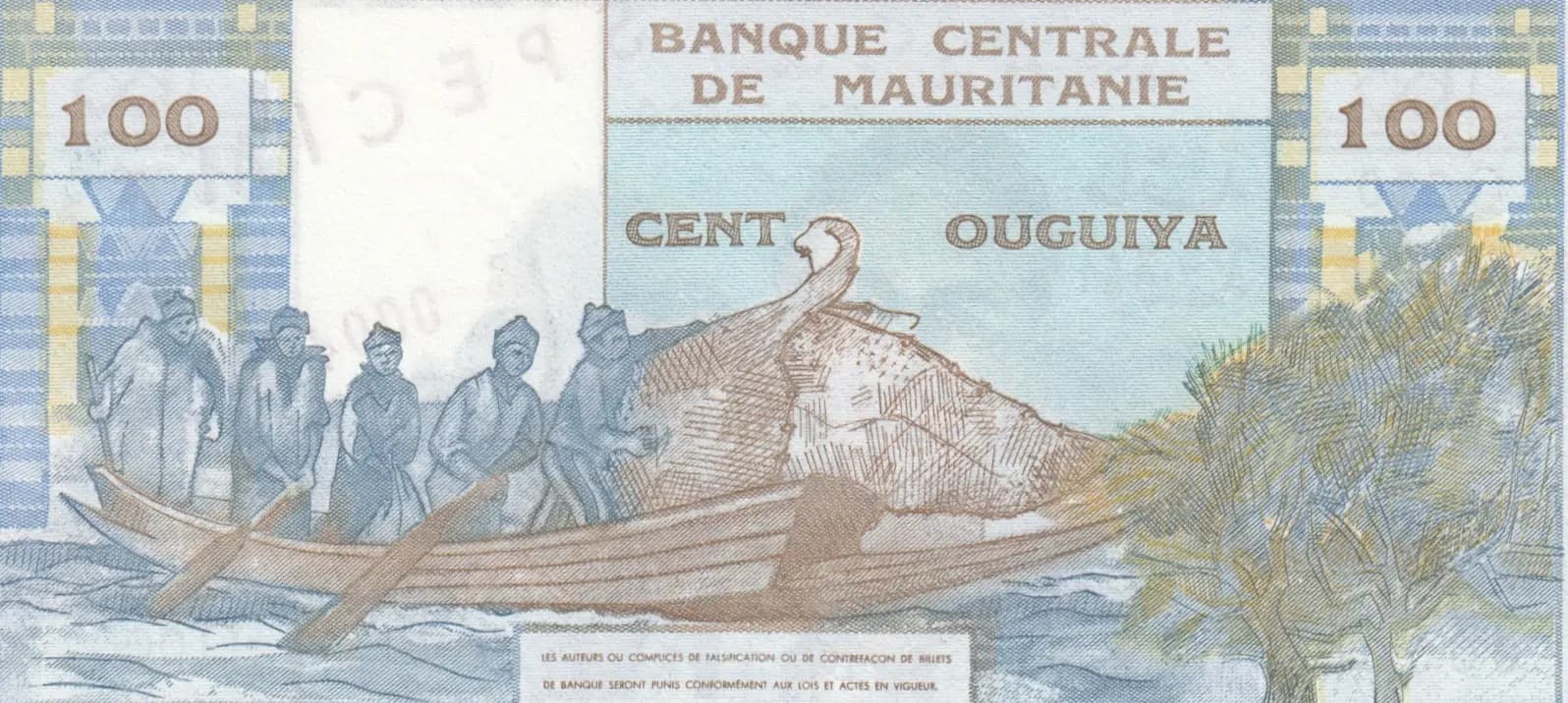
This is the 1973 inaugural 100 Ouguiya specimen note from Mauritania's first banknote issue, presented in pristine uncirculated condition. The note features a striking portrait of a man in traditional dress on the obverse and a detailed engraved scene of traditional fishermen in a sailing vessel on the reverse, reflecting the nation's maritime heritage. The red diagonal 'SPECIMEN' overprint and zero serial numbers confirm this as a non-circulating specimen note, making it a significant piece of Mauritanian numismatic history.
Common. Specimen notes from early national banknote series, while not circulated, were typically produced in sufficient quantities for official distribution to banks, governments, and archives. Market data shows UNC examples trading between $75–$153 on secondary markets (2013–2022), with consistent sales volume indicating availability. The Pick P-1s designation has multiple recorded PMG population entries. While historically significant as Mauritania's first banknote issue, specimen notes lack the scarcity of their circulation counterparts and remain accessible to collectors.
This note was issued on June 20, 1973, marking the Banque Centrale de Mauritanie's first banknote series following Mauritania's transition to the ouguiya currency. The imagery reflects the nation's cultural identity and economic foundation: the portrait represents Mauritanian leadership or tradition, while the fishing scene on the reverse highlights the critical role of maritime industries in the newly independent nation's economy. These specimen notes served as official reference pieces for the banking system and were never intended for general circulation.
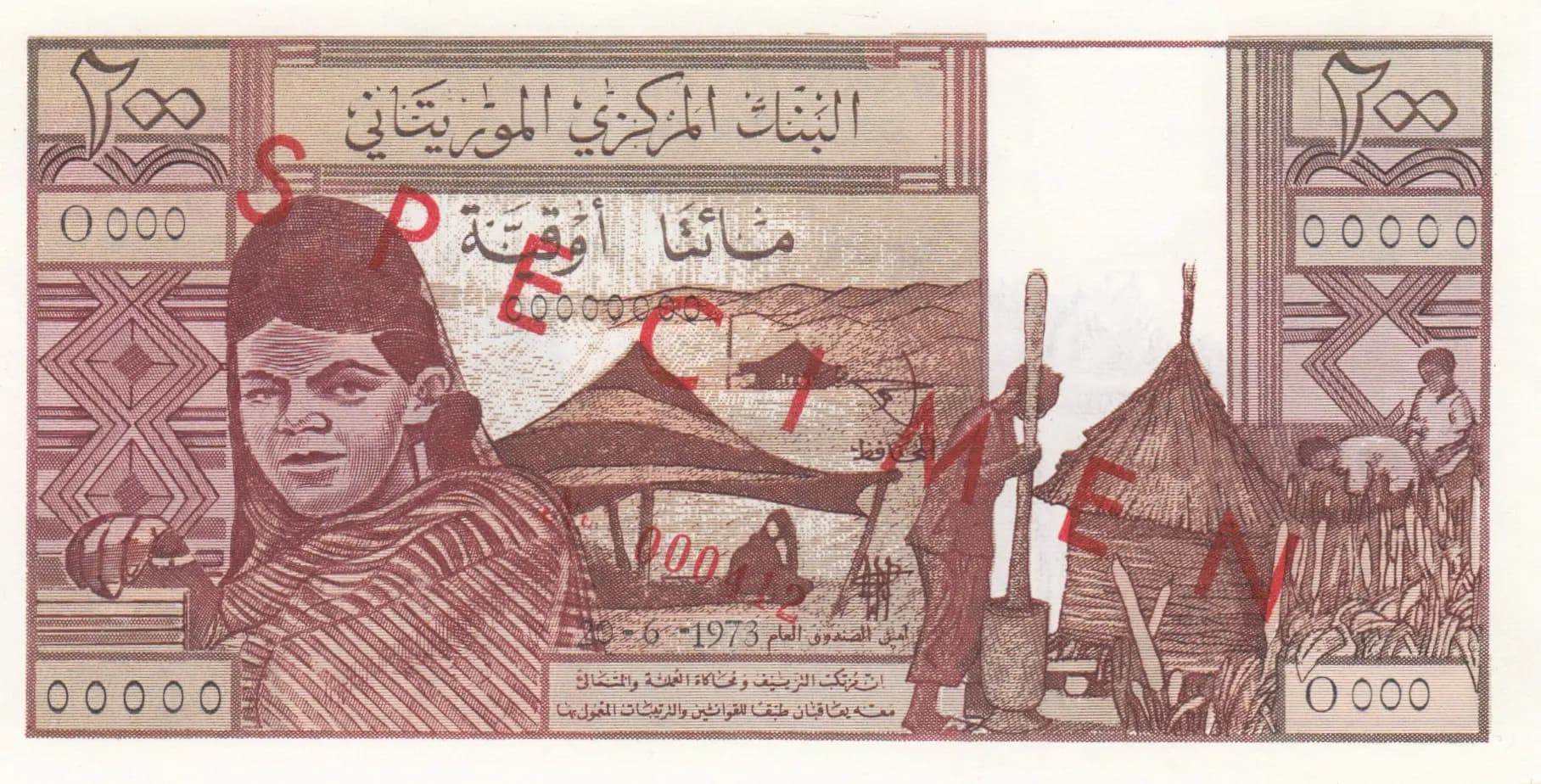
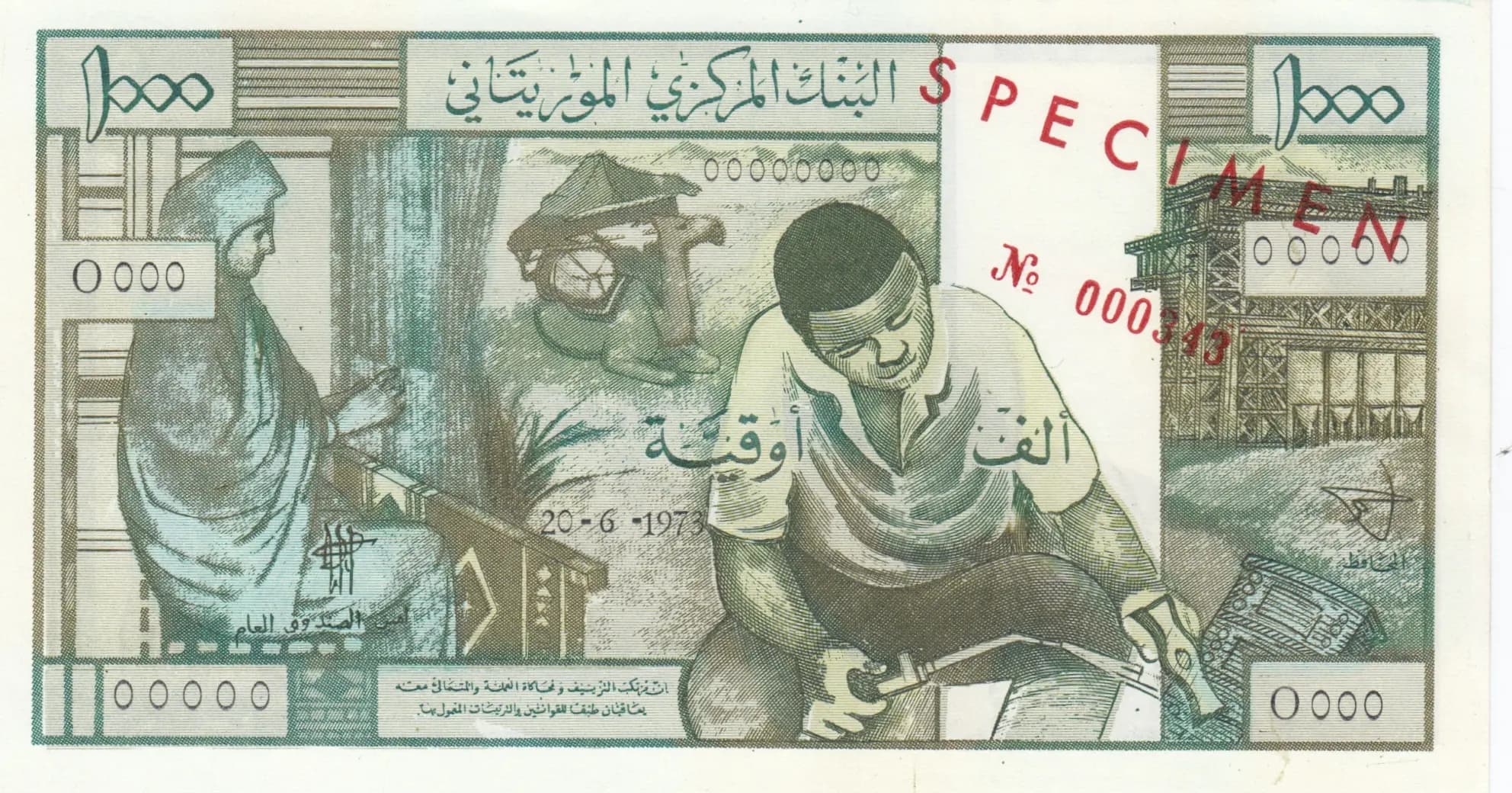
The obverse features a dignified portrait of a Mauritanian man in the center-left, rendered in traditional engraving style, wearing blue and striped traditional garments against a light blue background. Decorative geometric borders frame the design with diamond and line patterns characteristic of Islamic artistic traditions. The reverse depicts a historically significant scene of traditional Mauritanian fishermen operating a sailing vessel laden with cargo, set on water with reeds and vegetation visible along the shore—this imagery celebrates the nation's fishing heritage and maritime economy. Both sides employ fine-line engraving with warm tan, brown, and cream tones layered over cool blue underprints, creating visual depth and preventing counterfeiting through complexity of composition.
FRONT: Arabic text at top center reads 'البنك المركزي الموريتاني' (Central Bank of Mauritania), with denomination in Arabic 'ماتة أوقيــة' (One Hundred Ouguiya). Serial numbers appear as '0000' in corners with reference number '000416'. Red diagonal overprint states 'SPECIMEN'. BACK: French text at top reads 'BANQUE CENTRALE DE MAURITANIE' (Central Bank of Mauritania) with denomination 'CENT OUGUIYA' (One Hundred Ouguiya). Denomination numerals '100' appear in corners. Legal warning in French: 'LES AUTEURS OU COMPLICES DE FALSIFICATION OU DE CONTREFACON DE BILLETS DE BANQUE SERONT PUNIS CONFORMEMENT AUX LOIS ET ACTES EN VIGUEUR' (The authors or accomplices of the falsification or counterfeiting of banknotes will be punished in accordance with the laws and acts in force).
Intaglio engraving (recess printing), a security-printer standard for this era. Based on the catalog data showing this as Pick P-1s (specimen variant) from 1973, this note was likely produced by Giesecke+Dèvrient (G&D), the major security printer for African central banks during this period, evidenced by the sophisticated multi-color engraved design and fine security details. The detailed line work visible in both portraits and the fishing scene, combined with the complex geometric borders, are characteristic of high-security intaglio production methods.
This is cataloged as Pick P-1s, the specimen variant of the 100 Ouguiya 1973 issue. The 's' suffix indicates this is a specimen note, characterized by the red diagonal 'SPECIMEN' overprint and zero serial numbers (0000/00000000). The reference number '000416' visible in the lower right may indicate this as a specific specimen within the series. Standard production variants (P-1a) without specimen markings exist but are not represented in this example. The visual analysis confirms proper specimen characteristics consistent with official non-circulating reference pieces distributed to financial institutions.