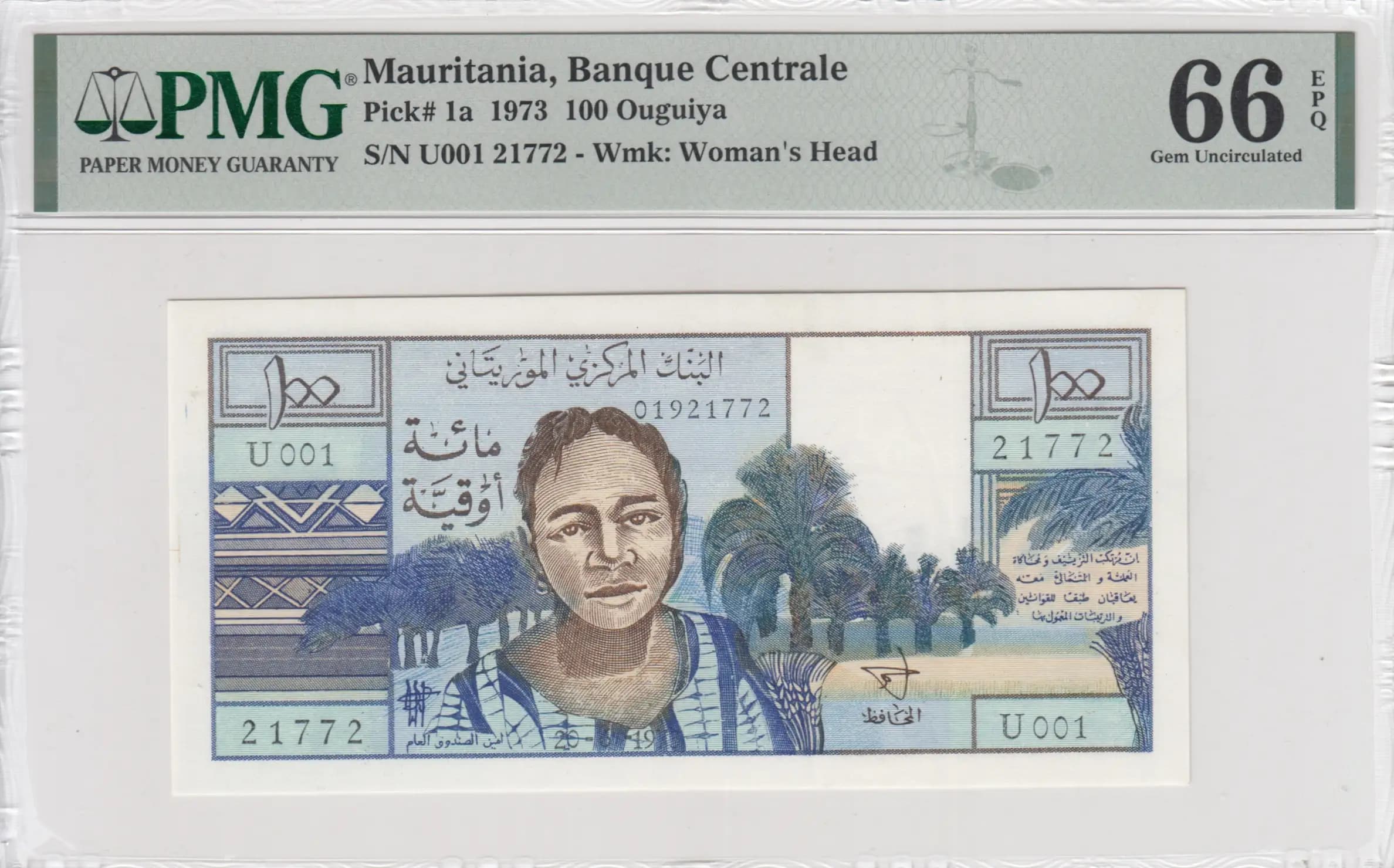
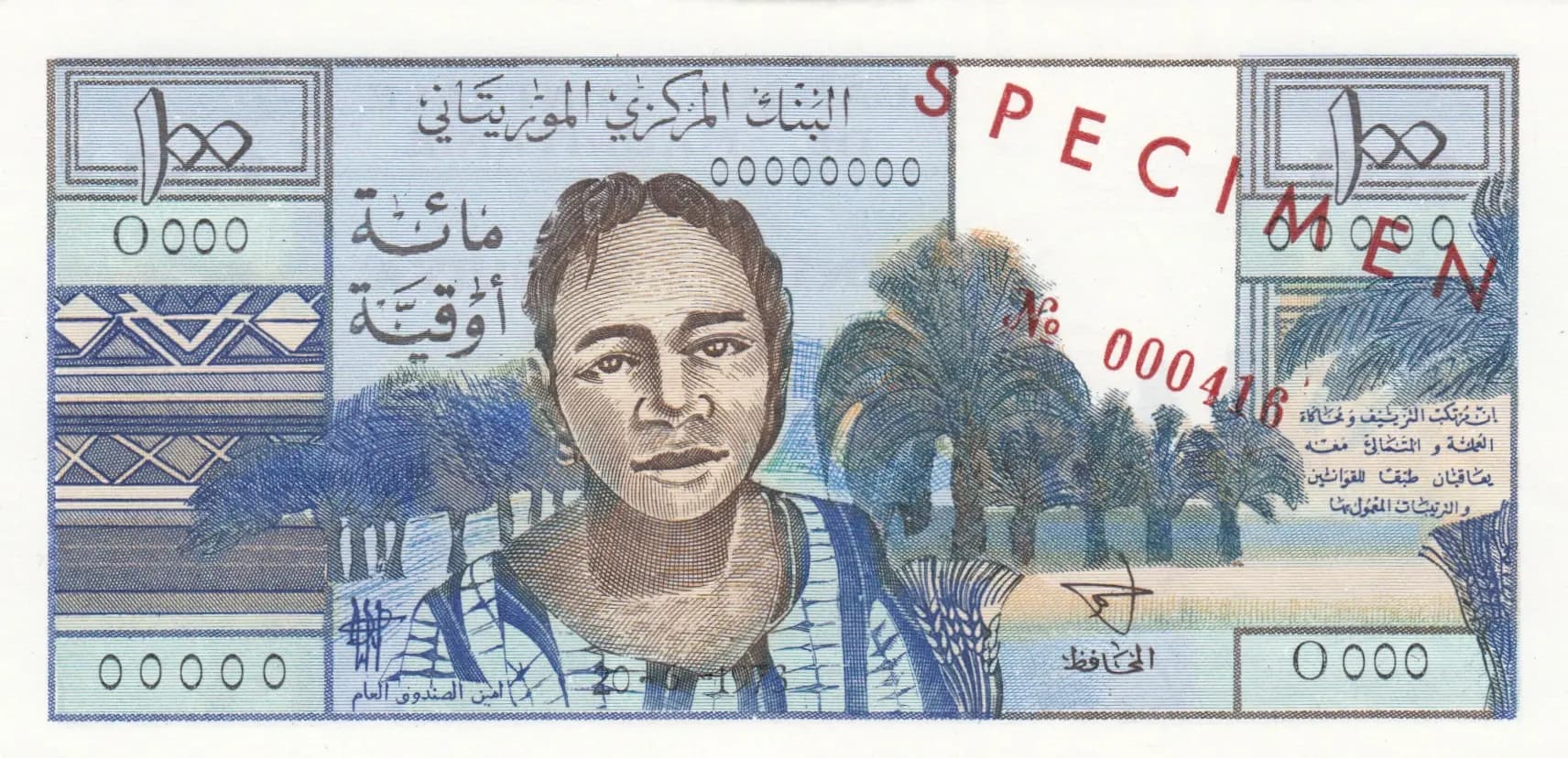
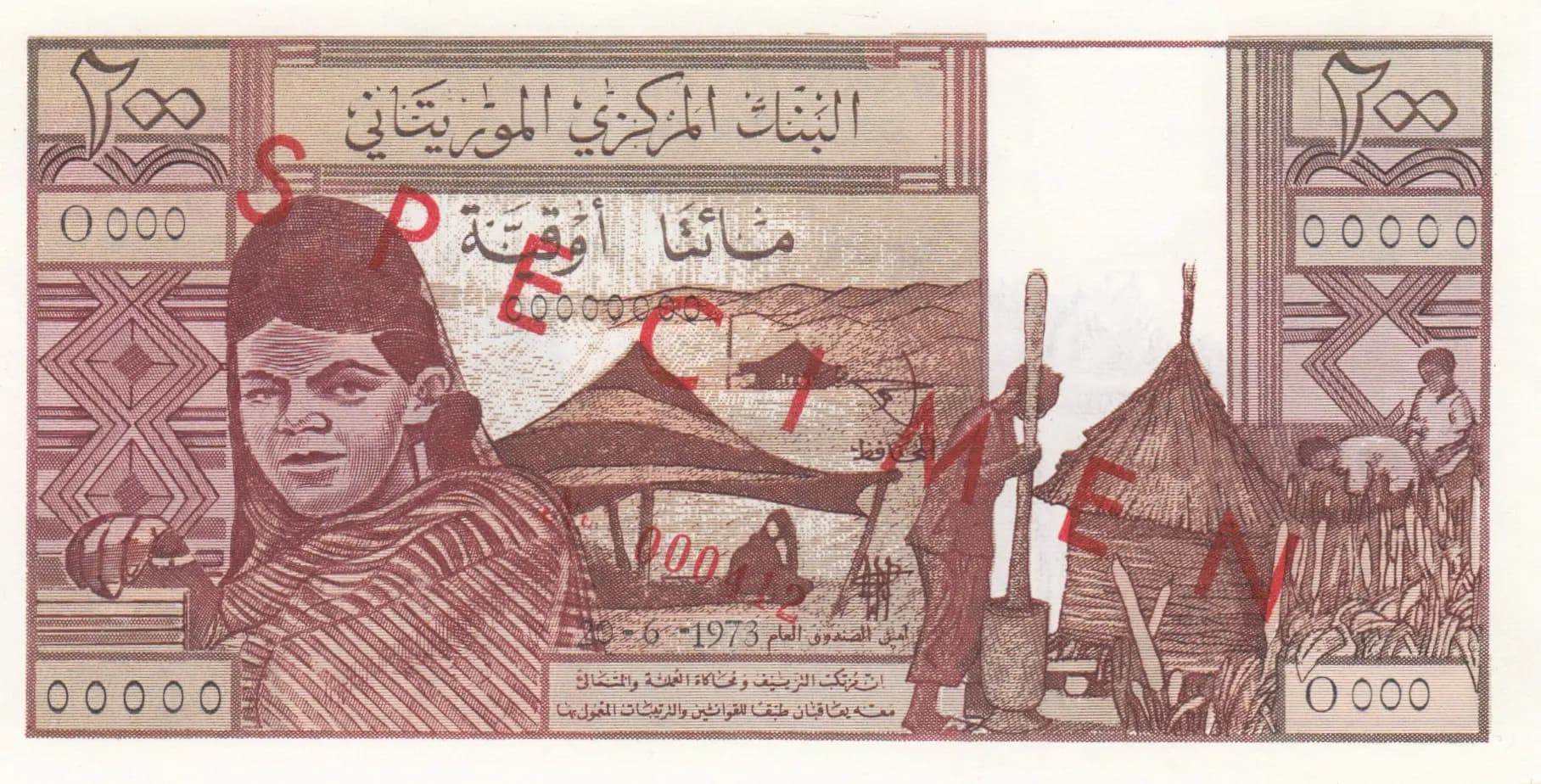
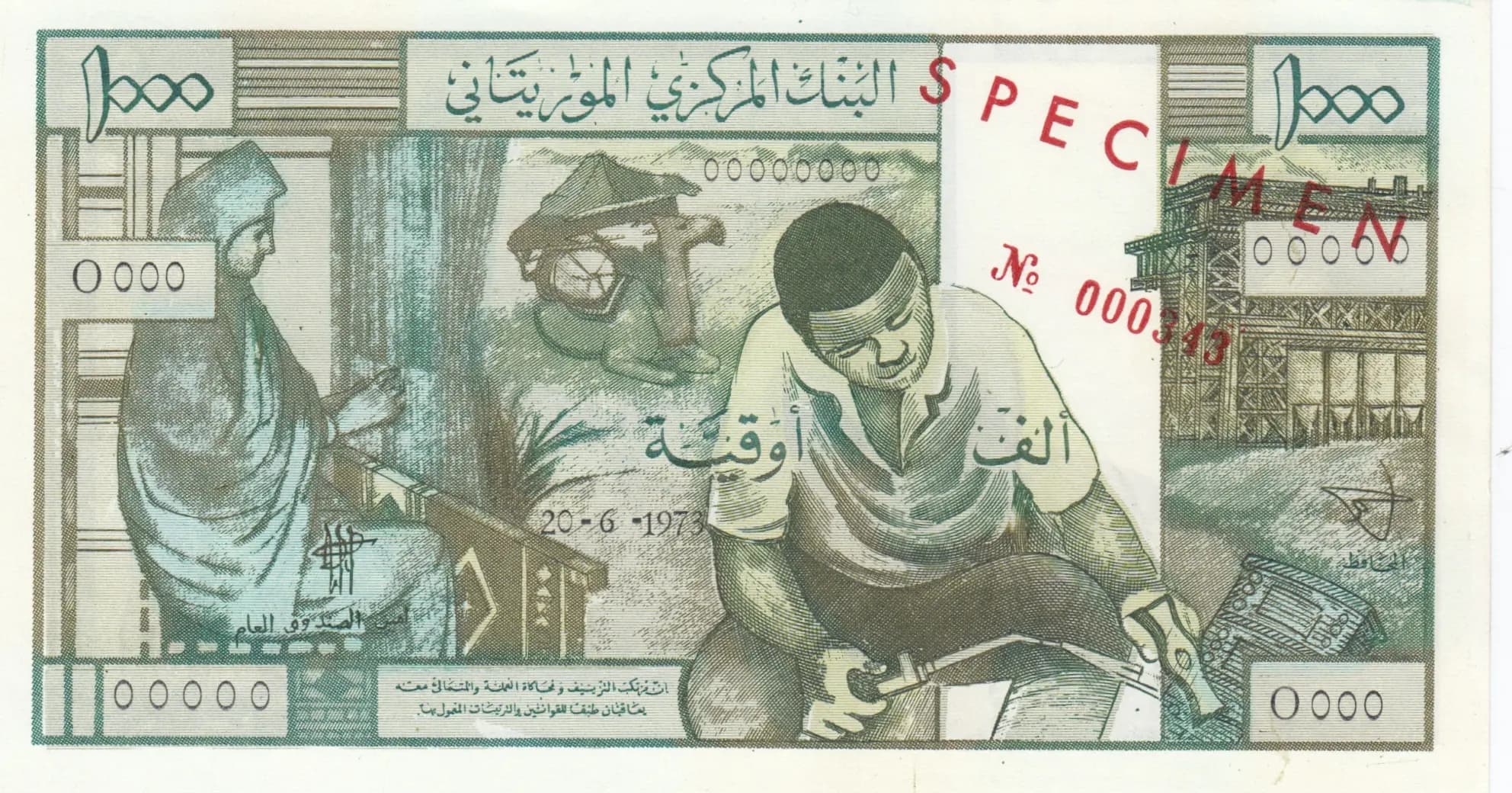
1000 ouguiya 1973 specimen
Market Prices
4 salesAbout This Note
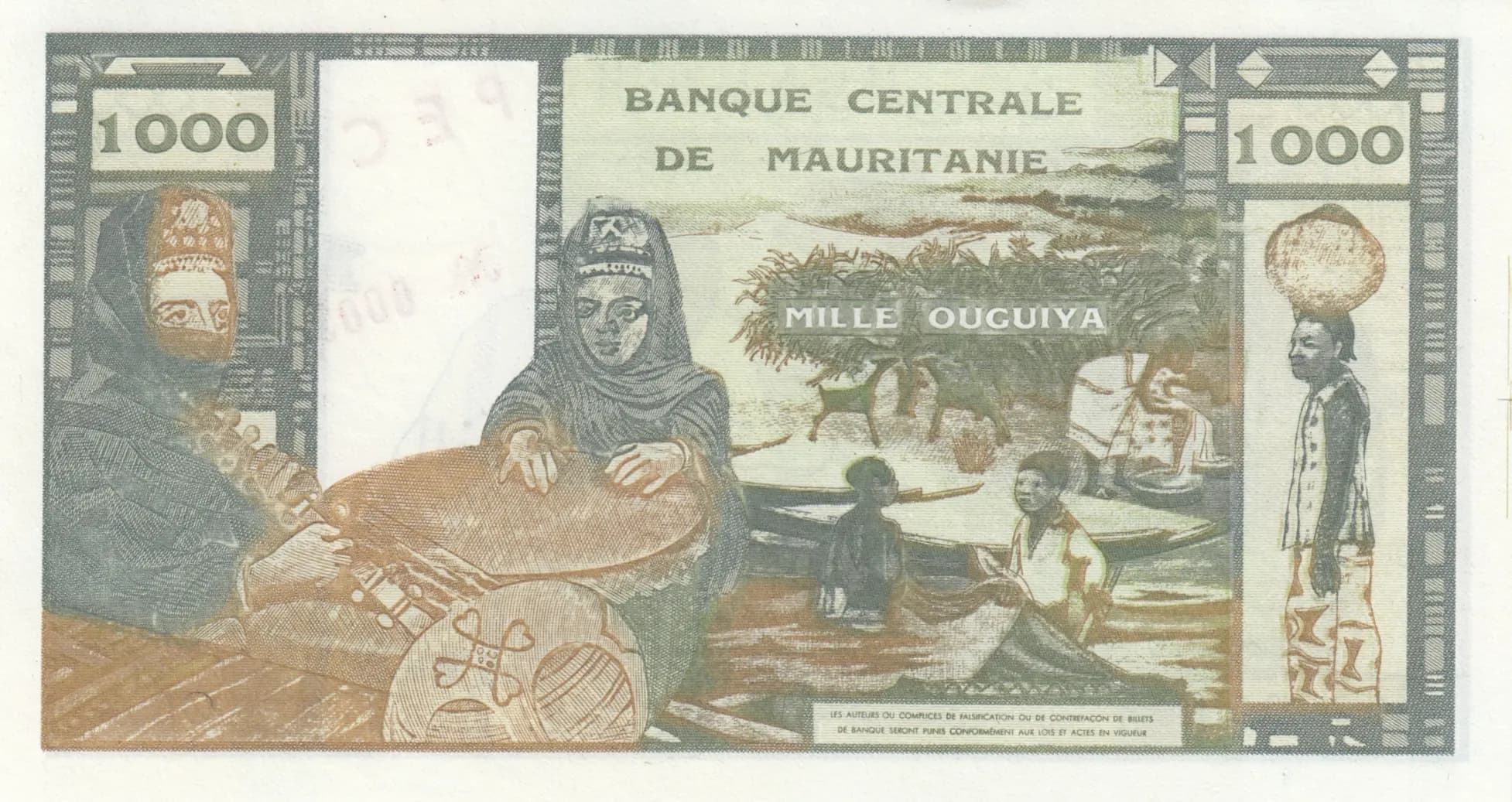
A pristine 1973 specimen banknote from Mauritania's first currency issue, featuring artisanal workers and traditional river life scenes rendered in green and earth-tone palettes. This UNC specimen note exhibits sharp, clear printing with no circulation wear and displays the characteristic red 'SPECIMEN' overprint with zeros in place of serial numbers. The note is notable as an early example of Mauritanian currency design and represents the foundational denomination series of the Banque Centrale de Mauritanie.
Common. While specimen notes are inherently produced in limited quantities compared to circulation currency, the 1973 Mauritanian 1000 ouguiya specimen remains relatively available in the collector market. eBay market data shows consistent sales activity with UNC examples selling in the $100-$172 range from 2011-2022, with catalog valuations around $300 (2019). These moderate prices and regular availability indicate a common specimen type rather than a rare issue. The note was part of Mauritania's foundational currency series with substantial official specimen distributions to banks and archives.
Issued on June 20, 1973, this note marks the inaugural currency series of the newly independent Mauritania, reflecting the nation's cultural identity through imagery of traditional occupations—weavers and craftsmen on the obverse, musicians and fishermen on the reverse. The design choices emphasize Mauritanian heritage and economic activities central to the region, while the bilingual French-Arabic inscriptions reflect the country's postcolonial linguistic landscape and ties to both francophone and Arab communities.
The obverse depicts three stylized human figures engaged in industrial and artisanal labor—a weaver or craftsman in traditional draped clothing on the left, a central worker in modern work attire with head covering, and a laborer bent in manual effort on the right. The background features industrial infrastructure including a prominent crane, symbolizing Mauritania's modernization and development aspirations. The reverse portrays a pastoral riverside scene with traditional figures in elaborate ceremonial dress, including a woman with ornate headdress and a man with distinctive spherical headdress ornament, alongside boats, vegetation, and water features representing Mauritania's fishing and riverine heritage. Both sides employ intricate guilloche border patterns and fine line engraving work typical of security printing, with denomination numerals '1000' positioned in all four corners.
FRONT SIDE: 'البنك الملكي الموريتاني' (Bank of Mauritania in Arabic); 'الف وقية' (One thousand ouguiya in Arabic); 'SPECIMEN' (English overprint); '20-6-1973' (Issue date); '1000' (Denomination); 'No 0000000' (Specimen serial number placeholder). BACK SIDE: 'BANQUE CENTRALE DE MAURITANIE' (Central Bank of Mauritania in French); 'MILLE OUGUIYA' (One thousand ouguiya in French); '1000' (Denomination); 'LES AUTEURS OU COMEDIES DE FABRICATION DU DE CONTREFACON DE BILLETS DE BANQUE SERONT PUNIS CONFORMEMENT AUX LOIS ET ACTES EN VIGUEUR' (Counterfeiting warning: 'The authors or accomplices in the manufacture or counterfeiting of banknotes will be punished in accordance with applicable laws and regulations').
Intaglio (engraved) multicolor printing with green, brown, tan, and cream color separations. The note exhibits fine line work, detailed guilloche patterns, and characteristic security engraving techniques consistent with specialized banknote production. According to PMG population data, this series was printed by TDLR (Taylorian De La Rue or similar security printer), indicated by the P-3 catalog designations. The specimen overprint and serial number placeholder (0000000) were applied during the security printing process.
This is specifically the P-3s specimen variety of the 1000 ouguiya denomination (as opposed to P-3C* or P-3Cs variants cataloged by PMG). The 's' designation indicates a specimen overprint. The note is marked with red 'SPECIMEN' text and displays characteristic specimen serial number formatting (0000000). No signature varieties, date variations, or prefix variations are applicable to specimen notes of this type, as these security features are standardized across all specimens of the same printing.