100 rupees 1960
Market Prices
15 salesAbout This Note
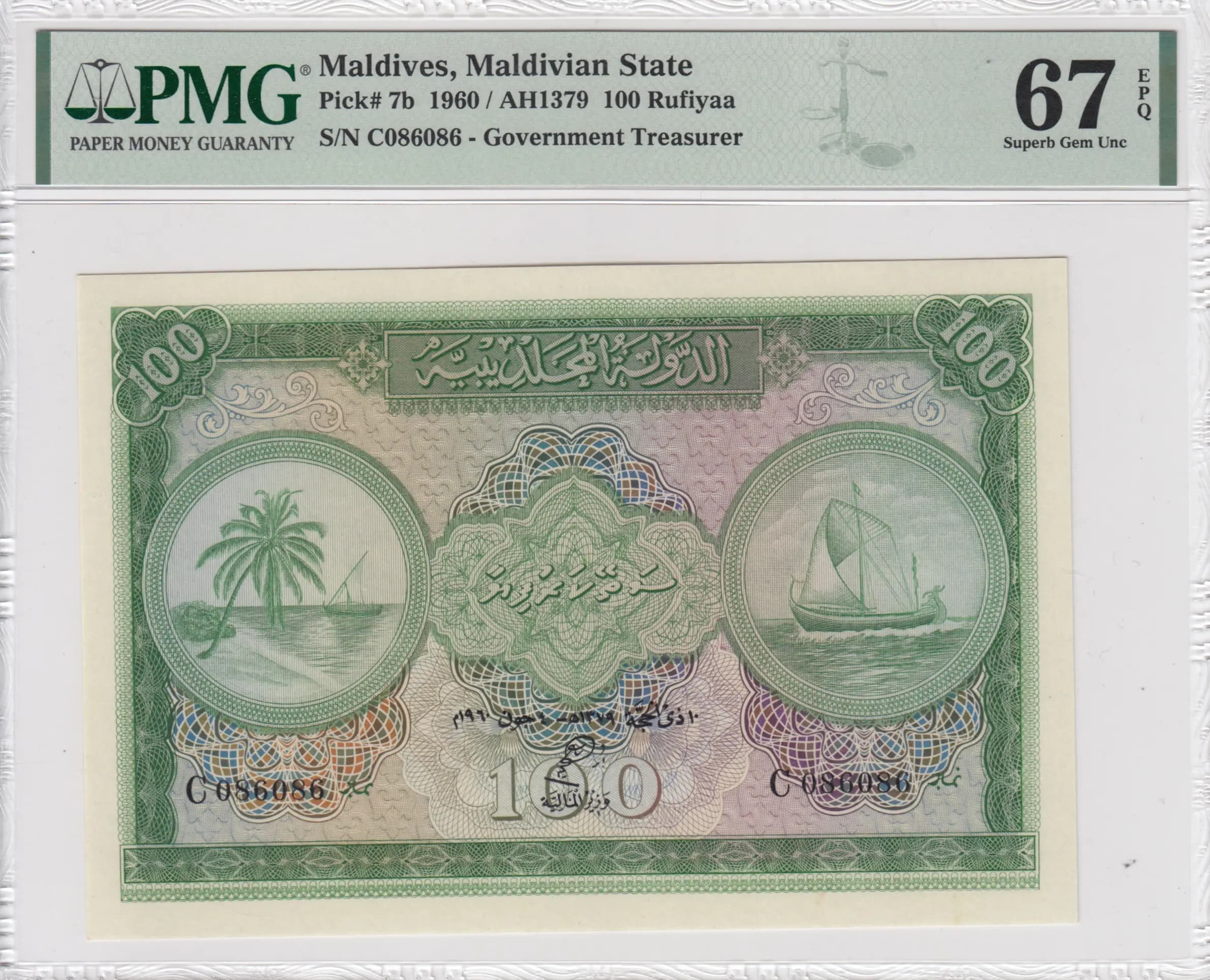
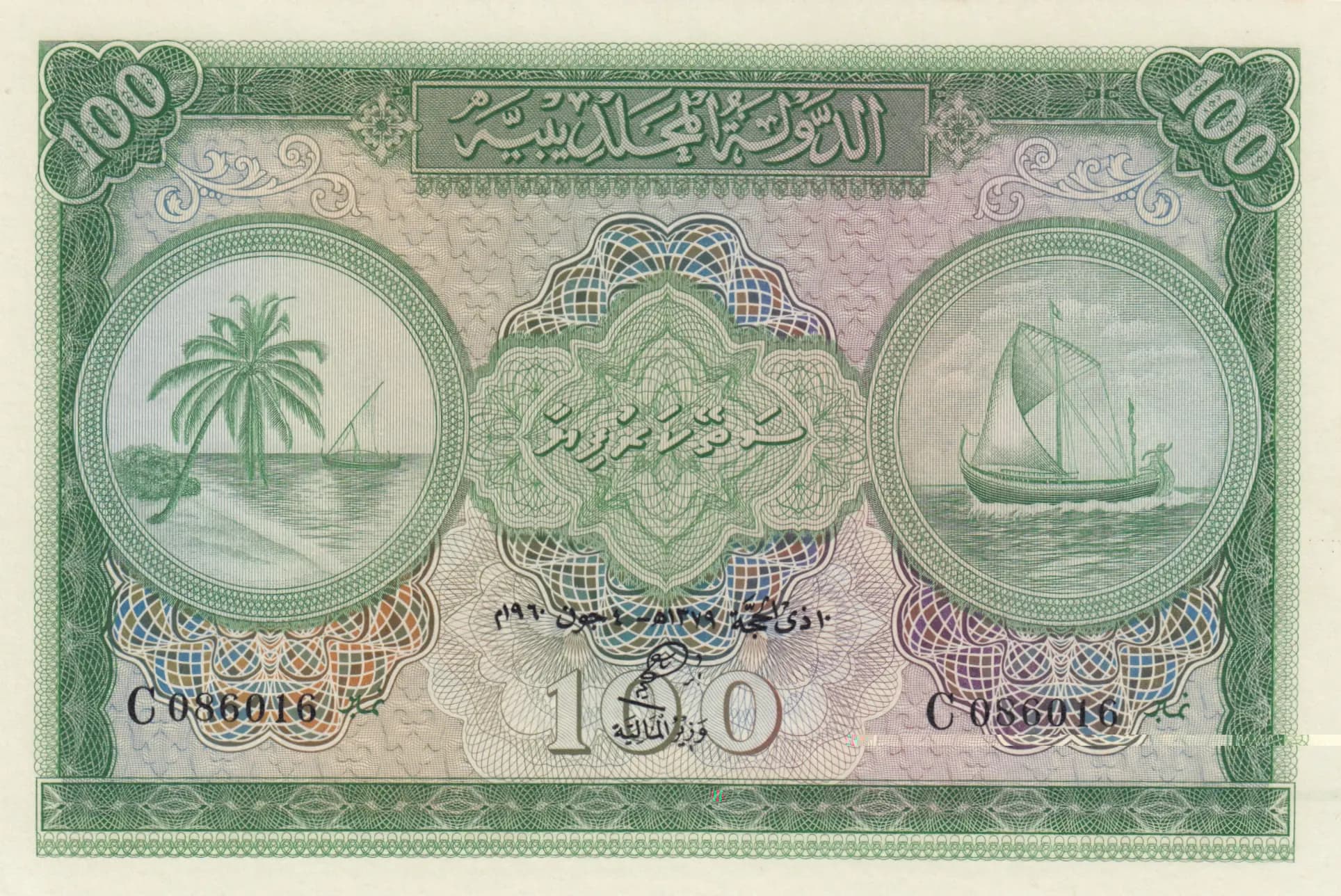
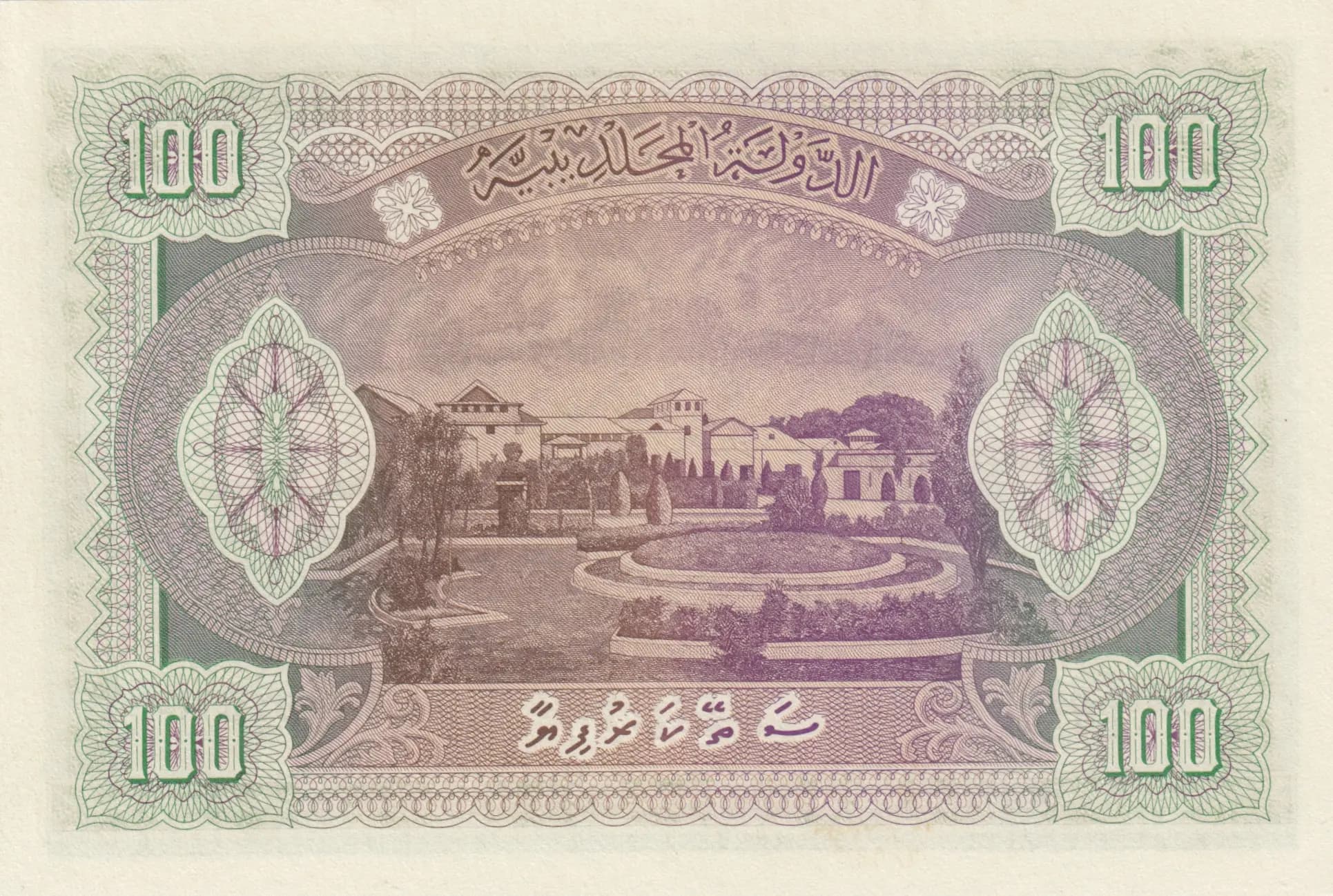
A stunning uncirculated example of the 1960 Maldivian 100 rupees (P-7b), featuring vibrant green and pink tones on the obverse with intricate geometric medallions and iconic imagery of a palm tree and traditional dhow sailing vessel. The reverse displays an ornate palace or governmental building complex set within formal gardens in purple and green hues, with exceptional fine line engraving throughout. This note represents an early issue from the Maldivian State Treasury and remains in pristine condition with no signs of circulation, making it an attractive example for collectors of Indian Ocean region currency.
Common. Secondary market data indicates regular availability with UNC examples selling in the $150–$225 range in recent years (2019–2024), with catalog valuations from 2019 listing UNC at approximately $200. The consistent supply of examples at auction and relatively stable, moderate pricing confirms this is not a scarce issue. While the note is desirable to collectors of early Maldivian currency and Indian Ocean region notes, it was produced in quantities sufficient to ensure regular availability in the collector market.
This 1960 issue represents the Maldives' early period of monetary independence, issued during a transitional phase in the archipelago's political status. The depiction of the palace or court building (likely the Court of Eterekoilu or Sultan's residence) reflects the sultanate's continued governmental presence during this era, while the symbolic imagery of the palm tree and dhow—key elements of Maldivian geography and maritime heritage—emphasize the nation's island identity and seafaring traditions. The Arabic inscriptions referencing the Islamic British State reflect the complex political relationship between the Maldives and Britain during this period of gradual decolonization.
The obverse features a sophisticated symmetrical layout dominated by a large ornamental geometric medallion at center with intricate blue and brown lattice patterns serving as the focal point. Flanking this central element are two circular vignettes: on the left, a tropical island landscape with a prominent palm tree at the shoreline with water, and on the right, a traditional single-masted dhow (Arabian sailing vessel) under sail on open water. The note employs a pale green and pink background with ornate decorative borders in green. Large denomination numerals '100' appear in all four corners within elaborate oval cartouche frames. The reverse depicts a formal governmental or palace complex with distinctive domed architecture, surrounded by manicured gardens with curved pathways, landscaping features, and mature trees, rendered in purple, green, white, and brown tones. Teardrop or petal-shaped ornamental medallions frame both sides of the central architectural vignette. Both sides display fine line engraving with complex geometric interlocking border patterns and ornamental designs.
Front: The central Arabic cartouche reads 'الدولة الإسلامية البريطانية' (al-Dawlah al-Islamiyyah al-Britaniyyah), translating to 'The Islamic British State.' The denomination appears as '١٠٠' (100 in Arabic numerals). Serial number present: 'C086016' (Latin numerals). Back: The same state inscription 'الدولة الإسلامية البريطانية' appears in the top cartouche. Denomination again shown as '١٠٠' (100). Additional Arabic inscription visible: 'نخود شريف' (appears to be an official name or title inscription, though exact transliteration and meaning requires verification by Arabic specialist—potentially relating to an official or treasurer's name).
Intaglio engraving (line engraving) on multicolor underprint, characteristic of high-security currency production from this era. The fine detail visible in the geometric patterns, architectural elements, and border designs, combined with the crisp color registration and the sophisticated multicolor printing on both obverse and reverse, indicates production by a specialized security printer—likely De La Rue or similar Commonwealth-era currency printer, though specific printer attribution for P-7b would require catalog verification. The intricate lattice patterns and fine line work serve dual purposes of aesthetic appeal and anti-counterfeiting security.
This note is cataloged as P-7b per the Pick standard. The PMG population data indicates at least five distinct varieties exist for the base Pick number 7: P-7a, P-7as, P-7b, P-7bs, and P-7s (the 's' suffix typically denotes 'specimen' notes, while variant suffixes often indicate signature varieties or minor printing differences). The specific variety P-7b likely represents a particular signature combination, serial number series, or printer's variant. Without access to the complete Pick catalog descriptors for each sub-variety, the precise distinguishing characteristics cannot be specified here, but the serial number C086016 and the signatures visible in the vignette would be necessary to confirm this specific variety assignment. Collectors should cross-reference against current Pick or IBNS catalogs for definitive variety identification.