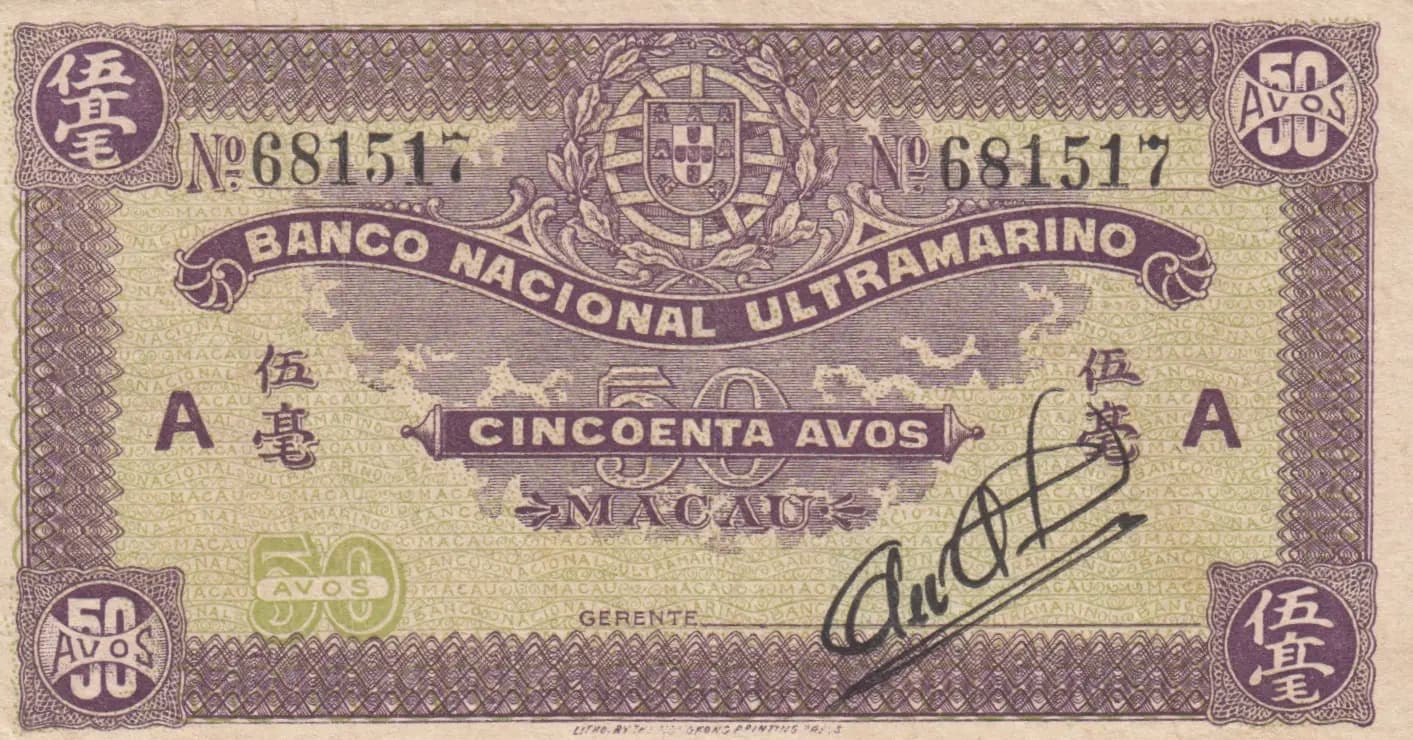
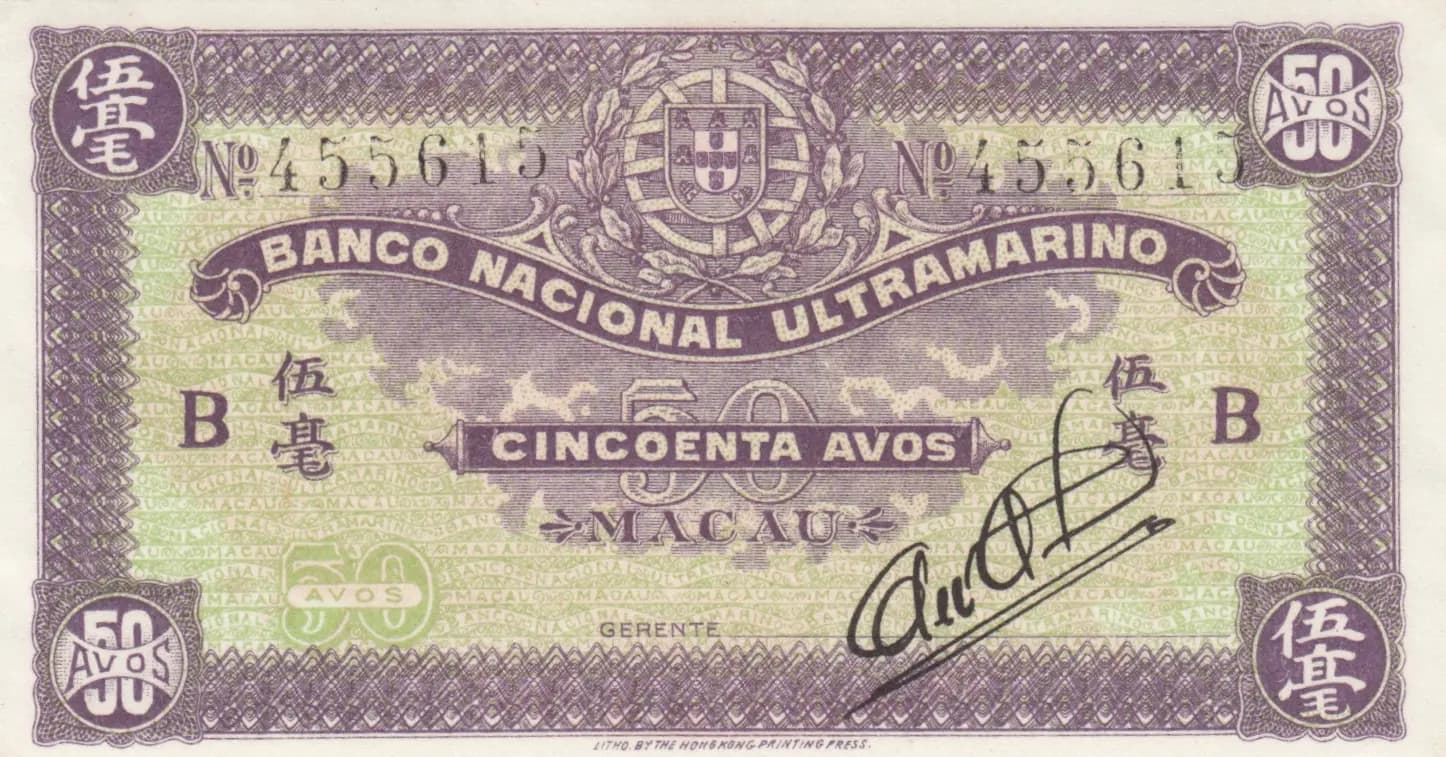
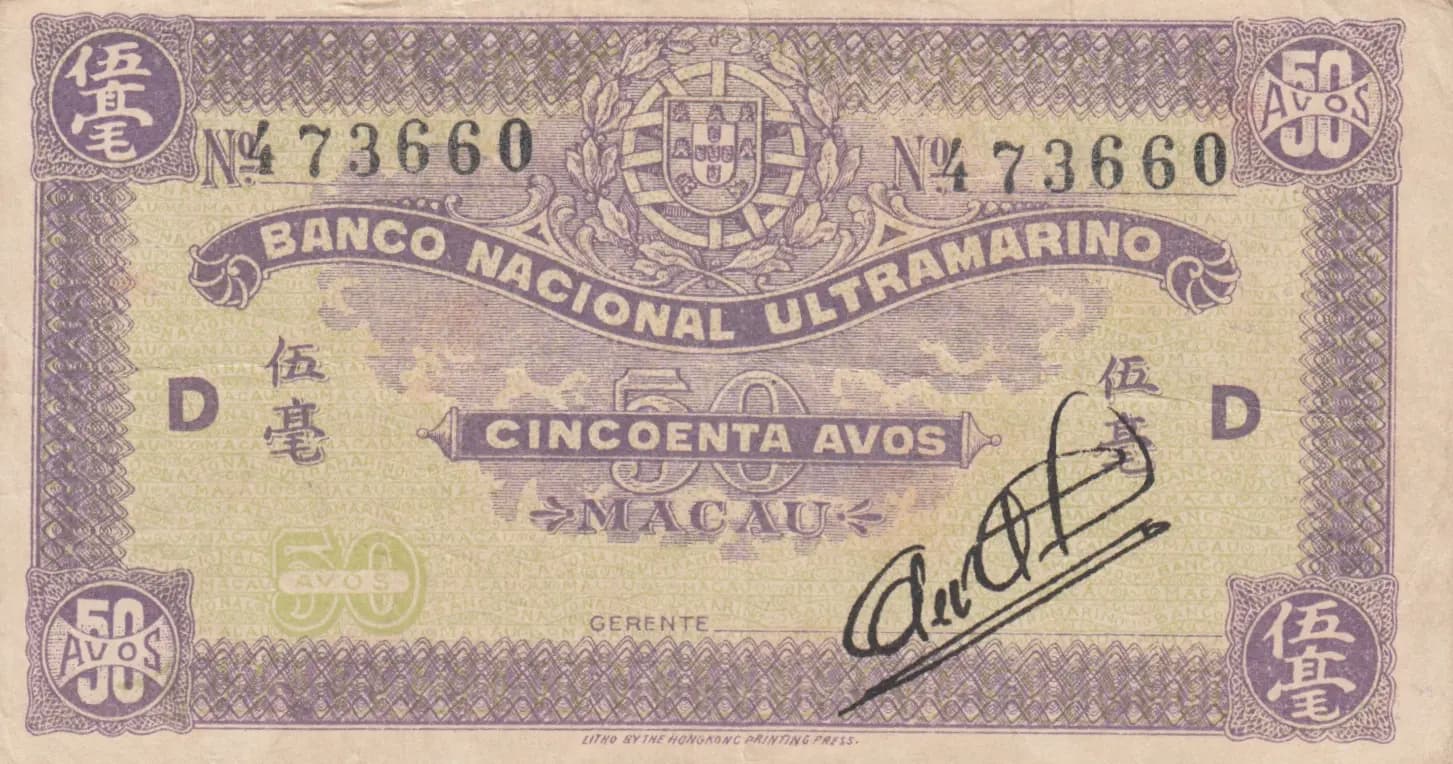
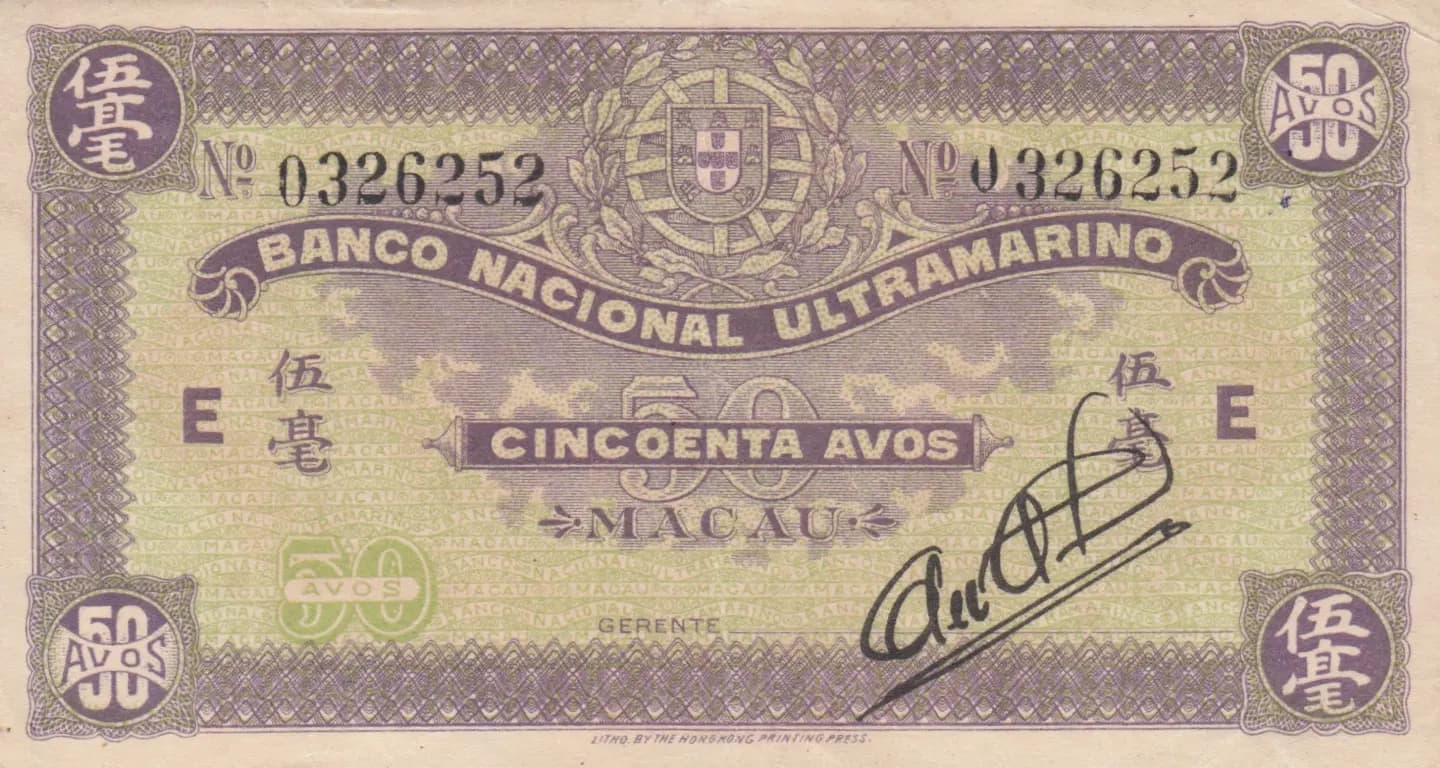
50 avos 1944
“serie G”
Market Prices
19 salesAbout This Note
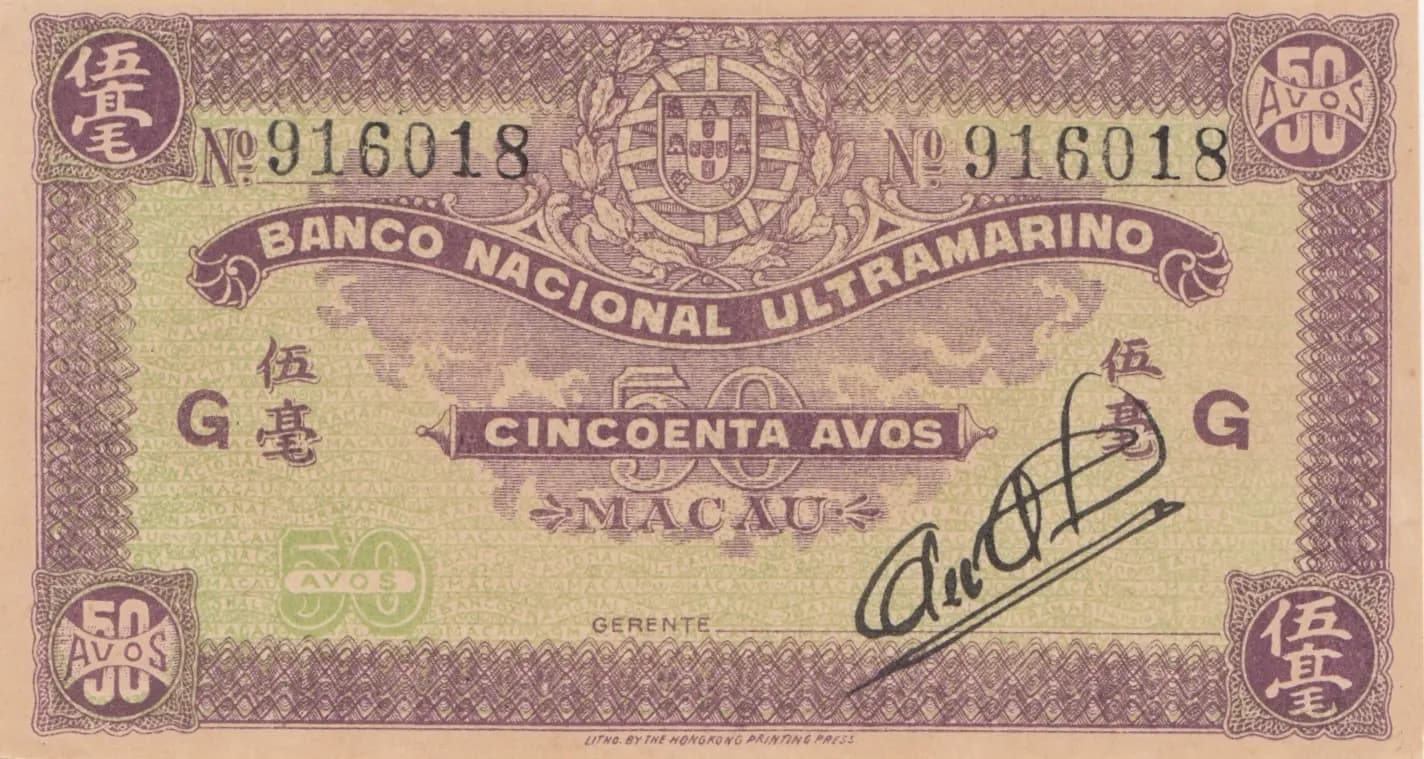
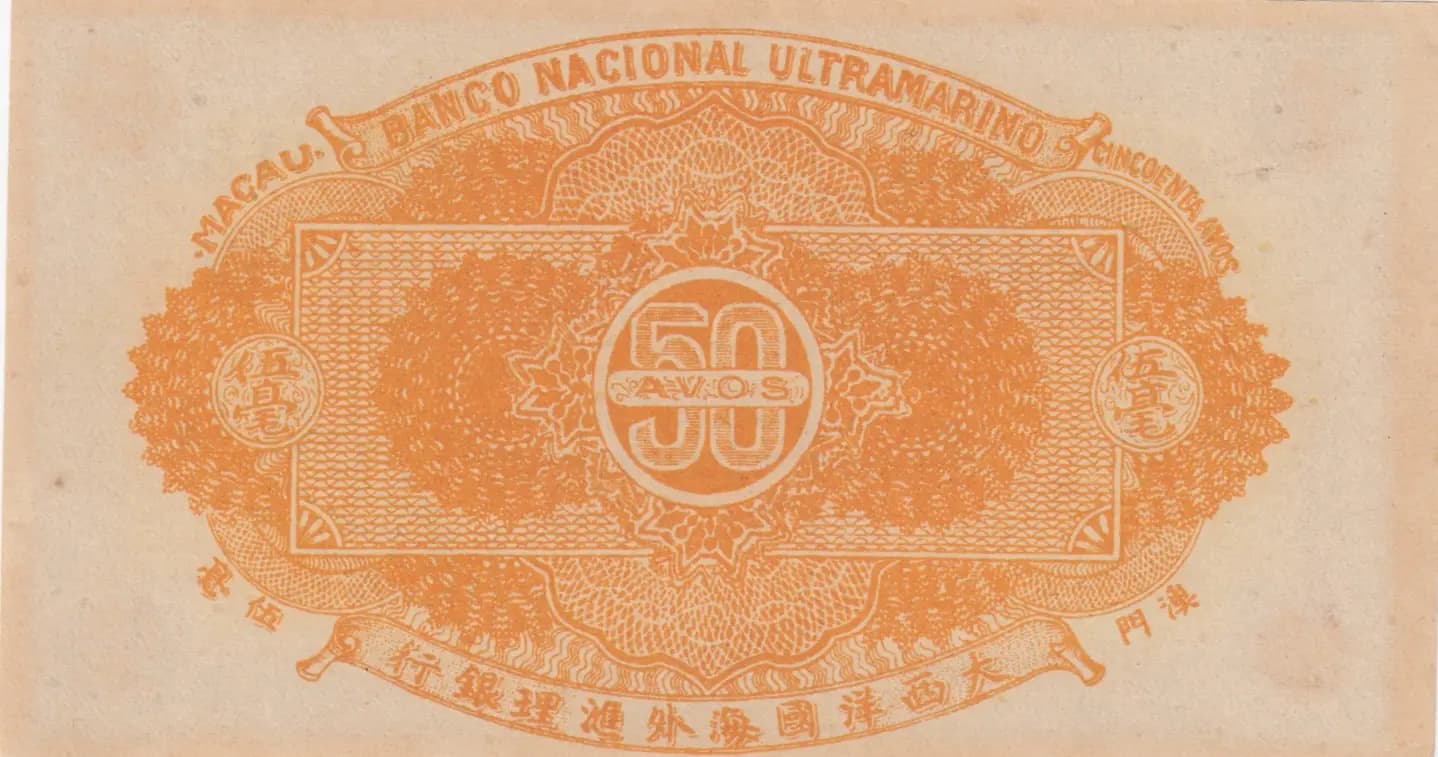
This is a well-preserved example of Macau's 50 avos banknote from 1944, issued by the Banco Nacional Ultramarino during Portugal's colonial administration. The note exhibits an attractive purple, beige, and green color scheme on the obverse with an ornate Portuguese heraldic coat of arms as the centerpiece, while the reverse features warm orange and tan tones with an elaborate circular medallion design. In AU condition with visible but light creasing and age-appropriate yellowing, this serie G note represents a historically significant piece of Macanese currency from the World War II era, particularly notable for its bilingual Portuguese-Chinese design and the Hongkong Printing Press imprint.
Common. The 50 avos denomination was a standard circulation note for Macau during the 1944 issue period, with no documented evidence of restricted print runs, early recalls, or extreme scarcity. Notes from this series and denomination appear regularly in the collector market at modest valuations, consistent with common pre-war colonial issues. The AU condition grade observed here represents a well-preserved example but does not substantially elevate rarity, as adequate supplies of these notes have survived.
This banknote was issued during 1944, midway through World War II when Macau maintained its status as a Portuguese colony despite Japanese occupation of surrounding territories. The Banco Nacional Ultramarino, Portugal's primary overseas banking institution, continued monetary operations in Macau throughout this period, with this denomination serving the colony's everyday commerce. The bilingual Portuguese-Chinese inscriptions and heraldic Portuguese coat of arms reflect Macau's unique position as a Western colonial enclave in East Asia, with the inclusion of Chinese characters demonstrating the accommodation of the predominant local population.
The obverse features a centrally positioned Portuguese national coat of arms rendered in fine detail, flanked by ornamental wreaths in a classical heraldic composition. Circular emblems containing Chinese characters occupy the corners, symbolizing the note's dual cultural context. An ornate geometric border frames the entire composition with repeating patterns characteristic of late-colonial Portuguese banknote design. The reverse displays a dominant circular medallion containing the '50 AVOS' denomination, surrounded by elaborate decorative borders featuring repeating floral and geometric motifs with rosette designs at the corners. The overall design reflects the aesthetic standards of 1940s Portuguese security printing, with the complex ornamentation serving both decorative and anti-counterfeiting purposes. No portraits or specific landmarks are depicted; instead, the design emphasizes heraldic symbols and ornamental patterns.
FRONT SIDE: 'BANCO NACIONAL ULTRAMARINO' (Overseas National Bank) — issuer name; 'CINCOENTA AVOS' (Fifty Avos) — denomination; 'MACAO' — place of issue; 'No 916018' — serial number; 'GERENTE' (Manager) — signature line; 'G' — series letter designation; '位' (Position/rank) — Chinese character; 'LITHO. BY THE HONGKONG PRINTING PRESS' — printer attribution. BACK SIDE: 'MACAU' — place of issue; 'BANCO NACIONAL ULTRAMARINO' — issuer name; '50 AVOS' — denomination; '澳門特別行政區政府' — text relating to Macao government authority.
Lithography, as explicitly attributed on the obverse to 'The Hongkong Printing Press.' This technique was standard for banknote production in this era, allowing for the fine detail and color gradation visible in the ornamental borders, heraldic imagery, and decorative patterns. The multi-color printing (purple/beige/green on obverse; orange/tan on reverse) required multiple lithographic stones or passes, typical of security printing practices of the 1940s.
This note is identified as serie G based on the catalog notation and visible 'G' letter designation on the obverse. The serial number 916018 is specific to this individual specimen. Varieties for Pick 21 (50 avos 1944) may include different series letters (A through G or beyond), though the extent of series variation for this denomination and issuer has not been comprehensively cataloged in readily available references. The signature line marked 'GERENTE' (Manager) may show variations based on different bank officials, though this specific signature variant is not identified here.