5 avos 1920
Market Prices
1 saleAbout This Note
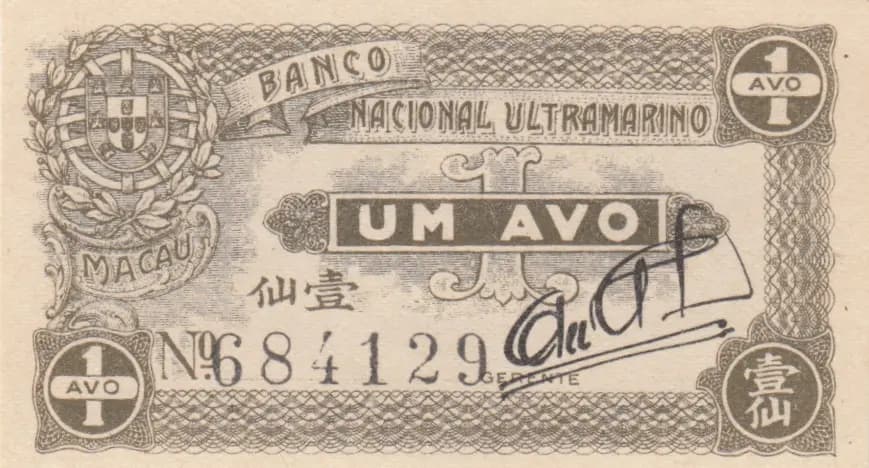
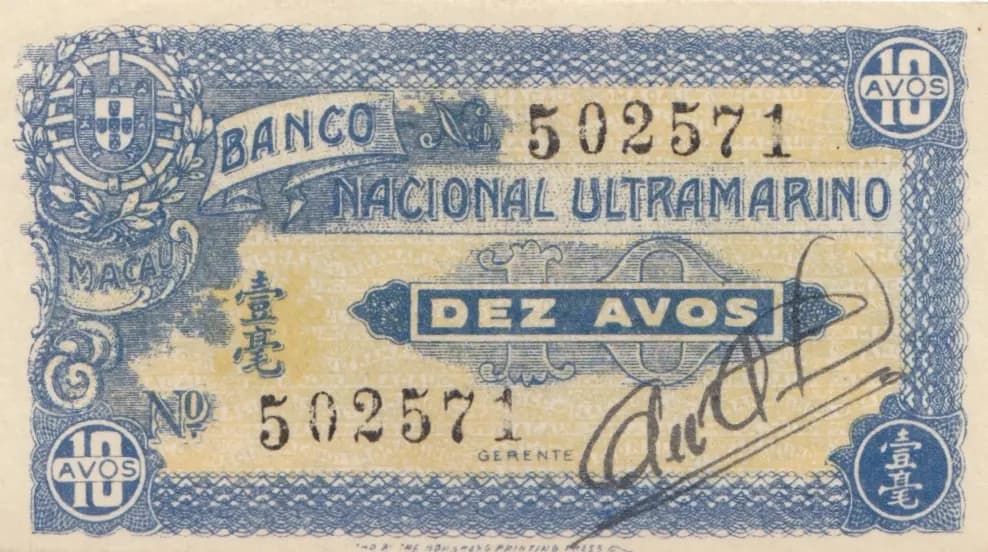
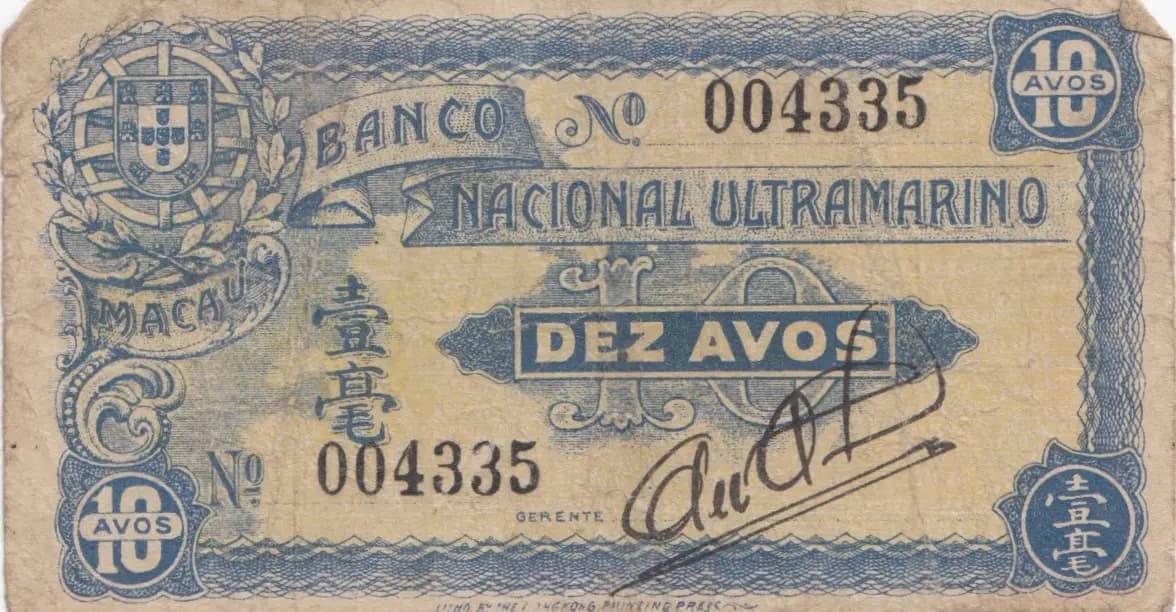
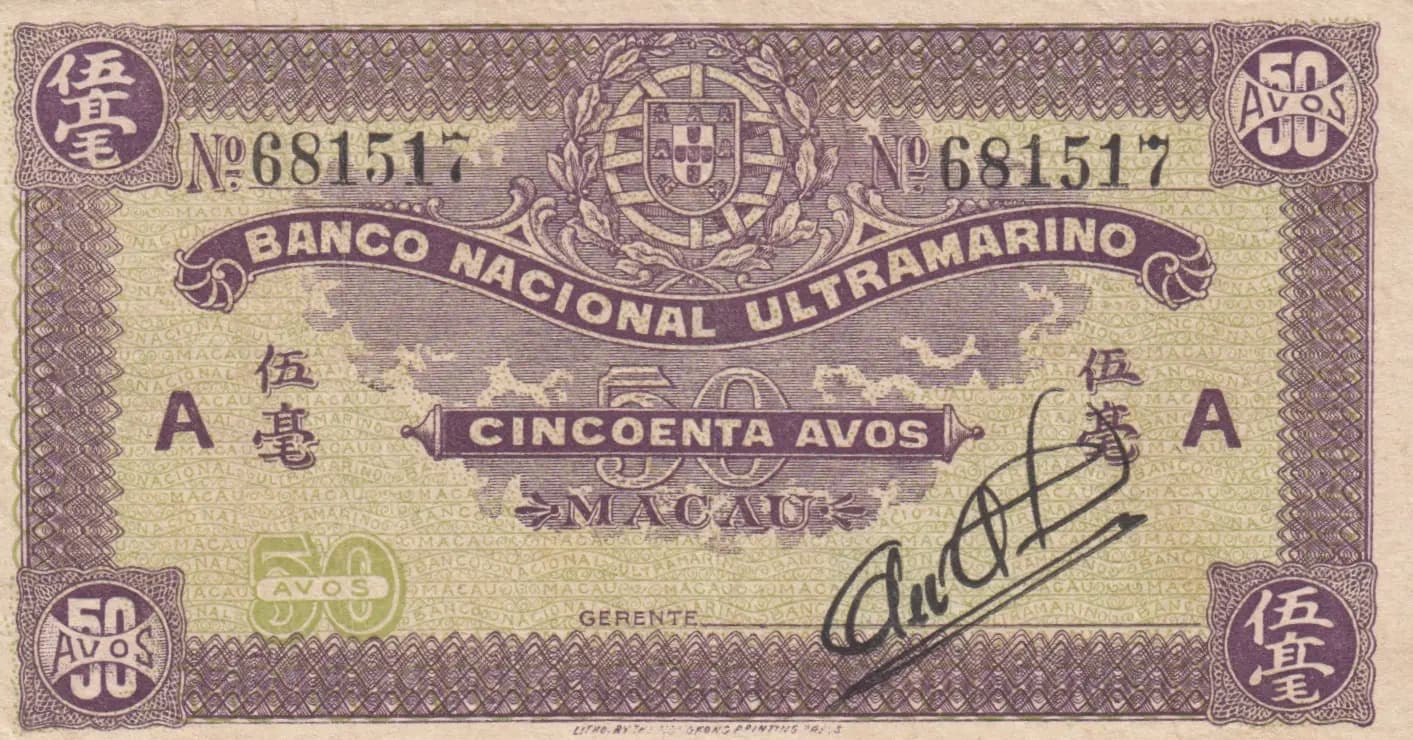
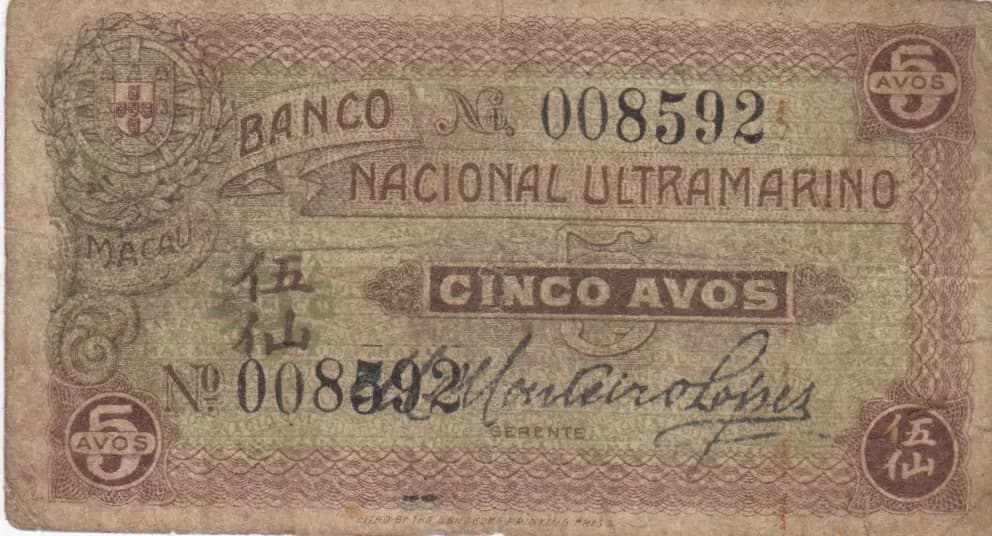
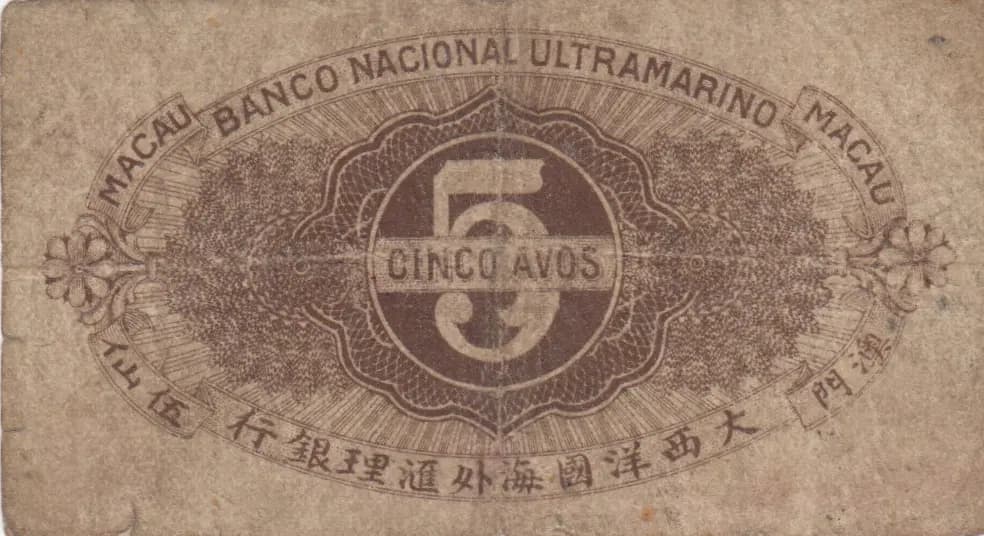
This 1920 Banco Nacional Ultramarino 5 Avos note from Macau presents a classic example of early Portuguese colonial currency design, featuring the Portuguese coat of arms prominently positioned on the obverse. The note exhibits VG condition with visible circulation wear, including creasing, foxing, and discoloration consistent with age and heavy handling. The brown and tan color scheme with repeated denomination markings in circular emblems and the ornate medallion design on the reverse showcase the decorative printing standards of the Hongkong Printing Press.
Common. The catalog values indicate strong availability at all grades (VG: $30, VF: $100, UNC: $400), and the eBay price history shows a PMG 65 example selling for approximately $380, consistent with regular circulation issues from major colonial banks. No evidence of limited print runs, recalls, or short-lived issuance exists for this Pick number. The subsequent 1942 reissue (P-14) noted in the catalog confirms this 1920 issue was part of a standard monetary series rather than a special limited release.
This note was issued during the early 20th century when Macau remained a Portuguese colonial territory, with the Banco Nacional Ultramarino serving as the primary currency issuer. The Portuguese coat of arms depicted on the obverse symbolizes colonial authority, while the bilingual Portuguese and Chinese inscriptions reflect Macau's unique position as a bridge between European and Asian cultures. The 1920 date places this note in the interwar period, capturing a specific moment in Macau's monetary history before the subsequent 1942 reissue noted in the catalog.
The obverse features the Portuguese coat of arms positioned at the upper left, composed of a shield with heraldic elements and crossed supports typical of Portuguese state symbolry. The denomination '5 AVOS' appears in three circular emblems — one in the top right corner and two in the lower corners — serving both decorative and security functions through repetition. The reverse presents a dominant central ornamental medallion containing the numeral '5' and text 'CINCO AVOS' within an intricately bordered decorative frame, flanked by symmetrical floral or leaf-like ornamental elements. Geometric border patterns with curved and linear elements frame all sides of both surfaces, characteristic of early 20th-century bank note design emphasizing ornamental security through complexity.
OBVERSE: 'BANCO NACIONAL ULTRAMARINO' (National Overseas Bank) — the issuing institution; 'CINCO AVOS' (Five Avos) — denomination in Portuguese; 'MACAU' — place of issue; 'GERENTE' (Manager) — signature line designation; Serial number 'Nº 008592' appears twice. REVERSE: 'CINCO AVOS' (Five Avos) — central denomination; 'BANCO NACIONAL ULTRAMARINO MACAU' (National Overseas Bank Macau) — issuer identification; Chinese characters present (partially visible in visual analysis) indicating bilingual currency standards of the colonial period.
This note was produced by the Hongkong Printing Press using letterpress and intaglio printing techniques, evidenced by the sharp definition of the coat of arms, the precise geometric borders, and the crisp inscription work visible despite age-related wear. The consistent brown ink application across both sides and the fine detail work on the ornamental elements and circular denomination markings indicate professional security printing standards. The layered underprint of green (noted in catalog as 'brown on green underprint') would have been applied separately, a common practice of the era for adding color complexity.
The specific variety can be identified by serial number 008592 and the 1920 date with ND (no date printed) designation standard for this issue. The catalog reference distinguishes this 1920 Hongkong Printing Press version from the later 1942 reissue (Pick P-14), which features different signatures and is cataloged separately. No other major varieties (different printers, signature variations, or overprints) are documented for this Pick number P-10.