10 avos 1946
Market Prices
5 salesAbout This Note
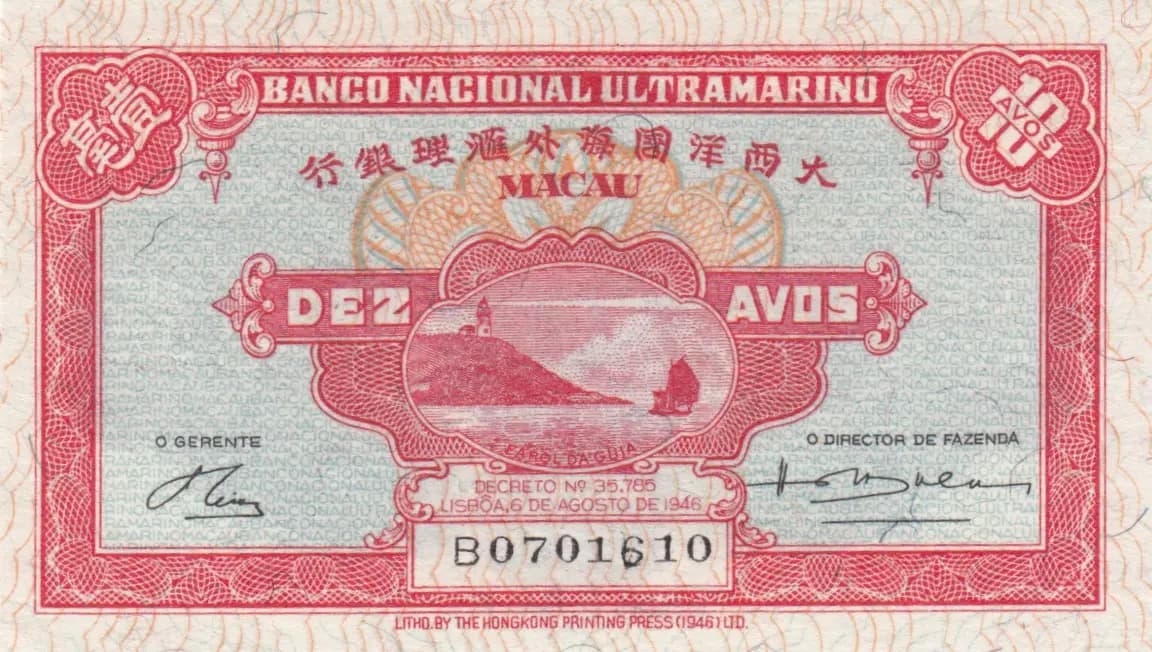
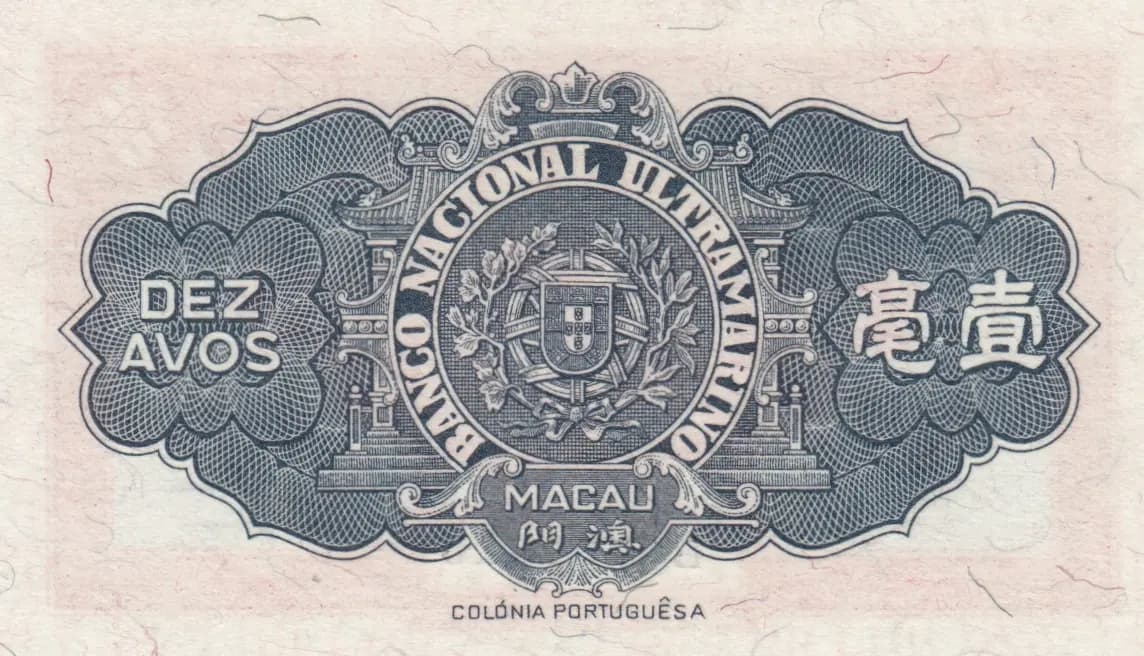
This 1946 Macau 10 avos note from Banco Nacional Ultramarino presents the classic colonial-era design featuring a traditional Chinese junk and mountain landscape on the obverse, rendered in red and pink tones with ornate decorative borders. The reverse displays the Portuguese coat of arms in dark blue with fine engraved detailing. Despite showing expected age-related creasing and light foxing consistent with 78-year-old paper currency, the note retains good clarity in its printed elements and serial numbering, representing a significant piece of Macau's Portuguese colonial monetary history.
Common. This denomination experienced regular circulation in Macau during the post-war period, and catalog values from 2016 list UNC examples at $105, with eBay transaction data showing consistent sales activity ranging from $5.65 to $71 across various condition grades over a 11-year period (2011-2019). The circulation price points and established market history indicate robust supply in the collector market. The note's print run was substantial enough to ensure availability in multiple condition grades.
This note was issued during the final years of World War II under Decree No. 35,795 from Lisbon on August 6, 1946, when Macau remained under Portuguese colonial administration. The deliberate inclusion of both Portuguese colonial heraldry and Chinese characters, along with the iconographic choice of a traditional Chinese junk alongside European architectural elements (implied by the mountain landscape), reflects the hybrid Sino-Portuguese cultural context of the territory. The Banco Nacional Ultramarino's issuance of this denomination in 1946 represents the post-war stabilization period of Portuguese colonial currency in Asia.
The obverse features an ornately bordered central vignette in a horizontal oval frame depicting a seascape scene with a traditional Chinese junk sailing vessel and a mountain landscape rendered against light blue-gray tones, flanked by the denomination 'DEZ AVOS' in red text within decorative cartouches. The design is framed by intricate red and pink floral and geometric ornamental borders with detailed corner flourishes characteristic of early 20th-century intaglio banknote design. The reverse displays a dark blue field with the Portuguese coat of arms as its central element—a shield with heraldic divisions and crown—surrounded by ornamental foliage and floral wreaths in cream/off-white tones. Both sides include fine-line engraved background patterns typical of security printing standards of the era.
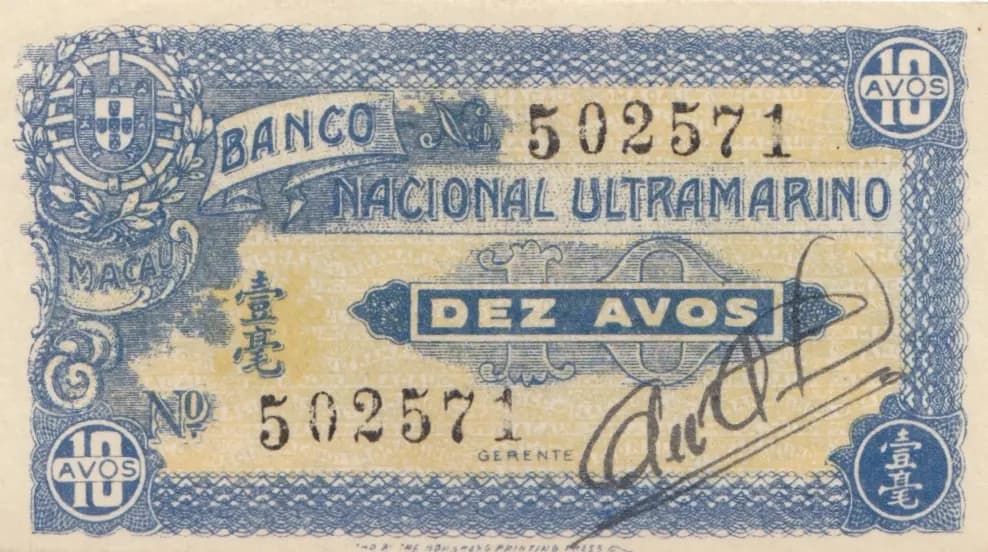
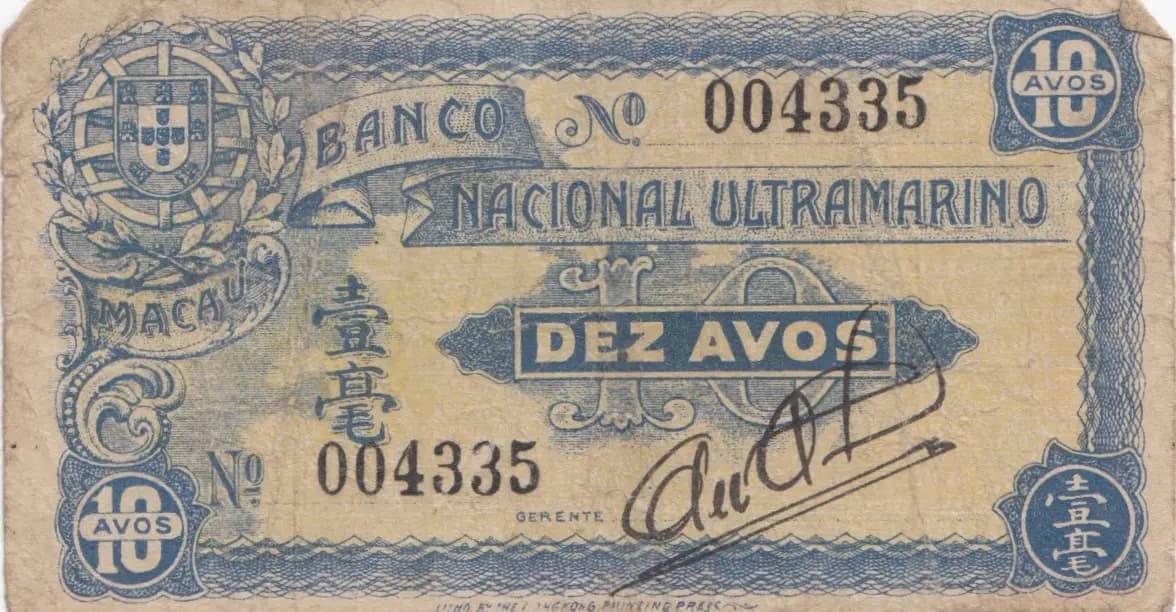
FRONT SIDE: 'BANCO NACIONAL ULTRAMARINO' (National Overseas Bank) with Chinese equivalent '葡萄牙進外海國洋幣大' (Portuguese overseas national currency); 'MACAU' (location); 'DEZ AVOS' (Ten avos, denomination in Portuguese); 'O GERENTE' (The Manager); 'O DIRECTOR DE FAZENDA' (The Director of Finance); 'DECRETO Nº 35.795' (Decree No. 35,795); 'LISBOA,6 DE AGOSTO DE 1946' (Lisbon, August 6, 1946); 'LITHO.BY THE HONGKONG PRINTING PRESS (1946) LTD.' (printer attribution); Serial number 'B0701610'. BACK SIDE: 'DEZ AVOS' (Ten avos); 'BANCO NACIONAL ULTRAMARINO' (National Overseas Bank); 'MACAU' (location); '澳門' (Chinese for Macau); 'COLÓNIA PORTUGUESA' (Portuguese Colony); '香港' (Hong Kong, likely printer attribution reference).
Lithography by The Hongkong Printing Press (1946) Ltd., as explicitly stated in the printer attribution. The visual evidence of fine line engraved patterns, the clarity of the heraldic coat of arms details, and the quality of the decorative borders suggest the primary design elements were executed using traditional intaglio engraving techniques combined with lithographic color work. The multi-color printing on the obverse (red, pink, light blue-gray) and the dark blue back with cream overprint are consistent with period lithographic color separation methods.
The observed serial number 'B0701610' with the 'B' prefix suggests a specific printing series or batch designation. The specific issue date of August 6, 1946 (Lisboa date) is consistent with the Decree No. 35,795 authorization. No major varieties are documented for this Pick number (P-36), though collectors should note signature varieties may exist depending on which bank officials countersigned specific batches. The lithographic printer attribution to 'The Hongkong Printing Press (1946) Ltd.' with the parenthetical year suggests this was a printer designation rather than indicating the note's issue date only.