1 pataca 1945
Market Prices
25 salesAbout This Note
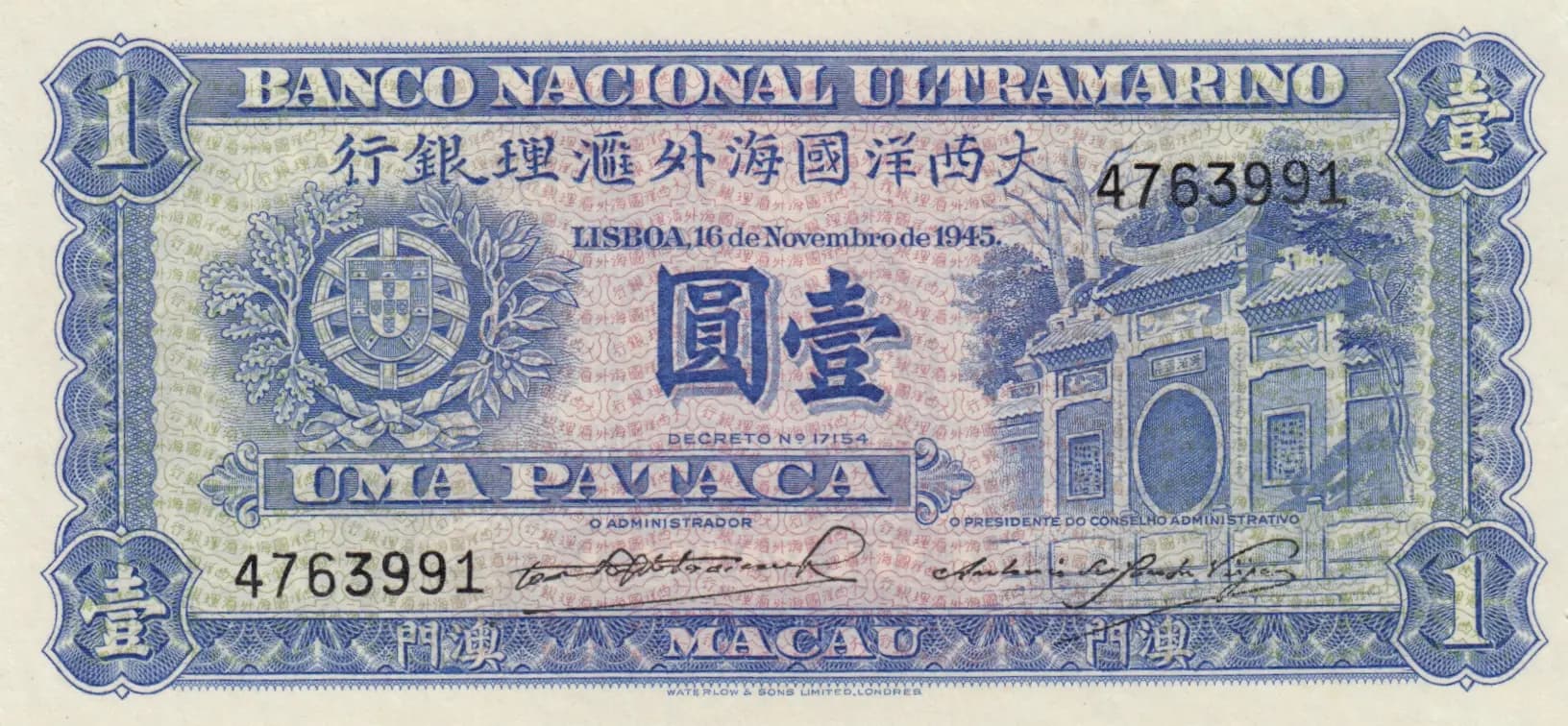
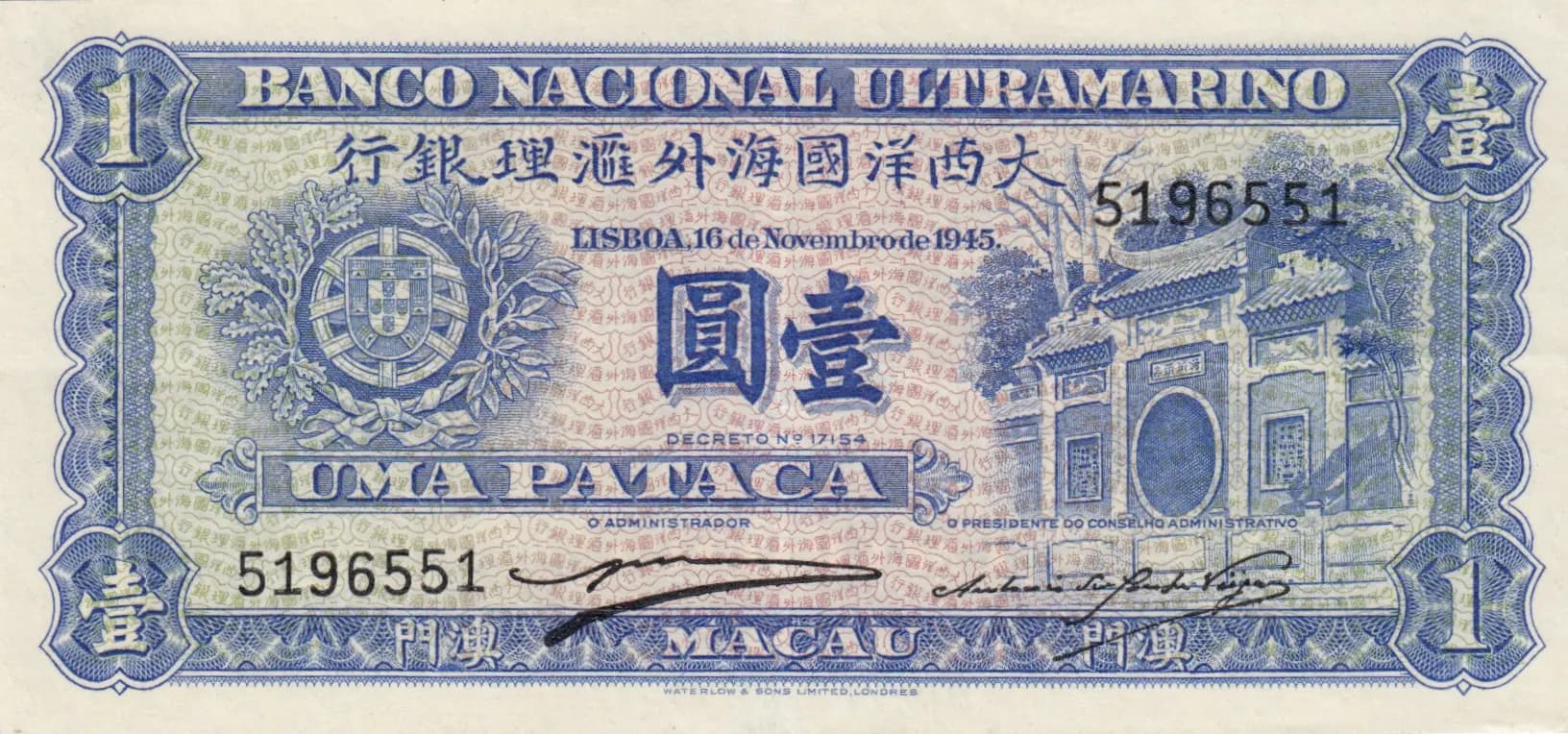
This 1945 Banco Nacional Ultramarino 1 pataca note presents an excellent example of colonial Macau currency with characteristic bilingual Portuguese-Chinese design elements. The EF-graded specimen displays moderate circulation wear with visible creasing and fold marks, along with light age-related discoloration, yet retains strong visual appeal with intact fine engraving details. The note's enduring collector interest—evidenced by consistent eBay market prices ranging from $80-$140 for similar grades—reflects its significance as a transitional piece of Portuguese colonial monetary history.
Common. The consistent eBay sales history spanning 2009-2025 with multiple examples in various grades selling regularly (typically $50-$150 for EF-AU grades, with even VG examples trading for $10-$40) indicates robust market supply. The note was issued in sufficient quantity by a major European security printer for a colonial territory, and no historical evidence suggests limited print runs, recalls, or scarcity. While not mass-produced to modern standards, this Pick-28 represents a standard circulation issue of its time with healthy collector availability.
Issued on November 16, 1945, just as World War II concluded and colonial Macau faced uncertain postwar conditions, this note represents Banco Nacional Ultramarino's continued authority over Macau's currency during the final decades of Portuguese colonial rule. The design elements—the A-Ma temple symbolizing Macau's Chinese heritage and the steamship representing maritime commerce—reflect the economic foundations of the colony, where Portuguese merchants and Chinese traders coexisted within the Portuguese colonial framework that would persist until 1999.
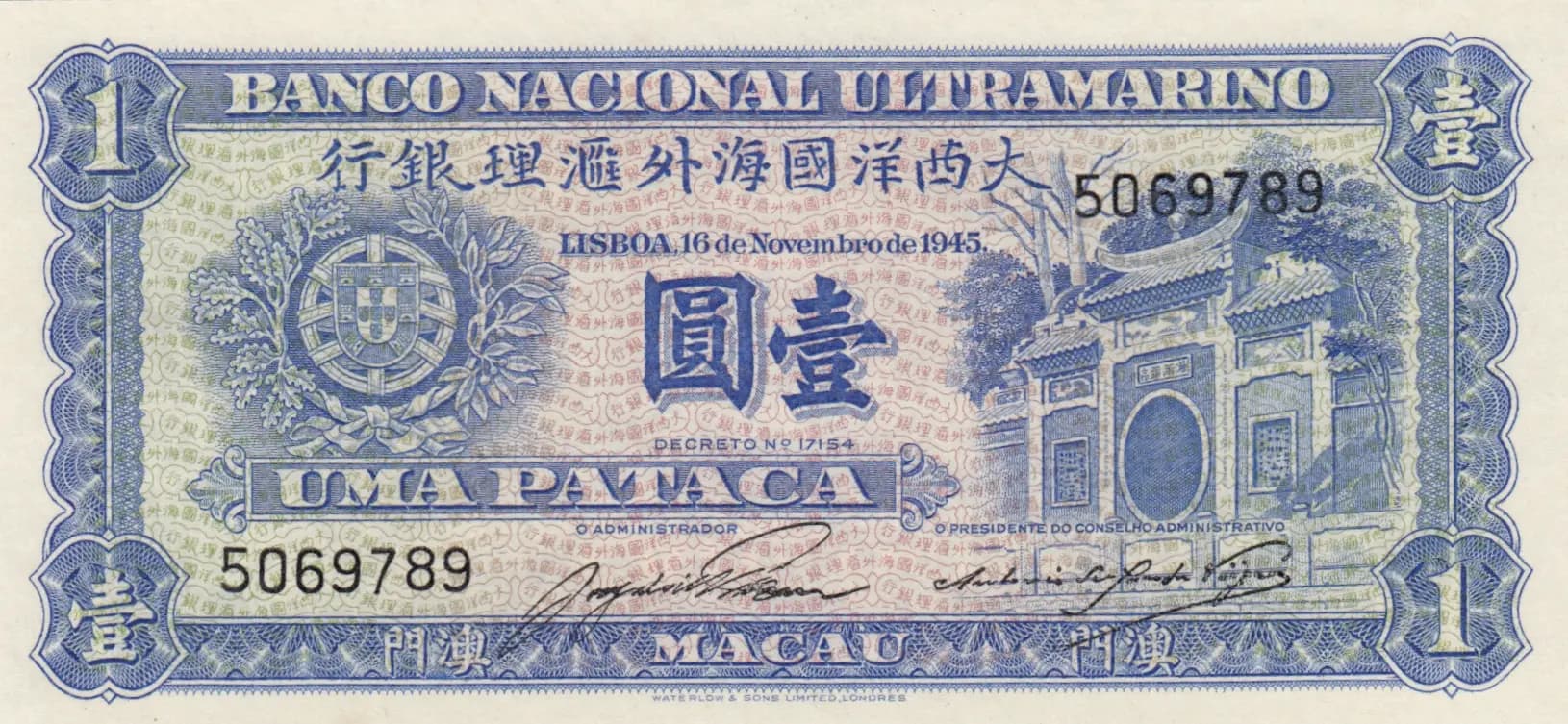
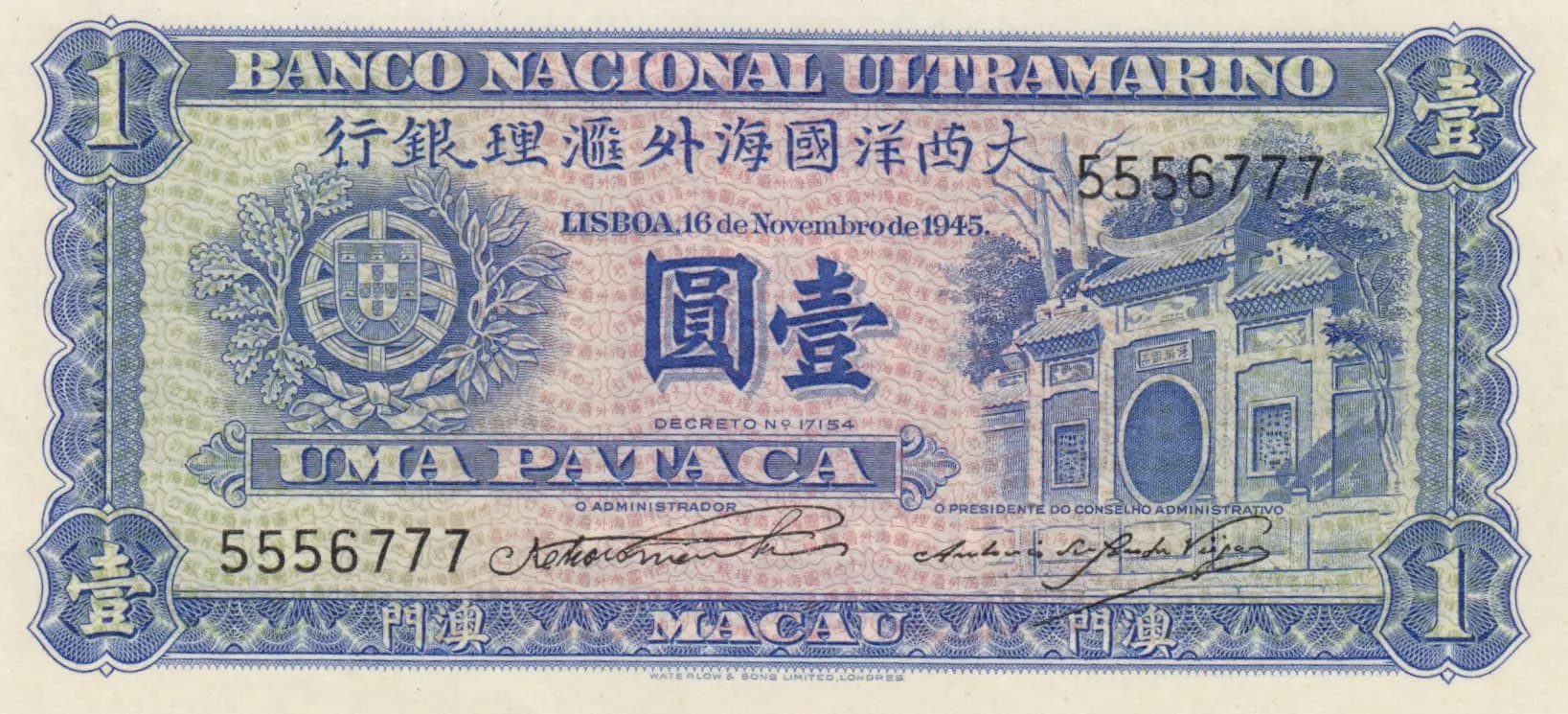
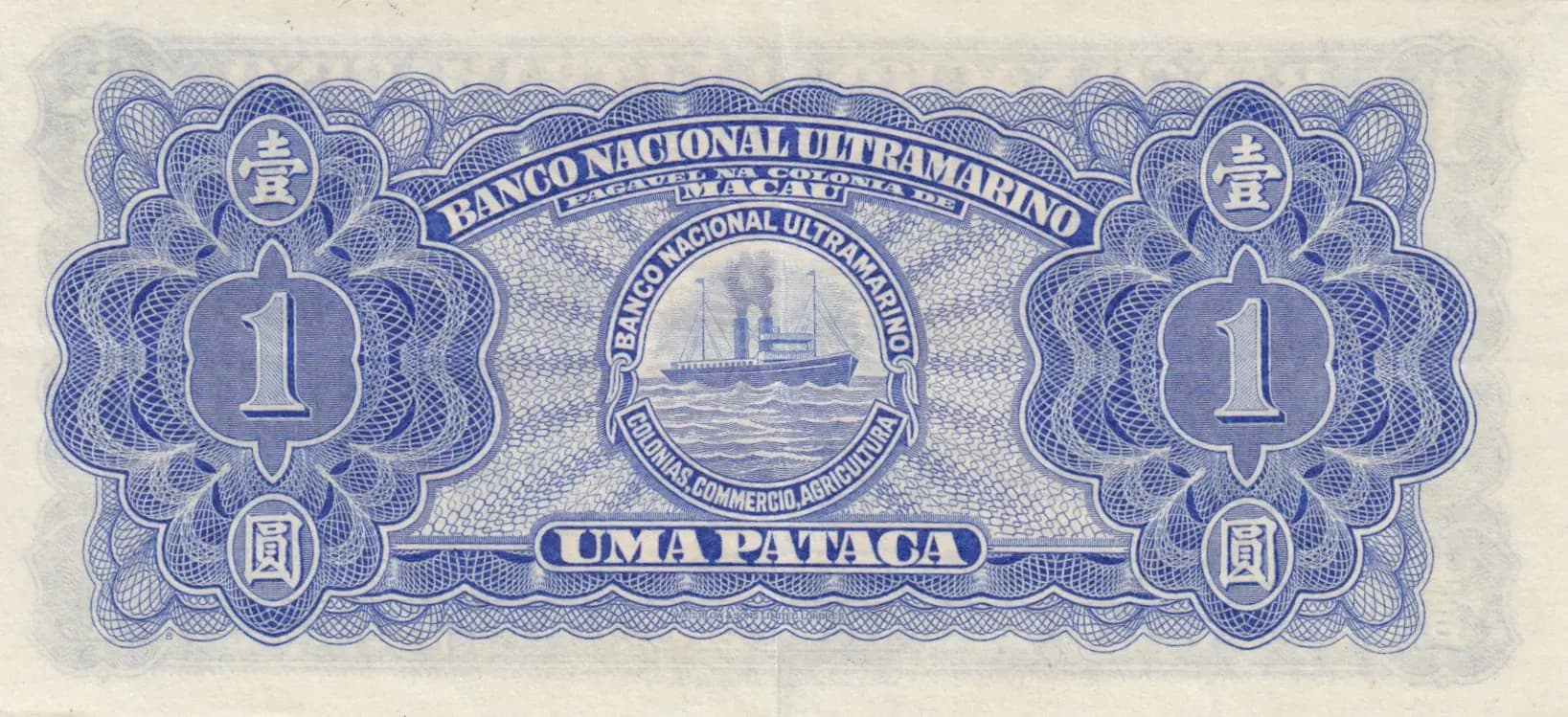
The obverse features the Portuguese coat of arms on the left, flanked by decorative floral wreaths, with the A-Ma Temple (also known as the Goddess of Heaven temple, Macau's oldest and most iconic temple) depicted on the right side showing traditional Chinese architectural style with multiple tiers and ornamental detailing. The center displays bilingual text with Chinese characters and denomination markers. The reverse showcases a circular medallion containing a detailed engraving of an ocean-going steamship with visible funnel smoke, symbolizing Macau's role in maritime trade. Large ornamental '1' denominations frame the composition on both sides, with extensive guilloche patterning and decorative borders throughout. The color scheme combines blue ink with cream/beige background tones and white space.
FRONT: 'BANCO NACIONAL ULTRAMARINO' (National Overseas Bank); '大銀行避外海國洋商' (Chinese translation of bank name); 'LISBOA, 16 de Novembro de 1945' (Lisbon, 16 November 1945); 'UMA PATACA' and '圓壹' (One pataca in Portuguese and Chinese); 'DECRETO Nº 17154' (Decree No. 17154); 'O ADMINISTRADOR' (The Administrator); 'O PRESIDENTE DO CONSELHO ADMINISTRATIVO' (The President of the Administrative Council); '澳門' (Macau); Serial number '5196551'. BACK: 'BANCO NACIONAL ULTRAMARINO' (repeated in circular band); 'UMA PATACA' and '壹圓' (One pataca in Portuguese and Chinese); 'UNIDAS COMMERCIO AGRICULTURA' (United commerce [and] agriculture).
This note was produced by Waterlow & Sons (W&S), London, utilizing intaglio engraving—the dominant security printing method for banknotes of this era. The visual analysis confirms extensive fine-line engraving, detailed guilloche patterns, and precision work evident in the steamship medallion and architectural temple rendering, all characteristic of high-quality intaglio production. The bilateral security features (intricate borders, fine linework, and ornamental designs) provided protection against counterfeiting typical of 1940s colonial currency standards.
The observed specimen displays handwritten signature varieties (noted as signature varieties exist for this issue) and a dual-stamped serial number '5196551', which may indicate a printing variety related to serial number application methods. The exact signature varieties and any known serial number prefixes would require comparison with other documented examples of P-28, but the presence of administrative signatures (Administrator and President of Administrative Council) is consistent with the standard issue type. No evidence of major varieties (overprints, color variants, or denomination variants) is visible on this specimen.