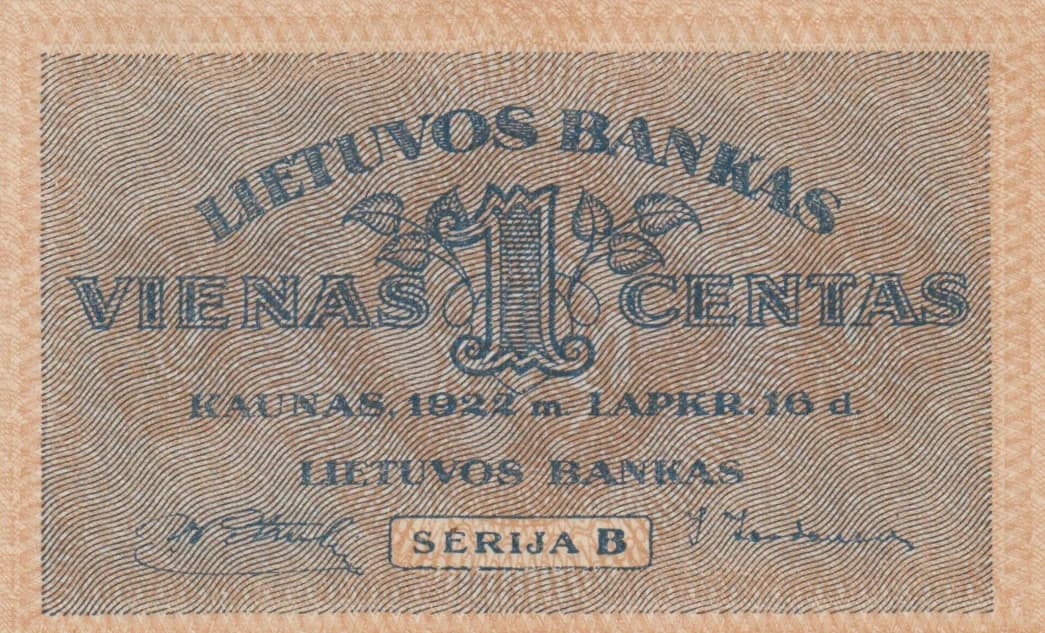
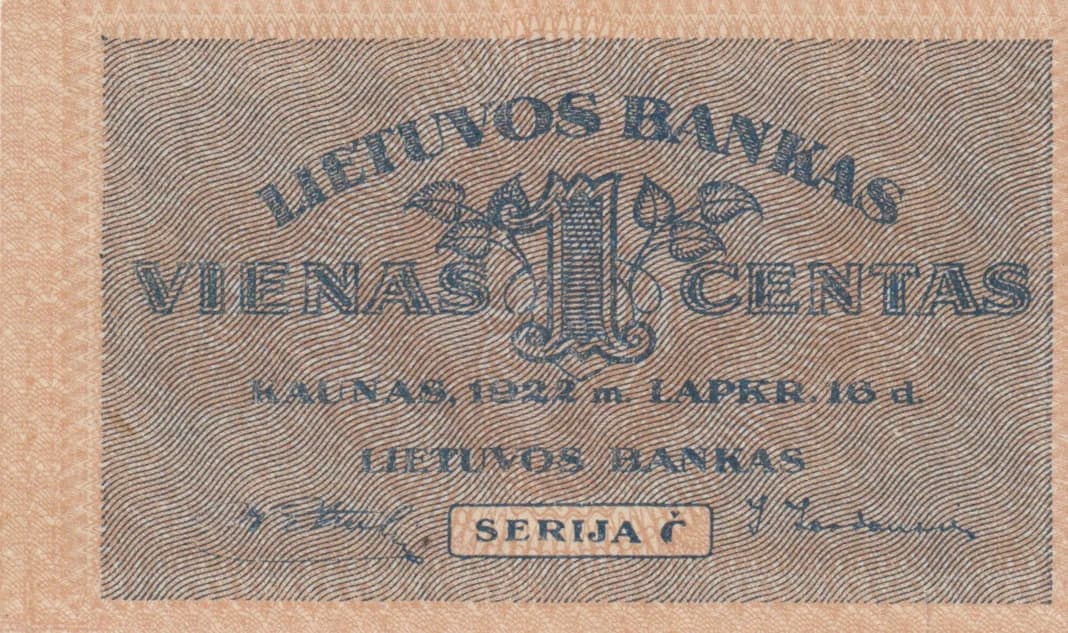
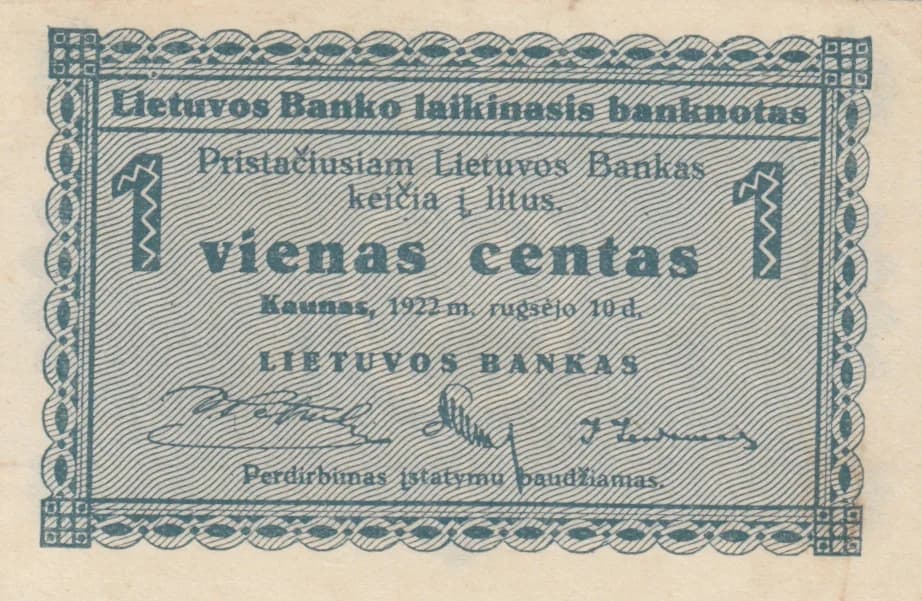
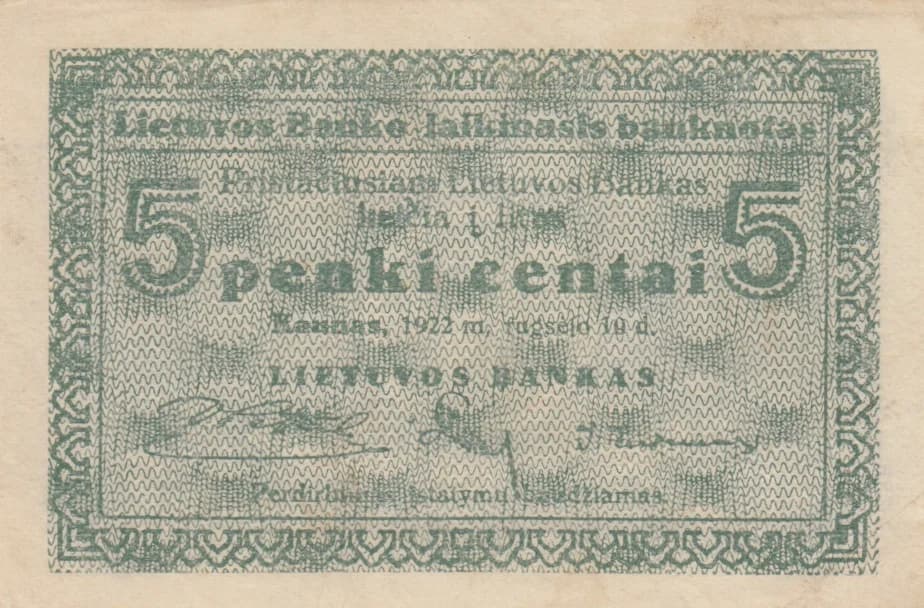
1 centas 1922
“serie O”
Market Prices
16 salesAbout This Note
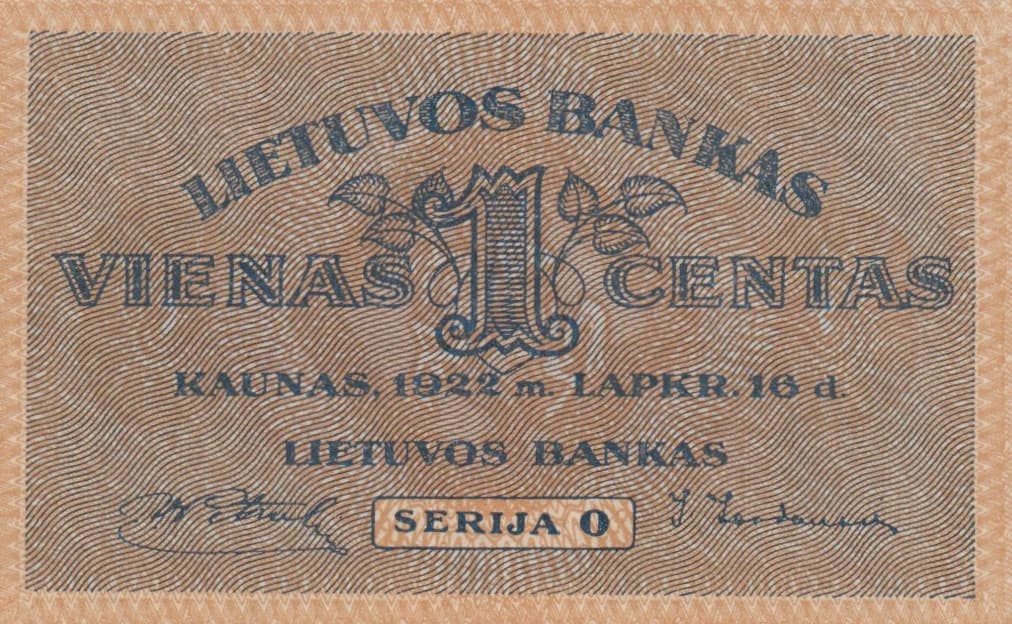
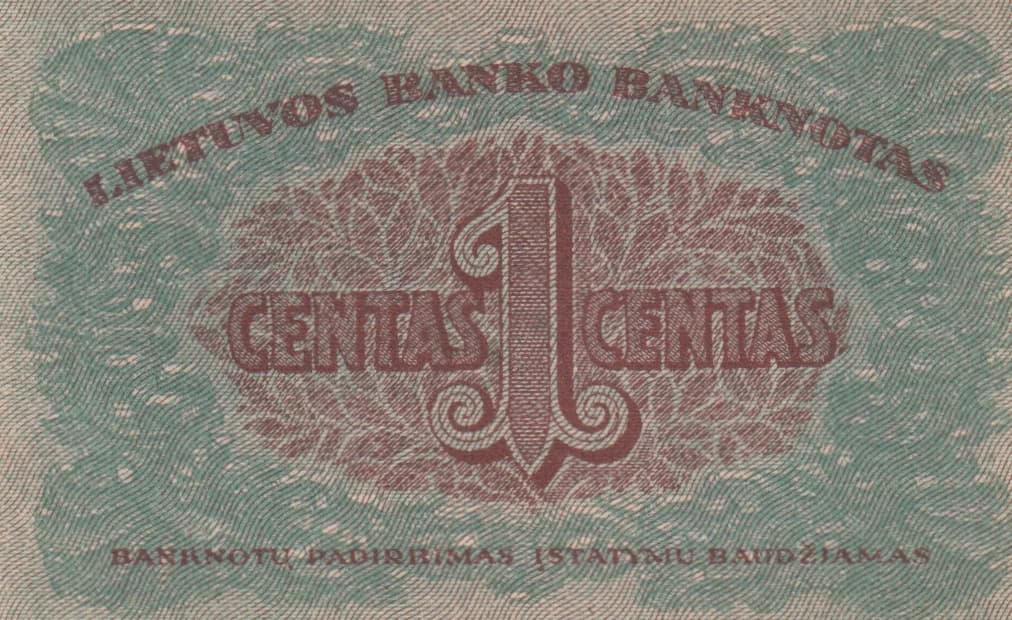
This is a spectacular example of Lithuania's first independent currency issue: a 1 Centas note from November 1922, graded UNC and from Series O. The note displays the characteristic dual-side design with ornamental numerals '1' framed by continuous wavy line security patterns, printed in contrasting color schemes (green and red/burgundy on front, tan/beige with blue-gray on back). In uncirculated condition with no wear, tears, or creases, this note represents an important artifact of Lithuania's brief interwar period of monetary independence.
Common. Despite being from Lithuania's early independence period, this 1 Centas denomination was issued in substantial quantities as it served as the lowest denomination for everyday transactions. eBay market data shows consistent sales ranging from $30-$177.50 depending on grade and grading service, with 2016 catalog values listing UNC at $70. The note's accessibility in the collector market, combined with relatively stable pricing and regular availability, confirms its common status. Even in UNC condition, the historical significance does not make it scarce—it remains an affordable entry point for collectors of early Lithuanian currency.
Issued by Lietuvos Bankas (Bank of Lithuania) on November 16, 1922, this note marks Lithuania's establishment of its own currency following independence from the Russian Empire. The denomination and design reflect the early, transitional phase of Lithuanian monetary policy, before the litas became the primary currency unit. The Kaunas date and issuer designation confirm this as an official central bank note during the formative years of the Lithuanian state.
This banknote features a symmetrical design centered on a large ornamental numeral '1' with elaborate decorative flourishes. The primary security feature is a continuous wavy line pattern that covers the entire background on both sides, creating a fine-line engraved texture. The front displays the numeral in red/burgundy against a green wavy line background, while the back presents it in a tan/beige field with blue-gray printed elements. The design is purely ornamental and numeric, with no portraits or architectural landmarks depicted. The multi-color printing and fine engraving techniques demonstrate the technical capabilities of the newly independent Lithuanian central bank.
Front side: 'LIETUVOS BANKO BANKNOTE' (Bank of Lithuania Note), 'CENTAS CENTAS' (Cent Cent), 'PASIRAŠĖ BANKO VALDYBOS PIRMININKAS' (Signed by the President of the Bank Board). Back side: 'LIETUVOS BANKAS' (Bank of Lithuania), 'VIENAS JI CENTAS' (One Cent), 'KAUNAS 1922 M LAPKRITIO D' (Kaunas 1922 November), 'SERIJA O' (Series O).
Intaglio engraving (line engraving) with multi-color letterpress printing. The continuous wavy line background pattern serves as both a design element and security feature, typical of early 20th-century European banknote production. The precise registration of the green and red/burgundy colors on the front, combined with the tan and blue-gray on the back, indicates professional security printing standards. The printer for P-7 is not definitively identified in available catalog data, though the technical quality suggests a reputable European security printer.
This note is catalogued as Pick P-7, Series O. The PMG Population Report identifies P-7a (1 Centas) as a distinct cataloging variant, suggesting possible minor design or printing differences across the full print run. The 'SERIJA O' (Series O) designation visible in the visual analysis indicates this is from the O series of the 1922 issue. No specific signature varieties, overprints, or notable serial number anomalies are evident from the visual analysis, though the series designation represents an identifiable variety marker within the broader P-7 issue.