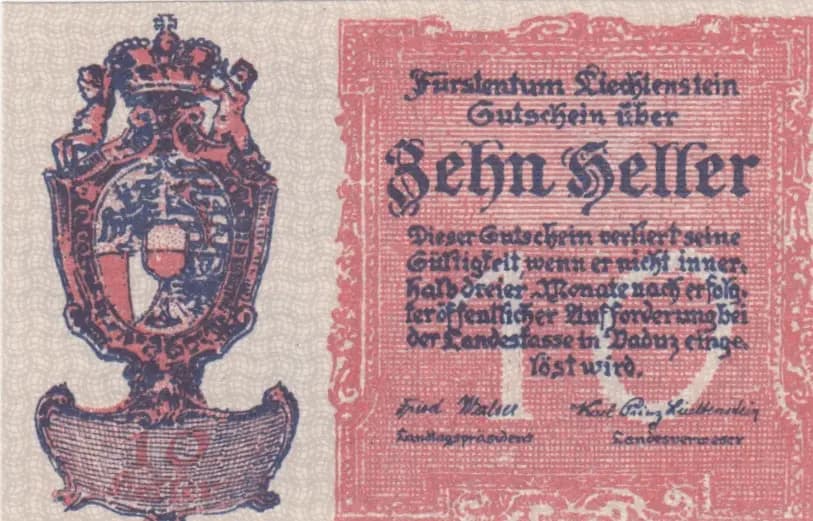
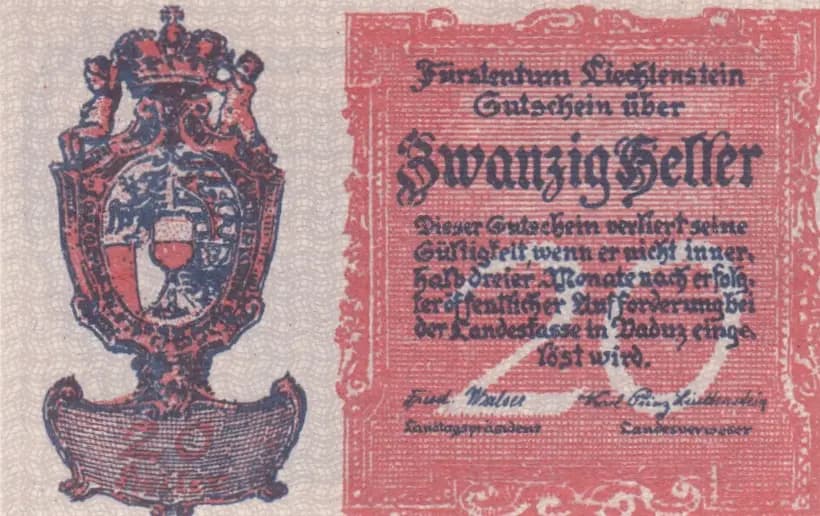
50 heller 1920
Market Prices
21 salesAbout This Note
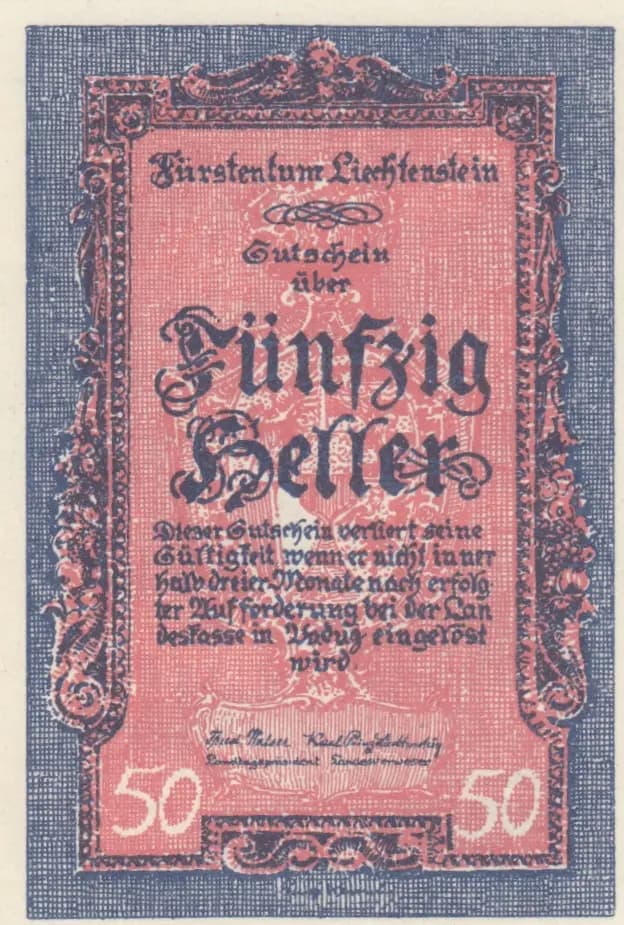
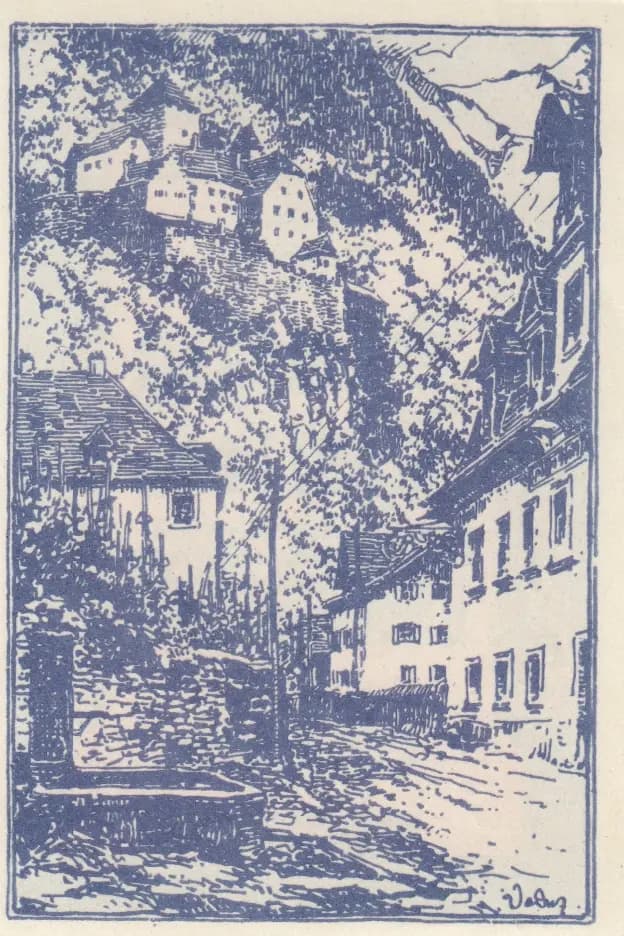
This 1920 Liechtenstein 50 Heller note is an ornately designed emergency currency voucher featuring an elaborate pink/salmon colored front with dark blue decorative borders and heraldic elements. The reverse displays a striking woodcut-style Alpine landscape depicting traditional chalets nestled in a mountain valley with dense forests, rendered in crisp navy ink. The note is presented in uncirculated condition with vibrant colors, sharp printing, and no visible wear or damage.
Common. The eBay price history shows consistent sales in the $15-$25 range for uncirculated examples from 2012-2024, with catalog values (as of 2016) listing UNC at $40. The regular circulation of sales data and stable pricing across a decade-long period indicates this is a frequently available note in the collector market. This represents a routine emergency issue from a small principality rather than a rare variant.
Issued during the early post-WWI period when Liechtenstein faced currency shortages following the dissolution of the Austro-Hungarian monetary union, this note represents the principality's transition to independent currency management. The Alpine landscape imagery on the reverse—showing the characteristic mountain villages and forests of the Liechtenstein/Swiss border region—reflects both the nation's geographic identity and its cultural connection to the Alpine world, while the ornate heraldic crown emphasizes the sovereign authority of the Fürstentum (Principality) during this period of monetary reorganization.
The obverse features the arms of Liechtenstein (represented by the decorative crown and heraldic elements at top center) integrated into an ornamental border design with Gothic-style lettering and symmetrical corner ornaments. The denomination '50' appears in both lower corners. The reverse depicts a detailed woodcut-style engraving of Vaduz Castle's surroundings—an Alpine mountain valley with traditional Liechtenstein chalets, dense coniferous forests on the steep mountainsides, and winding paths characteristic of the Rhine Valley settlement pattern. This landscape imagery serves as the identifying landmark for the note.
Front: 'Fürstentum Liechtenstein' (Principality of Liechtenstein), 'Gutschein' (Voucher/Certificate), 'Über' (For/Over), 'Fünfzig Heller' (Fifty Heller), '50' (numerical denomination). Back: 'K. Veiler' (artist signature, likely referring to the Alpine landscape engraver).
Letterpress and engraved/woodcut composite technique. The front denomination, text, and border ornaments appear to be produced via letterpress with blue and pink color separation printing. The reverse landscape is rendered as a fine-line engraving or woodcut suitable for banknote production, consistent with early 20th-century European emergency currency production standards.
Pick P-3 represents a single cataloged variant for the 50 Heller 1920 issue. No serial number variations, date variants, or printer marks are discernible from the visual analysis. The artist signature 'K. Veiler' on the reverse may represent a single engraver responsible for the landscape design. No overprints or secondary printings are evident in the uncirculated example observed.