50 livres 1964 specimen
Market Prices
3 salesAbout This Note
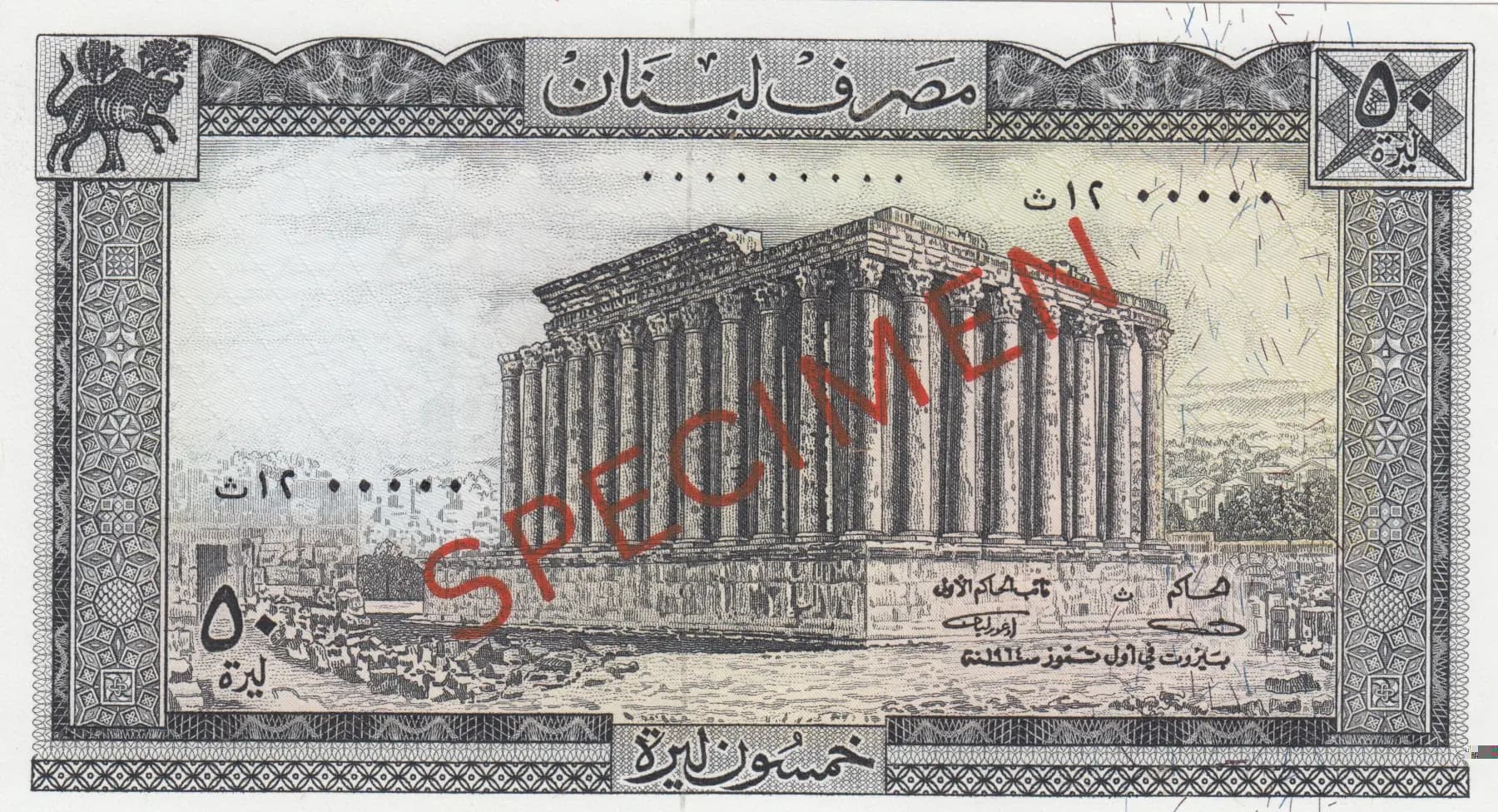
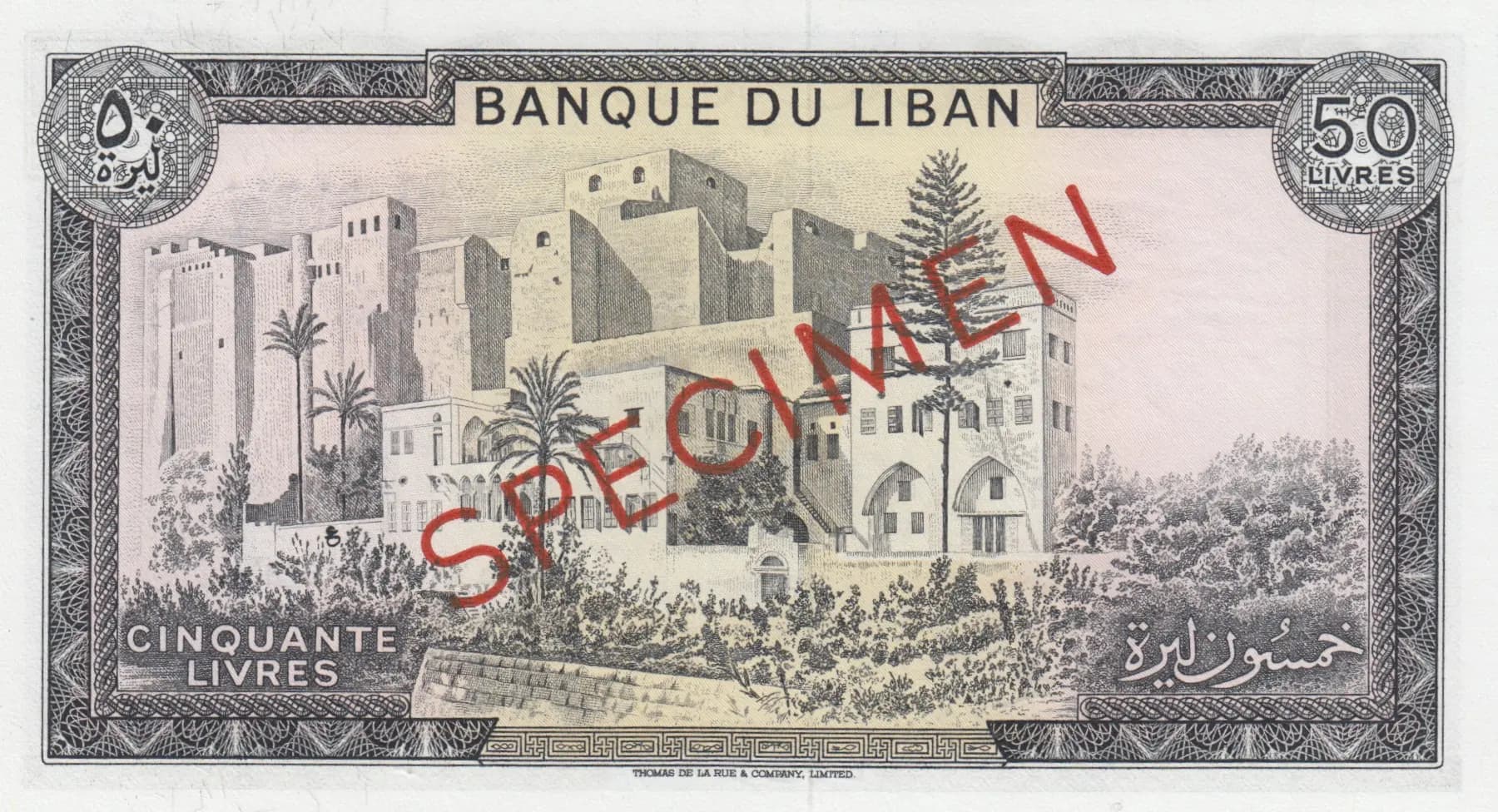
This is a Lebanese 50 Livres specimen banknote from 1964, issued by Banque du Liban and printed by Thomas de la Rue in London. The note features exceptional engraved designs on both sides—the Temple of Bacchus at Baalbek on the obverse and the St. Gilles citadel of Tripoli on the reverse—rendered in fine line work with gray, purple, and olive-green inks on a multicolored underprint. As a specimen note with the prominent red 'SPECIMEN' overprint, this represents an uncirculated piece with minimal handling, displaying only light foxing consistent with age, making it a desirable example for collectors of Lebanese currency and architectural numismatics.
Common. While this is a specimen note from 1964, the eBay price data provided shows UNC examples selling for $255 in 2015 and PMG-graded specimens (PMG 50, PMG 67) selling for $113.50–$237.06 in 2018. These moderate price points and the presence of multiple sales indicate this is a regularly available specimen note in the collector market. Specimen notes from major security printers like Thomas de la Rue are typically produced in larger quantities for distribution to banks and collectors, and Lebanese 50 Livres notes from the 1964–1988 series were printed in substantial numbers. No evidence of scarcity, short print runs, or recall status exists.
This 1964 specimen represents Lebanon's mid-20th century banking modernization under Banque du Liban, with imagery celebrating the nation's rich classical and medieval heritage. The Temple of Bacchus at Baalbek, depicted on the obverse, is one of the best-preserved Roman temples in the world and symbolized Lebanon's connection to Greco-Roman civilization. The reverse features St. Gilles citadel in Tripoli, representing the country's Crusader-era fortifications, while the cedar tree watermark and design element underscore the national symbol of Lebanon, reflecting post-independence pride in cultural identity.
The obverse features a classical architectural centerpiece: the Temple of Bacchus (Baalbek), a well-preserved Greco-Roman structure characterized by multiple tall Corinthian columns, rendered in fine engraving with a cityscape backdrop. A winged lion symbol appears in the upper left corner, representing Lebanese heraldry. The reverse depicts the St. Gilles citadel of Tripoli, a medieval Crusader fortress with distinctive crenellated towers and integrated residential structures on landscaped terrain. A prominent cedar tree on the right side of the fortress serves as both architectural framing and national symbol. Both sides are framed by ornate decorative borders featuring geometric Islamic patterns and corner ornamental designs. The color scheme employs dark gray, purple, dark olive-green, black, and cream tones, with the red SPECIMEN overprint applied diagonally across both faces.
OBVERSE: مصرف لبنان (Masraf Lubnan) = 'Bank of Lebanon'; خمسون لبنانية (Khamsun Lubnaniya) = 'Fifty Lebanese'; ٥٠ (Arabic numeral 50); ٢٠٠.٠٠ ليرة (200.00 Lira) [Note: visual analysis shows conflicting denomination text]; SPECIMEN (English overprint). REVERSE: BANQUE DU LIBAN = 'Bank of Lebanon' (French); CINQUANTE LIVRES = 'Fifty Livres' (French); 50 LIVRES (French); خمسون لبنانية (Khamsun Lubnaniya) = 'Fifty Lebanese' (Arabic); ٥٠ (Arabic numeral 50); THOMAS DE LA RUE & COMPANY, LIMITED = Printer attribution (English); SPECIMEN (English overprint).
Intaglio (line engraving) process, as evidenced by the fine line work, intricate border patterns, and precise architectural detail visible in both the temple columns and fortress structures. Thomas de la Rue & Company, Limited, London—one of the world's premier security printers—executed the design. The multicolored underprint, geometric border patterns, and ornamental corner designs indicate multiple-color intaglio printing with precise registration. The watermark feature (cedar tree) was incorporated during the papermaking process.
This is identified as a specimen note (Pick 65s) rather than a circulation issue (Pick 65), distinguishing it by the red SPECIMEN overprint applied during production. The visual analysis does not reveal visible signatures or serial numbers that would identify further varieties. As a specimen from the 1964 issue, it belongs to the first year of the 1964–1988 series. No other varieties (such as different signature combinations or serial number prefixes) are evident from the provided images; specimen notes typically do not carry serial numbers or are marked with specimen-specific numbering.