5 livres 1957
Market Prices
7 salesAbout This Note
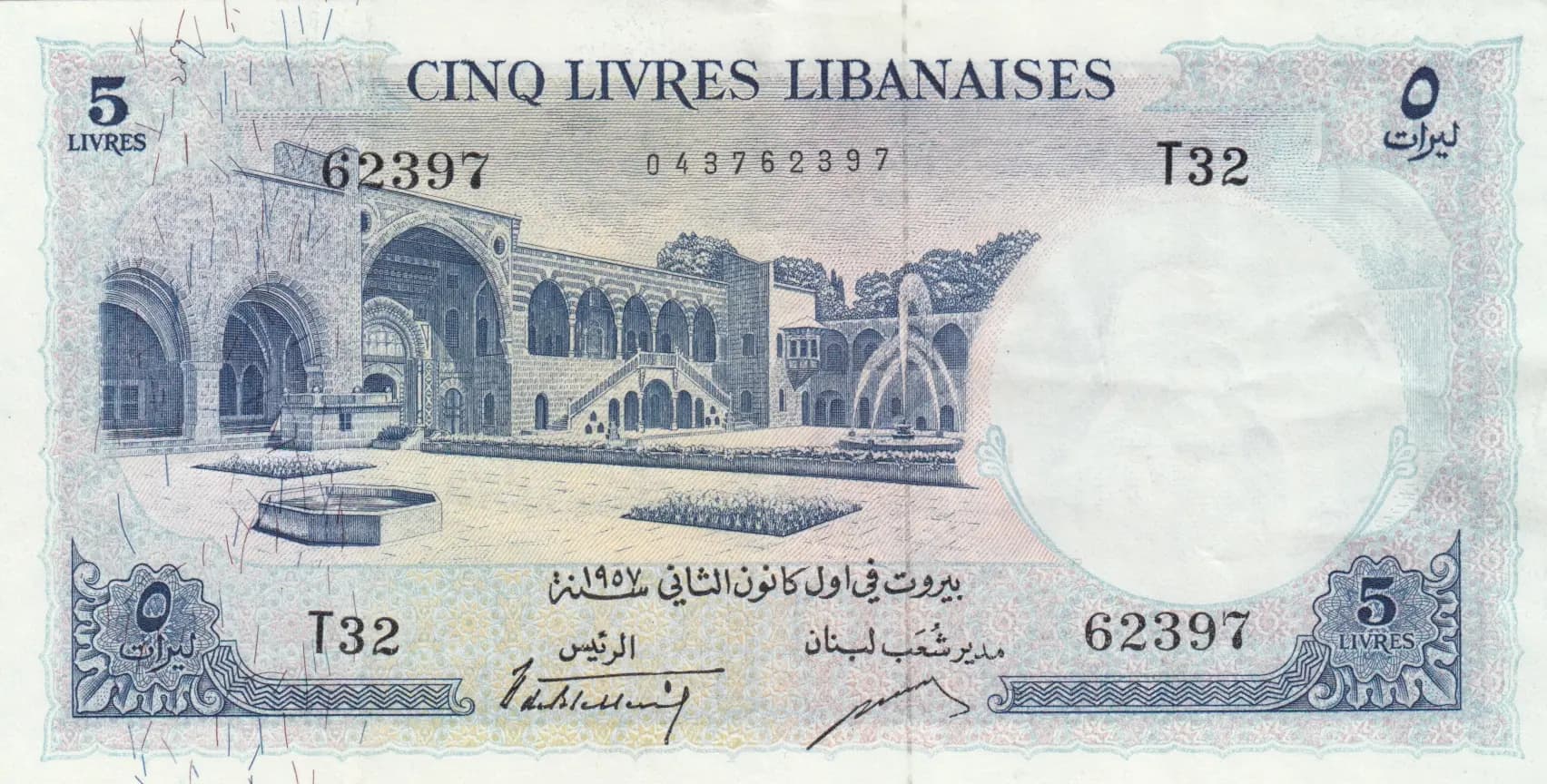
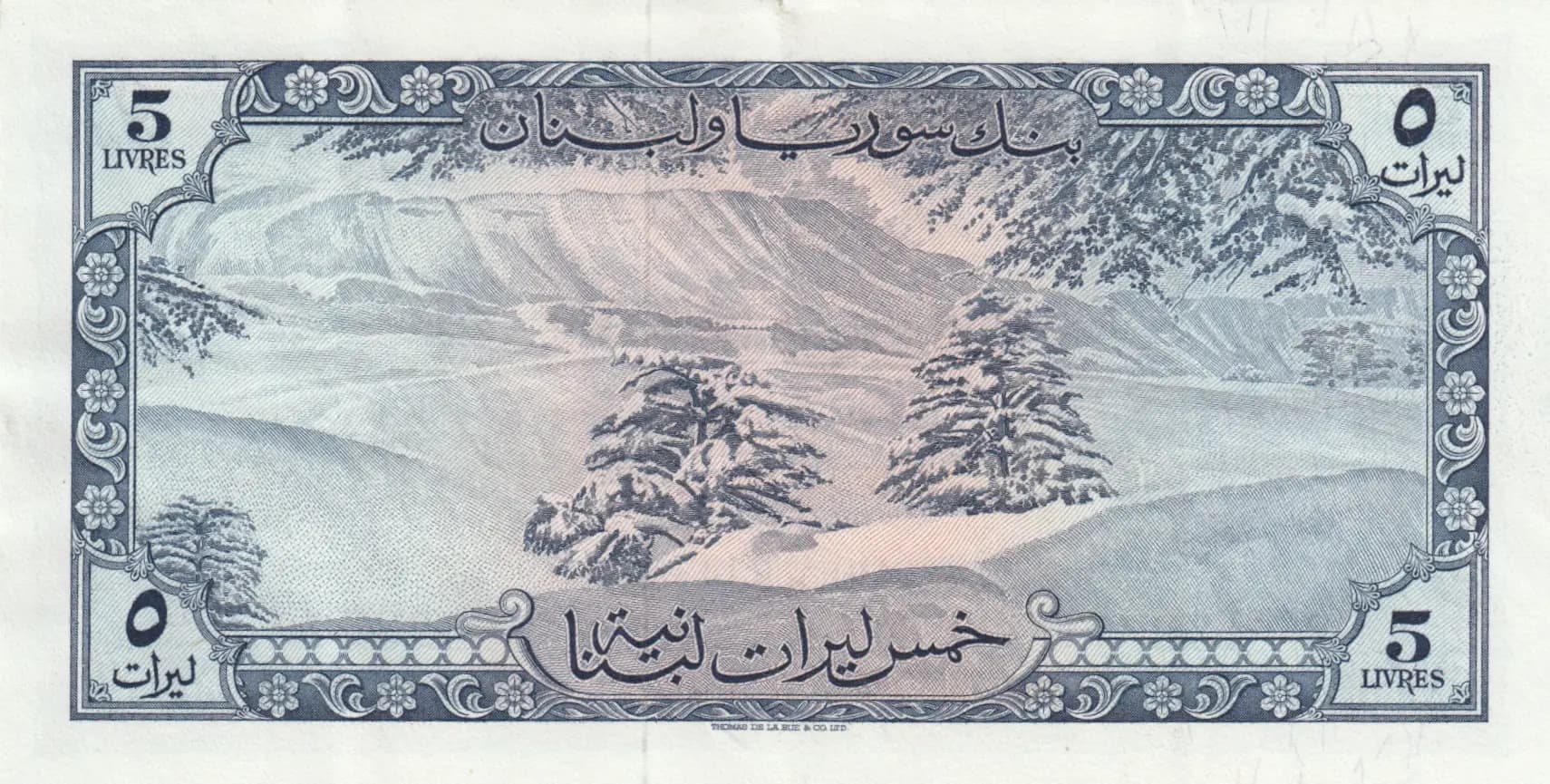
This 1957 Lebanese 5 Livres note (P-56a) showcases exceptional engraving work featuring the iconic Palais Beit-ed-Din courtyard on the obverse and Lebanon's legendary cedar forests on the reverse. In VF condition, the note displays expected circulation wear including creases and minor marking, yet retains crisp detail in the architectural and landscape vignettes. The dual-language (French/Arabic) inscriptions and multicolored blue-purple palette are characteristic of this mid-20th century issue from the Banque de Syrie et du Liban.
Common. The eBay price tracking data shows consistent sales activity across multiple grades (F and VF specimens) with prices ranging from $13.50 to $57.18 over a decade-long period. The 1952-1964 circulation period was lengthy, suggesting substantial print runs. VF specimens achieved approximately $45-57 in the secondary market (2010-2020 era), which is moderate for mid-20th century foreign currency. No documented print run restrictions, recalls, or supply constraints are known for P-56a.
Issued during a transitional period in Lebanon's monetary history (1952-1964), this note reflects the country's French colonial heritage through its bilingual design and reflects Lebanese national identity through its iconic imagery. The Palais Beit-ed-Din, a historically significant Ottoman-era palace, and the cedar trees—Lebanon's national symbol—dominate the design, emphasizing cultural pride and natural heritage. The 1957 date coincides with Lebanon's consolidation as an independent nation, making these notes symbols of post-independence sovereignty.
The obverse features a detailed engraved vignette of the Palais Beit-ed-Din (Palace of Beit-ed-Din), a restored Ottoman-era palace in the Chouf Mountains. The architectural rendering depicts an elaborate courtyard with characteristic Islamic arches, columns, and geometric patterns, including a decorative fountain or water feature in the foreground. The reverse depicts a scenic Alpine landscape representing Lebanon's cedar forests with snow-covered evergreen trees in the foreground and mountain peaks in the distant background, embodying the nation's natural treasures. Ornate floral corner decorations and guilloché border patterns frame both sides in the Art Deco style typical of Thomas de la Rue and Perkins Bacon productions.
FRONT: 'CINQ LIVRES LIBANAISES' (Five Lebanese Livres in French); '5' and 'LIVRES' (denomination markers); 'لبرات' (Livres in Arabic); 'بيروت في اول كانونالثاني سنة١٩٥٧' (Beirut on the 1st of January 1957); 'مديرشؤون لبنان' (Bank of Lebanon); 'الرئيس' (President); Serial numbers: '043762397' and '62397'; Printer mark 'T32'. BACK: '5' and 'LIVRES' (denomination in French); 'لبرات' (Livres in Arabic); 'خشرات لبنان' (Treasures/Resources of Lebanon); 'PERKINS BACON & CO LTD' (printer attribution).
Intaglio (engraved) process, executed by Thomas de la Rue, London, with back printing attributed to Perkins Bacon & Co Ltd. The visual evidence—fine line work, complex guilloché patterns, detailed topographical shading, and precise color registration—confirms traditional steel plate engraving technology. The intricate architectural details and landscape rendering could only be achieved through this labor-intensive method, characteristic of high-security banknote production in the 1950s.
This note is identified as Pick P-56a, which represents the standard variety with TDLR (Thomas de la Rue, London) printing. The PMG population report indicates three catalogued variants exist: P-56a, P-56b, and P-56s (specimen). The visual analysis confirms this is P-56a based on the printer attribution and design characteristics. The serial number prefix 'T32' observed on this specimen may indicate a specific printing batch or series, though this requires further research against period documentation. No overprints, signature variations, or other distinguishing features indicating a special issue are visible.