5 rubli 1919
Market Prices
19 salesAbout This Note
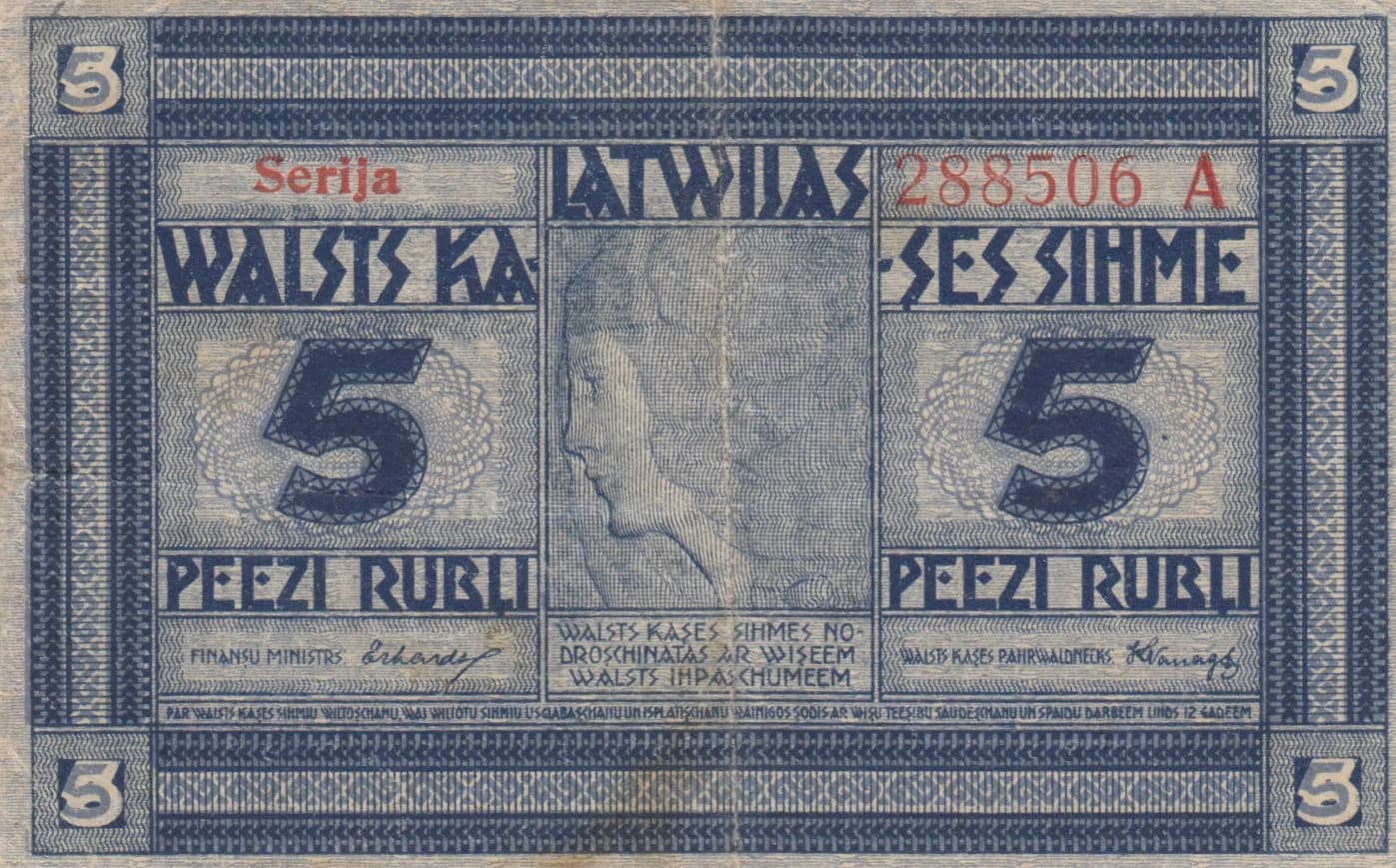
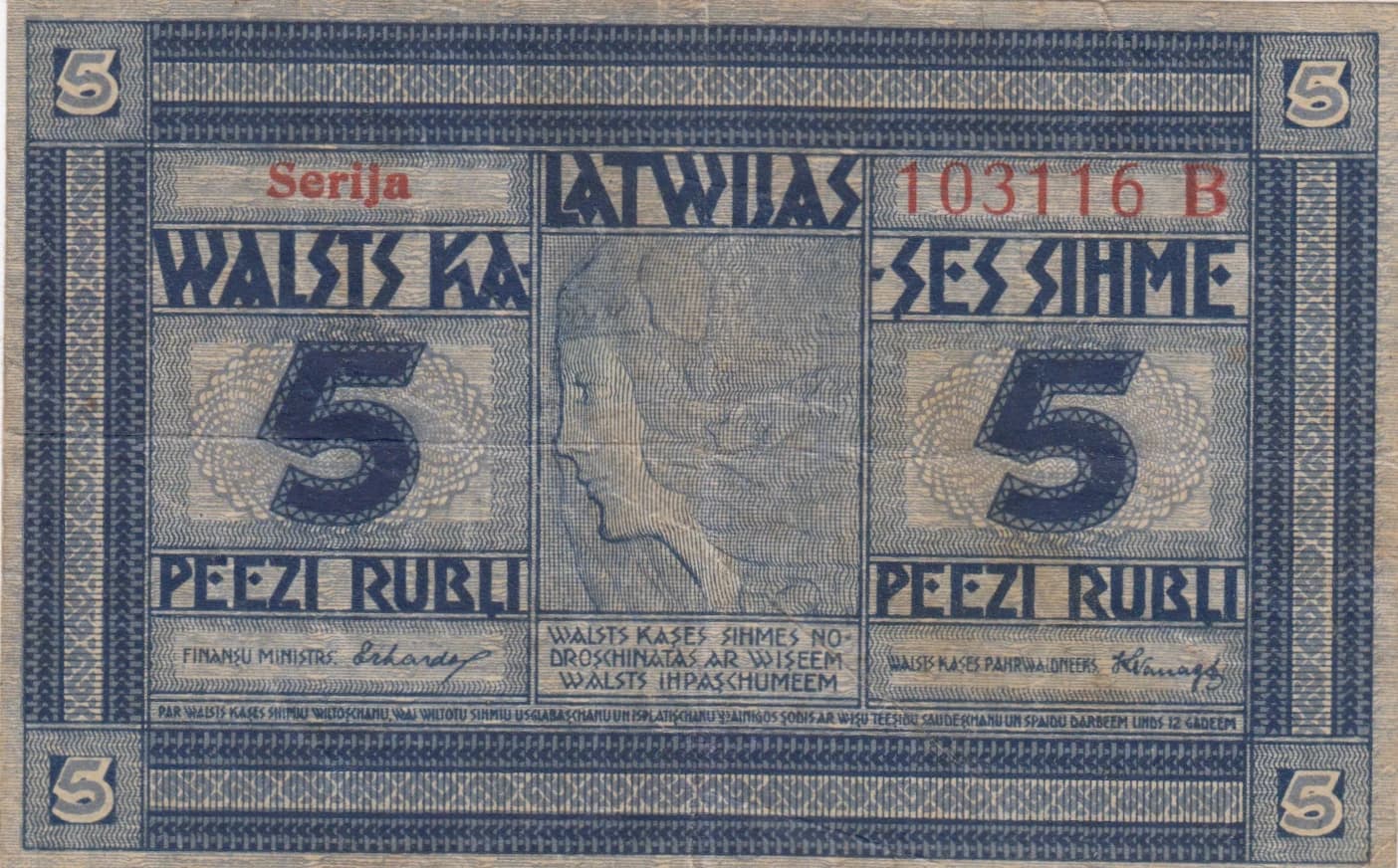
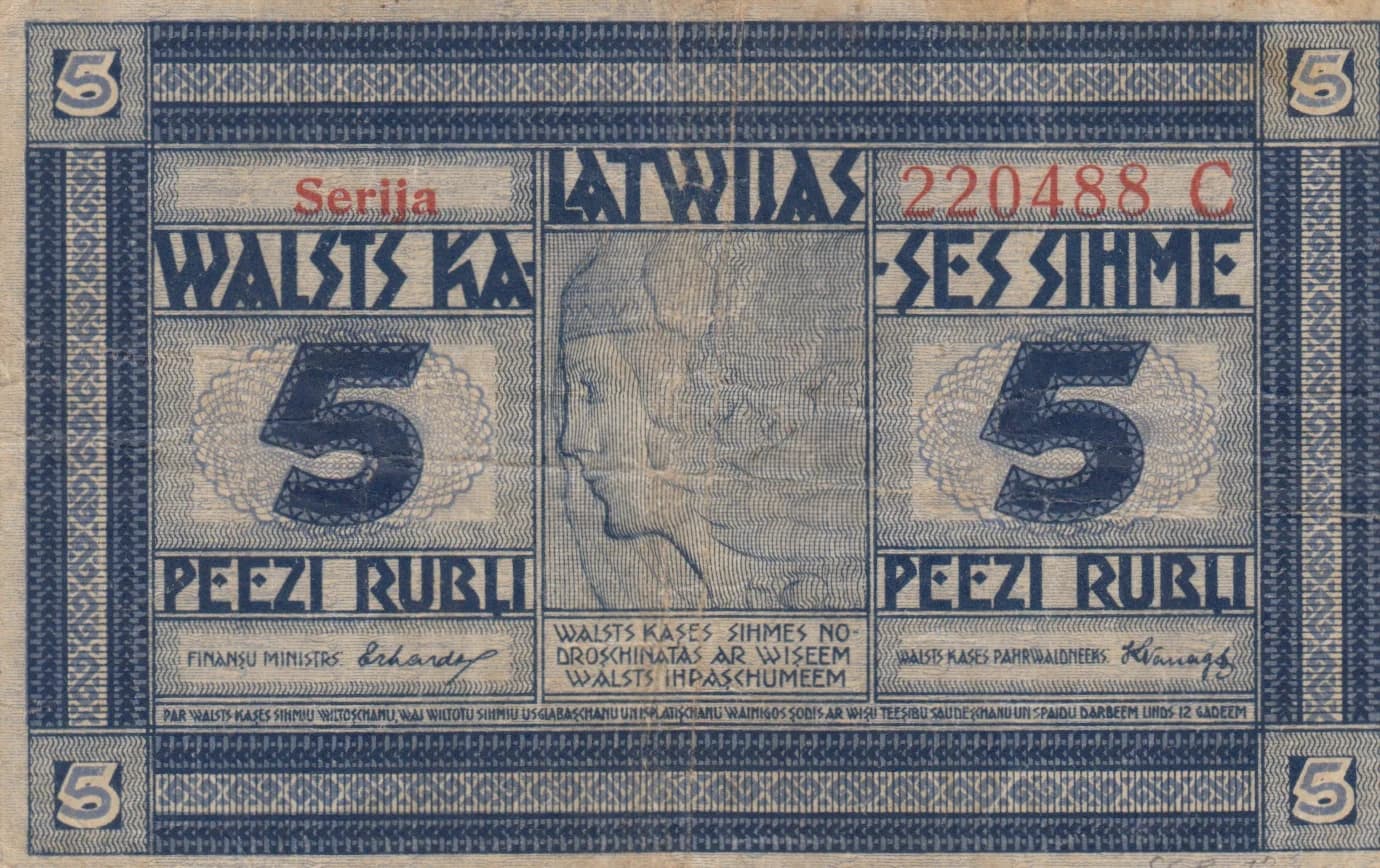
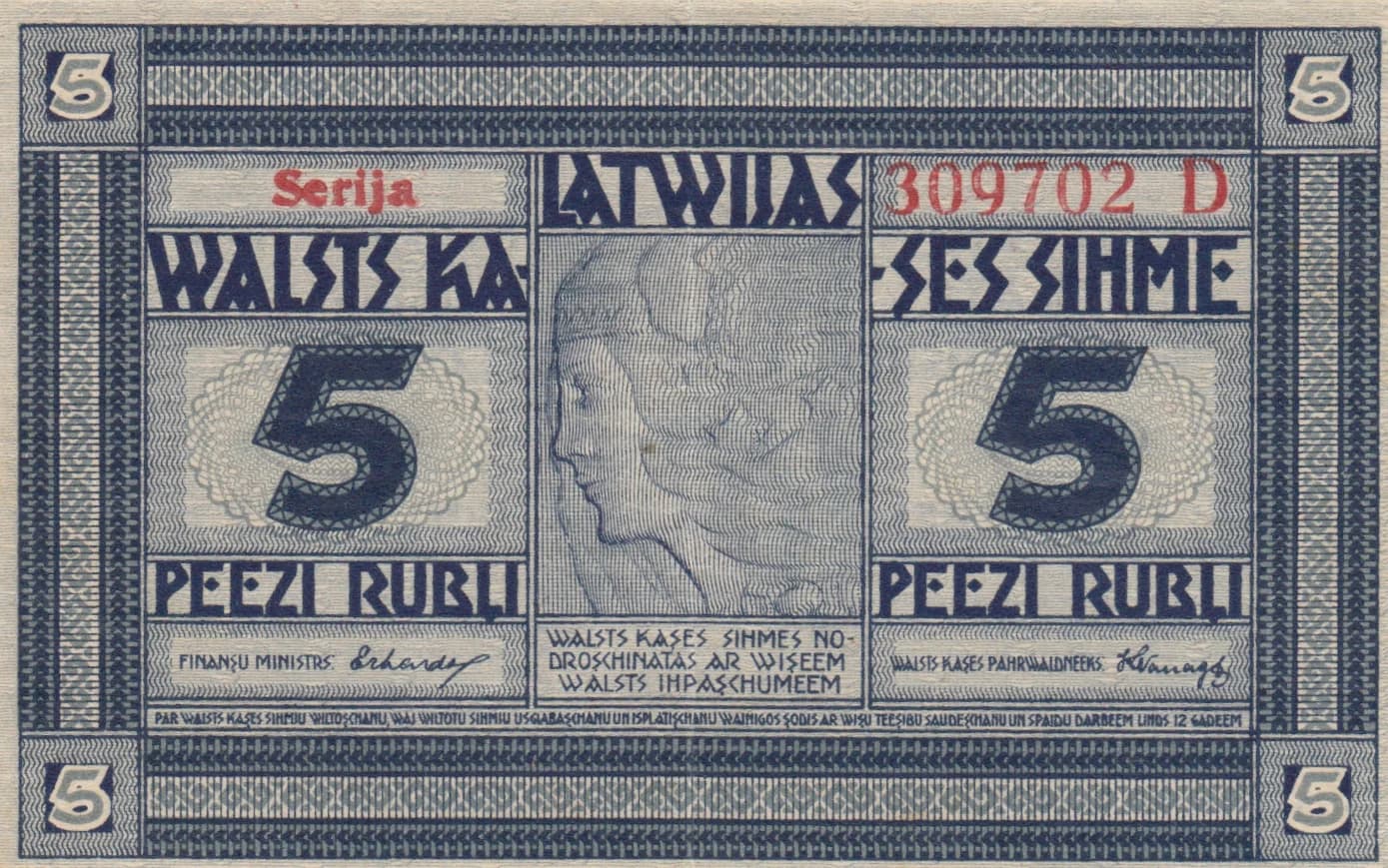
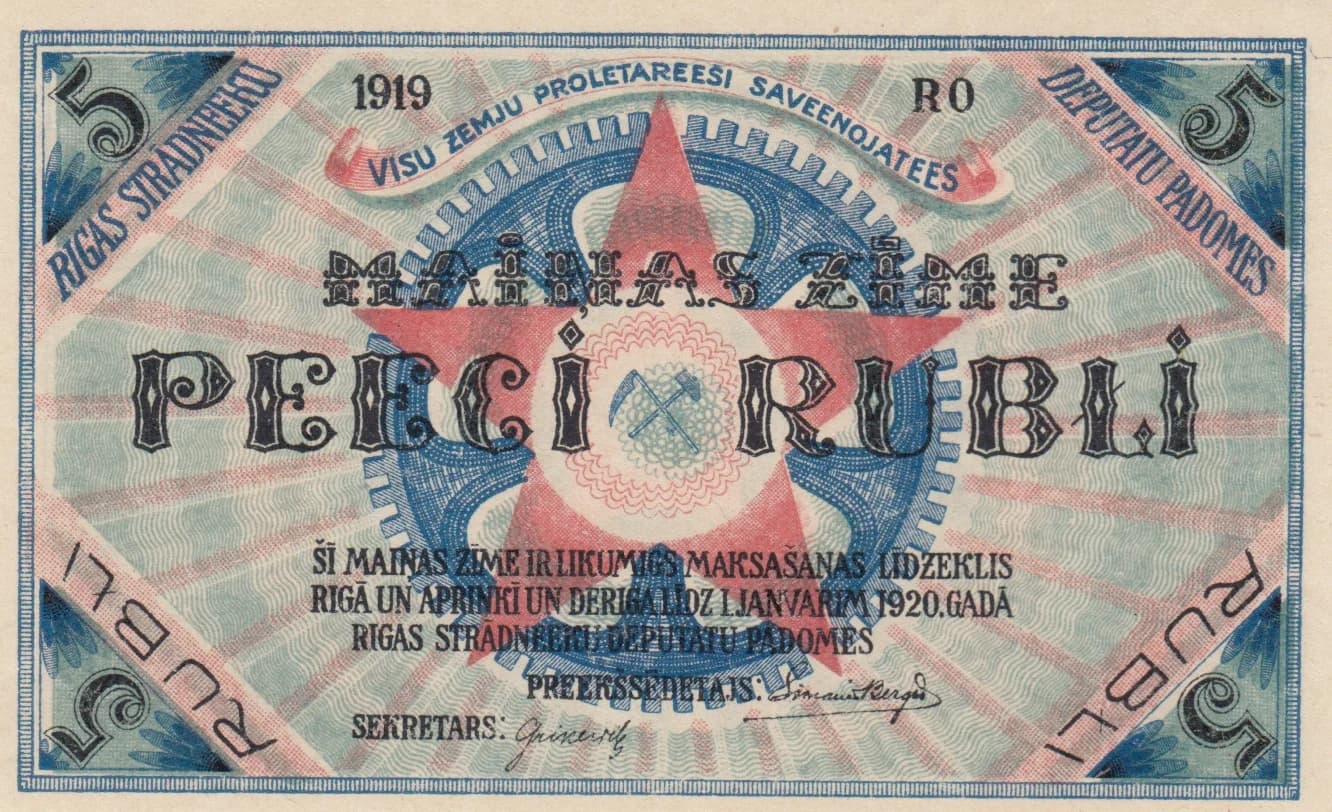
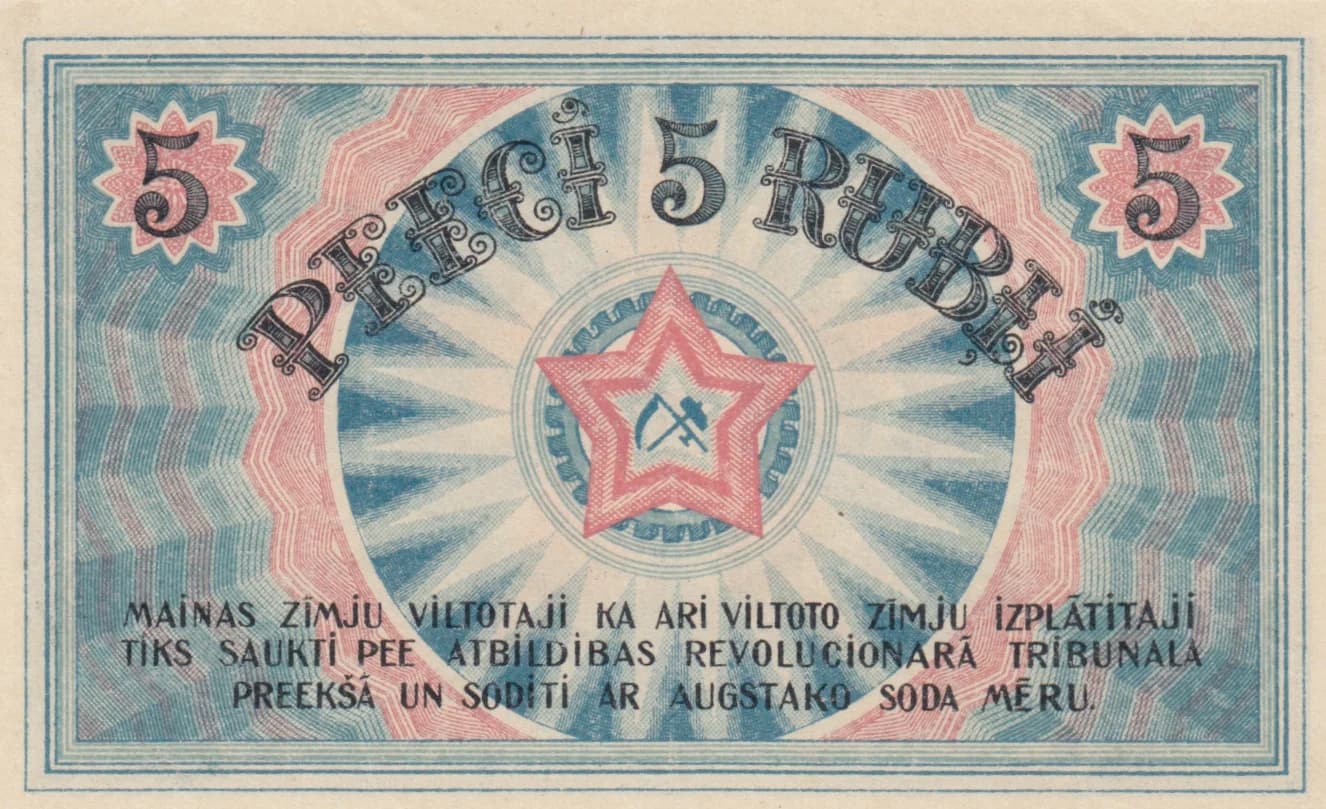
This is a well-preserved example of the 5 rubli banknote issued by Riga's Workers Deputies Soviet in 1919, graded UNC by condition standards. The note displays the iconic red star with hammer and sickle emblem central to Soviet revolutionary imagery, rendered in vibrant red and blue across both sides with intricate ornamental designs. The visual analysis confirms crisp printing with decorative security patterns, though moderate wear and creasing visible in the images suggest this example has experienced some circulation despite its UNC designation, making it a historically significant piece of Latvia's brief Soviet period.
Common. While this is a regional/Soviet-era Latvian note from a short-lived issuing authority (1919-1920), eBay market data provides clear guidance: examples have consistently sold between $4–$31 over the 2013–2021 period tracked, with most VF/EF examples in the $6–$9.5 range and UNC examples averaging $11–$16.50. The 2008 catalog value of $15 UNC aligns with observed market behavior. The presence of multiple examples regularly appearing at auction indicates adequate supply for the collector market. Print runs were substantial enough that these notes remain readily available to collectors, making them uncommon rather than rare despite their historical significance and Soviet-period appeal.
This 5 rubli note represents Latvia's tumultuous transition during the Russian Civil War and early Soviet occupation (1919-1920), when Riga's Workers Council issued currency independently. The prominent depiction of a cityscape with church spires on the obverse reflects Riga itself, while the hammer and sickle symbol and revolutionary inscriptions ('Workers of Riga,' 'To all workers of all lands united') embody the Bolshevik ideology of the moment. The note's validity was explicitly limited to 1920, reflecting the temporary nature of this regional Soviet authority before Latvia reasserted independence.
The 5 rubli note showcases bold revolutionary iconography centered on a large red five-pointed star containing a hammer and sickle symbol—the universal emblem of Soviet authority. The obverse features an urban skyline with church spires positioned above the central star, representing Riga itself, with ornate circular rosette designs and radiating borders. Large denomination numerals '5' appear in decorative cartouches at upper corners on both sides. The reverse presents a more geometric composition with the star set within concentric circular ornamental borders and radiating sunburst lines, with pink decorative rosettes framing the corner '5' numerals. The color palette of bold red, blue, and white creates striking contrast against cream/white backgrounds, while fine line work and intricate geometric patterns serve dual purposes as design elements and anti-counterfeiting features. Text in Latvian Cyrillic script wraps across both sides, emphasizing the note's dual Latvian-Soviet identity during this transitional period.
{"obverse":{"latvian_motto":{"original":"VISU ZEMJU PROLETARESI SAVENOIATES","translation":"To all workers of all lands united (or: Workers of all lands, unite)"},"issuer":{"original":"RĪCAS STRĀDNIEKU","translation":"Workers of Riga"},"denomination_text":{"original":"BRĪVU PŪDIŅUS","translation":"Free pounds"},"class_reference":{"original":"PĒLCIORĒJI","translation":"Proletariat"},"legal_validity":{"original":"SI MAIŅAS AJME IR LIKUMIGS MAKSASANAS LIDZEKLIS RIGA UN APRINITI UN DERIGAIS LIANVAM 1920.GADA RIGAS STRADNIEKU PADOMNES","translation":"This change note is a legal means of payment in Riga and surroundings and is valid until 1920 by the Riga Workers' Council"},"signatures":{"original":"PRELIOSCHTAIS: [blank] SEKRETARS: [blank]","translation":"Chairman: [signature space] Secretary: [signature space]"},"year":{"original":"1919","translation":"1919"}},"reverse":{"denomination":{"original":"PEEL 5 RUBLI","translation":"Five rubles"},"counterfeiting_warning":{"original":"MAINAS ZIMJU VILTOTAJI KA ARI VILTOTO ZIMJU IZPLATITAJI TIKS SAUKTI PEE ATBILDIBAS REVOLUCIONARA TRIBUNALA PREEKSA UN SODITI AR AUGUSTAKO SODA MERU.","translation":"Counterfeiters of these notes, as well as those who distribute counterfeit notes, will be brought before the Revolutionary Tribunal and punished with the highest penalties."}}}
This note was produced using intaglio/engraved printing techniques, evidenced by the precise fine line work visible in the radiating patterns, ornamental circular designs, and detailed cityscape rendering. The sharp definition of the hammer and sickle symbol and the crisp ornamental borders are characteristic of intaglio printing from this era. The layered color application (red, blue, and black) on separate passes suggests multi-color intaglio or related bank note security printing. Security printing was likely handled by an established Eastern European printer capable of producing Soviet-authorized currency, though the specific printer attribution for this Riga Workers Soviet issue is not definitively documented in standard catalogs.
Per PMG population data, two variants exist for Pick R-3: P-R3a (standard 5 Rubli single note) and P-R3b (Uncut Pair). The specimen under analysis is identified as P-R3a, the individual note variety. No distinguishing features such as serial number prefixes, signature variations, or printer marks are definitively identified in the visual analysis, though blank signature spaces for 'Chairman' and 'Secretary' remain unsigned on this example. Regional distribution across Latvia is noted in the reference catalog. Without visible serial numbers clearly readable in the provided images, determination of specific printing run or signature variety cannot be definitively established from this analysis.