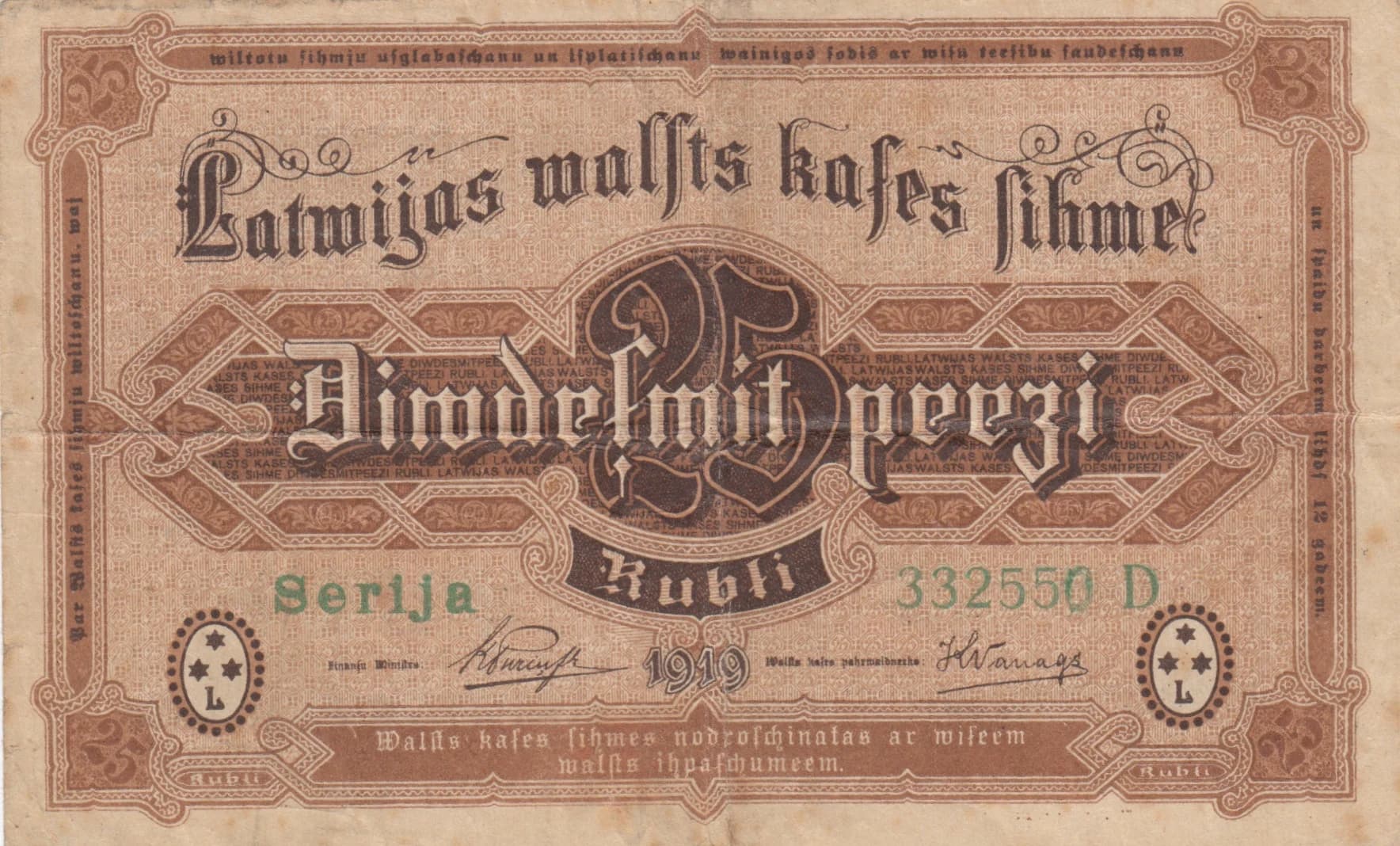
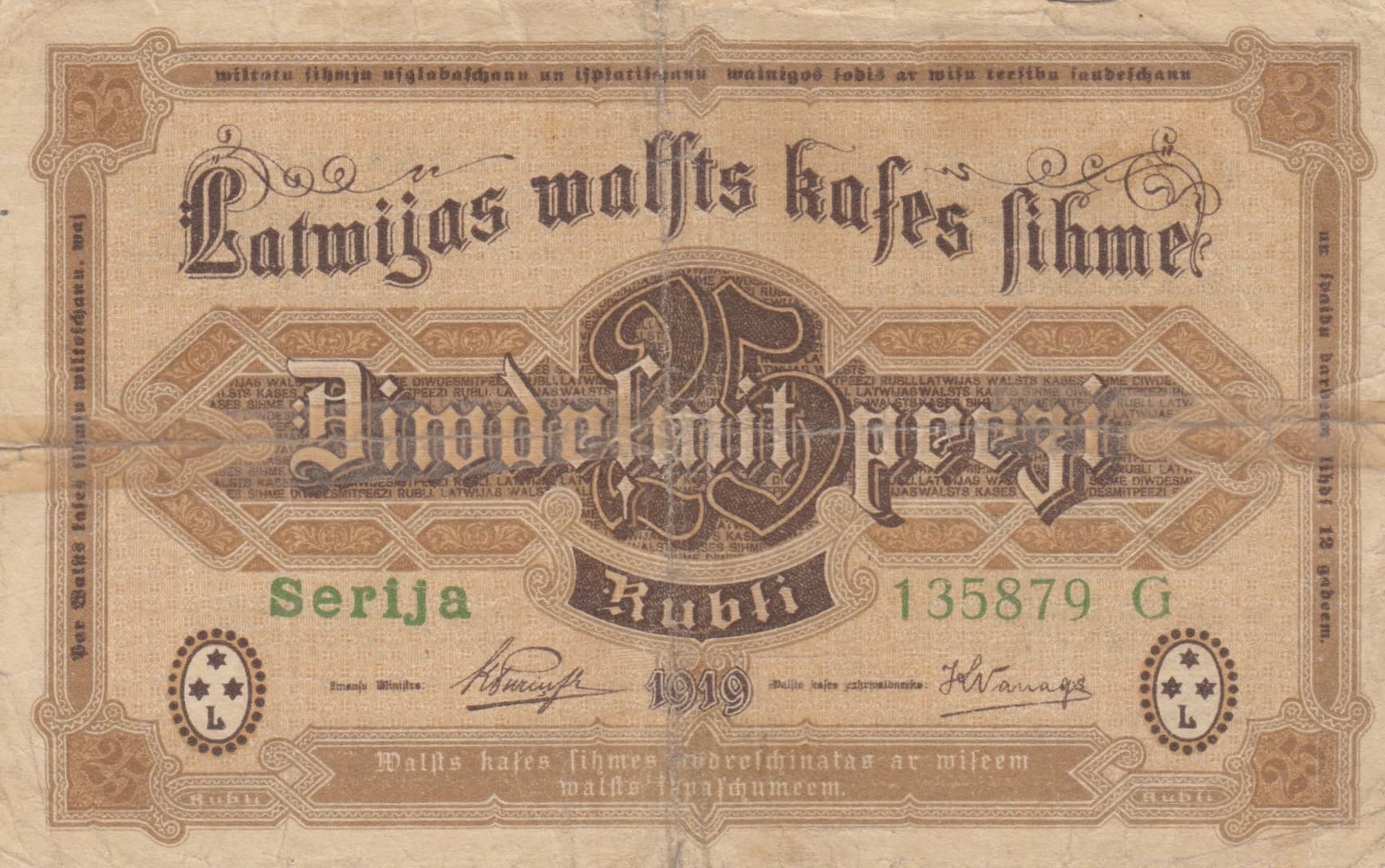
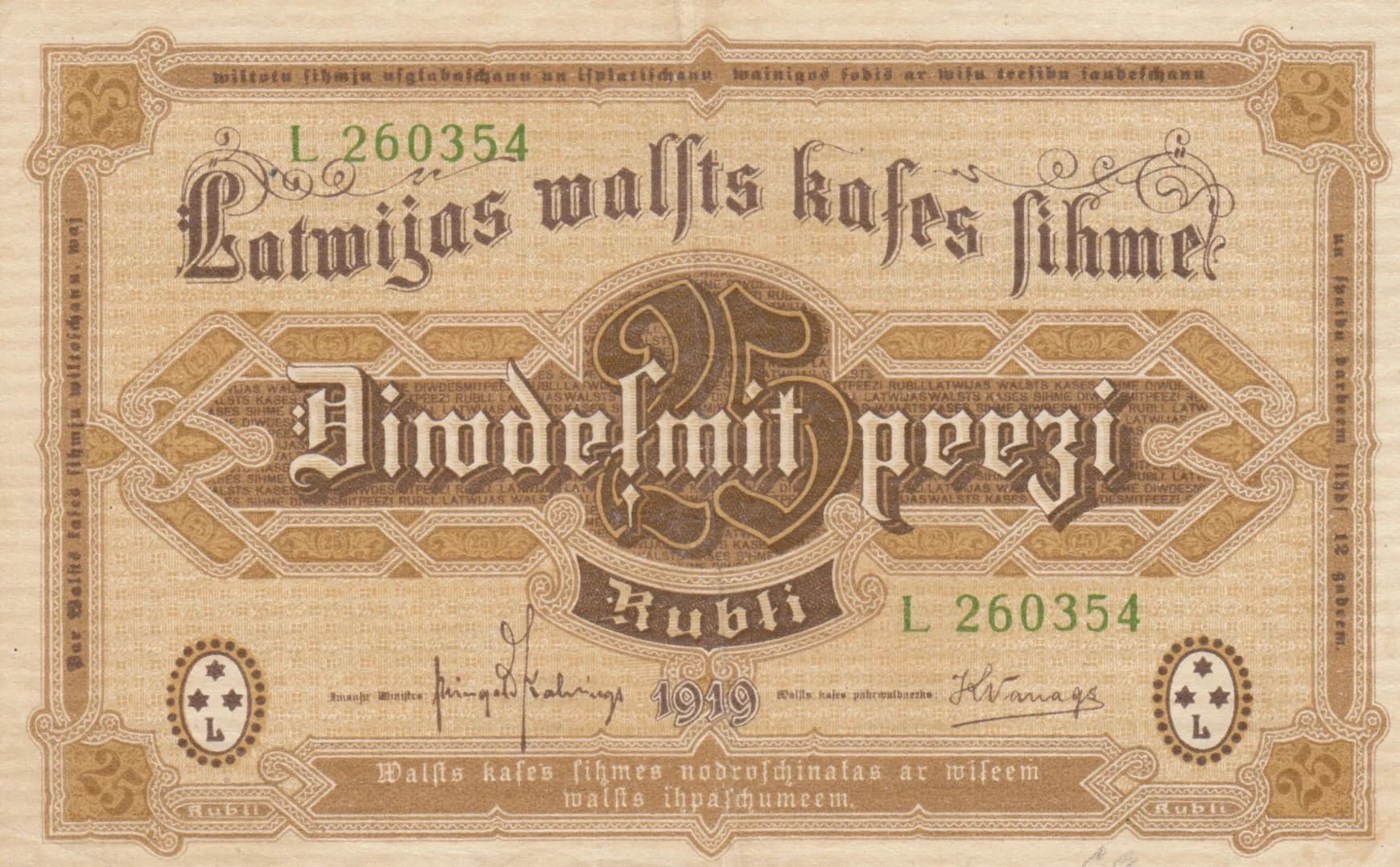
25 rubli 1919
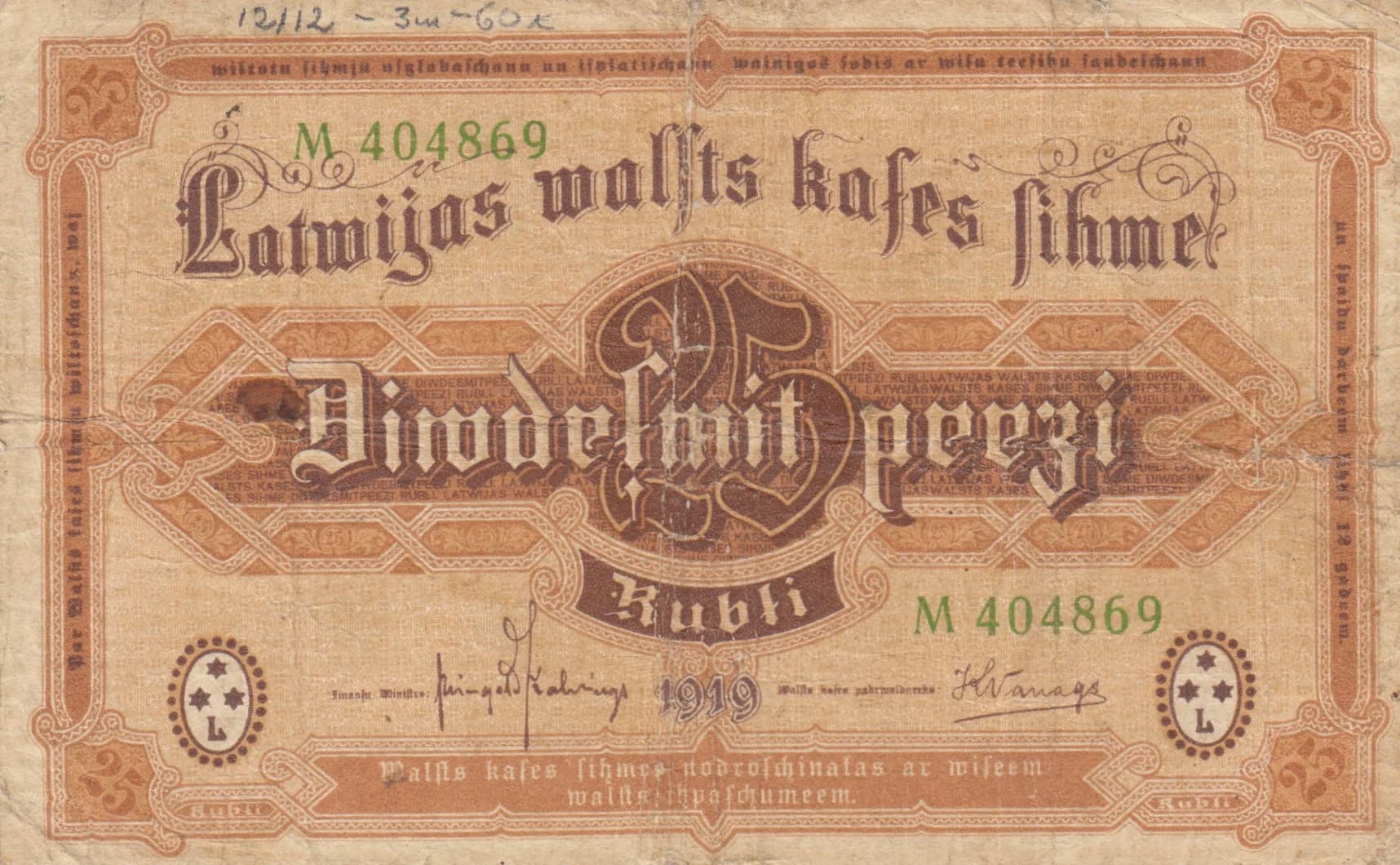
“serie M”
Market Prices
8 salesAbout This Note
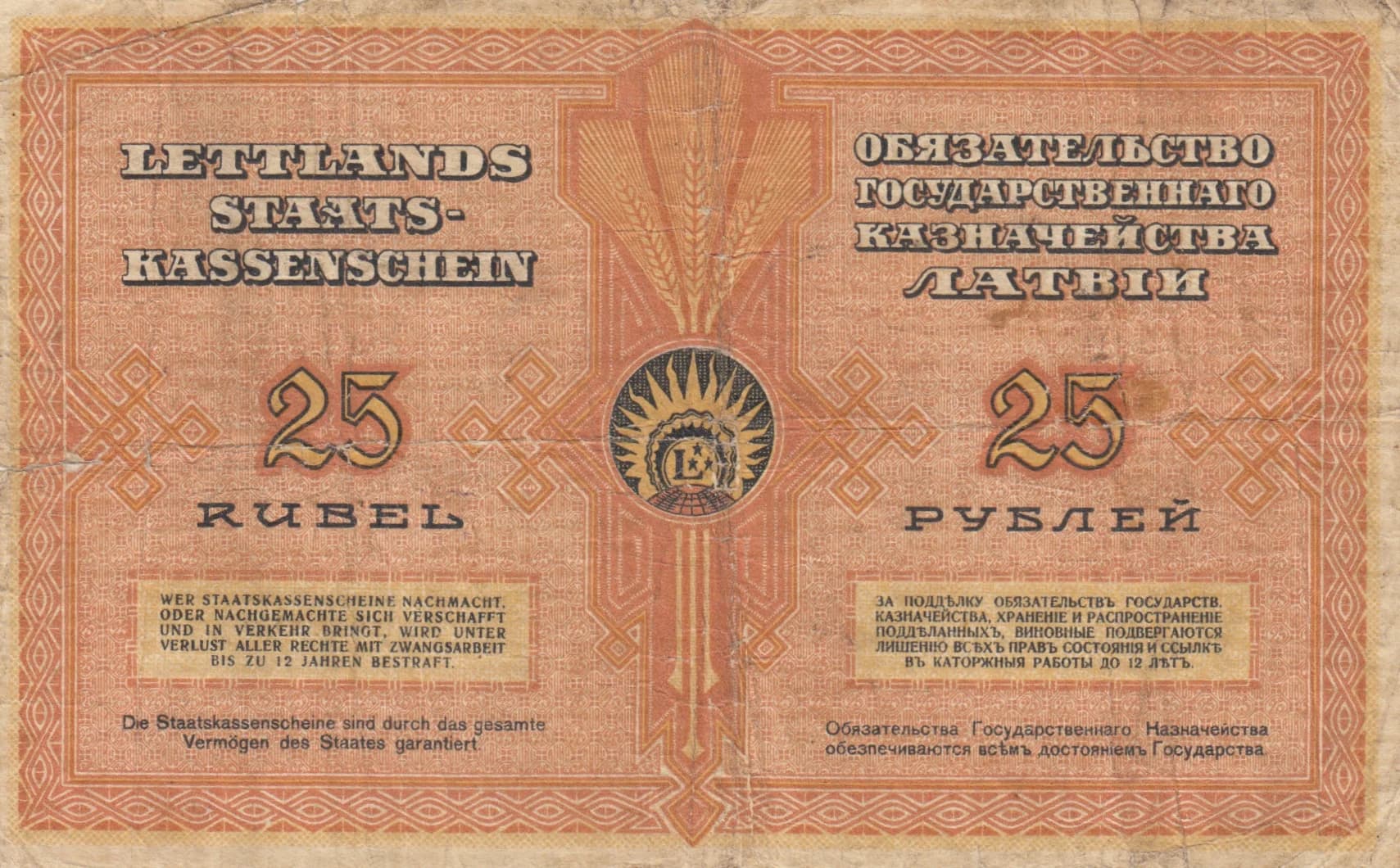
This 25 Rubli note from 1919 represents an important transitional currency of newly independent Latvia, issued during the country's first year of sovereignty. The note displays characteristic Art Nouveau styling on the obverse with a prominent Gothic numeral '25' in an ornate circular medallion, while the reverse features a striking Art Deco sunburst design with radiating wheat stalks—symbolizing Latvia's agricultural heritage. In VG condition with series M designation, this note shows expected age-related patina and creasing consistent with early 20th-century circulation, with visible serial number M 404869 and intact bilingual (German/Russian) legal text on the reverse.
Common. The eBay market data provided shows regular sales activity with VG-graded examples selling for $31.80 (2019), consistent with 2016 catalog values of $20 for VG condition. Multiple sales across various grades (F, VG, VF, EF, UNC) spanning from 2010 to 2026 indicate reliable supply in the collector market. The PMG population report lists P-5h without specific grading counts but indicates it is one of 18 cataloged variants of the base Pick number P-5, with no asterisks or notation suggesting limited production. Series M (the series of the submitted note) is among the common series listed (H, K, L, M, N, P, R, S). Early Latvian currency notes from the 1919 transitional period were produced in substantial quantities to support the new state's economic functions, and this denomination remains readily available to collectors.
The 25 Rubli denomination represents Latvia's transitional monetary system during 1919, when the newly independent nation (having just declared sovereignty from Russian/Soviet control) initially continued using Tsarist-era ruble denominations before transitioning to the Latu in the 1920s. The bilingual German and Russian inscriptions on the reverse reflect Latvia's complex geopolitical position between German and Soviet spheres of influence during this volatile post-WWI period. The wheat stalk imagery on the reverse emphasizes the agrarian foundation of the nascent Latvian state, while the state treasury guarantee language underscores the new government's efforts to establish monetary credibility and confidence.
The obverse features an Art Nouveau aesthetic dominated by tan and brown tones, with an elaborate ornamental border composed of spiral motifs and decorative corner elements. The central design showcases a large circular medallion with a thick ornate frame containing the Gothic numeral '25' in bold lettering. The denomination text and issuer identification curve along the top and bottom of the note in Latvian script, with serial number M 404869 printed in green ink in both the upper left and lower right corners. Oval seals with radiating star designs occupy both bottom corners. The reverse displays a more geometric, Art Deco-influenced composition featuring a central sunburst or radiating wheat stalk motif—a stylized representation of three ears of corn as cataloged—rendered in lighter tan against darker rust and brown background tones. A prominent oval central seal with radiating lines and an internal 'L' monogram anchors the design. The reverse is divided vertically into left (German) and right (Russian/Cyrillic) halves, with large '25' numerals positioned in both lower corners. Geometric diamond pattern borders frame the composition. The overall color palette—tan, rust, orange, and cream against dark brown—conveys both the agricultural symbolism and governmental authority of the young Latvian state.
{"obverse":{"latvian_issuer":"Latvijas walsts kafes libmete [Latvia State Treasury/State Bank]","denomination_latvian":"Simdekkath Operri Rubli [Twenty-five Rubles]","year":"1919","serial_number":"M 404869","fine_print":"Paldz kafes libmee nodroshnatas at misjem walts libjajchumeem [State Treasury obligation guarantee text - partial]"},"reverse":{"german_title":"LETTLANDS STAATS-KASSENSCHEIN [Latvia State Treasury Note]","russian_title":"ОБЯЗАТЕЛЬСТВО ГОСУДАРСТВЕННОГО КАЗНАЧЕЙСТВА ЛАТВИИ [Obligation of the State Treasury of Latvia]","german_denomination":"25 RUBEL","russian_denomination":"25 РУБЛЕЙ [25 Rubles]","german_counterfeiting_warning":"WER STAATSKASSENSCHEINE NACHMACHT, ODER NACHGEMACHTE SICH VERSCHAFFT UND IN VERKEHR BRINGT, WIRD UNTER VERLUST ALLER RECHTE MIT ZWANGSARBEIT BIS ZU 12 JAHREN BESTRAFT. [Whoever counterfeits state treasury notes, or procures counterfeited ones and puts them into circulation, will be punished with loss of all rights and forced labor up to 12 years.]","russian_counterfeiting_warning":"ЗА ПОДДЕЛКУ ОБЯЗАТЕЛЬСТВ ГОСУДАРСТВ. КАЗНАЧЕЙСТВА, ХРАНЕНИЕ И РАСПРОСТРАНЕНИЕ ПОДДЕЛЬНЫХ, ВИНОВНЫЕ ПОДВЕРГАЮТСЯ ЛИШЕНИЮ ВСЕХ ПРАВ СОСТОЯНИЯ И ССЫЛКОЙ В КАТОРЖНУЮ РАБОТУ НА 12 ЛЕТ. [For counterfeiting state treasury obligations, storage and distribution of counterfeits, the guilty are subject to deprivation of all civil rights and exile to hard labor for 12 years.]","german_guarantee":"Die Staatskassenscheine sind durch das gesamte Vermögen des Staates garantiert. [The state treasury notes are guaranteed by the entire property of the state.]","russian_guarantee":"Обязательства Государственного Казначейства обеспечиваются всем достоянием Государства. [The obligations of the State Treasury are secured by all the property of the State.]"}}
This note employs intaglio printing (engraved plate printing), evidenced by the fine detail resolution in the ornate borders, decorative elements, and text, as well as the perceptible impression depth visible in the imagery. The technical quality of the fine linework in the geometric patterns, the precision of the radiating wheat stalk design, and the sharpness of the bilingual text indicate use of steel engraved plates. The two-color printing (brown/tan primary with green serial numbers) suggests either multiple-pass intaglio printing or combination printing techniques. For Latvian Government notes of this 1919 period, printing was often conducted by established European security printers, though the specific printer is not confirmed in the available catalog data for P-5h (unlike P-58, which is credited to G&D—Giesecke & Devrient).
This note is identified as Pick P-5h, representing a specific watermark variety of the 25 Rubli 1919 issue. The visual analysis confirms Series M designation (visible in serial number M 404869), which is documented as one of eight known series for this denomination. The PMG population report identifies P-5g as a distinct variant with 'Light Lines' watermark, suggesting P-5h represents an alternative watermark type—consistent with the notation 'Line groups' watermark mentioned in the realbanknotes.com reference. The bilingual (German/Russian) text layout and wheat stalk reverse design are standard for this issue. No overprints, signatures, or date variations are evident in this example. The serial number prefix 'M' and the specific number sequence (404869) are consistent with standard production practices for this series.