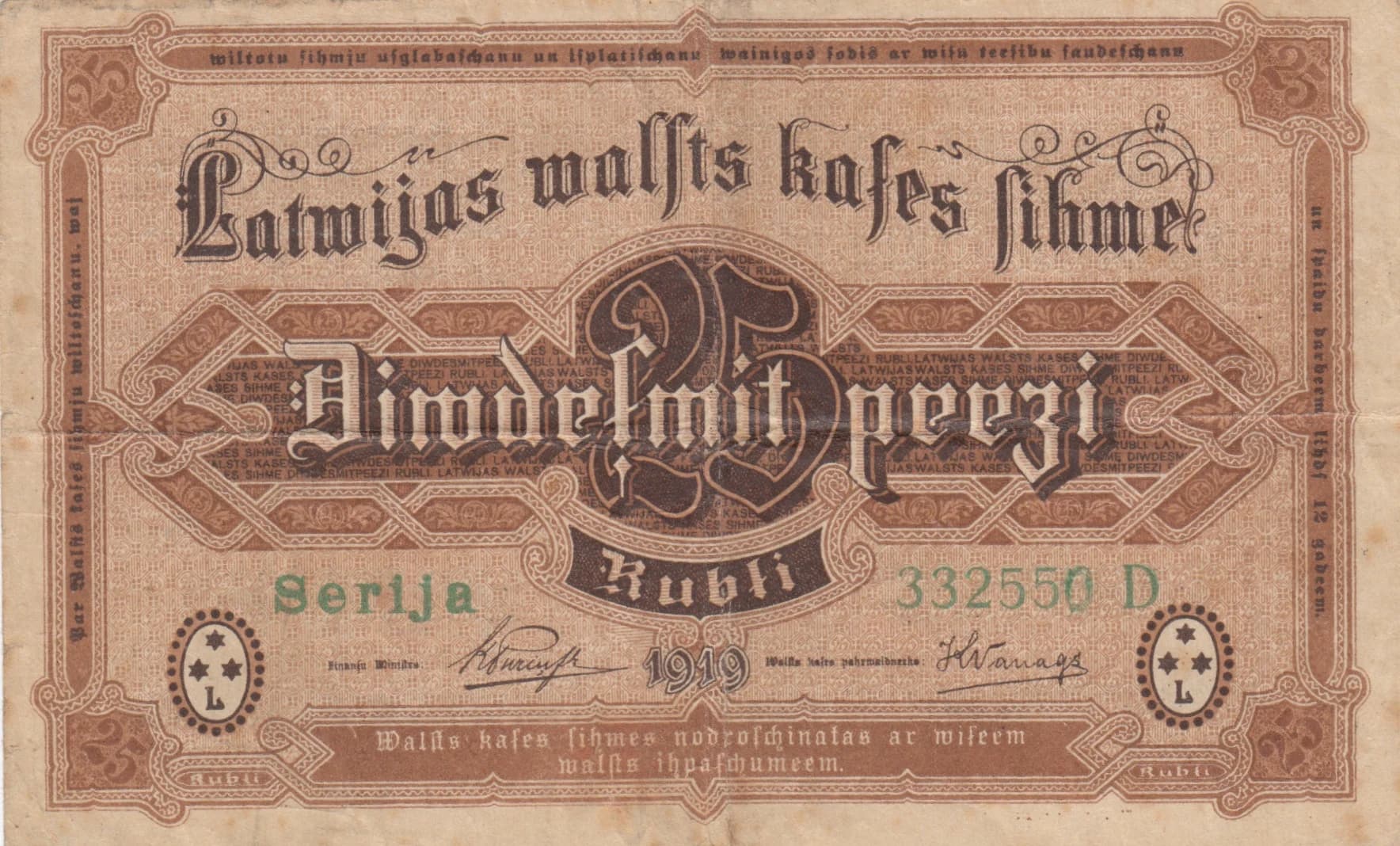
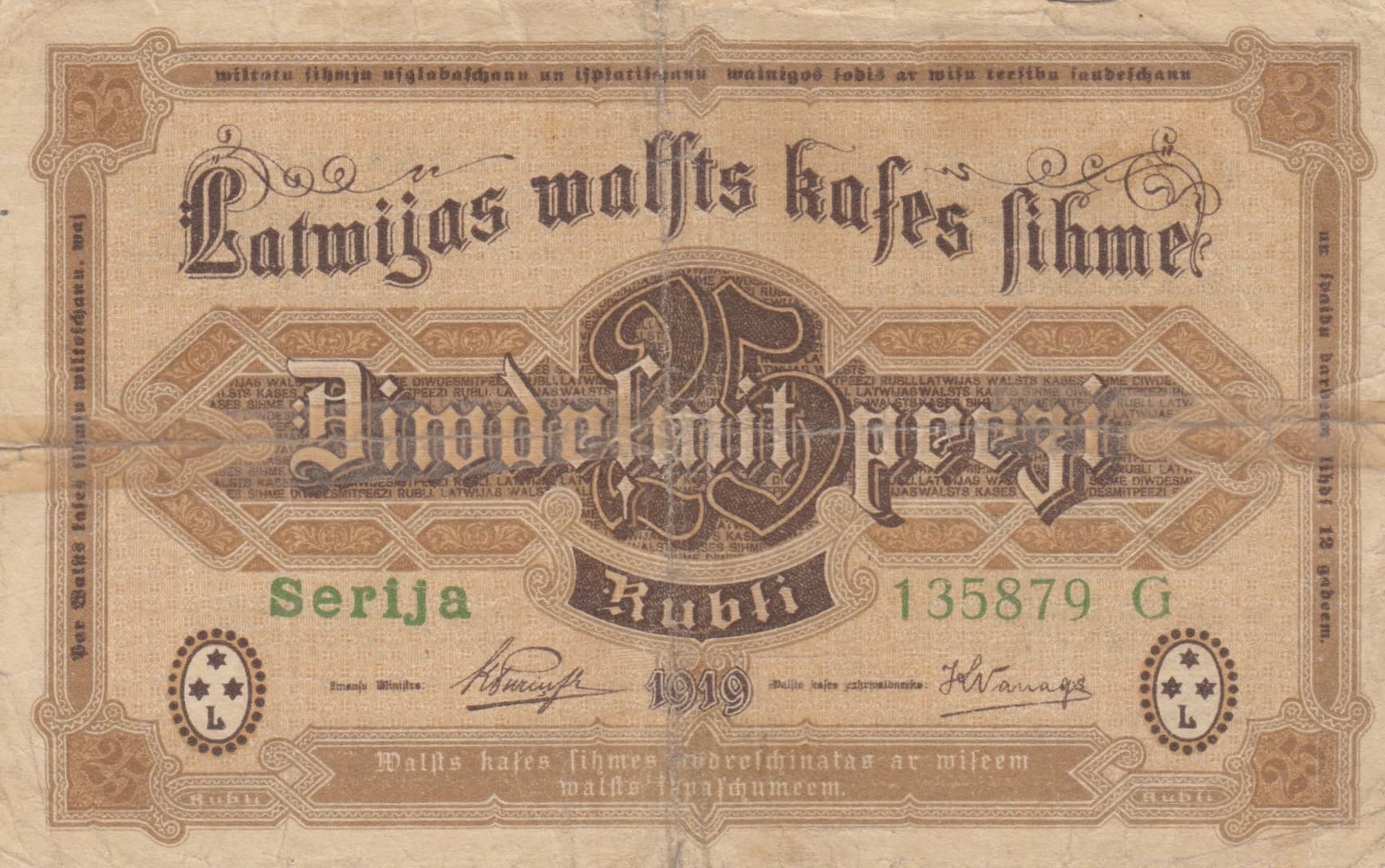
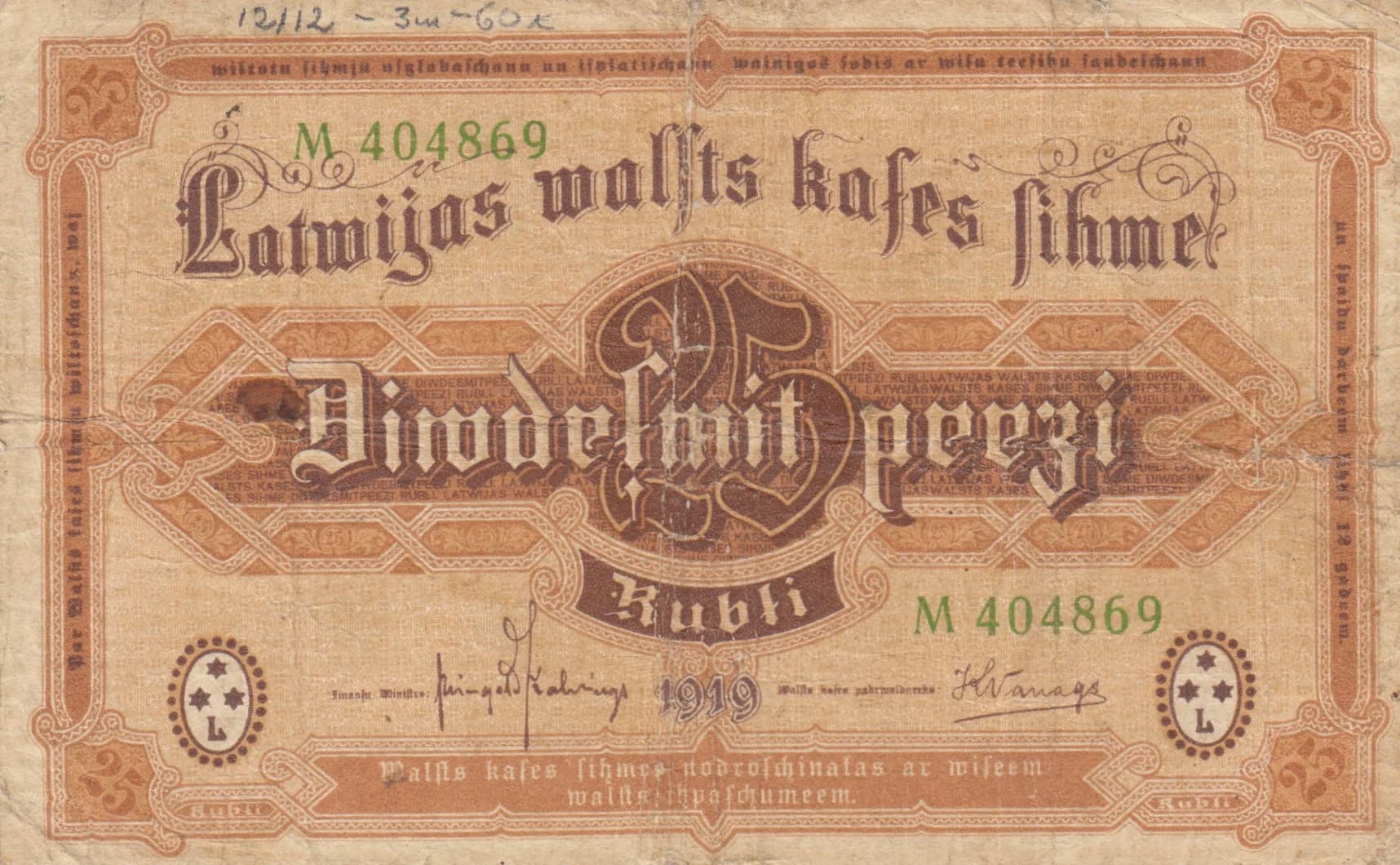
25 rubli 1919
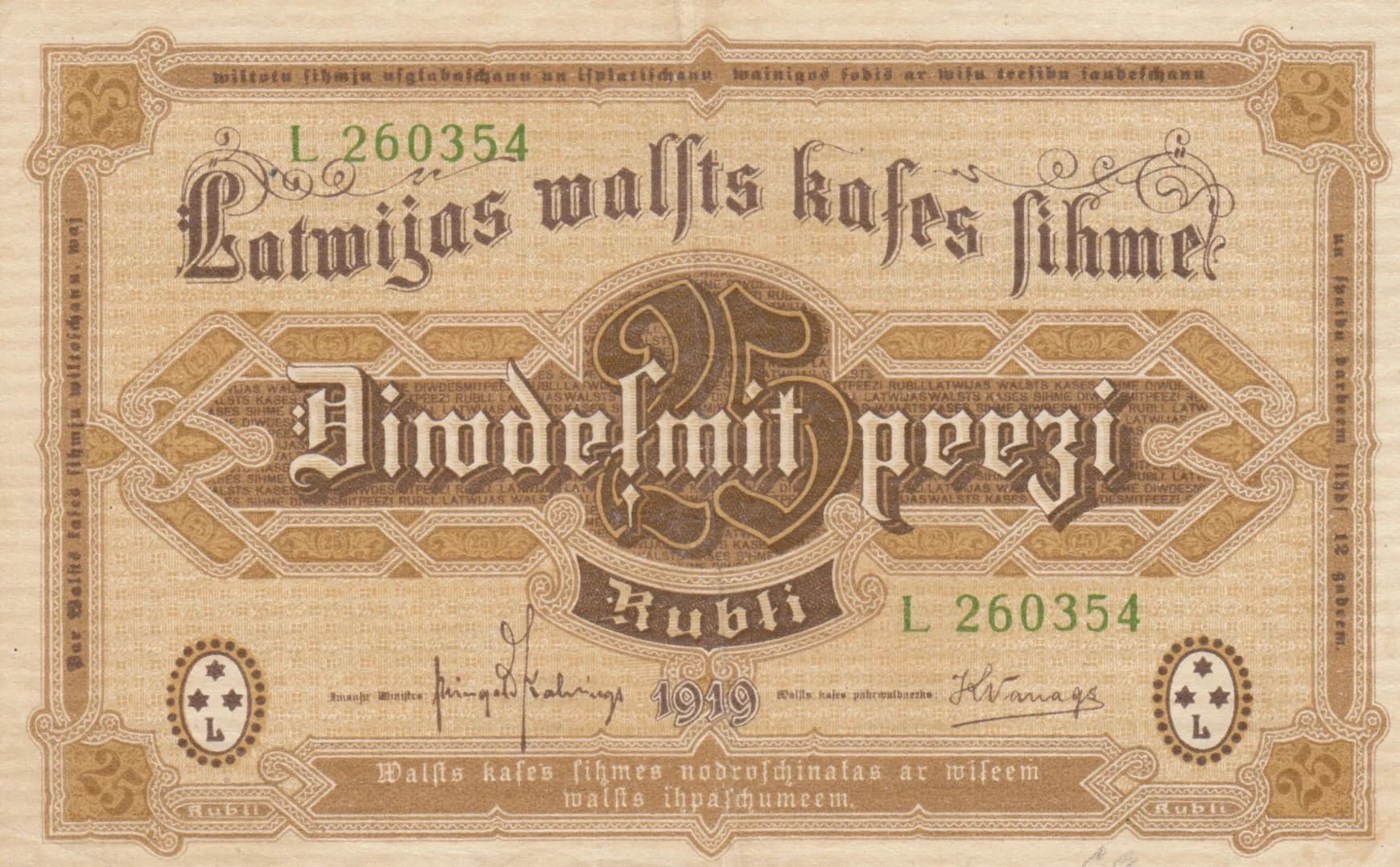
“serie L”
Market Prices
8 salesAbout This Note
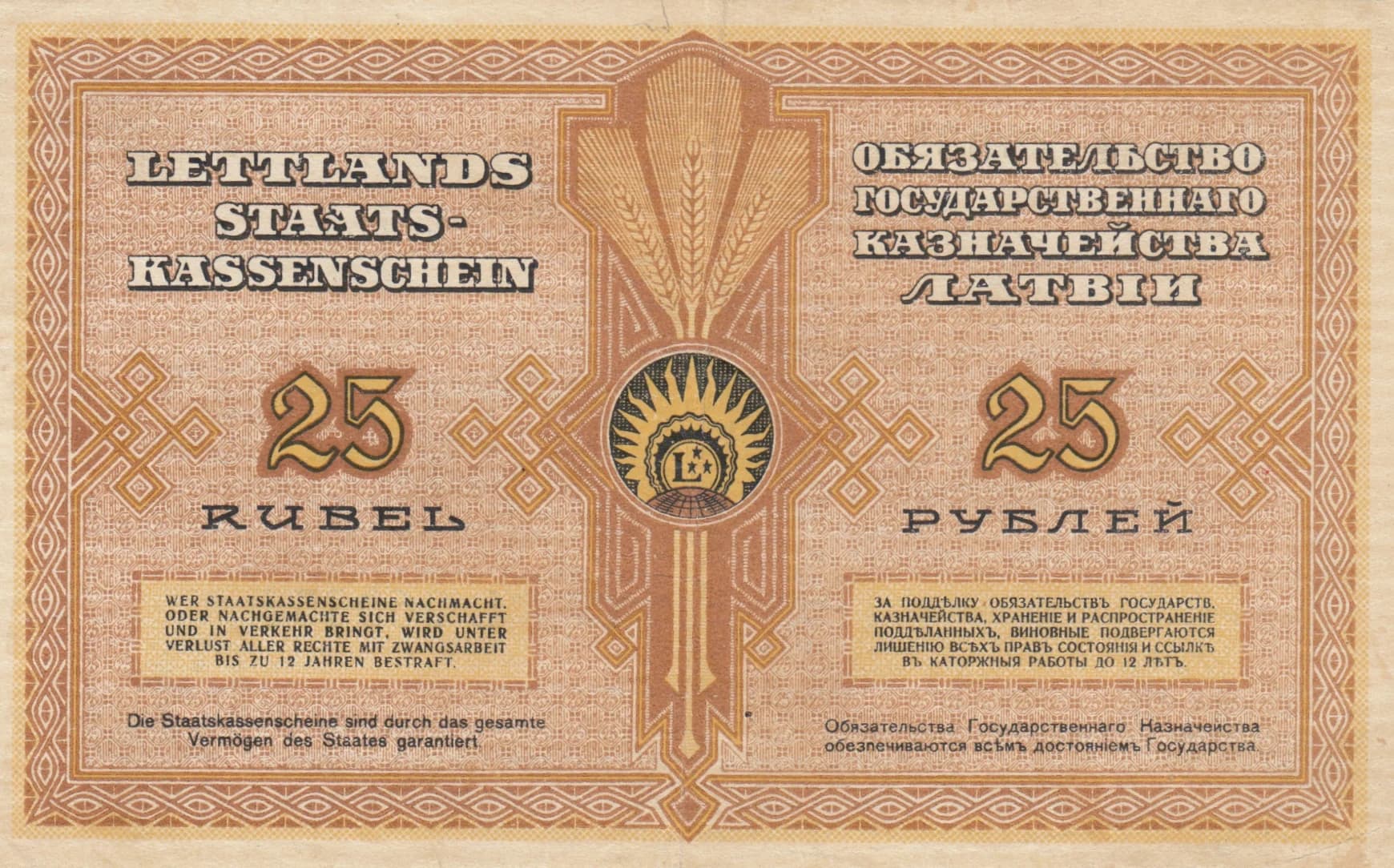
This is a Latvia 25 Rubli from 1919 in EF condition, representing an important transitional currency issued during Latvia's early independence period. The note features striking Art Nouveau-style ornamentation on the obverse in cream and brown tones, with a distinctive reverse design showcasing wheat stalks rising from a central emblem—symbolizing agricultural prosperity. The bilingual German-Russian text and Series L designation add to its historical significance, with this particular example showing authentic period aging and foxing consistent with genuine 1919 circulation pieces.
Common. The eBay market price data shows consistent sales ranging from $9.50 (F grade, 2026) to $220.50 (UNC, 2018), with multiple examples sold across various grades over a 16-year period. This indicates healthy circulation supply. The 2016 catalog value for EF condition notes is approximately $78, and this specific example sold for $78 in 2010, suggesting stable but modest collector demand. The existence of multiple series variants (H, K, L, M, N, P, R, S) and the note's regular issue status confirm wide original distribution. While historically significant as a Latvian independence-era note, it was produced in sufficient quantities to remain accessible to collectors.
Issued by the Latvian State Treasury (Latvijas Valsts Kase) in 1919, this note represents Latvia's brief use of the Russian ruble following its declaration of independence from the Russian Empire. The bilingual German and Russian inscriptions reflect Latvia's complex geopolitical position as a newly independent nation emerging from World War I, caught between German and Russian spheres of influence. The wheat stalk imagery on the reverse symbolizes the agrarian foundation of the new Latvian state during its formative years before transitioning to the Lats currency.
The obverse features an elaborate Art Nouveau rectangular frame with symmetrical ornamental corner decorations and a repeating geometric border pattern. The central design elements include a large ornamental oval cartouche rendered in brown and green inks against a cream background, flanked by circular seal emblems with radiating star motifs on the left and right sides. The reverse displays three stylized wheat or grain ear stalks rising from a central circular emblem bearing 'Lv' initials with a radiant sun-like design in blue-green. The reverse layout is deliberately bilingual, with German text occupying the left portion and Russian Cyrillic text on the right—a deliberate security and political design choice reflecting Latvia's transitional status. Diamond-shaped ornaments and a repeating eye-like geometric pattern border the entire reverse design. Denomination '25' appears prominently in both lower corners of the reverse.
OBVERSE: 'Latvijas Valsts Kasesihme' (Latvia State Cash Note), 'Dindelmit apeži Rubli' (Twenty-five Rubles), '1919' (year), 'Valts kafes sihmes nodroshinatas ac wifeem walts ihpaithumeem' (State cash notes are guaranteed by the entire state property). Serial number L260354 appears twice. REVERSE: German side: 'LETTLANDS STAATS-KASSENSCHEIN' (Lettonia State Cash Certificate), '25 RUBEL' (25 Rubles), 'WER STAATSKASSENSCHEINE NACHMACHT, ODER NACHGEMACHTE SICH VERSCHAFFT UND IN VERKEHR BRINGT, WIRD UNTER VERLUST ALLER RECHTE MIT ZWANGSARBEIT BIS ZU 12 JAHREN BESTRAFT' (Whoever counterfeits state cash notes or obtains and circulates counterfeited ones will be punished with forced labor up to 12 years and loss of all rights), 'Die Staatskassenscheine sind durch das gesamte Vermögen des Staates garantiert' (The state cash notes are guaranteed by the entire property of the state). Russian side: 'ОБЯЗАТЕЛЬСТВО ГОСУДАРСТВЕННОГО КАЗНАЧЕЙСТВА ЛАТВИИ' (State Treasury Obligation of Latvia), '25 РУБЛЕЙ' (25 Rubles), 'ЗА ПОДДЕЛКУ ОБЯЗАТЕЛЬСТВ ГОСУДАРСТВ, КАЗНАЧЕЙСТВА, ХРАНЕНИЕ И РАСПРОСТРАНЕНИЕ ПОДДЕЛЬНЫХ, ВИНОВНЫЕ ПОДВЕРГАЮТСЯ ЛИШЕНИЮ ВСЕХ В ПРАВАХ СОСТОЯНИЯ И ССЫЛКИ В КАТОРЖНЫЕ РАБОТЫ ДО 12 ЛЕТ' (For counterfeiting state treasury obligations and distribution of counterfeits, the guilty face deprivation of rights and hard labor up to 12 years), 'Обязательства Государственного Казначейства обезпечиваются всеми достояниями Государства' (State Treasury obligations are secured by all state property).
This note was produced using traditional letterpress printing technology, typical of early 20th-century European banknotes. The distinct color separation (brown, green, orange/rust, and gold/tan inks), the clarity of fine geometric line work in the borders, and the precision of text registration indicate multi-pass letterpress production. The ornate decorative elements and repeating patterns are characteristic of the detailed relief plate engraving used by security printers of the period. Based on catalog records, this note was likely produced by Giesecke & Devrient (G&D), the renowned Leipzig security printer that produced many early Baltic and Eastern European issues of this era.
This note is Pick catalog P-5h, part of a series with known variants. The visual analysis confirms Series L serial number (L260354), which is documented as one of eight known series (H, K, L, M, N, P, R, S) for this denomination. The PMG population report lists P-5g (25 Rubli with light line watermark) as a distinct variant, indicating that P-5h likely has different watermark characteristics. The two-serial-number layout observed is confirmed in reference data. No overprints, signatures, or date variations are apparent on this example—it represents the standard P-5h issue type from the regular 1919 emission.