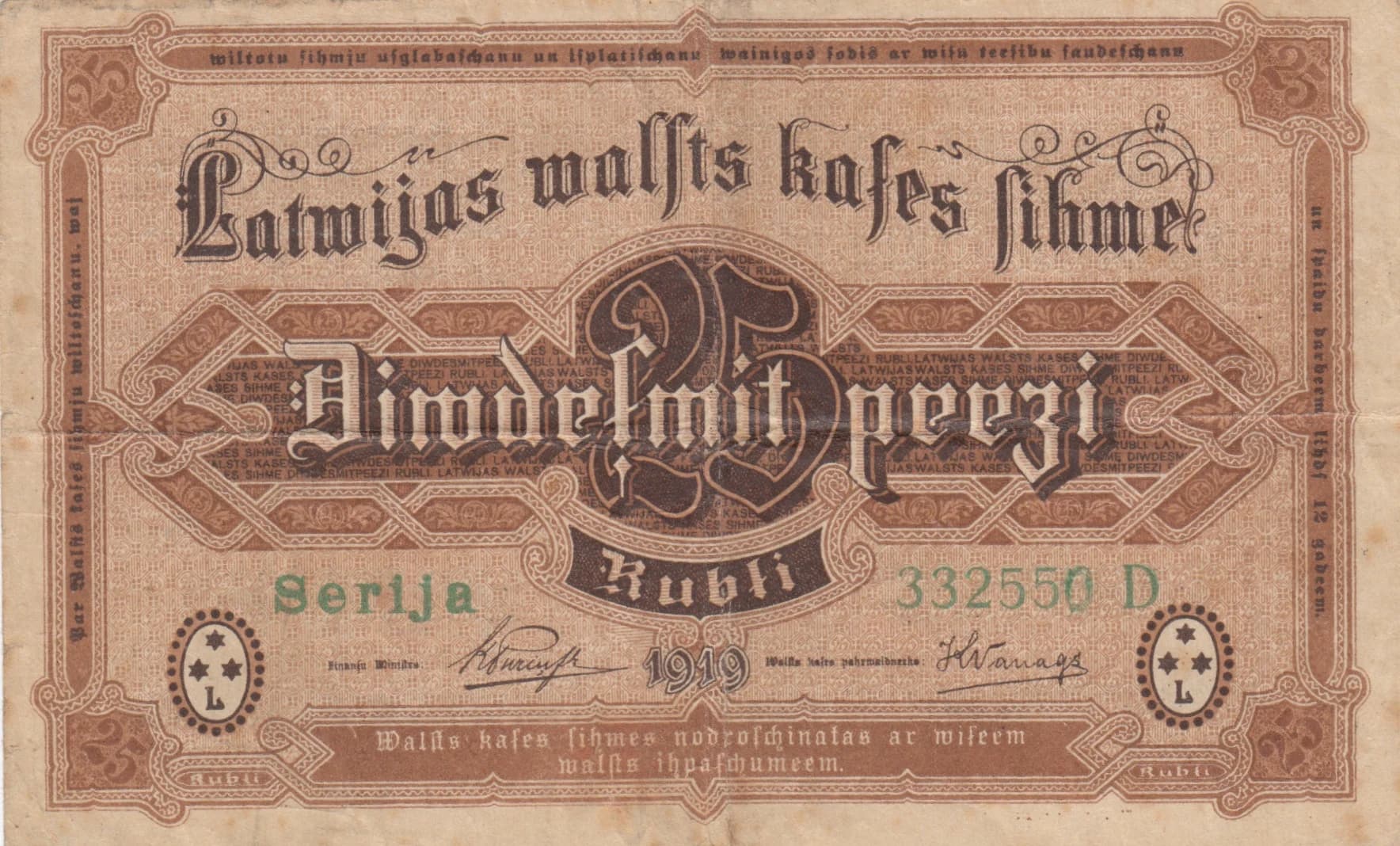
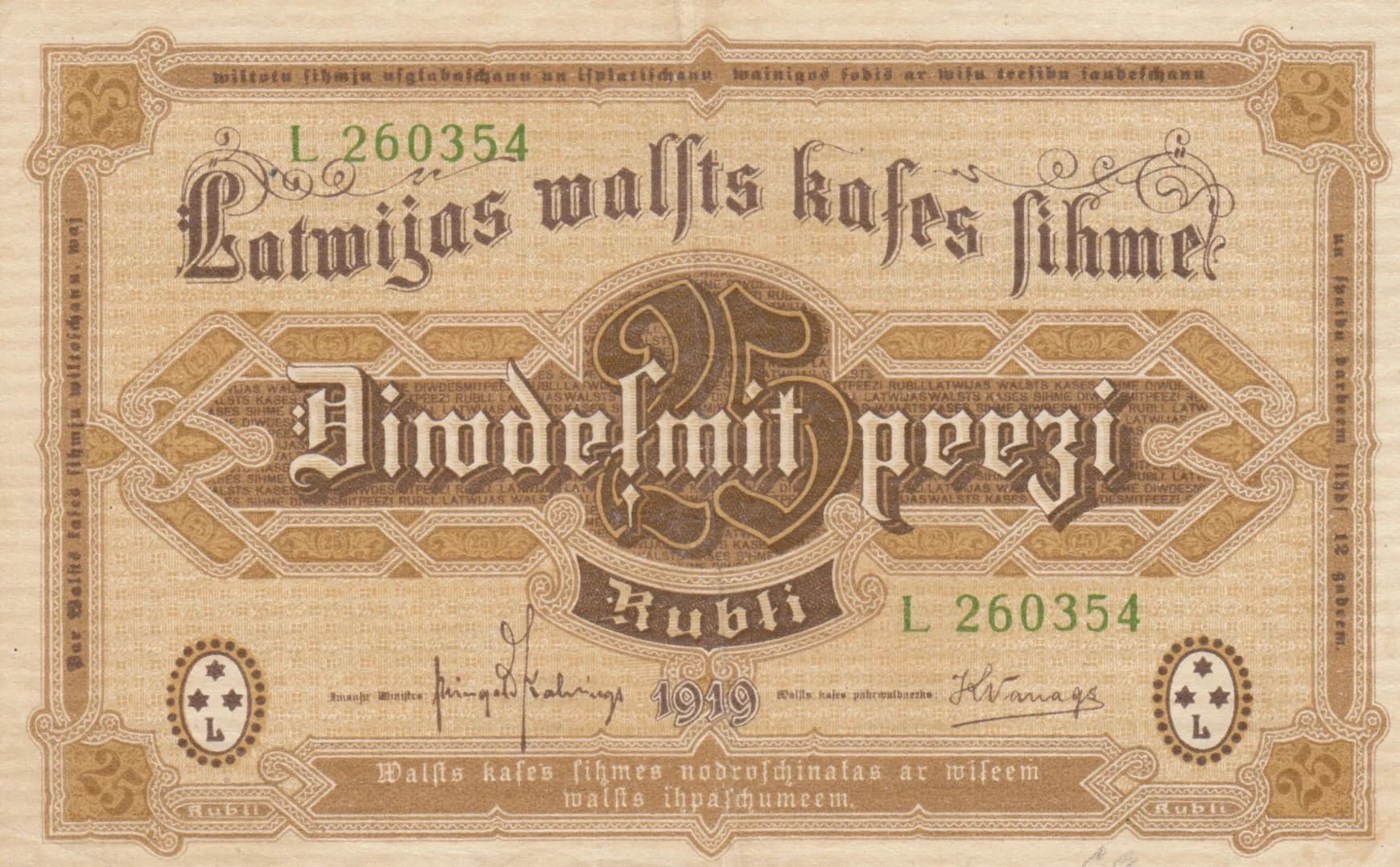
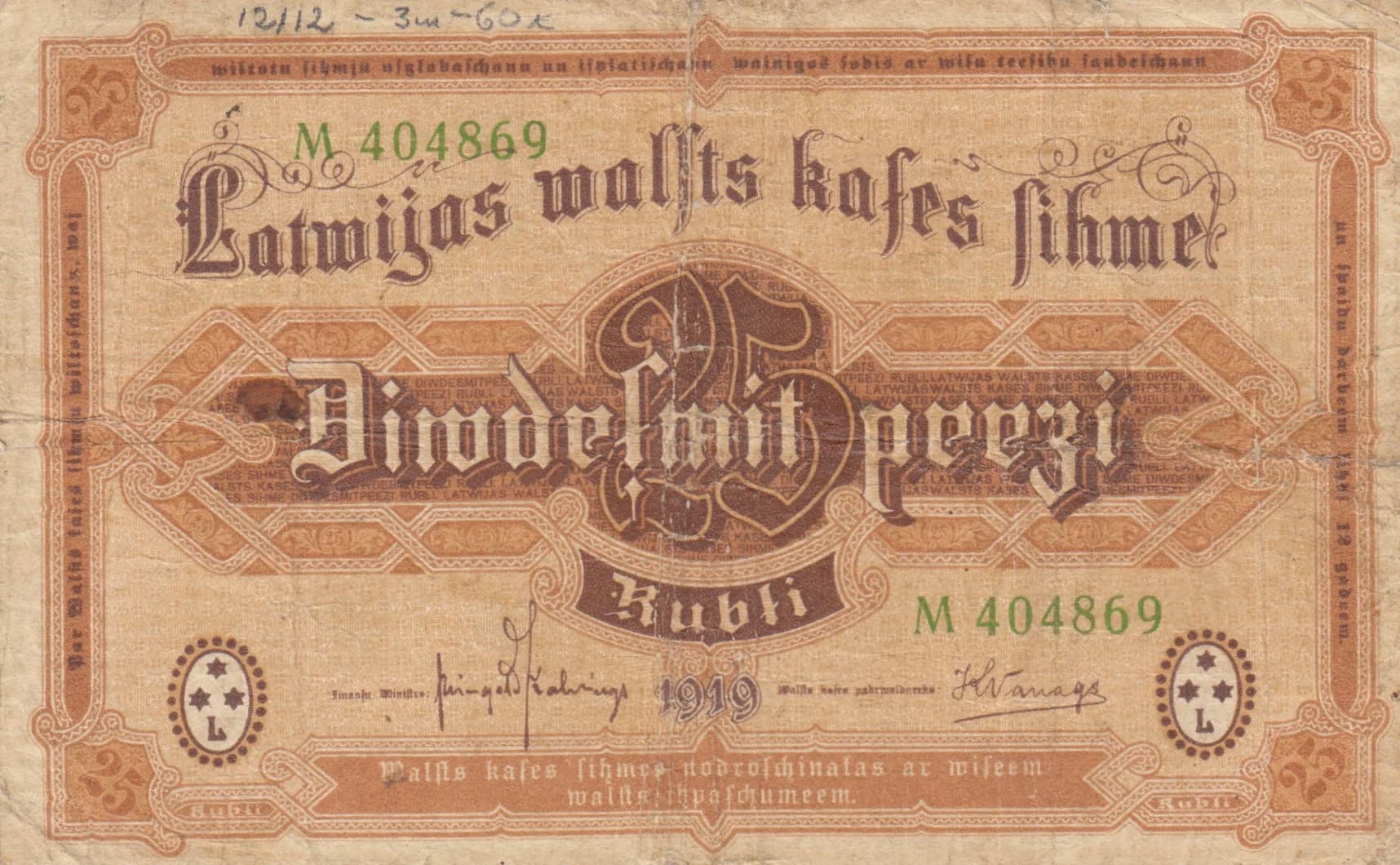
25 rubli 1919
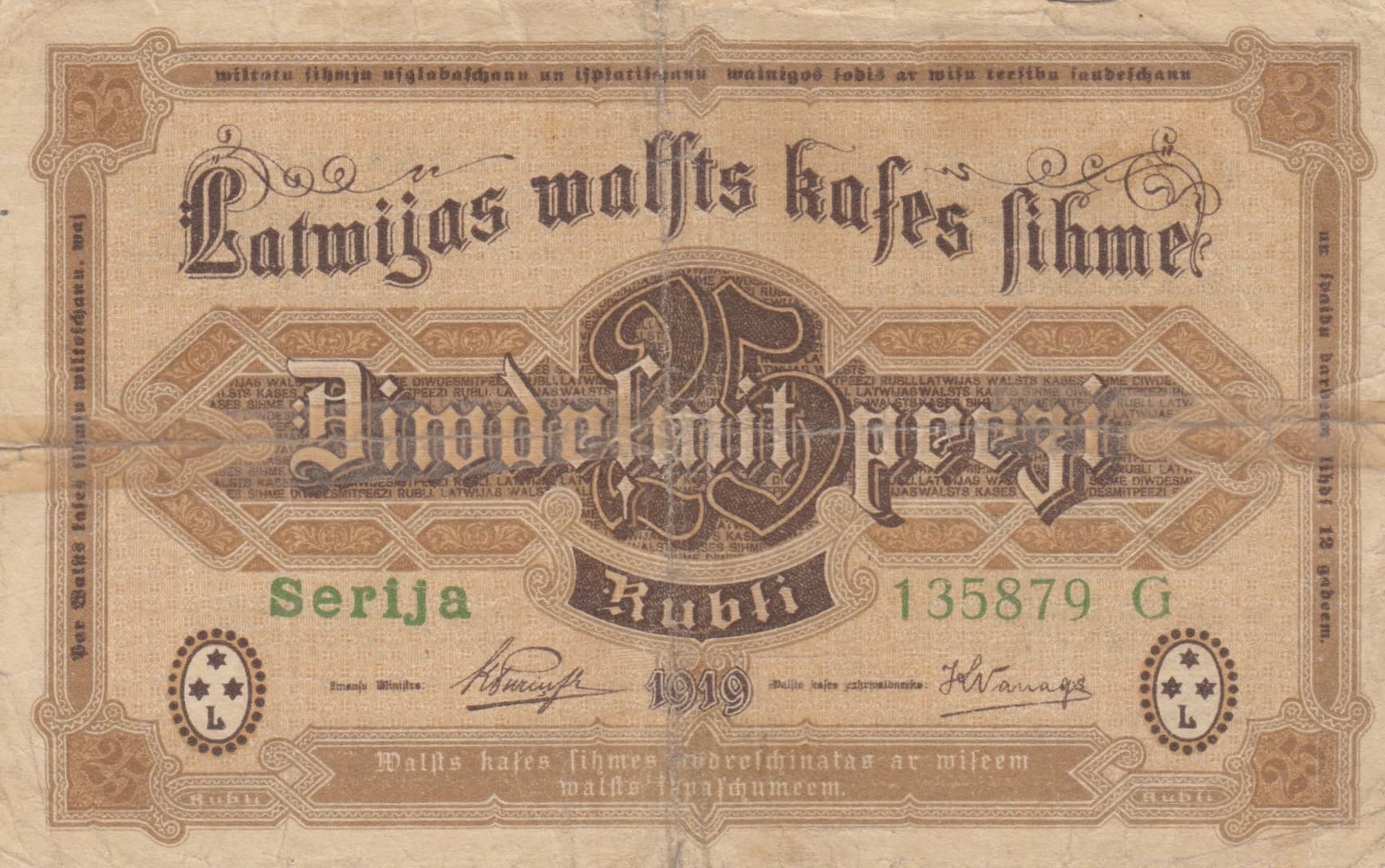
“serie G”
Market Prices
About This Note
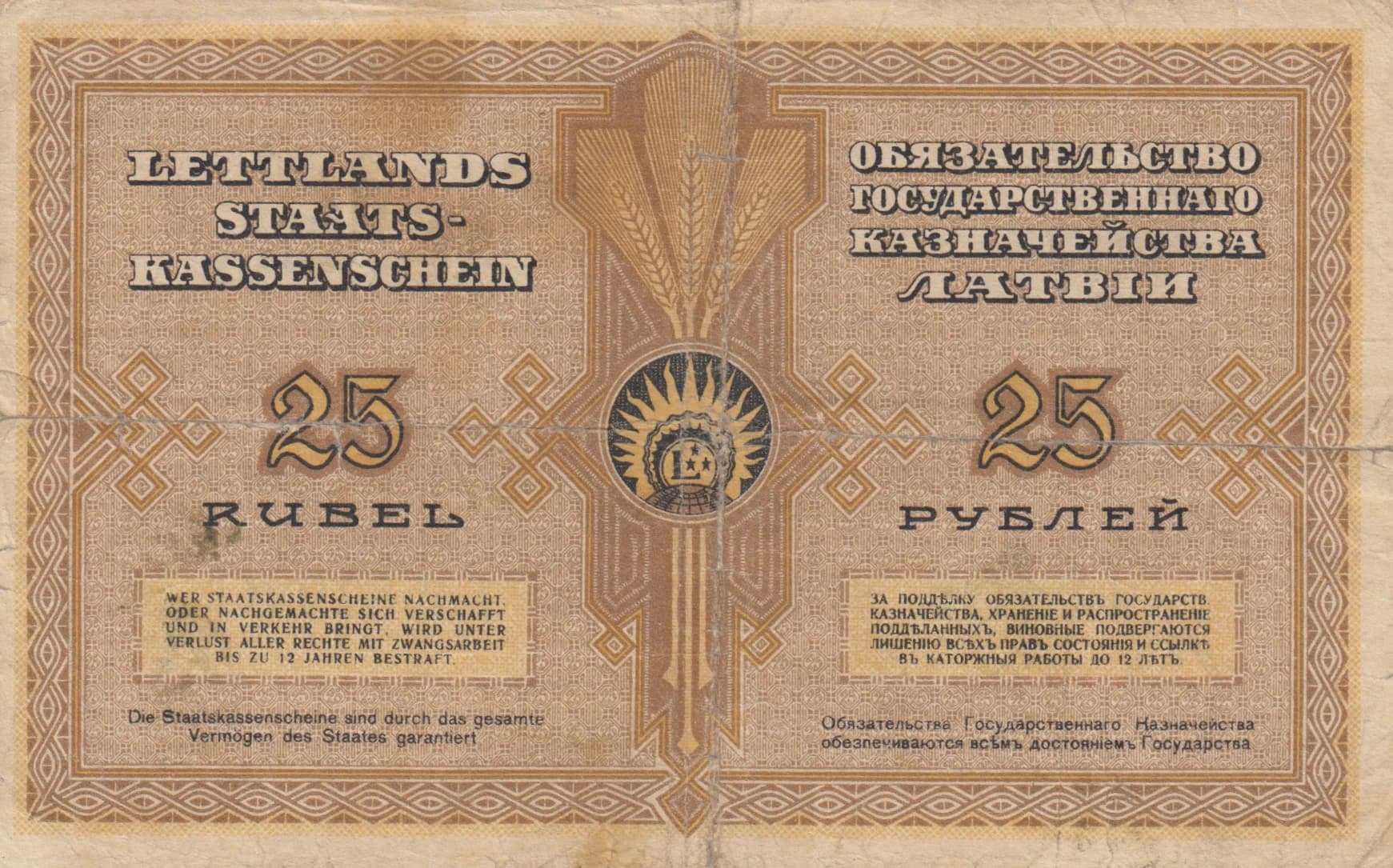
A 25 Rubli note from Latvia's early independence period (1919), issued by the Latvian Government during the transition from Russian Imperial currency. This Fine condition example (Pick P-5f, Series G) displays the characteristic brown/tan coloration and ornate Art Nouveau-influenced design typical of early Latvian treasury notes. The note exhibits moderate aging with visible creasing and foxing consistent with century-old paper currency, making it a tangible artifact of Latvia's brief first independence period (1918-1940).
Common. While this is a historically significant note from Latvia's first independence period, the 25 Rubli denomination was issued in substantial quantities (1919 was a regular issue year with multiple series printed). The existence of multiple series variants (E, F, G documented) and eBay market data showing prices ranging from $18-$249 USD with most circulated examples trading between $18-$50 USD indicates these notes remain readily available to collectors. Series G specimens are not documented as particularly scarce. Condition grade (Fine) places this in the typical collector range rather than premium territory.
Issued in 1919, this note represents Latvia's immediate post-WWI period when the newly independent nation created its own currency system before transitioning to the Latu in 1922. The bilingual German-Russian text reflects Latvia's complex historical position between German and Russian spheres of influence, while the wheat sheaf imagery on the reverse symbolizes the nation's agrarian economy and agricultural identity. The heraldic sun emblem represents Latvian sovereignty and national identity during this crucial nation-building period.
This note features a symmetrical, highly decorative design characteristic of early 20th-century European treasury notes. The obverse displays a formal layout with large gothic/blackletter typography and ornate scrollwork borders containing geometric patterns and interlocking designs. Two circular state seals with star symbols are positioned in the bottom corners, representing official authority. The reverse is the more visually distinctive side, dominated by a central heraldic composition featuring stylized wheat stalks radiating upward from a circular coat of arms seal with a prominent sun emblem—symbolic of Latvia's agricultural heritage and national sovereignty. The denomination '25' appears prominently on both left and right margins of the reverse. The bilingual layout (German on left, Russian on right) creates a balanced design while serving as a security feature and reflecting the multilingual nature of Latvia's early independence period. Fine line engraving throughout provides intricate detail work characteristic of professional security printing.
FRONT SIDE: 'Latvijas Valsts Kaşes Šimme' (Latvia State Treasury Note) with 'Serija' (Series) designation and serial number '135879 G'. Date shown as '1919' with signatures labeled 'Finanču Ministrs' (Finance Minister) and 'Valsts Kases Parakstis' (State Treasury Signature). BACK SIDE - GERMAN TEXT: 'Lettlands Staats-Kassenschein' (Latvia State Treasury Note) showing '25 Rubel' (25 Rubles). Warning inscription: 'Whoever counterfeits state treasury notes or obtains counterfeit notes and brings them into circulation will be punished with forced labor up to 12 years, with loss of all rights.' Guarantee statement: 'The state treasury notes are guaranteed by the entire assets of the state.' BACK SIDE - RUSSIAN TEXT: 'Обязательство Государственного Казначейства Латвии' (Obligation of the State Treasury of Latvia) with '25 Рублей' (25 Rubles). Corresponding penalty and guarantee texts in Russian matching the German versions.
Intaglio engraving (recess printing), the standard security printing method for this era. The fine line work, ornate borders, and detailed wheat sheaf imagery visible in the analysis confirm professional engraving plates. Based on catalog references for contemporary Latvian currency, this note was likely produced by Giesecke & Devrient (G&D), the major European security printer of the period, though specific attribution for P-5f requires confirmation from the Pick catalog.
This specimen is identified as Pick P-5f, Series G, with serial number 135879. The PMG population report confirms P-5g (25 Rubli with light line watermark) and P-5h (25 Rubli) as known catalog varieties, indicating multiple printings or watermark variants exist for this denomination. Series designations (E, F, G) represent different printing runs of the same design. The green serial number and series letter 'G' are consistent with documented variants of this issue. No overprints or special markings are noted in the visual analysis, indicating this is a standard regular-issue example.