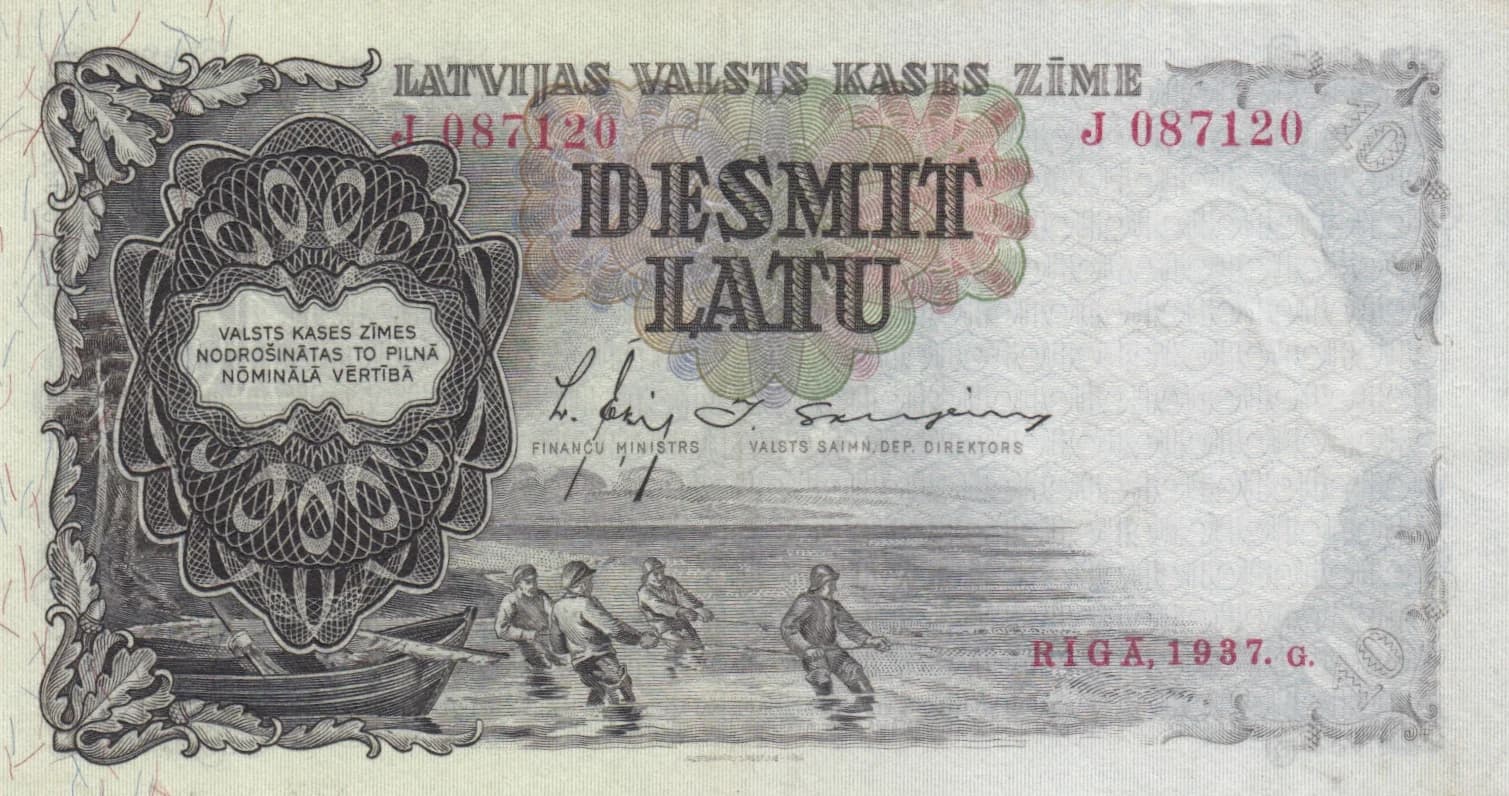
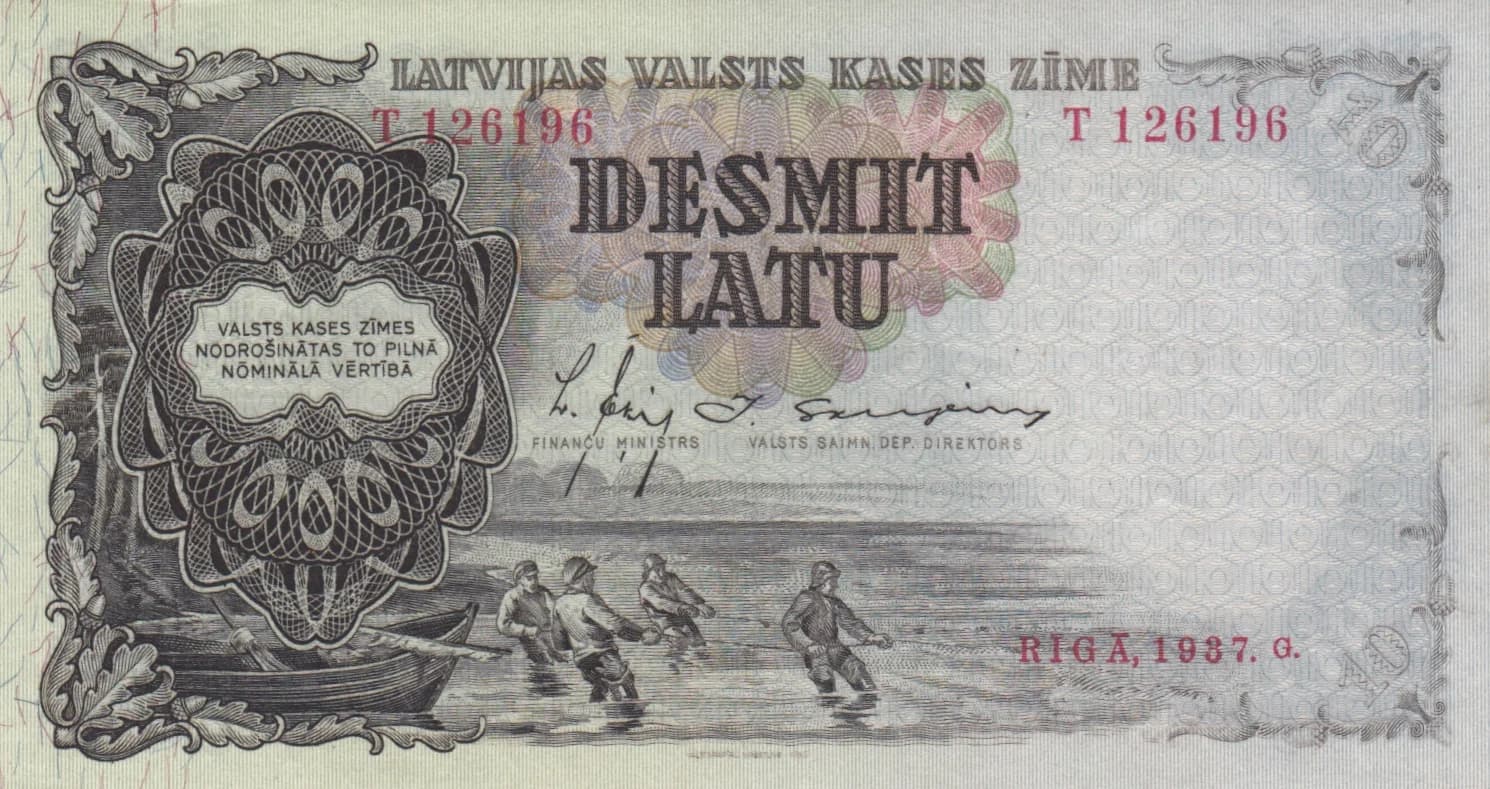
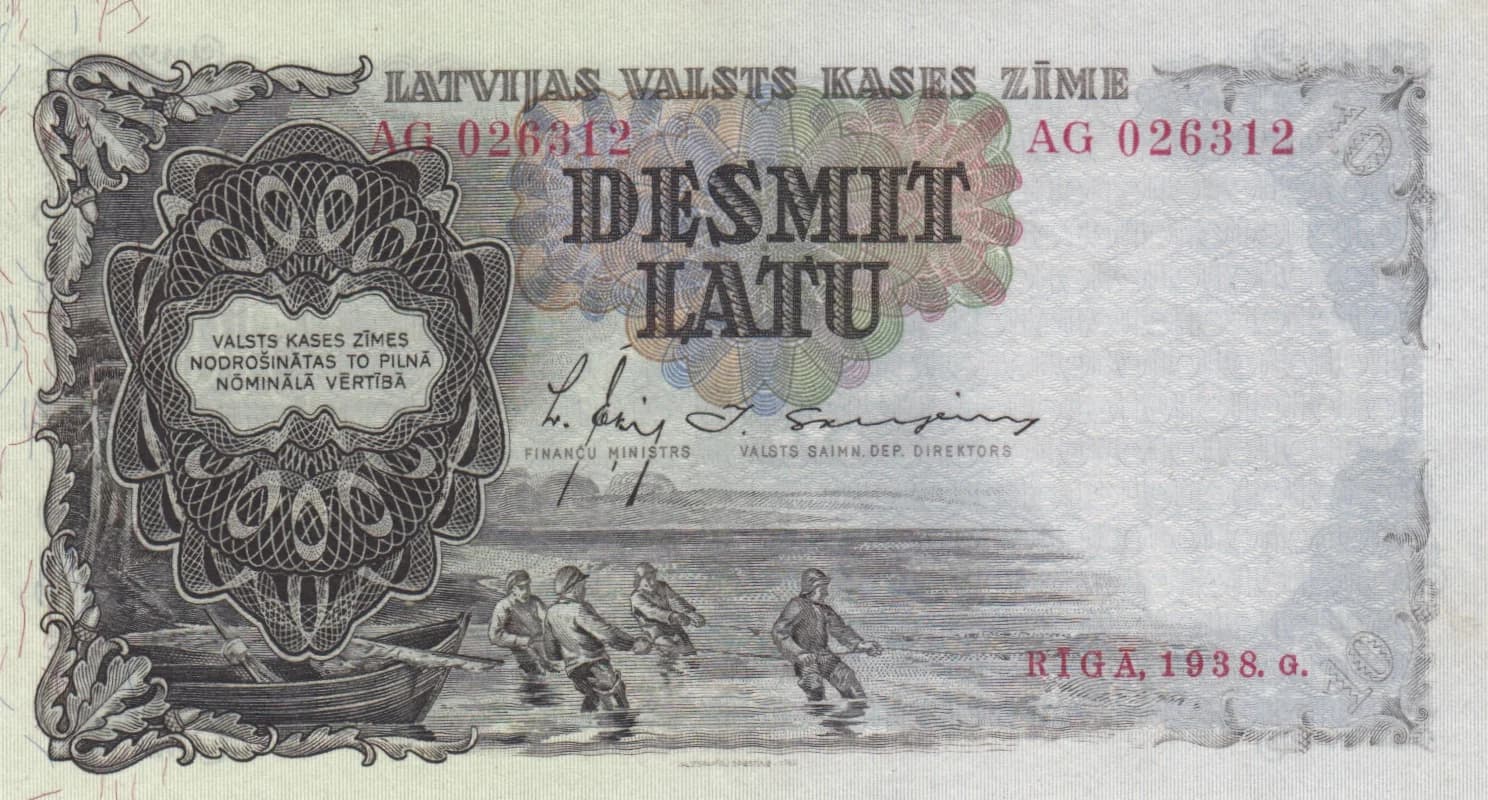
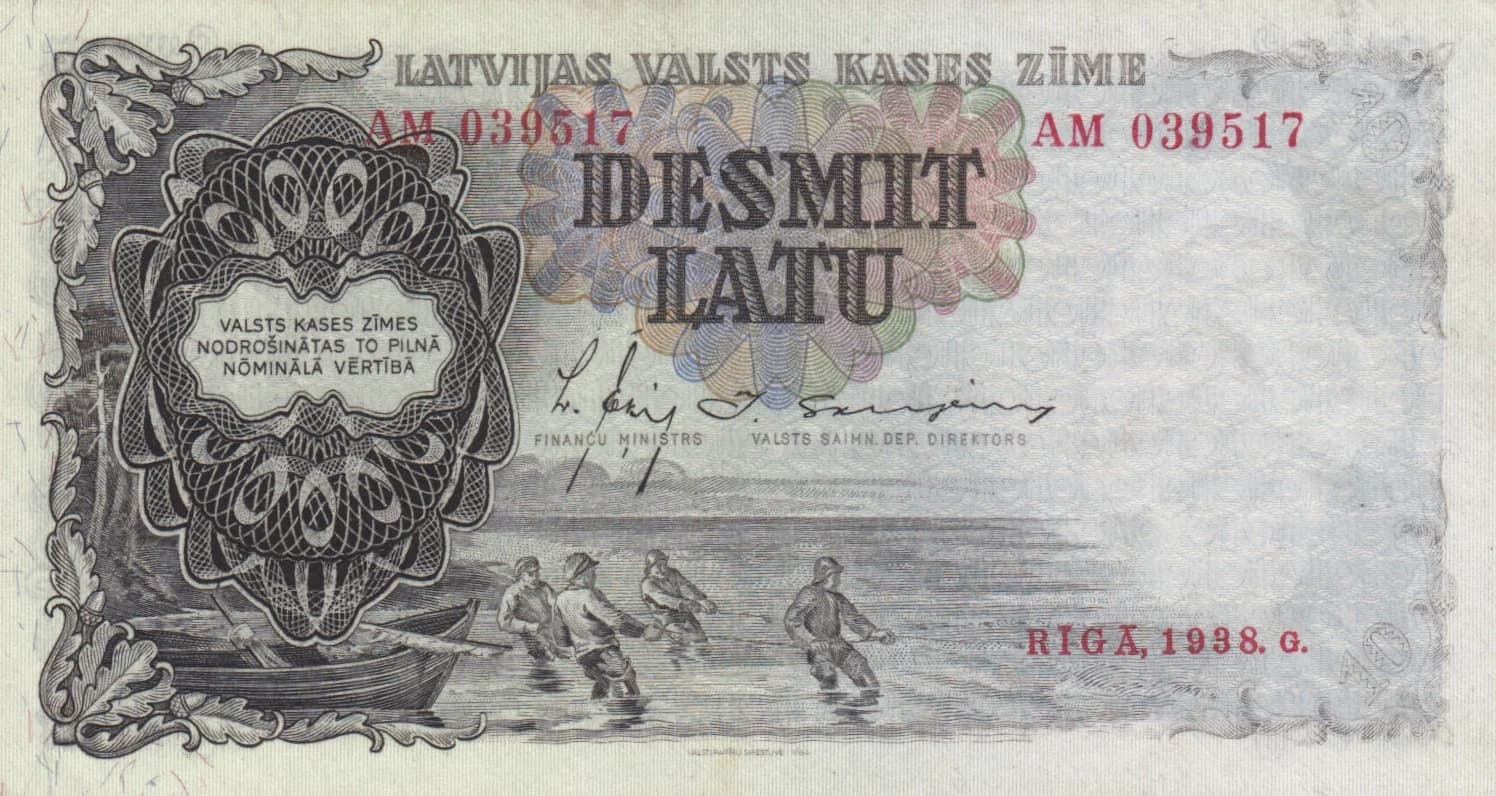
10 Latu 1940
“serie DE”
Market Prices
26 salesAbout This Note
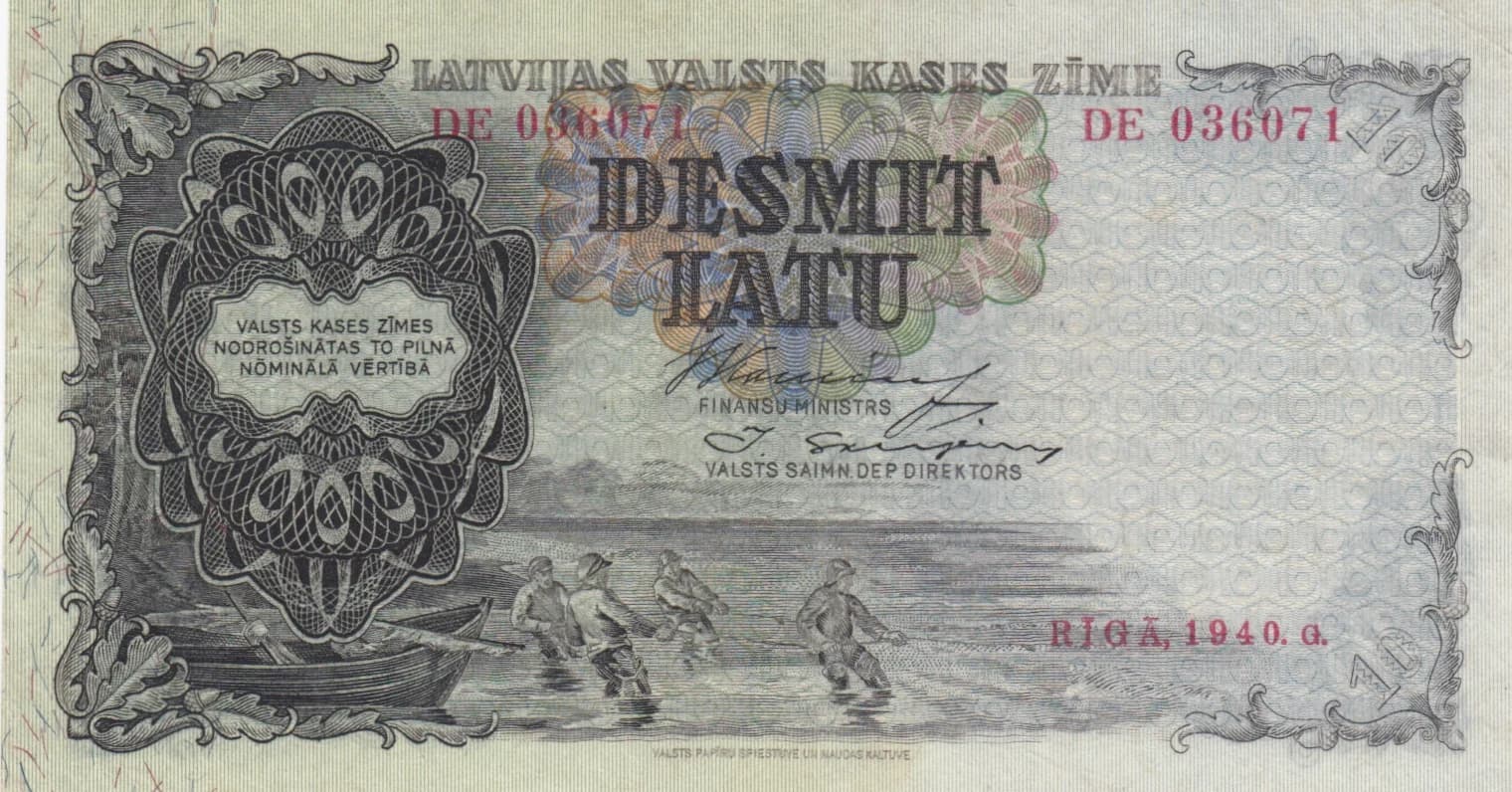
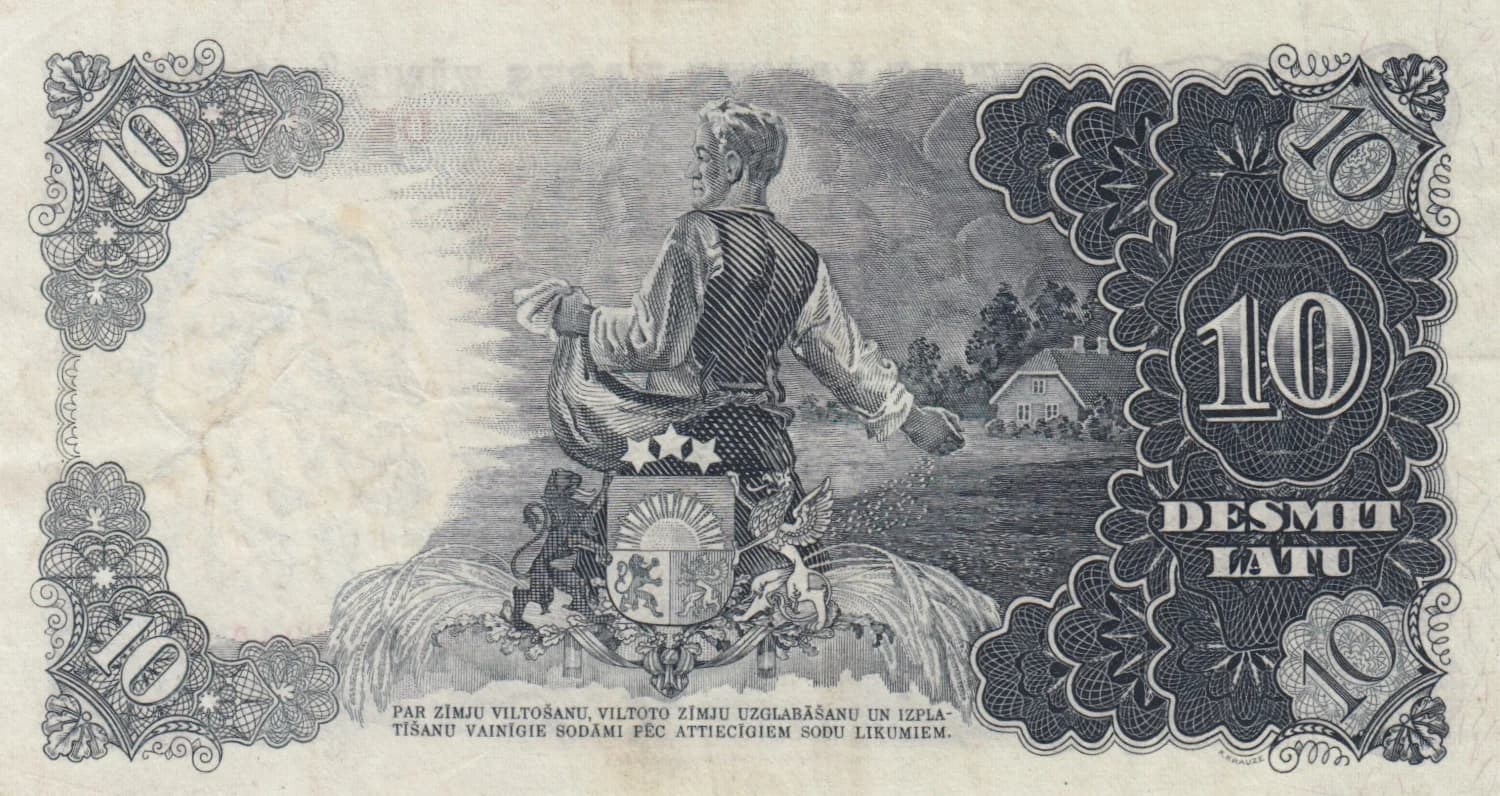
This is a well-preserved example of the 1940 Latvian 10 Latu note (Pick P-29d), graded AU, featuring the distinctive design characteristic of Latvia's interwar period currency. The note exhibits fine engraved work throughout with ornate heraldic elements, a water scene on the obverse, and a formal portrait on the reverse, all rendered in sophisticated black and gray tones with subtle color accents. The serial number DE 036071 places this in the DE series, and the note shows the patina and light creasing consistent with authentic 1940s currency while maintaining excellent overall preservation.
Common. The 10 Latu denomination from 1940 (Pick P-29d) was a standard circulating note issued by the Latvian government in its final year before Soviet annexation. While all Latvian interwar currency has historical significance, this particular denomination and year were produced in quantities typical of regular currency circulation. The AU condition grade and DE series designation do not indicate unusual scarcity. Notes of this type typically trade at modest prices reflecting their common status, with collector value deriving primarily from historical interest rather than rarity.
Issued in Riga in 1940, this banknote represents Latvia's final year of independent interwar currency before Soviet occupation in June 1940. The design incorporates traditional Latvian heraldic symbolism—the three-star coat of arms visible on the reverse representing the historical regions of Kurzeme, Vidzeme, and Latgale—reflecting the nationalist identity of the newly independent Latvian state established in 1918. The 'Latvian State Treasury Note' inscription and ministerial signatures underscore the authority of Latvia's pre-Soviet financial institutions during this critical political moment.
The obverse features an ornate heraldic emblem with intricate scrollwork and floral patterns in the upper left corner, serving as the primary security device. The central design showcases a detailed engraved water scene depicting multiple figures engaged in bathing or river activities, a common allegorical representation in Baltic currency of the era suggesting prosperity and national vitality. The reverse presents a formal portrait of a male figure in period dress positioned center-left, likely representing a Latvian national hero or statesman, accompanied by the three-star heraldic coat of arms of the Latvian state with eagles and multiple shields representing the nation's constituent regions. Decorative frames with geometric and floral patterns occupy all corners, and the denomination appears in an ornate cartouche on the right side. The sophisticated border design with elaborate flourishes throughout exemplifies the high-quality intaglio work characteristic of interwar Latvian currency.
FRONT SIDE: 'LATVIJAS VALTAS KASES ZĪME' (Latvian State Treasury Note) / 'DESMIT LATU' (Ten Latu) / 'VALSTS KASES ZĪMES NODROŠINĀTĀS TO PILNĀ NOMINĀLĀ VERTĪBĀ' (State Treasury Notes guaranteed at full nominal value) / 'FINANŠU MINISTRS' (Minister of Finance) / 'VALSTS SAIMN DEP DIREKTORS' (State Economy Department Director) / 'RĪGA, 1940. g.' (Riga, 1940) / Serial number: 'DE 036071'. BACK SIDE: 'DESMIT LATU' (Ten Latu) / '10' (numeral) / 'PAR ZĪMJU VILTOŠANU, VILTOTO ZĪMJU UZGLABĀŠANU UN IZPLAIŠANU VAINIGIE SODĀMI FĒC ATTIECĪGIEM SODU LIKUMIEM' (Forgers, possessors and distributors of counterfeit notes are punished according to applicable laws).
Intaglio engraving (line engraving), the standard security printing method for European banknotes of this period. The fine line engraving throughout, complex heraldic imagery, intricate decorative patterns, and detailed portraiture are hallmarks of intaglio printing. This note was produced by Latvia's state printing authority; the specific security printer details are consistent with Latvian government currency production of the 1930s-1940s era.
The serial number prefix 'DE' identifies this as part of a specific series within the 1940 10 Latu issue. The specific serial number DE 036071 indicates this is a mid-range serial number from that series. Known varieties of Pick P-29d include different signature combinations representing different Ministers of Finance and State Economy Department Directors; without clear visibility of all signatures in the analysis, the exact signature variety cannot be definitively determined, but the 1940 date and DE series designation confirm this as a standard circulation variety rather than an overprint or special issue.