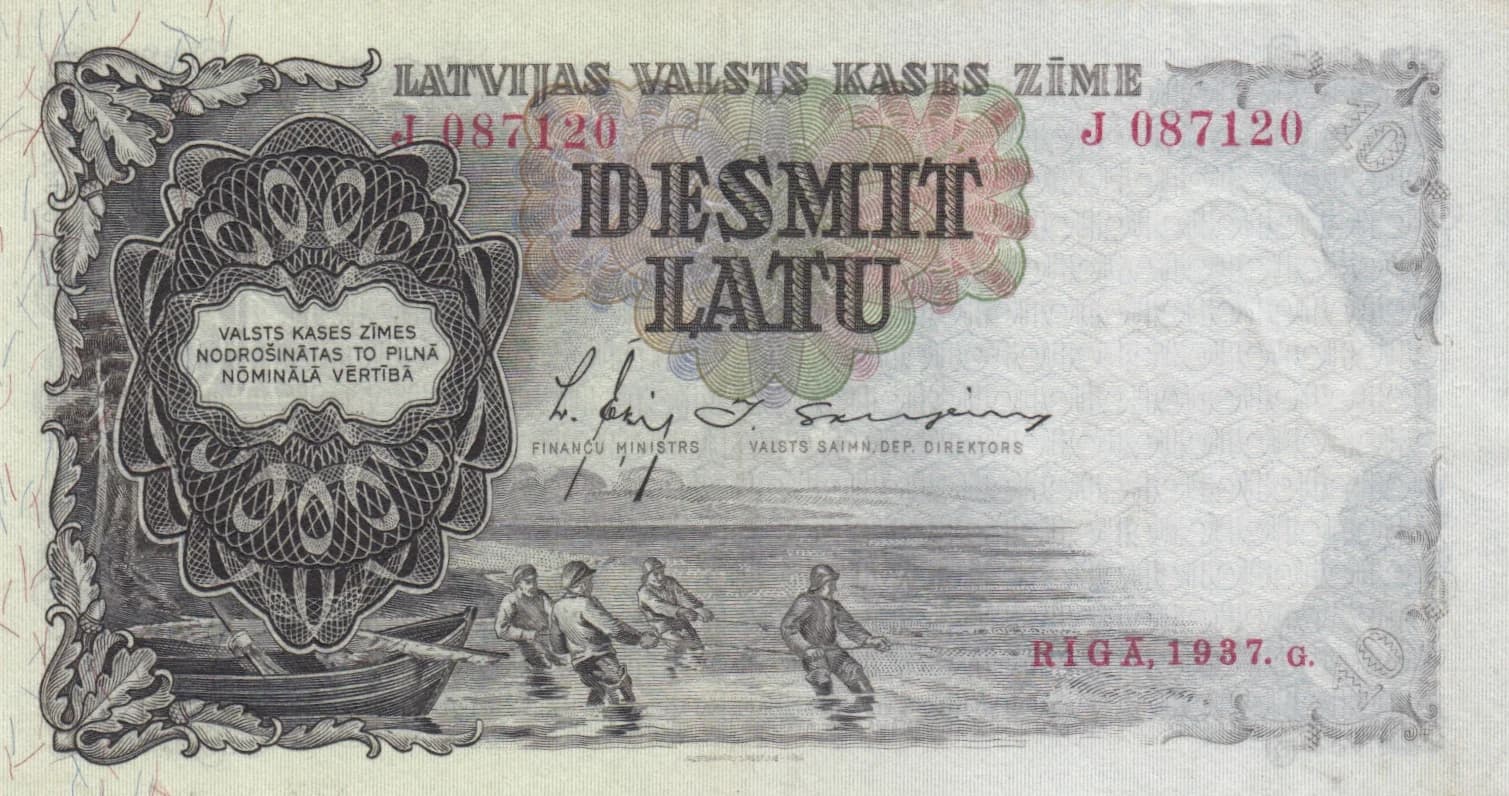
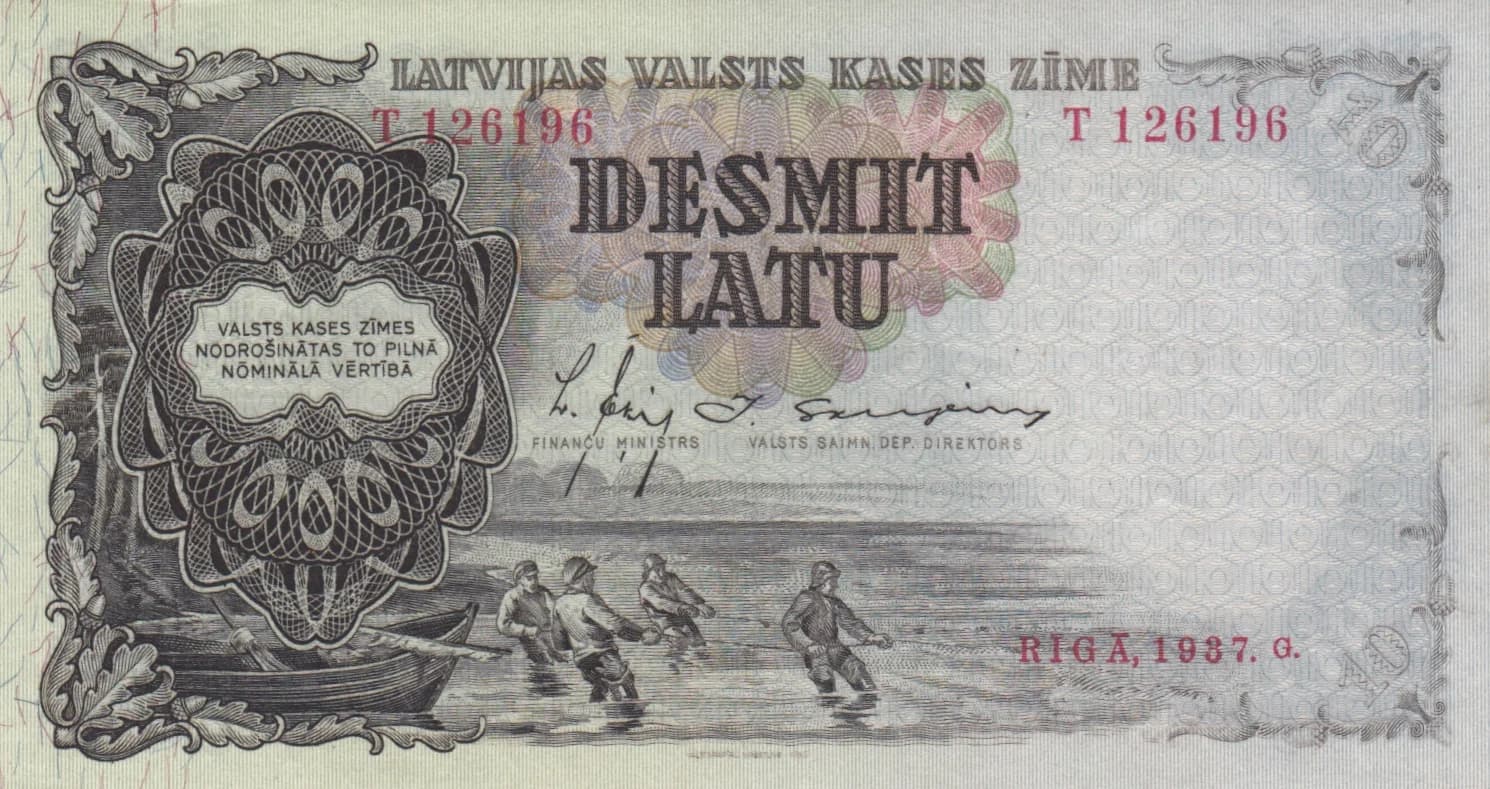
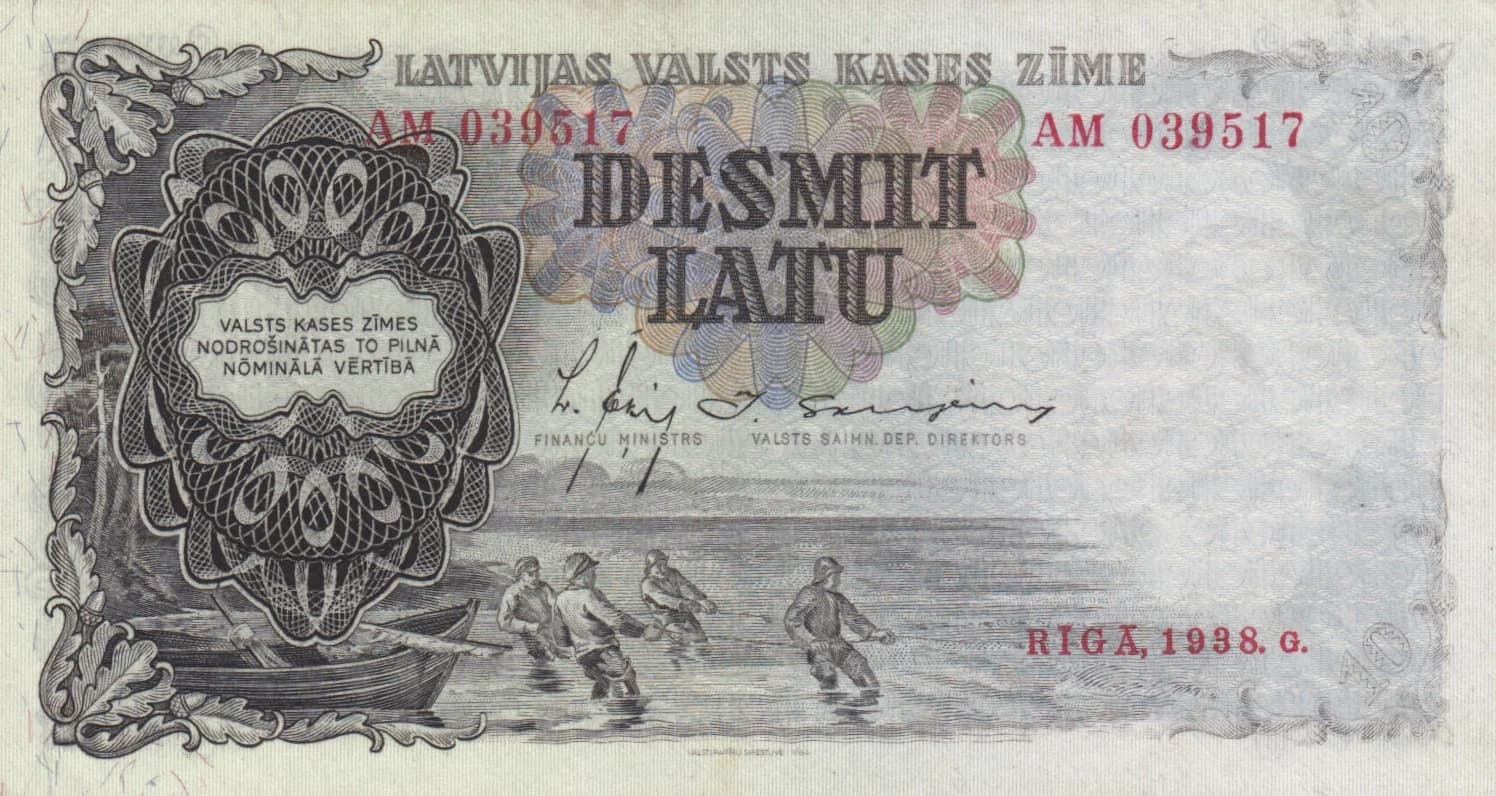
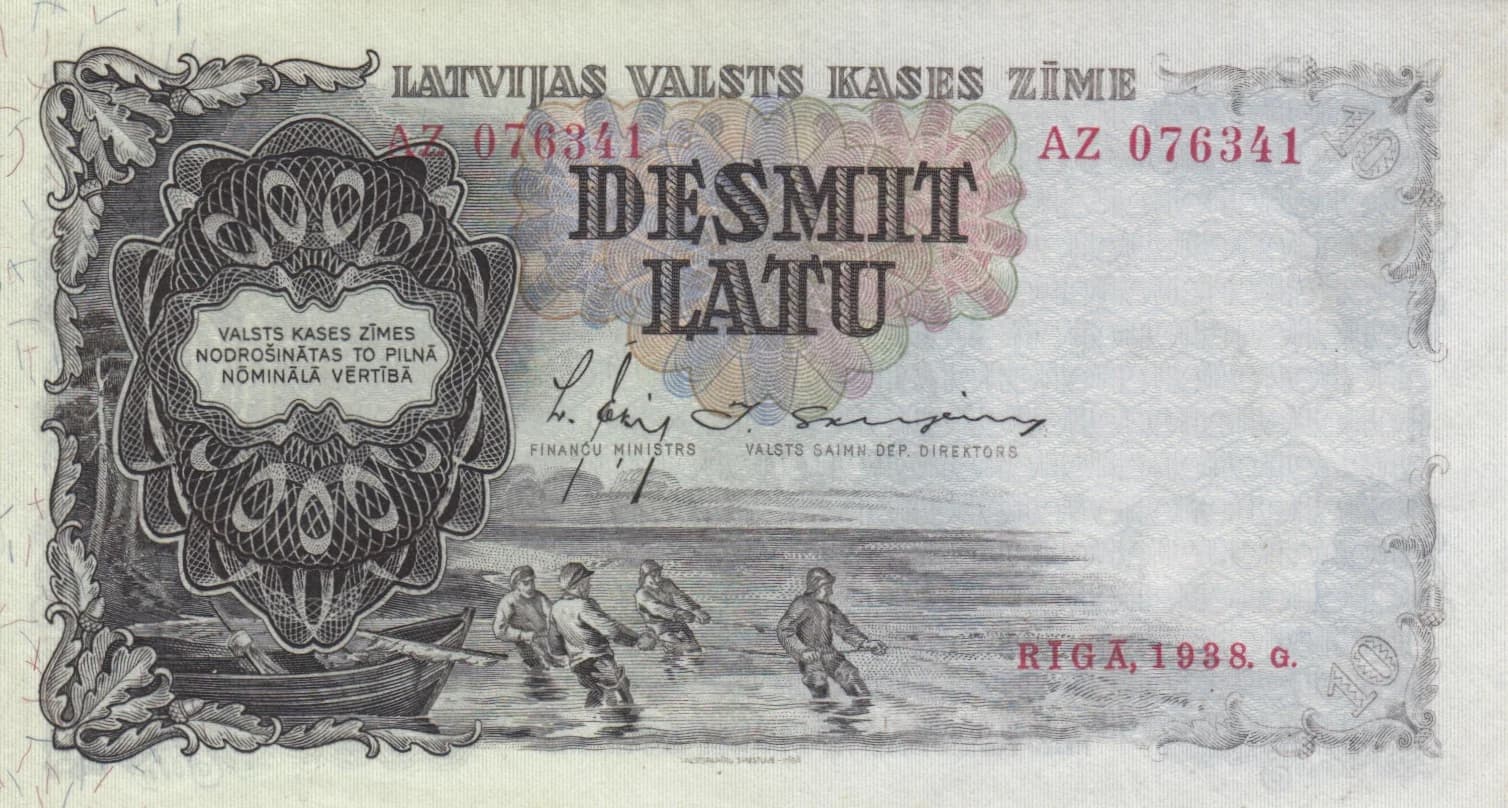
10 Latu 1938
“serie AG”
Market Prices
21 salesAbout This Note
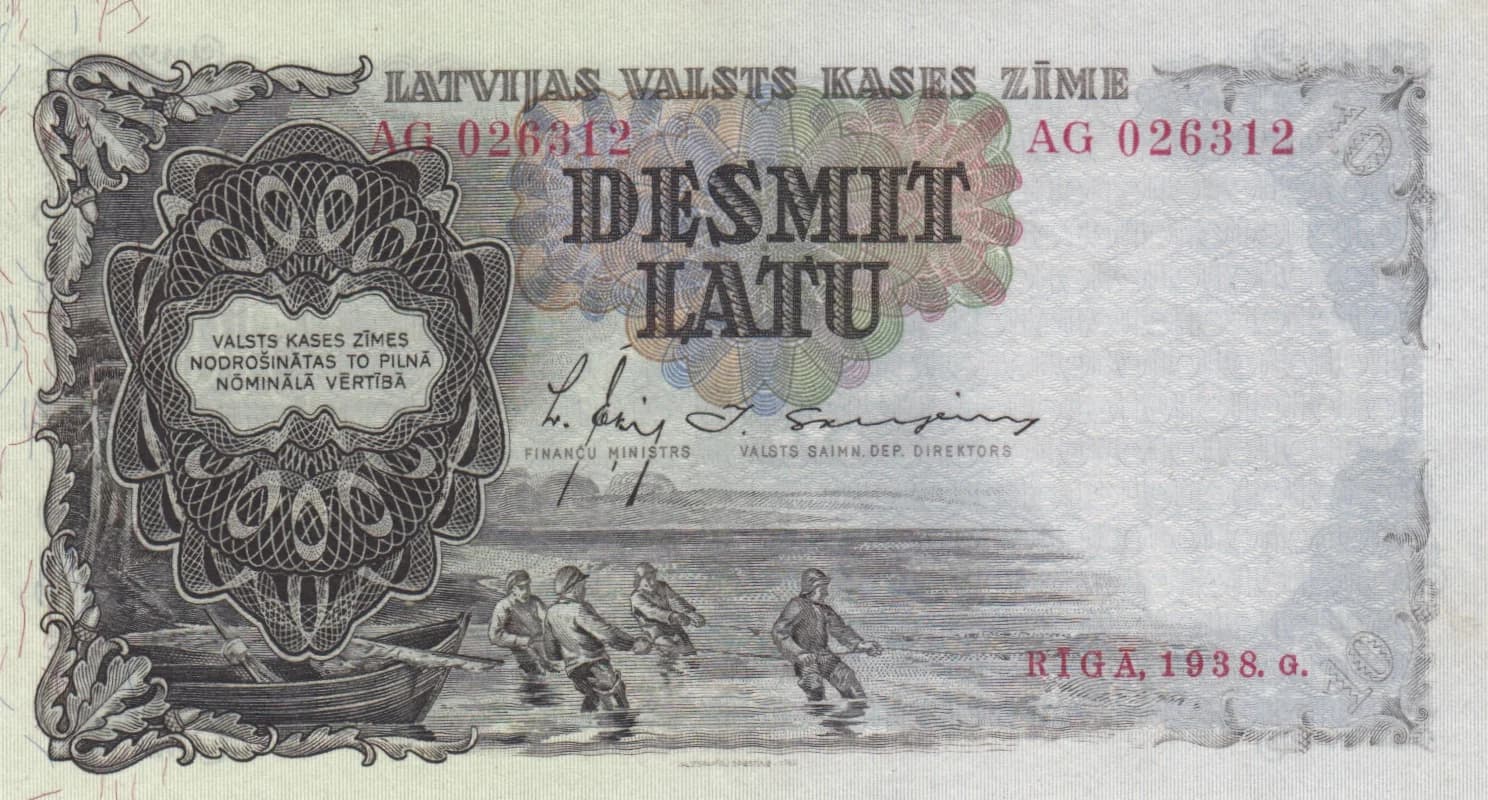
This EF-graded 10 Latu from 1938 represents a well-preserved example of Latvia's interwar currency, featuring the characteristic fishermen scene on the obverse and a classically-robed male figure on the reverse. The note exhibits the cream/beige patina and fine engraving typical of this series, with clear red serial numbers (AG 026312) and minimal creasing consistent with Extremely Fine condition. The robust secondary market activity documented on eBay, with EF examples realizing approximately $32-33, confirms this as a stable collector piece from Latvia's brief period of independence.
Common. This is a regular issue from Latvia's final years of independence (1937-1940), printed by the official state printer in quantities typical for circulating currency. eBay market data shows consistent availability with EF examples selling in the $30-35 range, indicating steady collector demand but abundant supply. No evidence of low print runs, recalls, or rarity designation in catalog data. The note's common status reflects its late-period issuance during normalized peacetime circulation before the 1940 Soviet occupation.
Issued during 1938 by the Latvijas Valsts Kases (Latvian State Treasury), this note represents the later stage of Latvia's independent monetary period, which would end with Soviet occupation in 1940. The imagery—featuring fishermen and a sower/farmer—reflects the agrarian and maritime economy of interwar Latvia, while the ornate baroque-style design and heraldic emblems emphasize the new nation's sovereignty and cultural identity established after 1918.
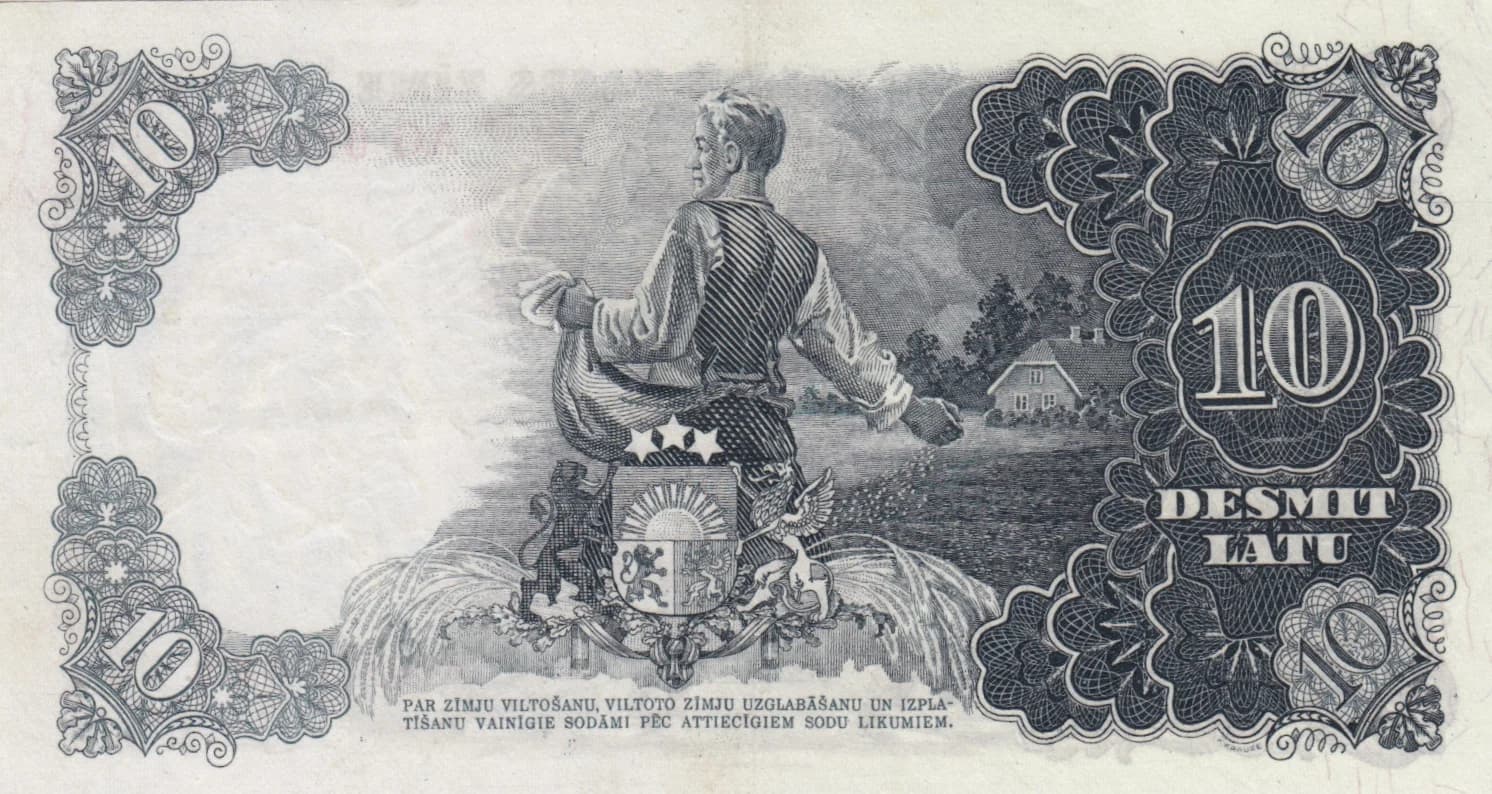
The obverse features an elaborate baroque cartouche containing treasury text on the left, with the denomination 'DESMIT LATU' prominently displayed in the center-right framed by decorative rosette patterns. The lower center depicts a scene of fishermen wading or swimming in water, symbolizing Latvia's maritime heritage and fishing industry. The reverse presents a standing male figure in classical drapery facing left in profile, likely representing agricultural prosperity or national virtue, accompanied by a rural landscape with trees and a distant building. Below this figure is Latvia's state coat of arms featuring heraldic shields and wings, emphasizing national sovereignty. Ornamental rosette cartouches containing the numeral '10' appear in both upper and lower corners, with complex floral and scrollwork borders framing the entire design. The multi-colored printing in black, gray, and red (for serial numbers) creates visual depth and security.
FRONT: 'LATVIJAS VALSTS KASES ZĪME' (Latvia State Treasury Note); 'DESMIT LATU' (Ten Latu); 'VALSTS KASES ZĪMES NODROŠINĀTĀS TO PILNĀ NOMIĀLĀ VĒRTĪBĀ' (State Treasury Note secured at its full nominal value); 'FINANČU MINISTRS' (Finance Minister); 'VALSTS SAIM. DEP. DIREKTORS' (State Treasury Department Director); 'RIGA, 1938. G.' (Riga, 1938); Serial number 'AG 026312'. BACK: 'DESMIT LATU' (Ten Latu); '10' (denomination); 'PAR ZIMJU VILTOŠANU, VILTOTO ZIMJU UZGLABĀŠANU UN IZPLATĪŠANU VAINĪGIE SODAMI PĒC ATTIECCĪBIEM SODU LIKUMIEM' (Those guilty of counterfeiting notes, possessing or distributing counterfeit notes shall be punished according to criminal laws).
Intaglio engraving (copperplate/steel plate), characteristic of high-security banknote production. The note was printed by Valsts Papiru Spiestuve (State Printing Works) in Riga. The fine line work visible in the ornamental borders, heraldic details, and portrait work, combined with the multi-color printing technique (black primary design with red serial numbers), indicates professional security printing methods standard for central bank currency of the period. The intricate engraved patterns serve as both aesthetic and anti-counterfeiting features.
Catalogued as Pick-29b, identified by watermark type (Man's Head). The visual analysis confirms serial number format 'AG 026312' in red ink, consistent with 1938 production. This specimen falls within the documented variety P-29b from the PMG population report. The catalog notes series 'AG' designation, which aligns with observed red serial numbering. No exceptional varieties (such as overprints, error notes, or signature variations) are apparent in this example. The note represents a standard production variety without noted rarity variants.