10 Latu 1940
“serie CZ”
Market Prices
26 salesAbout This Note
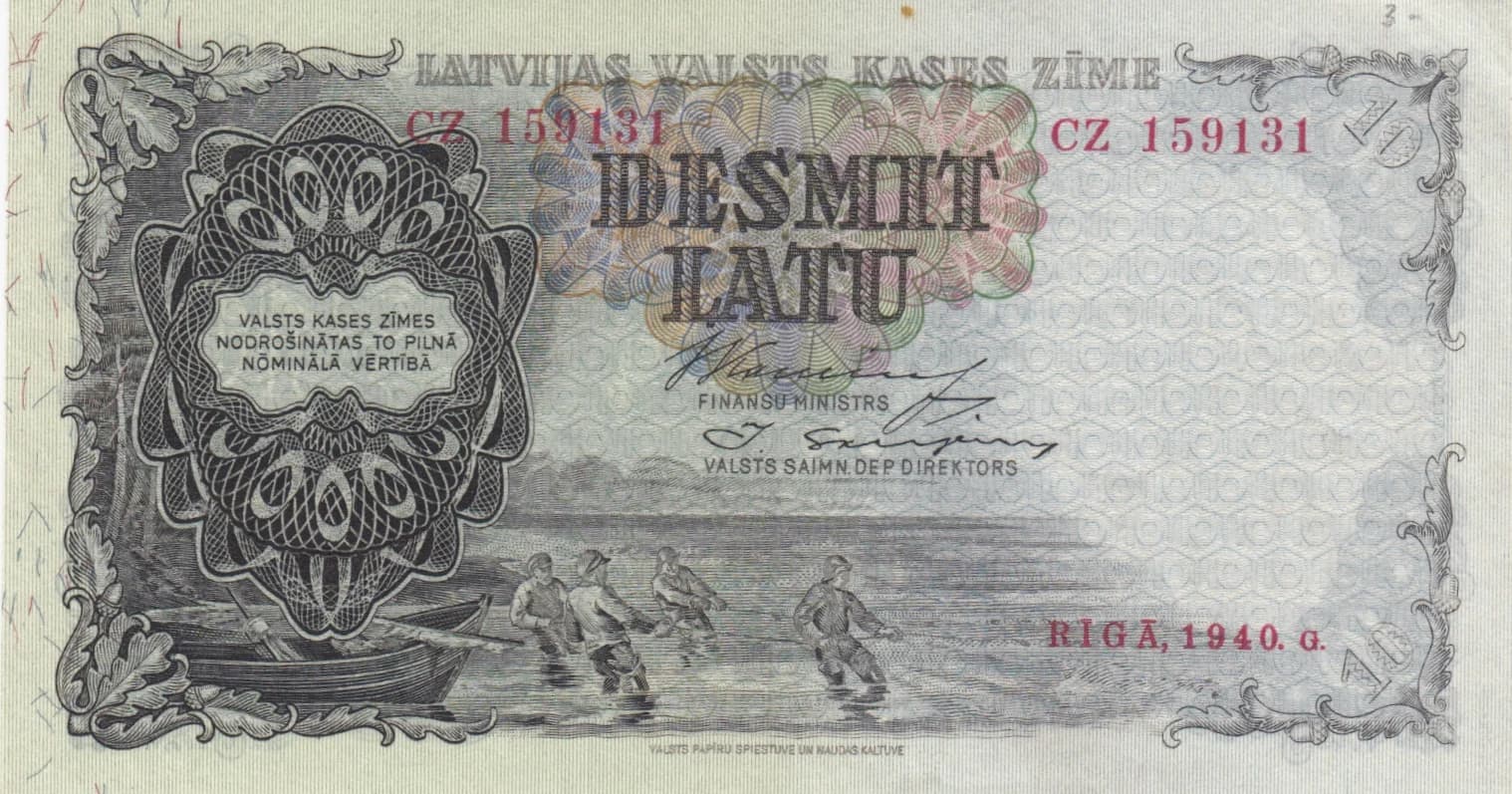
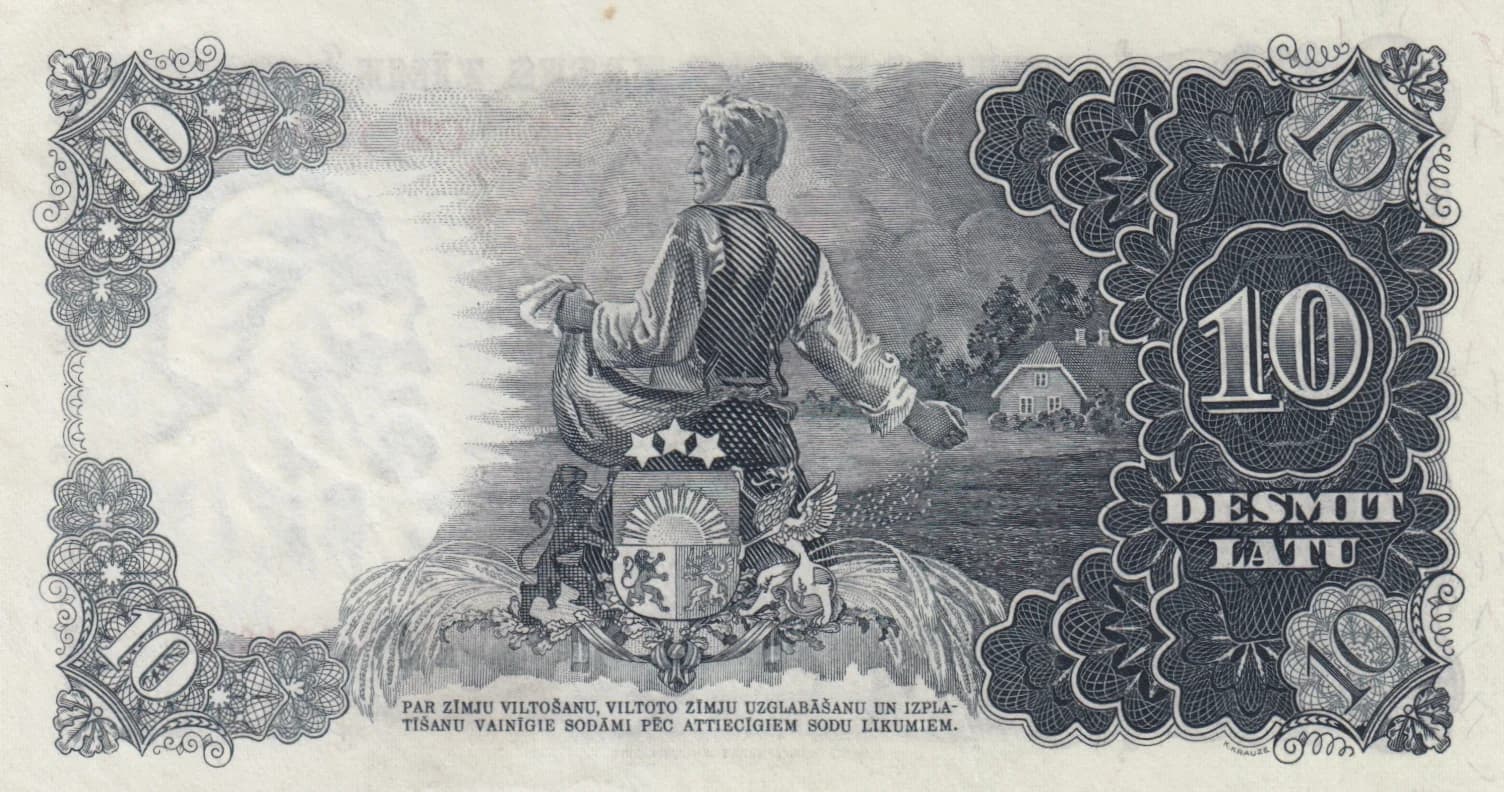
This is a well-preserved AU example of the Latvian 10 Latu note from 1940 (Pick P-29d), featuring the classic maritime and agricultural imagery characteristic of interwar Latvia's state banknotes. The note displays excellent detail in its intricate engraving work with minimal wear, showing the fishermen scene on the obverse and allegorical farmer figure on the reverse, both rendered in fine line work typical of 1930s-1940s European currency design. The serial number CZ 159131 and crisp red printing of the date 'RIGA, 1940. G.' are clearly visible, making this an appealing example for collectors of Baltic numismatics.
Common. Market data from realbanknotes.com shows consistent availability with moderate pricing: PMG-graded examples in the AU-UNC range (PMG 65-67) have sold for $47-$121 in recent years, while raw VF examples typically fetch $4-$50. The broad range of sales across multiple conditions and the consistent presence on the market indicate this was a substantial print run with adequate surviving examples. AU-grade notes like this example appear with reasonable frequency in the market, making it a common date and denomination for the series.
Issued by Latvijas Valsts Kases (the Latvian State Treasury) in 1940, this note represents the final year of independent Latvia's interwar currency period, just before the Soviet occupation in June 1940. The imagery—fishermen and a farmer sowing—deliberately celebrates Latvia's agrarian and maritime economy, reflecting nationalist themes common to interwar Baltic states. The heraldic coat of arms with lion and crown symbols underscores Latvia's sovereignty and statehood during this brief period of independence between the world wars.
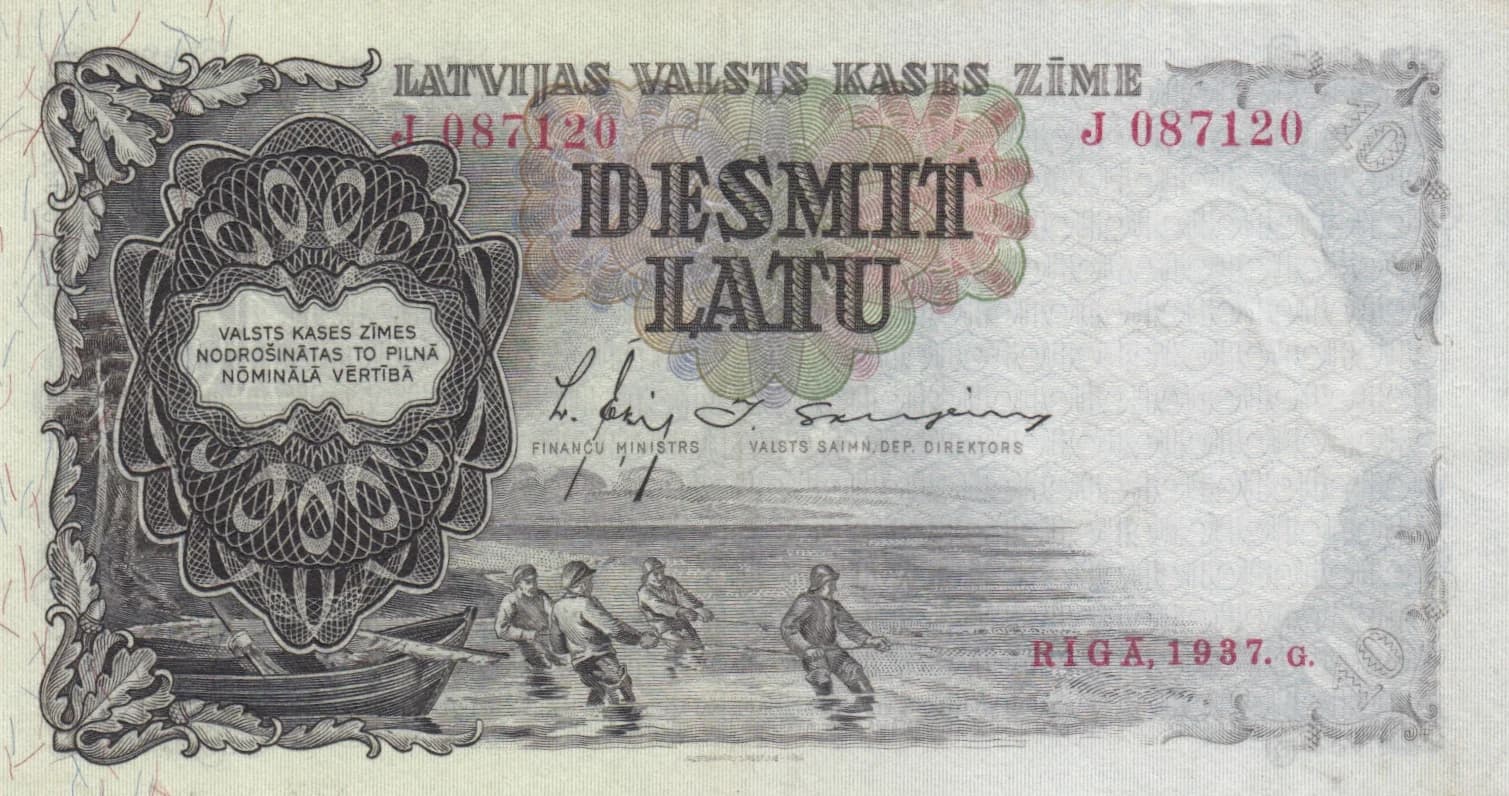
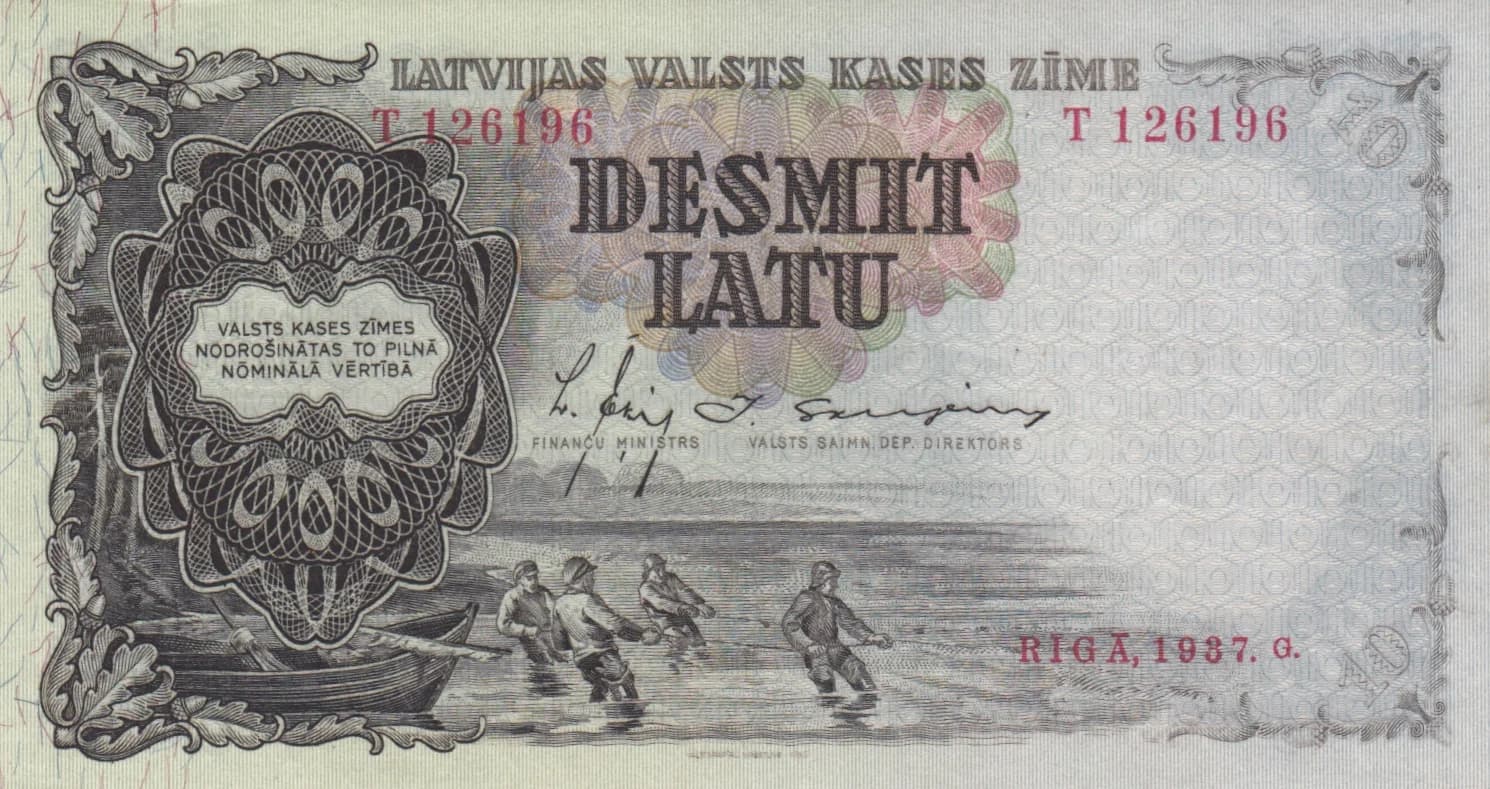
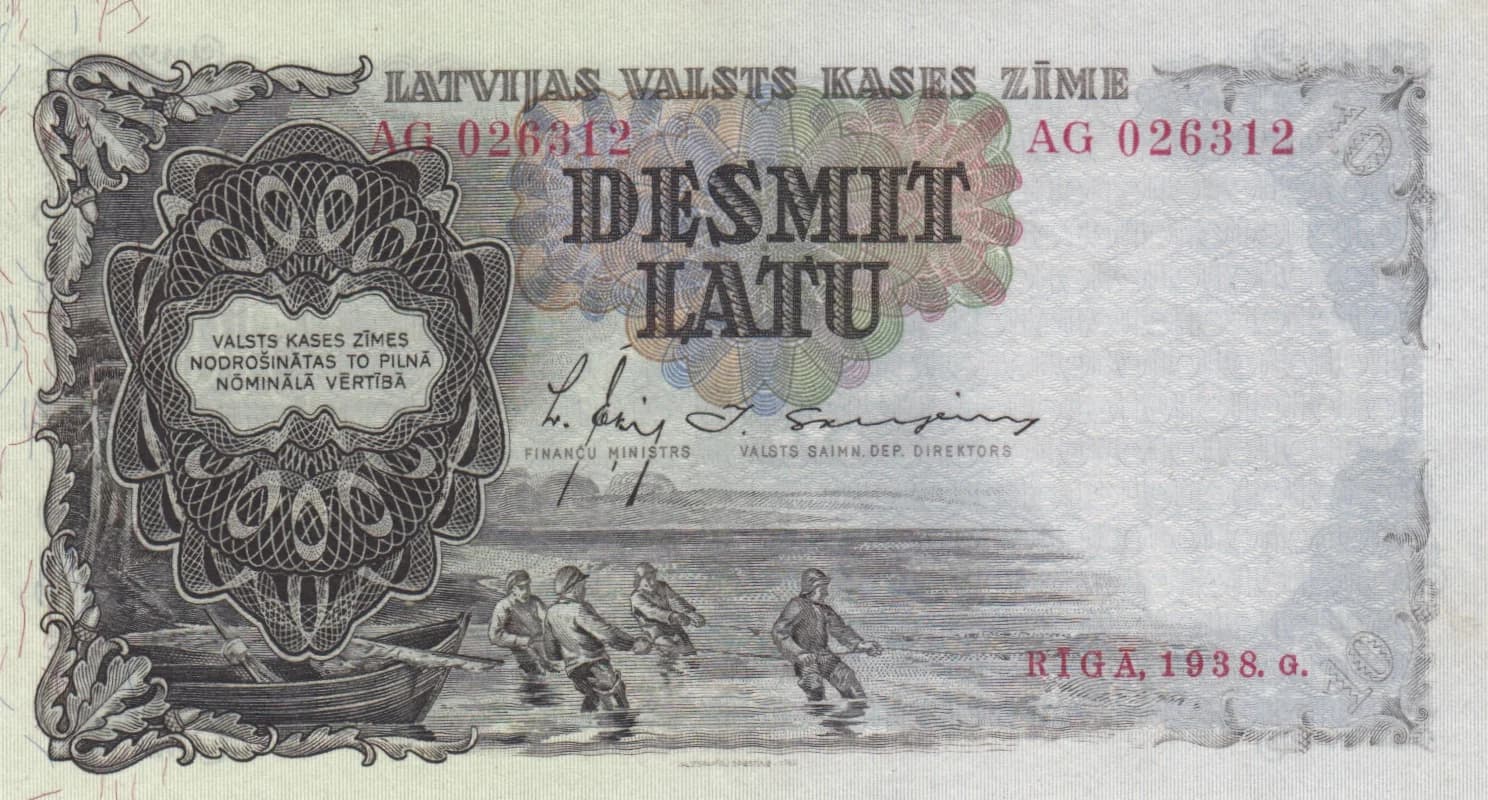
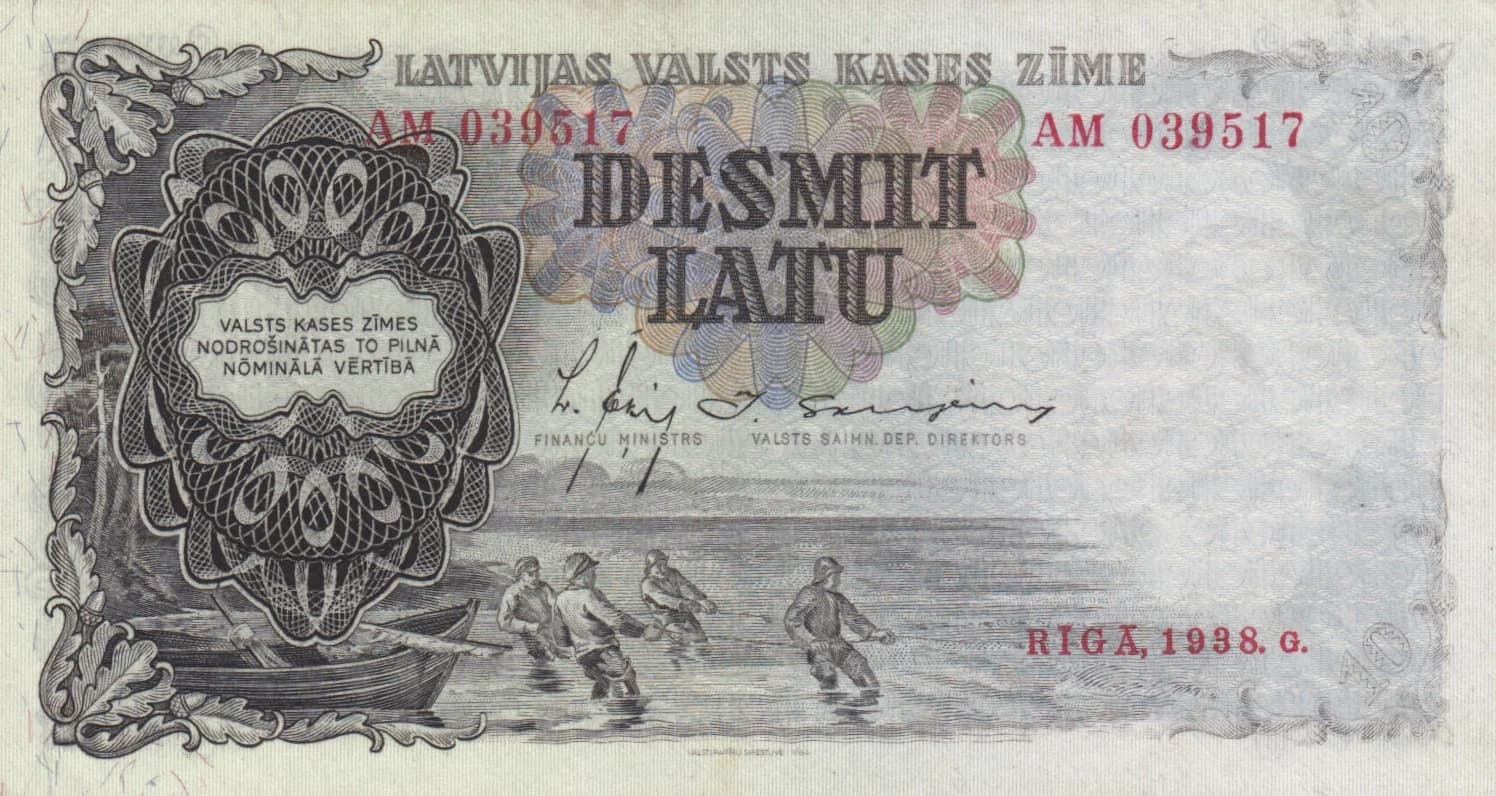
The obverse features a detailed maritime scene depicting Latvian fishermen in a boat on water, positioned on the lower right portion of the note, symbolizing the nation's fishing heritage and coastal economy. A large heraldic shield containing Latvia's state coat of arms—featuring a crowned shield with lion and regional divisions—dominates the left side, emphasizing national sovereignty. The reverse displays an allegorical male figure in classical draped robes, representing the farmer or agricultural worker, positioned against a rural landscape with a cottage and countryside scenery, symbolizing Latvia's agricultural foundation. Large ornate numerals '10' appear in decorative cartouches in both lower corners. Throughout both sides, elaborate ornamental borders with intricate scrollwork and floral motifs frame the composition, while the text 'DESMIT LATU' (Ten Lats) appears prominently in the center. The entire design was executed using fine line engraving with detailed cross-hatching and guilloche patterns typical of high-security banknote production.
FRONT SIDE: 'LATVIJAS VALSTS KASES ZĪME' (Banknote of the State Treasury of Latvia); 'DESMIT LATU' (Ten Lats); 'VALSTS KASES ZĪMES NODROSINĀTĀS TO PILNĀ NOMINĀLĀ VĒRTĪBĀ' (State Treasury banknote secured with full nominal value); 'FINANSU MINISTRS' (Finance Minister); 'VALSTS SAIMN DEP DIREKTORS' (State Treasury Department Director); 'RIGA, 1940. G.' (Riga, 1940). BACK SIDE: 'DESMIT LATU' (Ten Lats); 'PAR ZĪMJU VILTOŠANU, VILTOTO ZĪMJU UZGLABĀŠANU UN IZPLATĪŠANU VAINIGIE SODAMI PĒC ATTIECĪGIEM SODU LIKUMIEM.' (Those guilty of counterfeiting, possessing or distributing counterfeit notes shall be punished according to applicable penalty laws.)
Intaglio (line engraving), as evidenced by the fine detail work, deep impression characteristics, and elaborate guilloche patterns visible throughout the note. Printed by Valsts Papiru Spiestuve (State Paper Printing Works) in Riga, the official printer for Latvian currency. The security features include intricate cross-hatching, fine line work, and complex background patterns characteristic of 1930s-1940s European central bank note production.
This is Pick P-29d, identified by the man's head watermark characteristic of the P-29 series variants. The specific variety P-29d is one of four catalogued variants (P-29a, P-29b, P-29d, P-29e) in the PMG population report, all sharing the same watermark type. The serial number prefix 'CZ' and the 1940 date are consistent with late-issue examples from this final year of independent Latvia. No overprints or special markings are evident, indicating this is a standard issue from the regular production run.