1 rubel 1919
“serie K”
Market Prices
17 salesAbout This Note
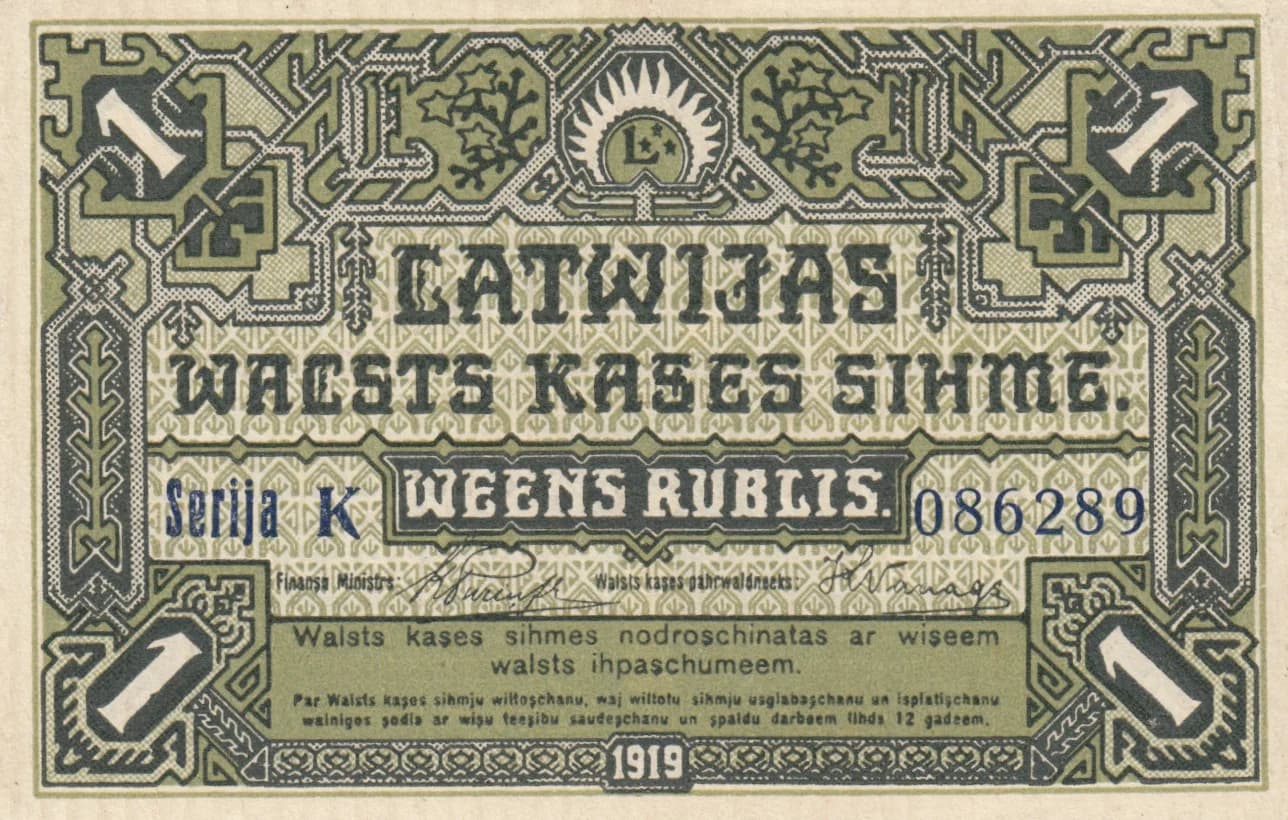
This is a Series K example of the Latvia 1 Rublis P-2b from 1919, graded AU by condition. The note features striking Art Nouveau geometric border designs in green and cream with a prominent rising sun symbol at the top center of the obverse. The sharp, well-defined printing and minimal wear visible in the images are consistent with the AU grade, making this an attractive example of early Latvian currency from the tumultuous post-WWI period.
Common. The eBay price history provided shows numerous sales ranging from $4.75 to $129.50, with the majority of graded examples (PMG 64) selling consistently in the $19-$52 range, and even high-grade PMG 66 examples selling for approximately $130. This consistent market activity and moderate pricing at all grade levels indicates robust circulation of surviving examples. Series K was among the standard series printed for this issue. No print run restrictions or recall information suggest this variety is common in the collector market.
Issued during Latvia's independence in 1919, this note represents the transitional currency period following the Russian Empire's collapse and Latvia's declaration of independence from Soviet Russia. The multilingual inscriptions in Latvian, German, and Russian reflect the complex geopolitical and ethnic composition of the newly independent state. The rising sun symbol on the obverse and the Art Nouveau design aesthetic were contemporary design choices meant to project modernity and stability for the fledgling Latvian nation.
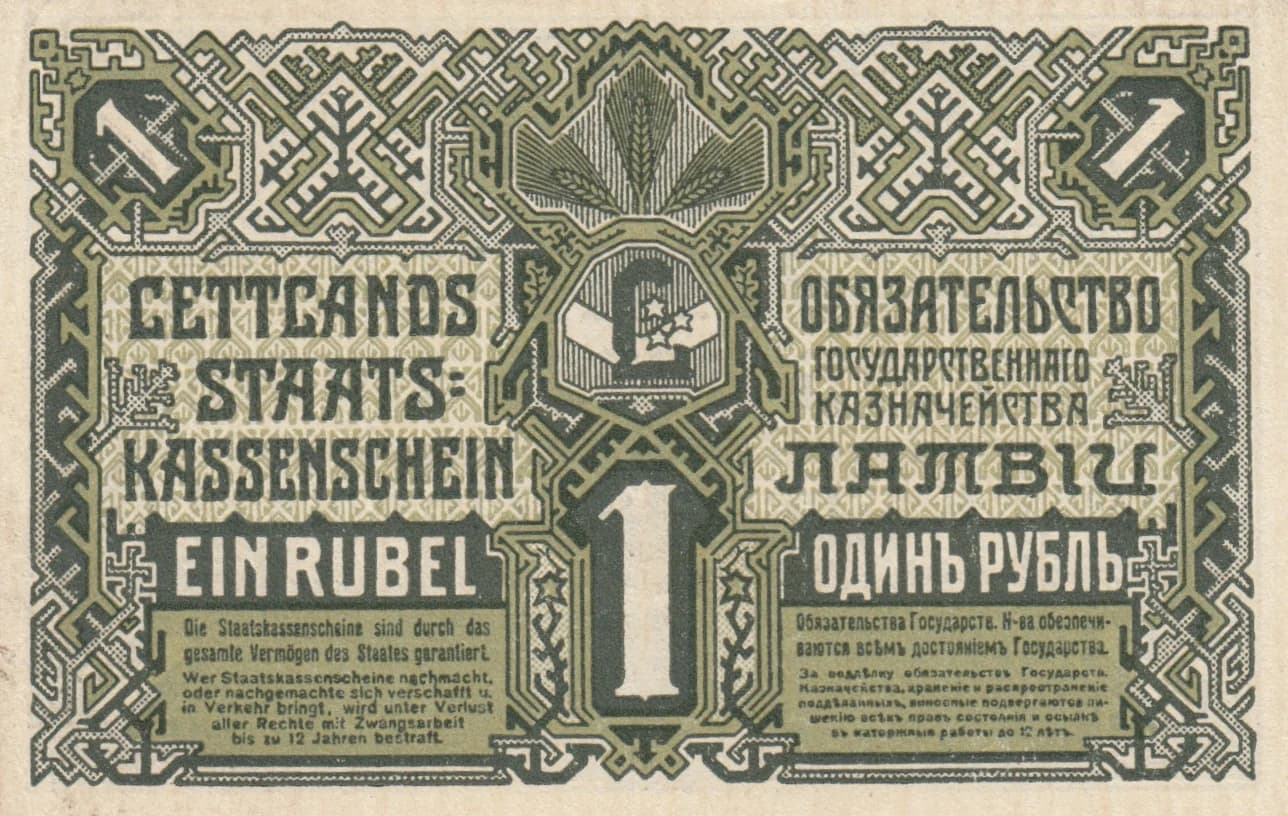
The obverse features an ornate Art Nouveau-style border composed of interlocking geometric shapes and botanical floral motifs in green and cream. A radiating rising sun symbol dominates the top center, symbolizing national renewal and hope. Text panels with bilingual Latvian and German inscriptions occupy the central field. The reverse mirrors the symmetrical border design with similar geometric and botanical elements, prominently displaying a large numeral '1' in the center. Heraldic emblems or coats of arms appear in shield form, typical of state treasury notes of this era. The multilingual text includes German and Russian versions of the same legal guarantees and penalty clauses, reflecting the note's use across the Baltic region and its origins in the multilingual Russian Empire.
OBVERSE: 'LATVIJAS WALSTS KASES SIHME' (Latvian State Treasury Note), 'MEENS RUBLIS' (One Ruble), 'Serija K' (Series K), Serial number '086289', '1919' (year of issue), 'Walsts kases sihmes nodroschinatas ar wiseem walsts ihpaschumeem' (State treasury notes are guaranteed by all state property), 'Par Walsts kases sihmju witloscchanu, maj witlolu simju usglaodscchanu un isglatchanu wasiiges sodas in wisu feriodu sudedscchanu un spaldu darbem tiba 12 gadiem' (For the implementation of state treasury note obligations, which are issued and put into circulation for public works, there is a period of 12 years). REVERSE: 'EESTLANDS STAAT-KASSENSCHEIN' (Estonia's State Treasury Note in German), 'EINRUBEL' (One Ruble in German), Russian inscriptions: 'ОБЯЗАТЕЛЬСТВО ГОСУДАРСТВЕННОГО КАЗНАЧЕЙСТВА ДЛЯ ЛЬГОТ' (Obligation of the State Treasury for Benefits), 'ОДИН РУБЛЬ' (One Ruble), German legal text regarding counterfeiting penalties (forced labor up to 12 years), Russian legal text regarding state obligations and penalties for counterfeiting (death or hard labor up to 12 years), Large denomination '1'.
Intaglio letterpress printing, evidenced by the crisp, well-defined geometric borders, sharp text impression, and the depth visible in the decorative patterns. The intricate interlocking geometric design served as both aesthetic element and security feature against counterfeiting. The consistent color registration in green and cream across both sides suggests professional security printer production typical of early 20th-century European central banks. The specific printer for Pick P-2b is not definitively documented in standard catalogs, though Latvian currency of this period was often produced by established European security printing firms.
This is Pick catalog number P-2b, Series K, Serial number 086289. The P-2b designation indicates this is a variant of the basic 1 Rublis type, with variants P-2a and P-2b documented by PMG. Series letters for this issue include E, F, G, H, and K per the realbanknotes.com reference. The specific distinguishing characteristics of P-2b versus P-2a (such as printer marks, signature combinations, or subtle design variations) are not resolved in the provided visual analysis, but the Series K designation and multilingual inscriptions (Latvian, German, Russian) are consistent with documented varieties of this issue.