1 rubel 1919
“serie H”
Market Prices
17 salesAbout This Note
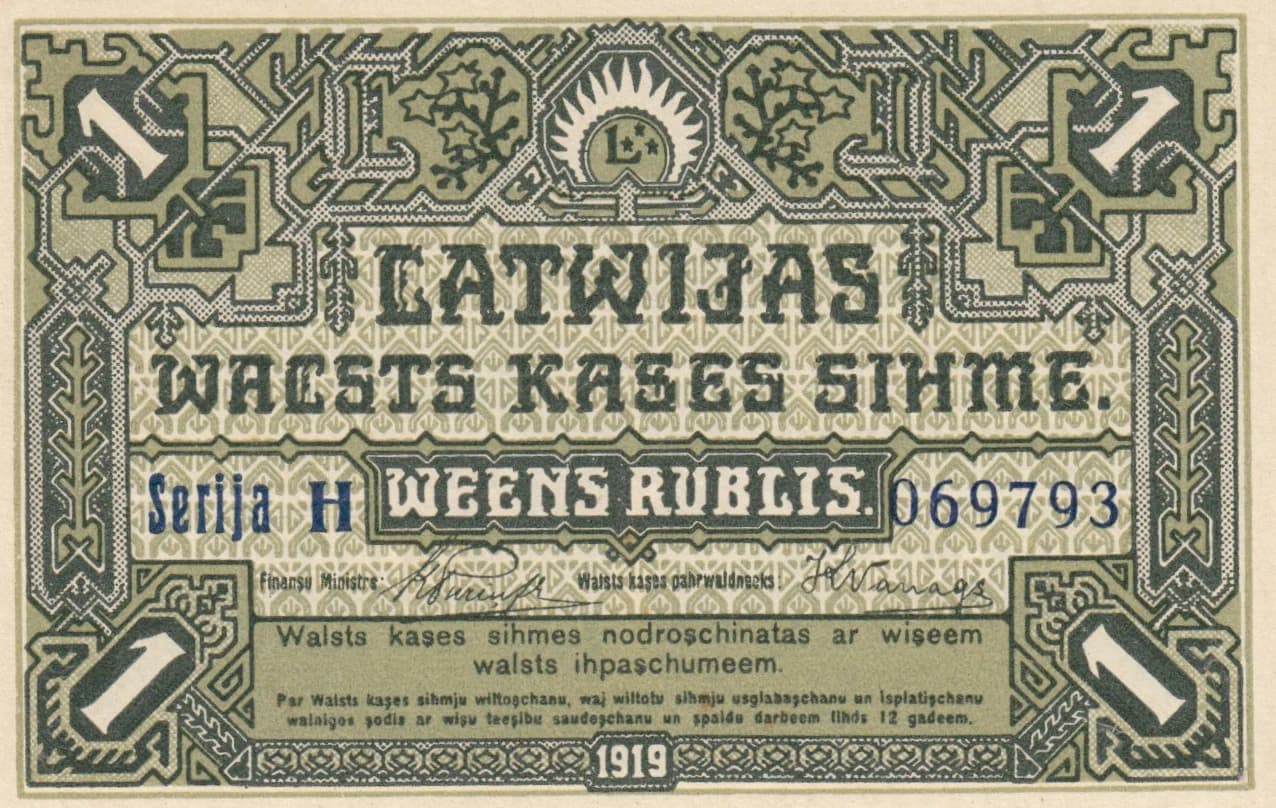
This is an uncirculated 1 Ruble note from Latvia's 1919 government issue, representing an important early monetary instrument of the newly independent Latvian state. The note displays exceptional preservation with crisp printing, well-defined Art Nouveau borders featuring geometric guilloche patterns and a prominent rising sun motif, rendered in cream/beige with dark green and black inks. Series H designation and serial number 069793 are clearly visible, making this an attractive example of Latvia's transitional currency during the post-WWI period.
Common. The 1919 Latvian 1 Ruble (Pick P-2b) was issued during the early period of Latvian independence as a fundamental denomination in the new state's currency system, resulting in substantial print runs. No historical evidence suggests limited production, recall, or scarcity. Series H notes, while identified by series letter, do not command significant premiums. The note's uncirculated condition is desirable but does not substantially elevate rarity, as other examples in similar states are known to exist in the collector market.
Issued in 1919 by the Latvian Government during the nation's emergence as an independent state following World War I and the collapse of the Russian Empire, this note represents Latvia's early monetary sovereignty. The trilingual design—featuring Latvian, German, and Russian text—reflects the complex linguistic and political environment of the region during this transitional period. The rising sun motif and Art Nouveau styling symbolize optimism for the new nation, while the security warnings translated into multiple languages underscore the government's concerns about counterfeiting during economically unstable times.
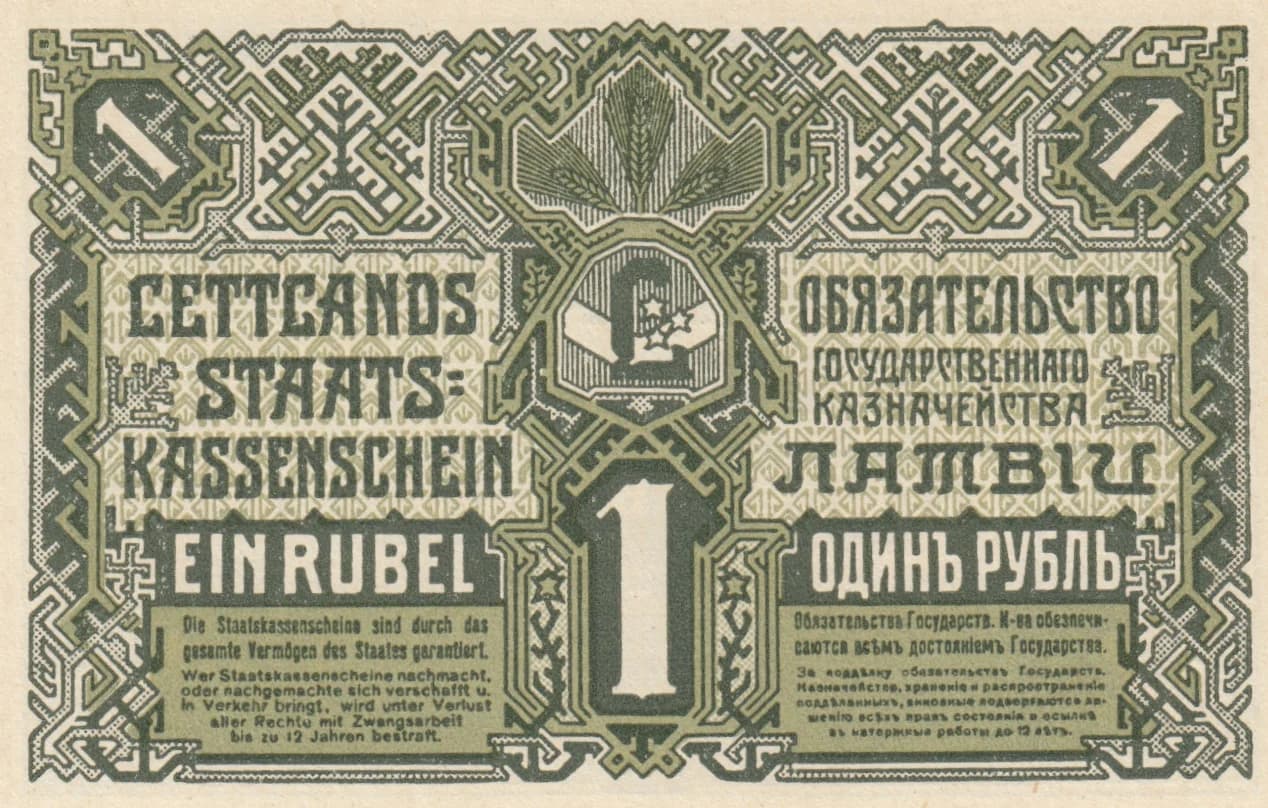
This banknote exemplifies early 20th-century Art Nouveau design applied to state currency. The front features an ornate geometric and floral border pattern with decorative corner numerals in an angular Art Nouveau style. The dominant design element is a rising sun or sunburst motif positioned in the upper center, symbolizing Latvia's emergence as a new nation. The back maintains the same ornamental border treatment and introduces a large central numeral '1' as the primary denomination indicator, flanked by heraldic shield or coat of arms motifs in the upper center section. No portraits are depicted; instead, the design emphasizes symbolic national imagery and elaborate security patterns through intricate guilloche work and geometric designs. The bilingual and trilingual text arrangement serves both functional and security purposes, reinforcing the note's connection to Latvia's multilingual cultural context.
FRONT SIDE: 'LATVIJAS WALSTS KASES SIHME' (Latvia's State Treasury Note), 'WEENS RUBLIS' (One Ruble), 'Serija H' (Series H), serial number 069793, 'Finanču Ministri' (Ministry of Finance), 'Walsts kases sihmes nodroschinatas ar wiseem walsts ihpaschumeem' (State treasury notes are secured by all state property), and penalty clause: 'For circulation of state treasury notes, counterfeiting or illegal distribution penalties include imprisonment up to 12 years.' BACK SIDE: 'LETTLANDS STAATS-KASSENSCHEIN' (Lettland State Treasury Certificate) and 'EIN RUBEL' (One Ruble) in German; 'ОБЯЗАТЕЛЬСТВО ГОСУДАРСТВЕННОГО КАЗНАЧЕЙСТВА' (Obligation of the State Treasury) and 'ОДИН РУБЛЬ' (One Ruble) in Russian. German penalty text: 'State treasury certificates are guaranteed by the entire assets of the state. Counterfeiting state treasury certificates or distributing counterfeits is punishable by forced labor up to 12 years.' Russian penalty text: 'State obligations are secured by all state property. Counterfeiting, manufacture, destruction and distribution of forged certificates is punishable by loss of all civil rights and hard labor up to 12 years.'
The note was produced using letterpress or intaglio printing techniques, evidenced by the crisp, well-defined impression of the fine guilloche patterns, geometric borders, and text throughout both sides. The consistent color registration and sharp line work characteristic of these observations indicate professional security printing. While the specific security printer for Pick P-2b is not definitively documented in widely available sources, the technical quality suggests production by an established European security printer, likely a firm with experience in post-WWI government currency production.
This example is identified as Series H by the 'Serija H' marking visible on the front and serial number 069793. For Pick P-2b, series designations represent the primary variety classification. The series letters (A through H or beyond) were used to control production batches. Series H represents a later printing batch within the 1919 issue. No significant printing variations, watermark differences, or overprints are evident in this specimen. Collectors of Latvian currency typically seek examples across multiple series to represent the full range of the 1919 issue.