1 rubel 1919
“serie G”
Market Prices
17 salesAbout This Note
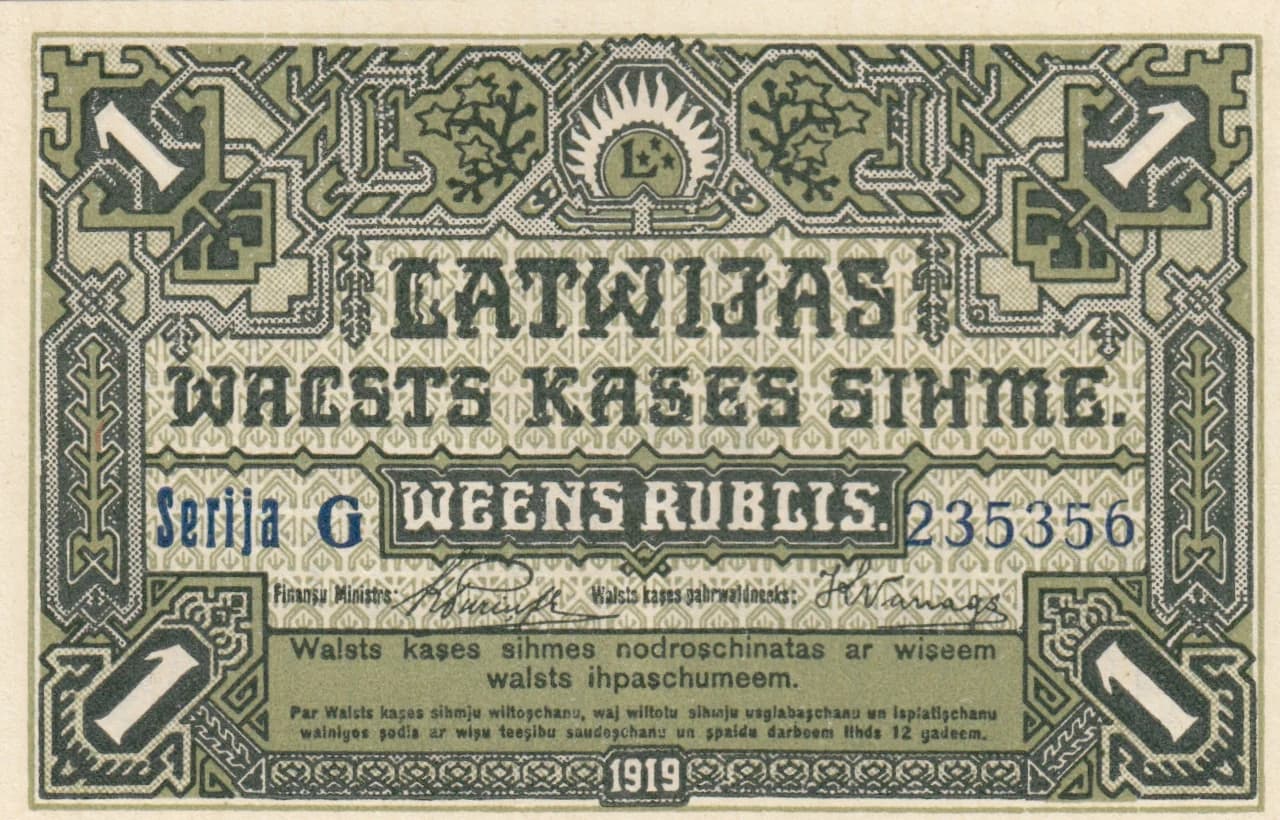
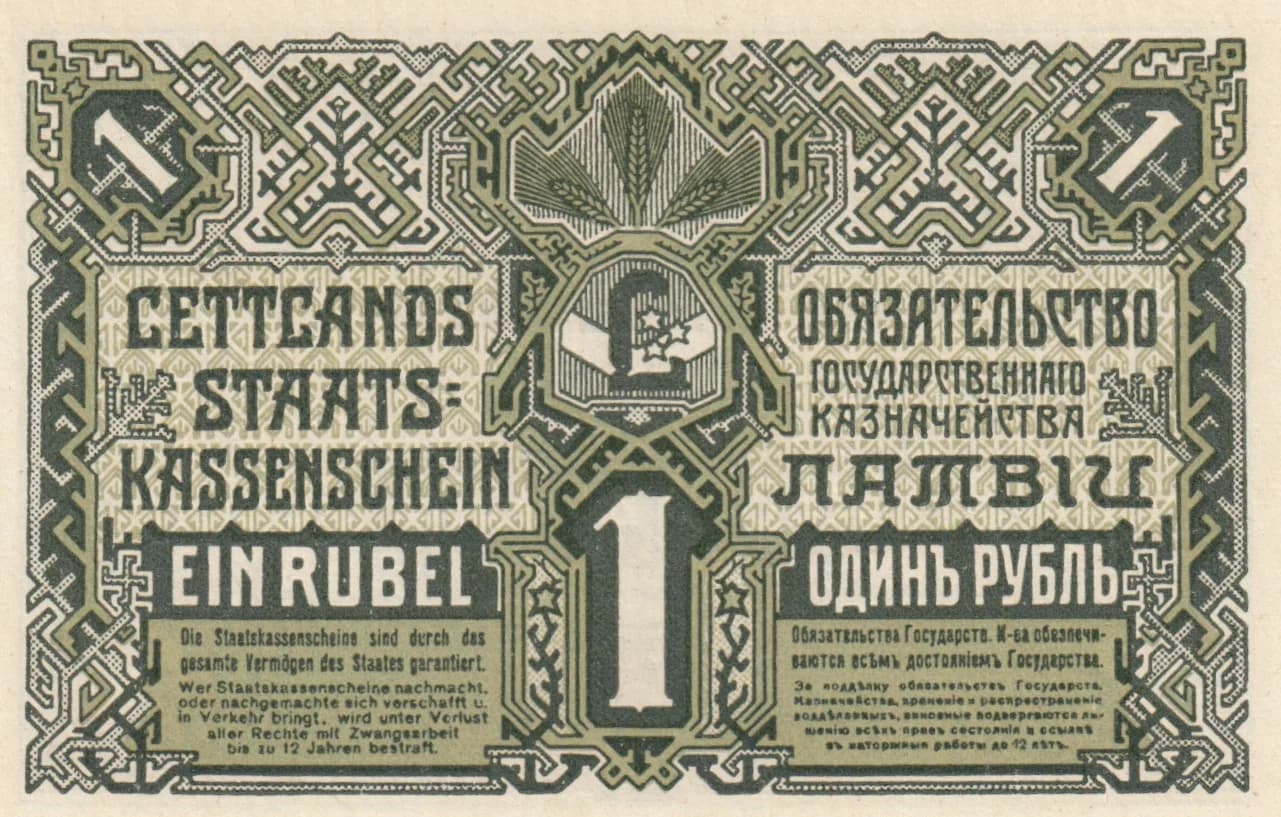
This 1919 Latvian 1 Rubel note (Pick P-2b, Series G) showcases the early independence currency of Latvia with exceptional Art Nouveau design featuring ornate geometric borders, a radiating sun motif on the obverse, and a central heraldic emblem with wheat stalks on the reverse. The note exhibits authentic aging characteristics including visible creasing and fold marks consistent with circulation during the early Soviet period, making it a historically significant artifact of Latvia's brief first independence era. The trilingual text (Latvian, German, and Russian) reflects the complex linguistic heritage of the region during this transitional political period.
Common. The 1919 Latvian 1 Rubel (Pick P-2b) remains relatively common in the numismatic market. These notes were issued in substantial quantities as the foundational currency of the newly independent Latvian state and circulated widely until replaced by subsequent currency issues. While the note has historical significance, large quantities survived, particularly in European collections and archives. The Series G designation and specific serial number 235356 do not indicate a particularly scarce variety. UNC examples are more desirable than circulated pieces, but the denomination and issue remain accessible to collectors at moderate prices.
Issued during Latvia's declaration of independence in 1919, this banknote represents the fledgling Latvian state's assertion of sovereignty following the Russian Revolution and World War I. The multilingual inscriptions (Latvian, German, and Russian) on both sides reflect Latvia's position at the crossroads of Baltic, Germanic, and Russian spheres of influence. The heraldic imagery featuring wheat stalks on the reverse symbolizes the agricultural foundation of the Latvian economy, while the explicit anti-counterfeiting warnings in multiple languages underscore the nation's determination to establish credible monetary institutions.
This banknote exemplifies early 20th-century Baltic Art Nouveau currency design with symmetrical composition and intricate ornamentation. The obverse features a radiating sun or star motif at the apex, symbolizing enlightenment and national rebirth, surrounded by elaborate geometric borders incorporating floral and vine ornamental designs in green and black on cream-colored paper. The reverse displays a central heraldic emblem featuring wheat or grain stalks arranged around a shield or crest, representing agricultural prosperity and national identity. Large numeral '1' denominations appear at both corners of the front side and centered at the bottom of the reverse. Handwritten signatures of the Finance Minister and State Treasury Manager are present, adding authenticity and individual accountability to each issued note. The consistent color scheme of green, black, and cream across both sides creates visual harmony while the bilateral language presentation (front in Latvian, back in German and Russian) serves both functional and political purposes.
FRONT SIDE - Latvian inscriptions: 'LATVIJAS WALSTS KASES SIHME' (Latvia's State Treasury Note), 'WEEINS RUBLIS' (One Ruble), 'Serija G' (Series G), 'Finanšu Ministris' (Finance Minister), 'Walsts kases Žahvaldnieks' (State Treasury Manager), 'Walsts kases sihmes nodroschinatas ar wiseem walsts ihpaschumeem' (State treasury notes are secured by all state property), 'Pär Walsts kases sihmu wittojchanu, waj wiltolu sihuju usglabajchanu we isplatigchanu wainigos gadia ar wipu teesibu saudojchanu un spaidu darboem lihds 12 gadeem' (For counterfeiting, forging, or fraudulent use of state treasury notes, punishment up to 12 years imprisonment), Serial number '235356', Date '1919'. BACK SIDE - German inscriptions: 'GETLANDS STAATS KASSENSCHEIN' (Courland State Treasury Note), 'EINRUBEL' (One Ruble), 'Die Staatskassenscheine sied durch das gesamte Vermögen des Staates garantiert. Wer Staatskassenscheine nachmacht, oder nachmachte sich verschafft u. in Verkehr bringt, wird unter Verfust aller Rechte mit Zwangsarbeit bis zu 12 Jahren bestraft' (The state treasury notes are guaranteed by the entire wealth of the state. Whoever counterfeits state treasury notes or procures counterfeited notes and brings them into circulation will be punished with loss of all rights and forced labor up to 12 years). Russian inscriptions: 'ОБЯЗАТЕЛЬСТВО ГОСУДАРСТВЕННОГО КАЗНАЧЕЙСТВА ЛАТВИИ' (State Treasury Obligation of Latvia), 'ОДИН РУБЛЬ' (One Ruble).
The note was produced using intaglio (engraved) printing, evidenced by the fine line work, intricate geometric borders, and detailed botanical engravings visible in both the visual analysis and characteristic of Latvian currency of this period. The sharp definition of the decorative patterns, serifs on text, and depth of the heraldic emblem indicate steel plate engraving. The printer for this Pick P-2b issue is consistent with early Latvian state currency produced by established Central European security printers contracted by the Latvian Government in 1919, likely involving firms with expertise in multilingual banknote production.
This specimen is identified as Series G, as confirmed by the 'Serija G' inscription visible on the obverse. The serial number 235356 places this note within the documented range for the 1919 issue. Known varieties of Pick P-2b include different series designations (A through G have been documented), with variations in signature combinations of the Finance Minister and State Treasury Manager. No evidence of overprints, date variations, or other distinguishing features beyond standard series variation is present in this specimen. The 1919 date is consistent across all P-2b issues.