1 rubel 1919
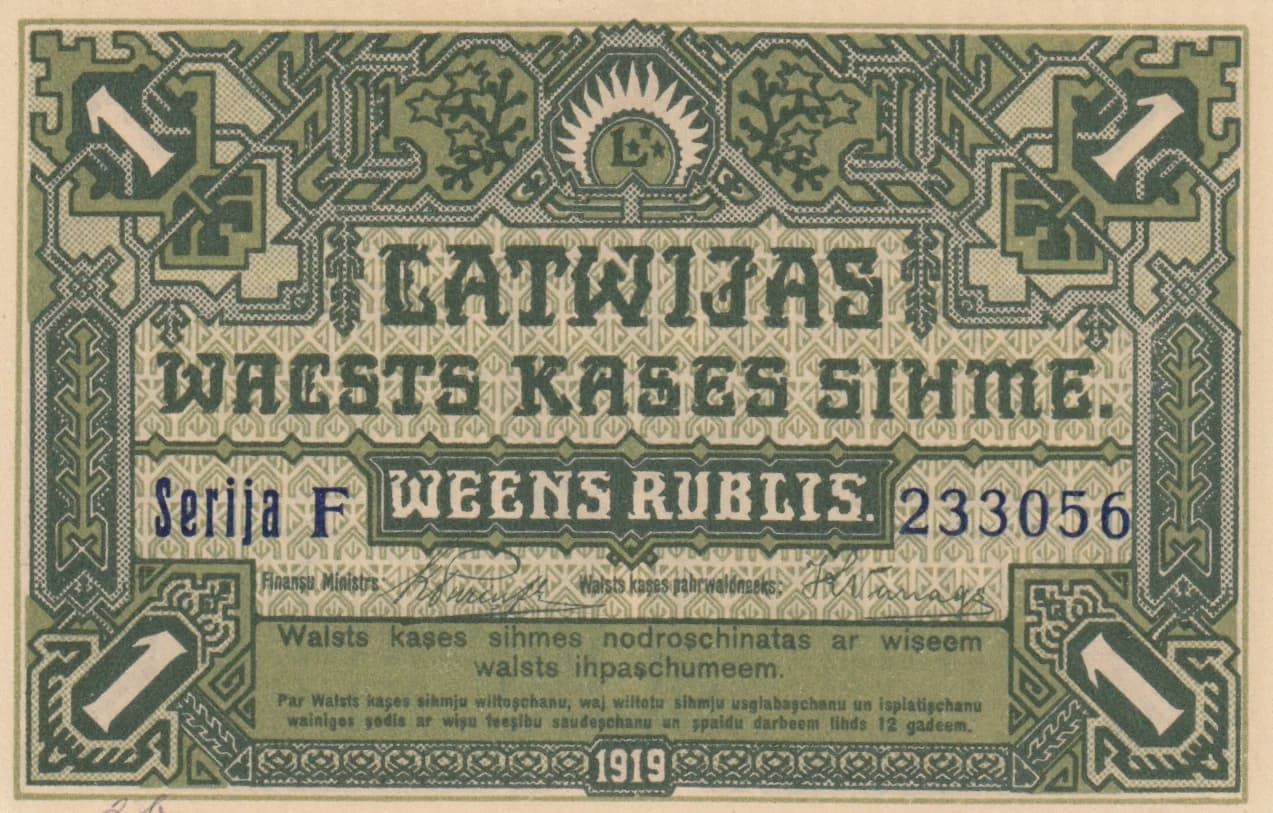
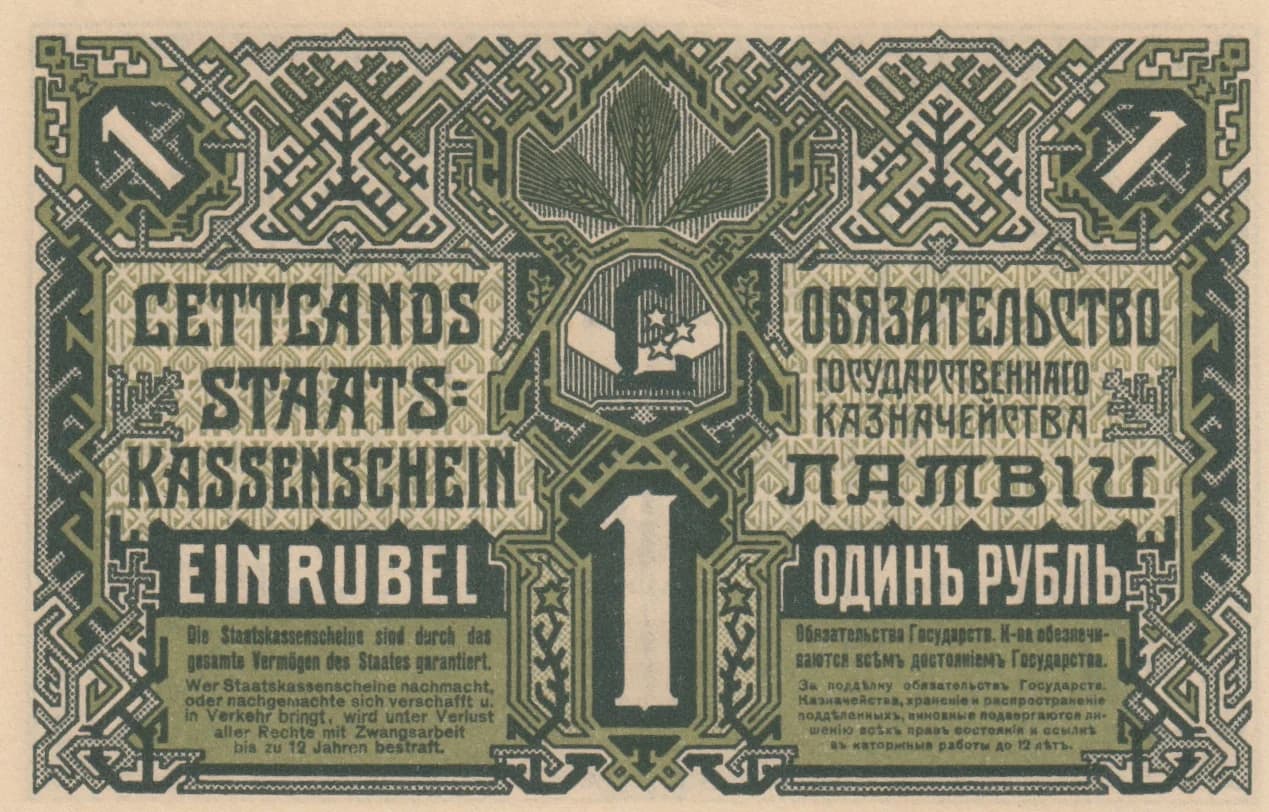
“serie F”
Market Prices
17 salesAbout This Note
This is an uncirculated example of Latvia's first issued 1 Rubel banknote from 1919 (Pick-2b), displaying exceptional preservation with no visible wear, creases, or stains. The note features a striking Art Nouveau design with ornate green and cream-colored geometric borders, dual-language text in German and Russian reflecting the transitional political period, and fine-line engraving throughout. This series F specimen represents an important early issuance from Latvia's newly independent government.
Common. The 1919 Latvian 1 Rubel (Pick-2b) was issued in substantial quantities as the denomination of a government treasury note during Latvia's early independence period. While these notes are now over a century old, they were widely printed and significant quantities have survived, making uncirculated examples readily available to collectors at modest valuations. No evidence of small print runs, recall, or scarcity conditions applies to this Pick number.
Issued in 1919 by the nascent Latvian government following independence from the Russian Empire, this banknote reflects the complex linguistic and political heritage of the period through its bilingual German-Russian inscriptions. The central heraldic emblem and treasury designation ('Staatskassenschein') mark this as a government obligation backed by state assets, while the severe counterfeiting penalties inscribed in both languages underscore the currency's official status during Latvia's establishment of national financial authority.
The note features a symmetrical Art Nouveau composition centered on a heraldic emblem (likely representing the Latvian state coat of arms with crown motif) flanked by ornamental geometric and floral border patterns in interlocking designs. Decorative leaf or floral motifs appear at the top center, with the large denomination numeral '1' prominently displayed in the center. The border design employs fine-line engraving with intricate geometric lattice work and leafwork in green and dark olive tones against a cream/beige background. The dual-language layout places German text on the left and Russian on the right, reflecting the multinational administration of the newly independent Latvian state. No portraits or specific named landmarks are depicted; the design emphasizes heraldic symbolism and geometric ornamentation typical of early 20th-century treasury notes.
FRONT (German side): 'Lettlands Staats Kassenschein' (Latvia's State Treasury Note), 'Ein Rubel' (One Ruble), and a counterfeiting warning: 'Die Staatskassenscheine sind durch das gesamte Vermögen des Staates garantiert. Wer Staatskassenscheine nachmacht, oder nachgemachte sich verschafft u. in Verkehr bringt, wird unter Verlust aller Rechte mit Zwangsarbeit bis zu 12 Jahren bestraft.' (State treasury notes are guaranteed by the entire assets of the state. Whoever counterfeits state treasury notes, or procures counterfeited ones and brings them into circulation, will be punished with loss of all rights and forced labor up to 12 years.) FRONT (Russian side): 'Обязательство Государственного Казначейства' (Obligation of the State Treasury), 'Один Рубль' (One Ruble), and corresponding counterfeiting penalties in Russian.
Intaglio (copperplate/steel plate engraving), evidenced by the fine-line detail, crisp impression quality, and the precise geometric and floral borders visible throughout the note. The clarity and depth of the ornamental patterns and the quality of the line work are characteristic of high-security intaglio printing used for official government currency. The specific printer for Pick-2b Latvian notes of this period was likely Waterlow & Sons or a similar European security printer, though attribution would require additional documentation.
This example is identified as series F based on catalog notation. Varieties for Pick-2b are primarily distinguished by serial number prefixes and series designations. The series letter (F in this case) represents one of multiple printings; other series letters exist and may have minor variations in printing characteristics or security features. Collectors should note serial number patterns and series letters when cataloging examples, as these may indicate different printing batches or security iterations, though all belong to the same basic Pick-2b classification.