1 rubel 1919
“serie D”
Market Prices
11 salesAbout This Note
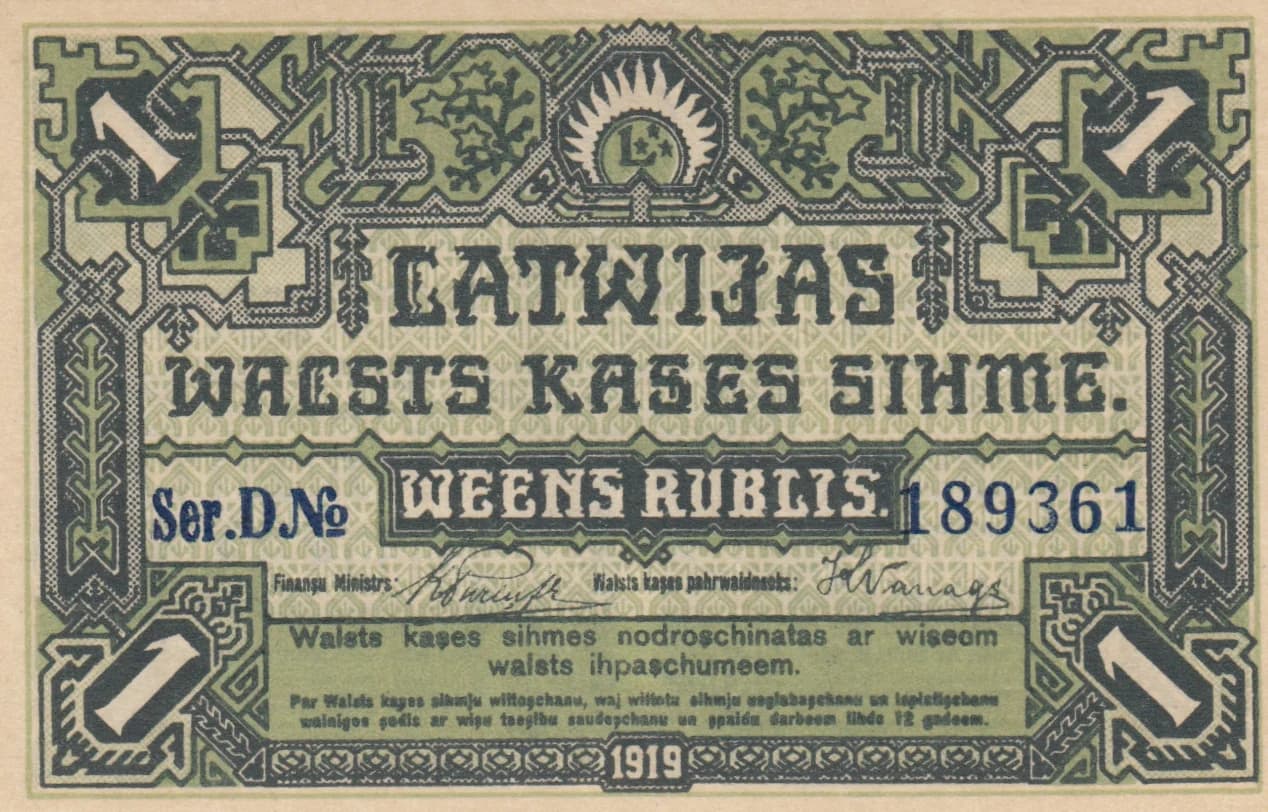
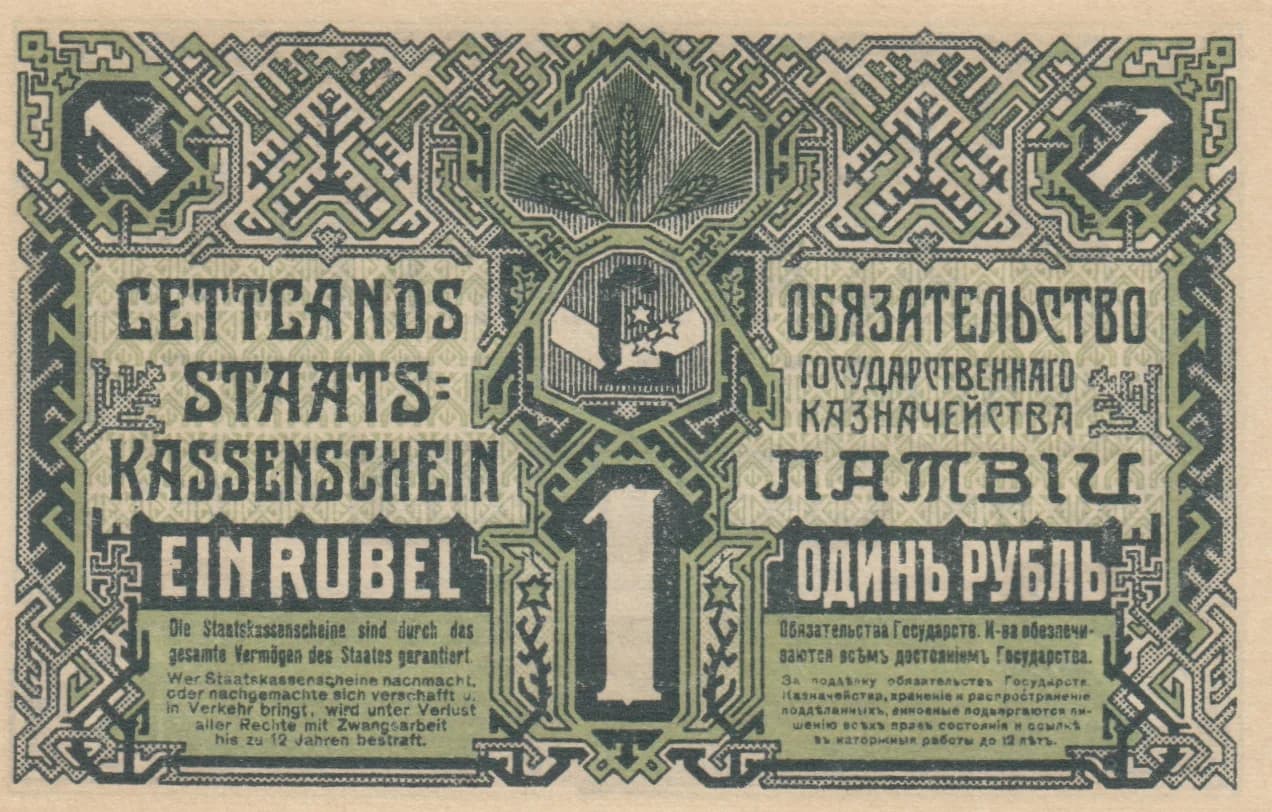
This is a 1919 Latvian 1 Rubel banknote (Pick P-2a) in Series D, displaying excellent preservation with minimal circulation wear typical of UNC graded notes. The note features striking ornamental design work with radiating sunburst motifs, geometric borders, and heraldic elements rendered in green and black on a cream background. The presence of bilingual text (Latvian, Russian, and German) reflects Latvia's transitional political period, making this a historically significant artifact from the newly independent Latvian state.
Common. The 1919 Latvian 1 Rubel (Pick P-2a) was issued in substantial quantities to establish the new nation's currency in circulation during the post-war transition period. Series D notes, as indicated by this specimen, are frequently encountered in the numismatic market, particularly in collections of Baltic or Eastern European currency. UNC examples are moderately priced and regularly available, indicating no significant scarcity or collector premium for this specific variety.
Issued in 1919 by the Latvian Government during the nation's struggle for independence from the Russian Empire, this banknote represents Latvia's first domestic currency issue. The multilingual inscriptions—prominently featuring Latvian alongside Russian and German—reflect the complex linguistic and political landscape of the Baltic region during the Russian Civil War and Latvian War of Independence. The ornate heraldic seal and sunburst design symbolize the new state's sovereignty and institutional authority during this period of nation-building.
The 1 Rubel features a symmetric ornamental design with elaborate geometric and floral border patterns framing all sides. The dominant central motif is a radiating sunburst or crown design positioned at the top center of the obverse, symbolizing state authority and sovereignty. The reverse displays a heraldic seal with shield design and wreath-like ornamental elements, reflecting contemporary Baltic heraldic traditions. No portraits are depicted; instead, the design relies entirely on geometric ornamentation, radiating patterns, and institutional seals to convey legitimacy and authority. The note's structure uses layered decorative borders with interlocking geometric patterns in green and black, typical of early 20th-century Eastern European treasury notes. Signature lines for the Finance Minister and Head of State Treasury appear on the obverse, authenticating the note as an official government obligation.
FRONT SIDE: 'LATVIJAS WALSTS KASES SIHME' (Latvia's State Treasury Note), 'MEENS RUBLIS' (One Ruble), 'Ser.D.№ 189361' (Series D, Number 189361), 'Finansu Ministers' (Finance Minister), 'Naists kases pahurvaldnicas' (Head of State Treasury), '1919' (year of issue), 'Walsts kases sihmes podroschinatas ar wisedom walsts ihpaschumeem' (State treasury notes are guaranteed by the entire property of the state). BACK SIDE: 'STAATS-KASSENSCHEIN' (State Treasury Note) and 'EIN RUBEL' (One Ruble) in German; 'ОБЯЗАТЕЛЬСТВО ГОСУДАРСТВЕННОГО КАЗНАЧЕЙСТВА ЛАТВИИ' (Obligation of the State Treasury of Latvia) and 'ОДИН РУБЛЬ' (One Ruble) in Russian; 'Die Staatskassenscheine sind durch das gesamte Vermögen des Staates garantiert!' (The state treasury notes are guaranteed by the entire property of the state!); 'Wer Staatskassenscheine nachmacht I. oder nachzumachen sich vornimmt, wird unter Verlusst aller Rechte mit Zwangsarbeit bis zu 12 Jahren bestraft' (Whoever counterfeits state treasury notes or attempts to do so will be punished with forced labor for up to 12 years and loss of all rights); corresponding Russian text warning of 12-year punishment for counterfeiting.
This note was produced using letterpress and intaglio printing techniques, evident from the crisp geometric borders, fine line work in the ornamental designs, and the depth of impression visible in the heraldic elements. The color work in green and black suggests multi-pass printing. For Latvian issues of this period, production was typically handled by established security printers in Berlin or Vienna; however, the specific printer for P-2a is not definitively documented in standard references. The intricate border work and fine detail throughout indicate high-quality intaglio security printing consistent with early independent Baltic state currency production.
This note is identified as Series D with serial number 189361, indicating it belongs to the fourth series of the 1919 issue. The multilingual text variants (Latvian/Russian/German) represent the standard design for P-2a. No overprints or surcharges are evident. The specific series designation (D) and sequential numbering within the series are the primary variety markers for early Latvian currency, with earlier series (A, B, C) potentially carrying different collector values, though all series of this denomination remain relatively common.