1 rubel 1919

“serie C”
Market Prices
11 salesAbout This Note
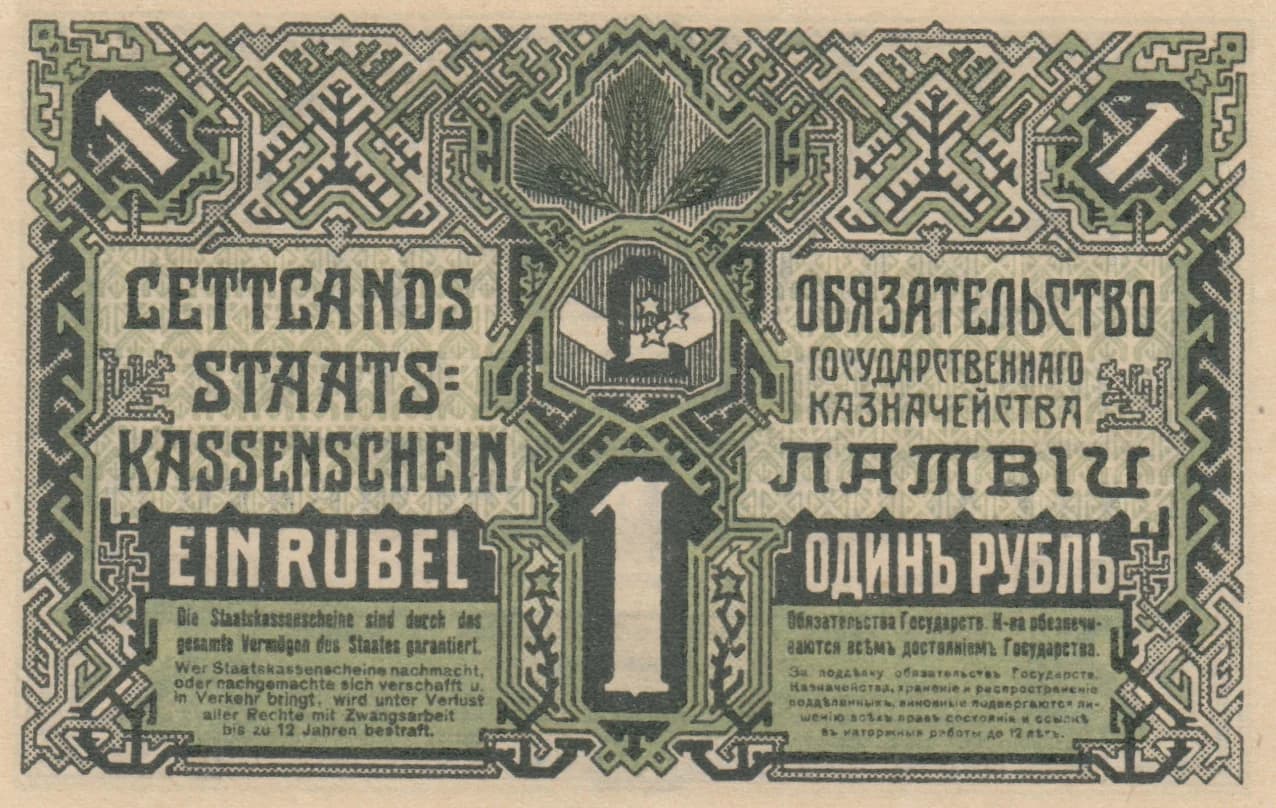
This is a Latvian 1 Rubel note from 1919 in UNC condition, representing an early emission of Latvia's first independent currency. The note features an elegant bilingual design in German and Russian Cyrillic script, reflecting Latvia's complex linguistic and political heritage during the transition from Russian Empire rule. The crisp printing, sharp details, and well-preserved condition make this an attractive example of early 20th-century Baltic numismatics.
Common. The eBay sales data provided shows consistent pricing in the $5-$17 range across various grades from 2013-2025, with catalog values in 2016 listing UNC specimens at $60. The note was issued in substantial quantities as a regular issue of the Latvian state treasury, and multiple series variants (B, C, D) are documented in PMG records. High-grade examples command moderate premiums but remain readily available in the collector market, indicating a common issue.
Issued in 1919 by the newly independent Latvian state, this note represents the transitional period when Latvia was establishing sovereignty following World War I and the Russian Revolution. The bilingual German-Russian inscriptions reflect Latvia's position between Western European and Russian spheres of influence, while the state coat of arms symbolizes the fledgling nation's assertion of independence. The prominent warning against counterfeiting in both languages underscores the challenges of establishing monetary authority and public trust in a newly formed state.
The note displays a masterfully executed Art Deco-influenced design with ornate geometric borders featuring interlocking maze-like patterns that serve both aesthetic and security functions. The central upper portion contains the state emblem or coat of arms, depicted as a geometric design with a star motif representing the newly independent Latvian nation. Oak leaf decorative elements appear in the corners, symbolizing strength and national identity. The denomination '1' is prominently displayed in the center. The color scheme utilizes greenish-gray with dark green printing on a cream/beige background, creating visual depth and distinction. The bilateral presentation with German on the left and Russian Cyrillic on the right reflects the transitional administrative structure of early independent Latvia.
FRONT SIDE - German text: 'Gettsands Staats-Kassenschein' (State Treasury Certificate), 'Ein Rubel' (One Rubel), and a lengthy warning: 'Die Staatskassenscheine sind durch das gesamte Vermögen des Staates garantiert. Gefälschte Kassenscheine nachzumachen oder nachgemachte sich zu verschaffen, ist Verrat. Wird unter Verlust aller Rechte mit Zwangsarbeit bis zu 12 Jahren bestraft.' (State treasury certificates are guaranteed by the entire wealth of the state. Counterfeiting treasury certificates or obtaining counterfeited ones is treason. It is punished with loss of all rights and forced labor of up to 12 years.) FRONT SIDE - Russian Cyrillic text: 'Обязательство Государственного Казначейства' (Obligation of the State Treasury), 'Латвіш' (Latvia), 'Одинь Рубль' (One Ruble), with corresponding counterfeiting warning in Russian.
The note was produced using intaglio printing (engraved relief printing), evidenced by the sharp, precisely rendered geometric borders, fine line work in the decorative elements, and the crisp quality of the bilingual text visible in the UNC specimen. The elaborate ornamental patterns and the precise execution of the state emblem indicate professional security-printer production. While the specific printer is not definitively documented in the provided catalog data, such high-quality Latvian treasury notes were typically produced by established European security printers of the period.
This specimen is identified as Pick P-2a, the primary variety of the 1 Rublis 1919 issue. The series letter 'C' noted in the collector notes indicates this is from Series C, one of three known series (B, C, D) documented with wavy line watermarks. The P-2 designation encompasses at least two major varieties (P-2a and P-2b), with this being the 'a' variant. The specific series designation would be relevant for advanced collectors tracking all production variants of this transitional currency.