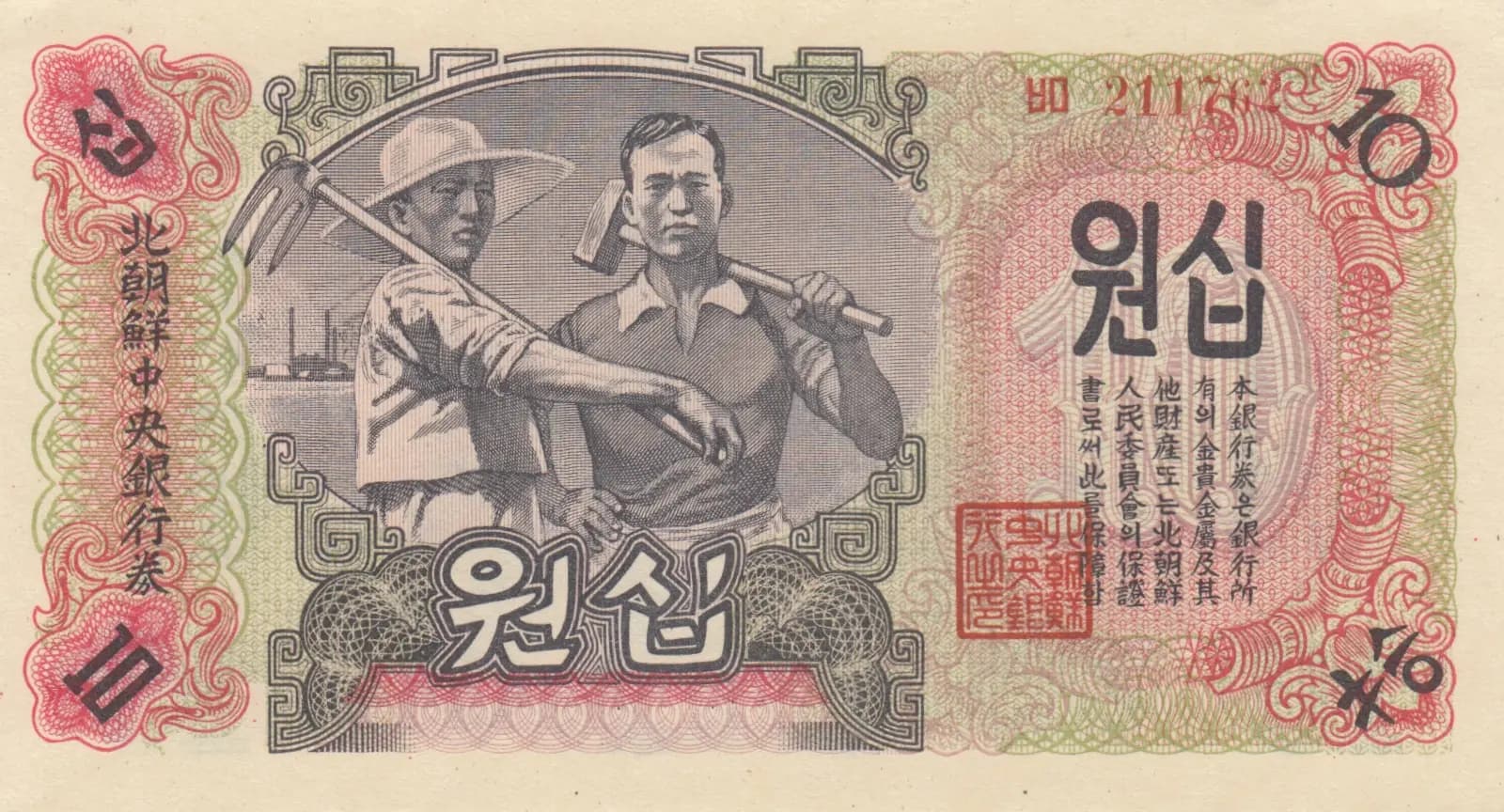
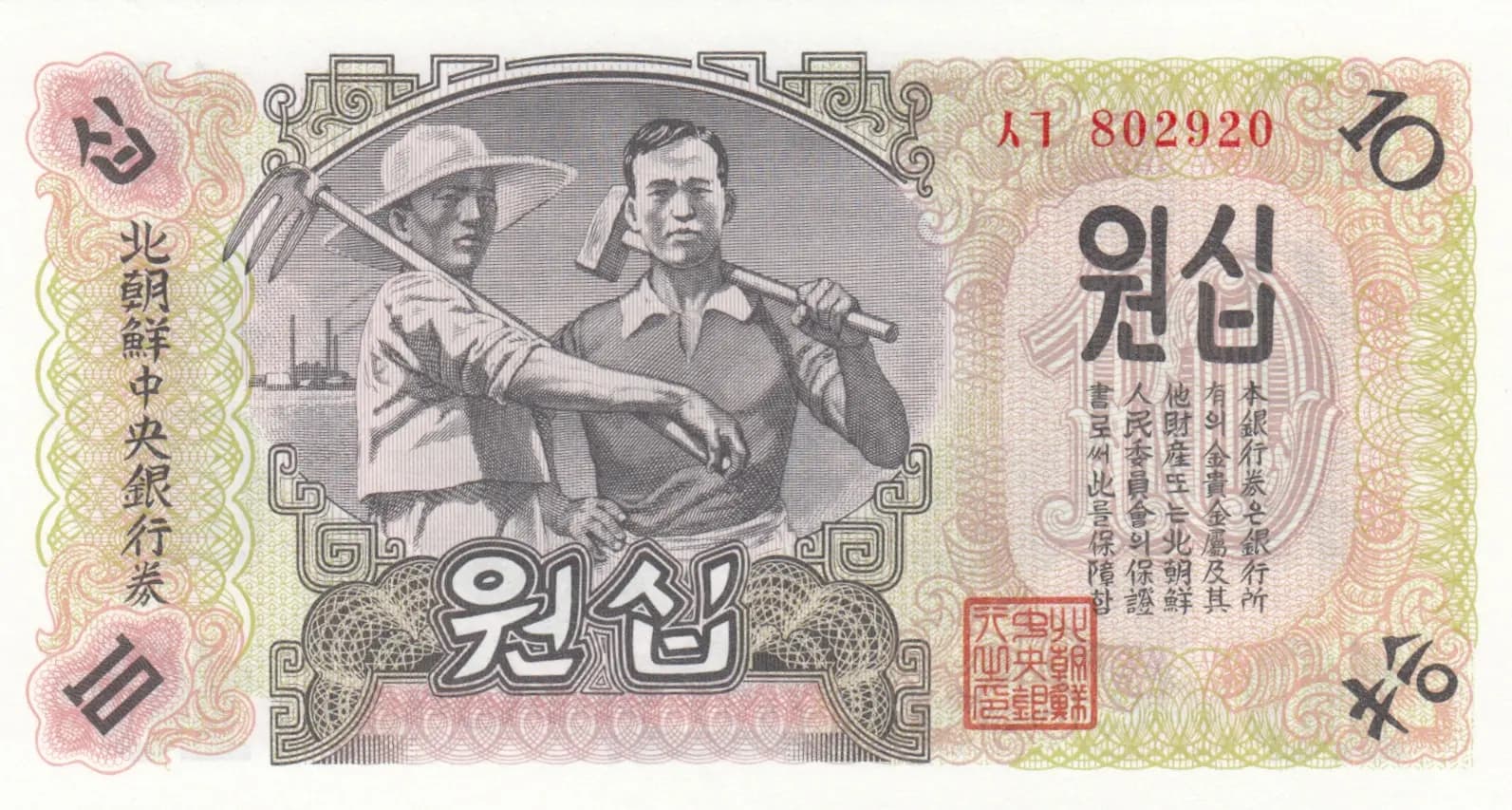
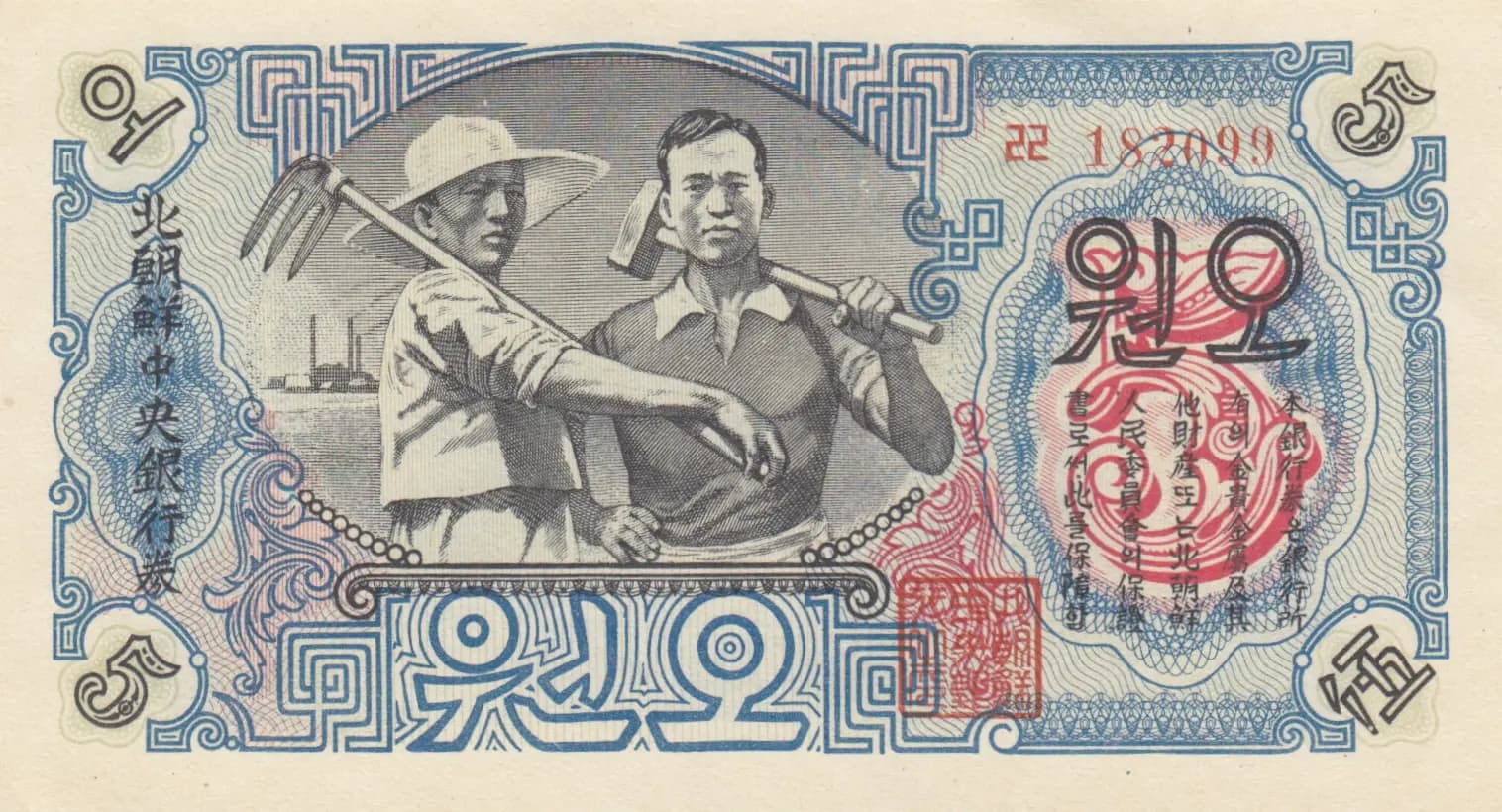
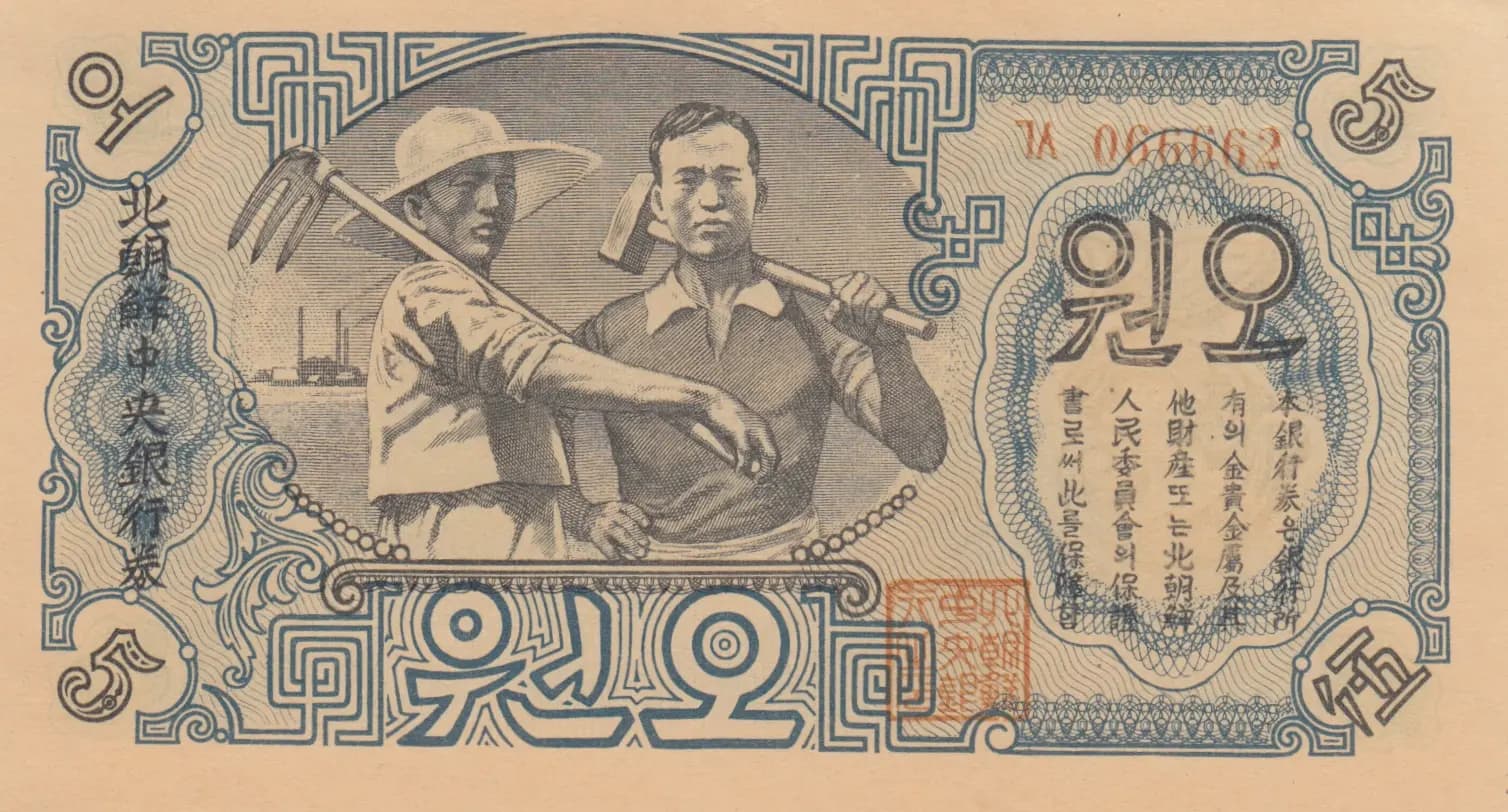
5 won 1947
About This Note
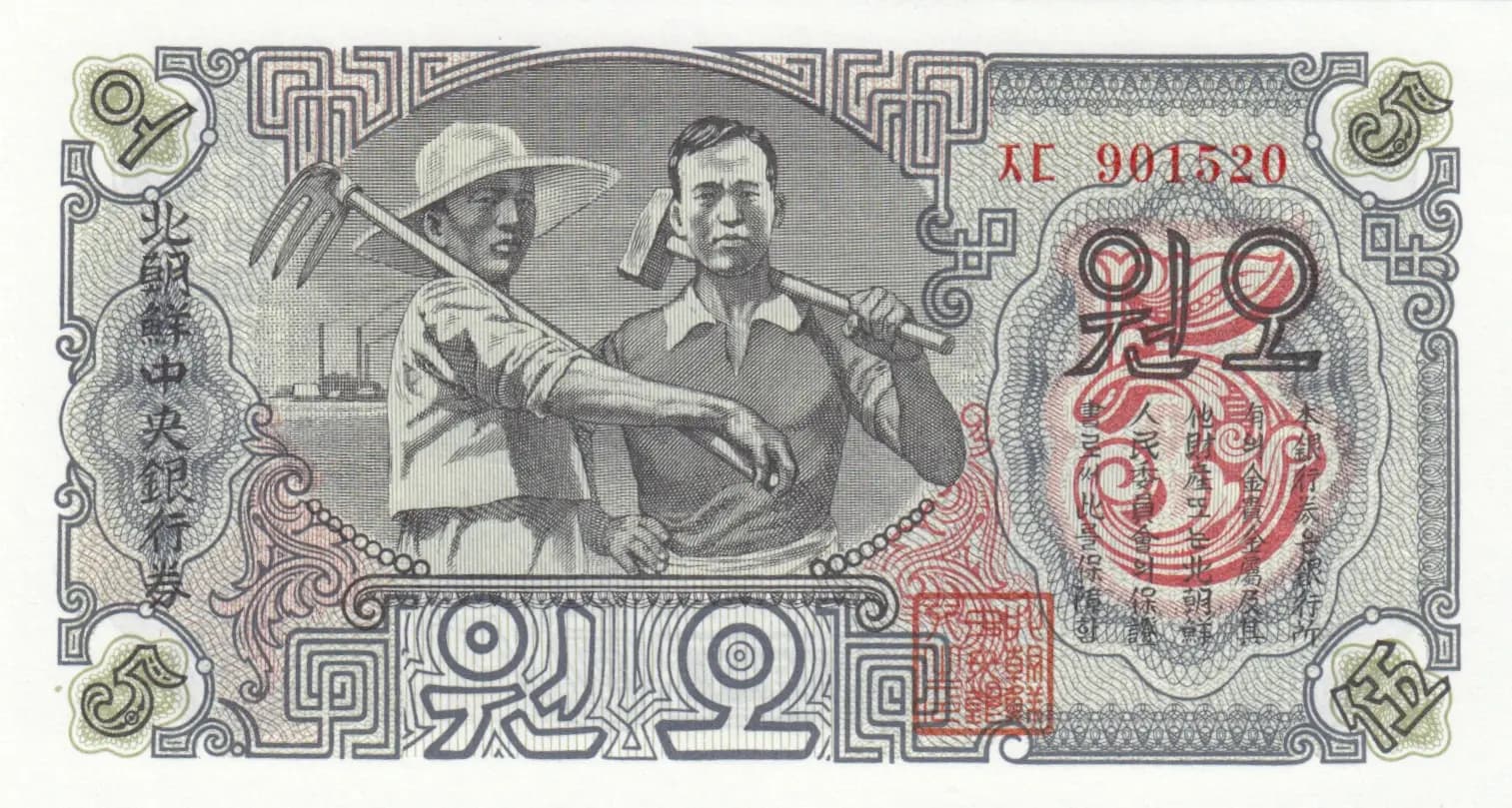
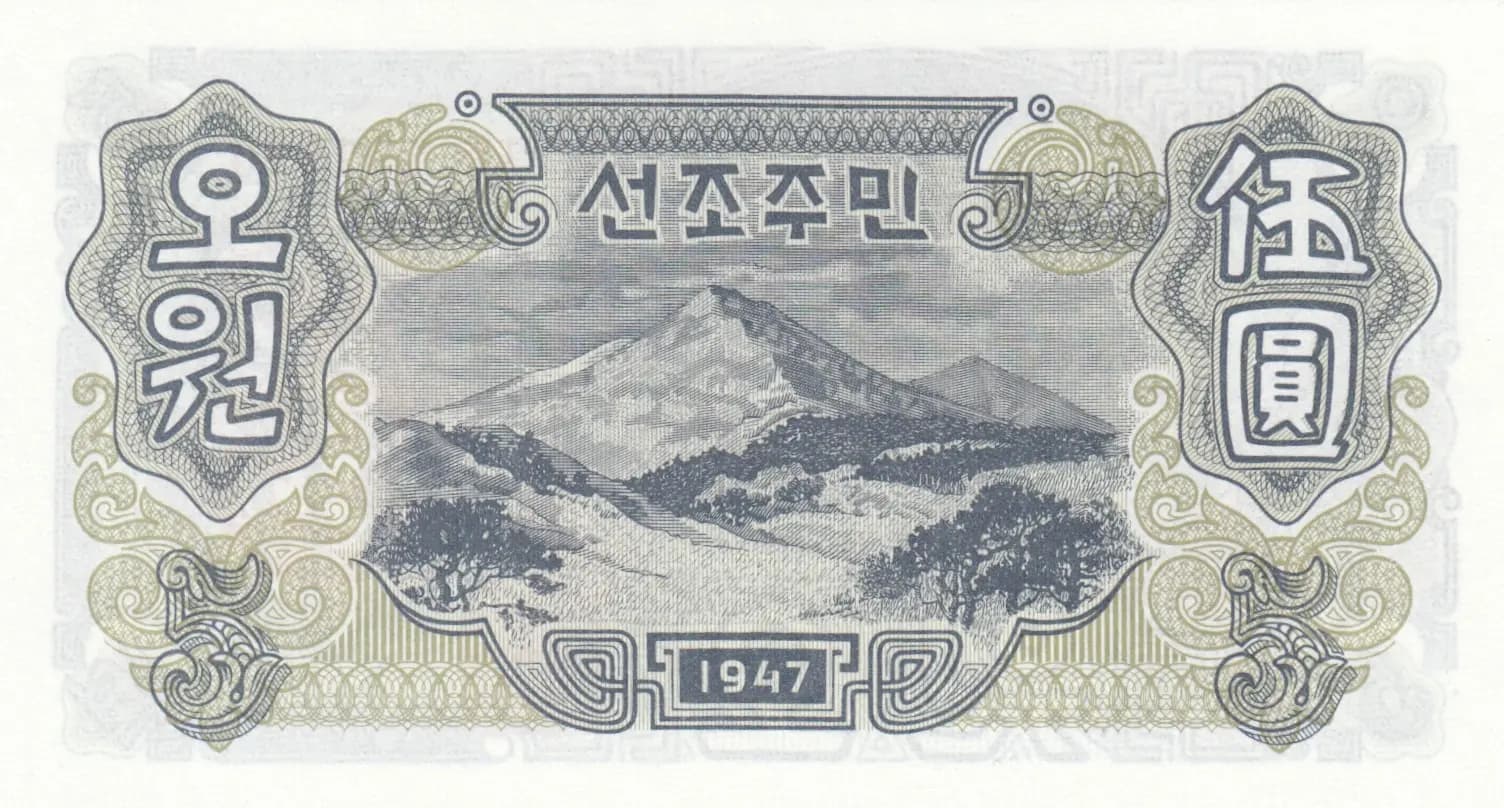
This is a North Korean 5 won note from 1947 (Pick P-10b), graded UNC, representing one of the earliest currency issues of the newly established Democratic People's Republic of Korea. The note features striking socialist-realist imagery on the obverse—two workers (a miner with pickaxe and an industrial laborer with hammer) symbolizing the nation's working class—while the reverse displays a majestic snow-capped mountain landscape, likely depicting Mount Paektu, sacred to Korean national identity. The exceptional condition and fine engraving detail make this an important example of early North Korean banknote design.
Common. The 1947 North Korean 5 won note is a foundational issue from the earliest period of DPRK currency, and examples in UNC condition remain relatively available in the collector market. While early North Korean notes have historical significance, this Pick number does not exhibit characteristics indicating a restricted print run or high rarity—it represents a standard circulation issue from the initial currency series.
Issued in 1947 by the North Korea Central Bank, this note was produced during the formative period immediately following Korea's liberation from Japanese occupation and the establishment of the DPRK in 1948. The deliberate iconography—featuring workers with tools of industry and agriculture alongside a prominent mountain—reflects the new regime's emphasis on labor, national pride, and self-reliance that would define its founding ideology. The denomination in won and the 1947 date place this among the very first currency issues of the nascent Korean socialist state.
The obverse depicts two male figures representing the working class: a miner on the left wearing a wide-brimmed hat and holding a pickaxe, and an industrial worker on the right wearing a cap and holding a hammer. These iconographic elements symbolize North Korea's agricultural and industrial sectors. Both figures are centrally positioned within an ornate geometric border featuring decorative scrollwork and circular emblems in the upper corners, with an ornamental cartouche containing Korean characters on the left. The reverse showcases a landscape composition featuring a prominent snow-capped mountain (likely Mount Paektu, Korea's highest peak and a symbol of national identity) with forested slopes and vegetation in the foreground, surrounded by matching ornate borders and decorative corner elements. The color palette is primarily grayscale with cream and red/burgundy accents.
Front side: Serial number 'KE 901520' (English alphanumeric); '북한' (Korean: 'North Korea' or 'Puk-han'). Back side: '선조종민' (Korean text at top center, likely relating to state or bank nomenclature); '100원' (Korean: '100 won', though cataloged as 5 won—this may indicate a denomination marking or design element); '1947' (issue year).
Line engraving on intaglio press, evidenced by the fine, precise line work visible throughout both sides, the intricate geometric border patterns, detailed landscape rendering, and the characteristic depth and quality of engraved security features. The complexity of the decorative elements and fine detail work indicates production by a specialized security printer, likely Soviet or East German (both common sources for early DPRK currency).
Pick P-10b designation indicates this is the second variety of the 5 won 1947 issue. Specific variety identification would be based on the serial number prefix 'KE' and potentially other features such as signature variants or minor design differences between early printings. The serial number 'KE 901520' should be compared against known variety listings for this issue to determine the precise printing batch or variety status.