1 pound 1964
Market Prices
7 salesAbout This Note
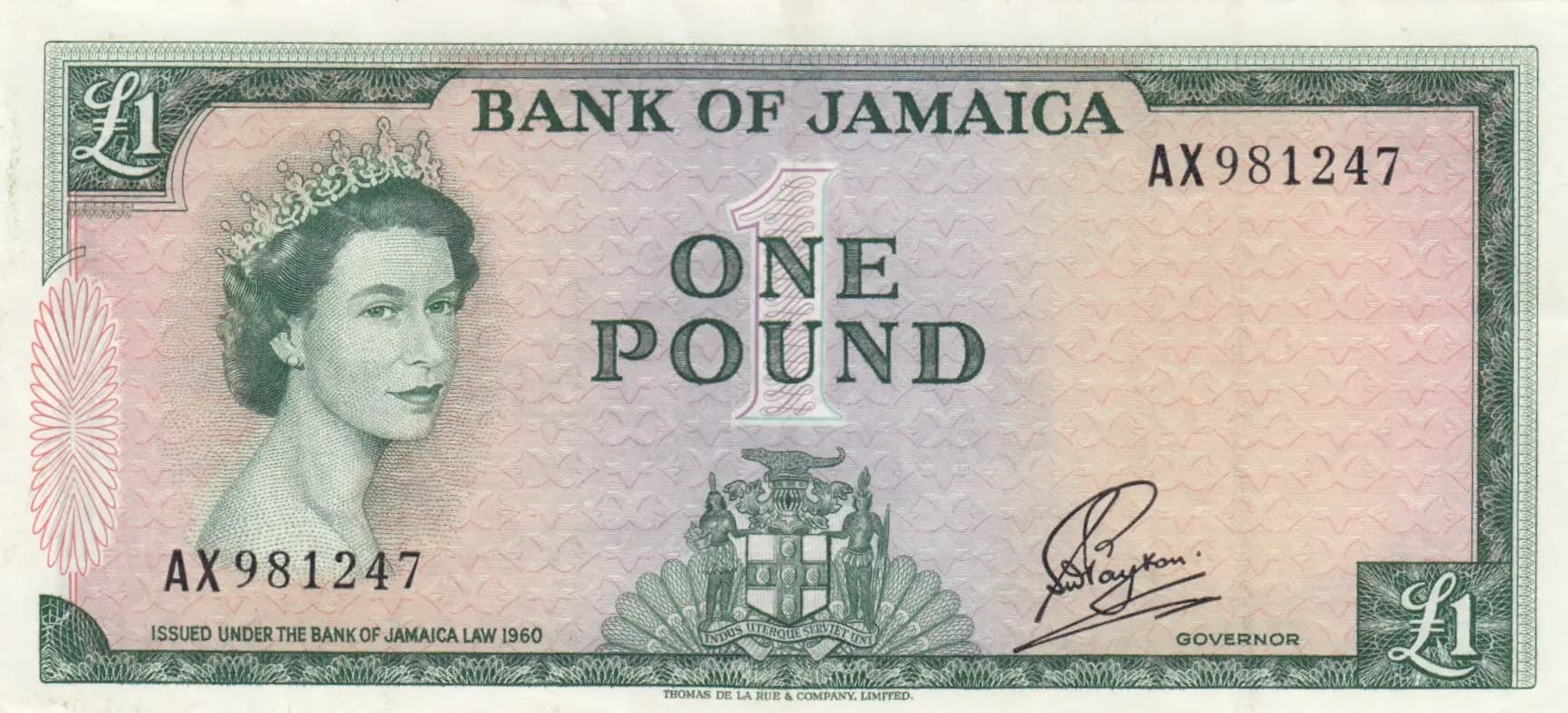
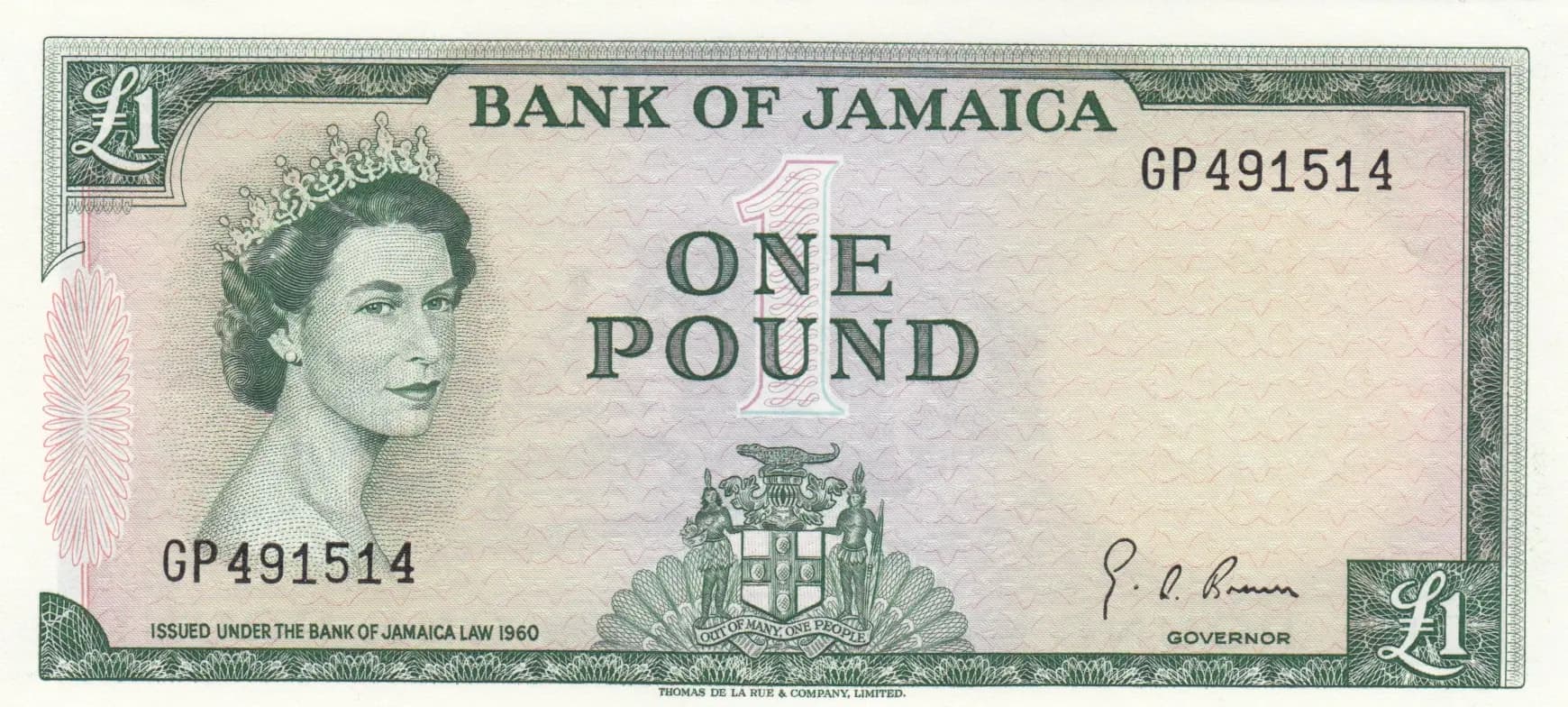
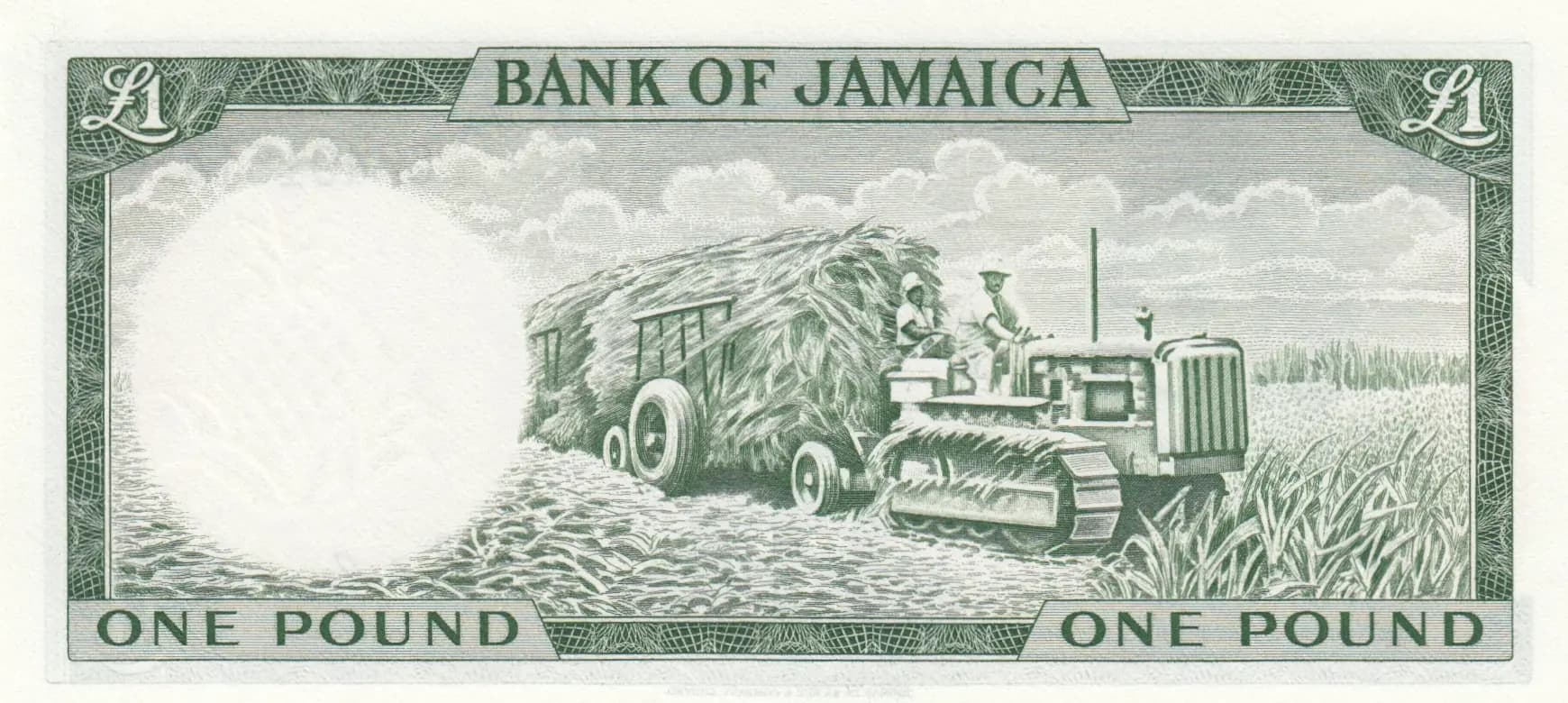
This is an uncirculated 1964 Jamaican one pound note (Pick P-51Ce) featuring Queen Elizabeth II in profile on the obverse and an agricultural scene of sugar cane harvesting with a tractor on the reverse. The note displays crisp printing with vibrant green and pink coloration on a cream background, with no visible wear, creases, or damage consistent with original UNC condition. This early Bank of Jamaica issue represents a significant piece of Jamaica's post-independence monetary history, printed by Thomas de la Rue with fine line engraving throughout.
Common. While this is an early Bank of Jamaica issue from 1964, the catalog values and eBay market data indicate relatively modest prices even for UNC examples ($250 catalogue value in 2019, with recent sales in the $25-$35 range for lower grades). The note was produced in substantial quantities by Thomas de la Rue, and multiple varieties (P-51Ca through P-51Ce) exist for the £1 denomination from this series. The UNC grade specimen observed here, while desirable, does not command premium prices typical of rare notes, suggesting adequate supply in the collector market.
Issued under the Bank of Jamaica Law of 1960, this 1964 pound note reflects Jamaica's early years following independence (1962) and the establishment of its central banking authority. The reverse design prominently features a sugar cane harvesting scene with modern agricultural machinery, illustrating the critical role of agriculture and mechanization in Jamaica's post-colonial economy during the 1960s. The depiction of the tractor and harvesting operations underscores the nation's emphasis on modernizing its agricultural sector during this transformative period.
The obverse features Queen Elizabeth II depicted in left-facing profile wearing a tiara, reflecting Jamaica's continued Commonwealth status in 1964. A coat of arms with shield design featuring crossed elements appears centrally below the denomination. The note is framed with ornamental leaf and fan designs in pink on the left border, with pound symbols (£) positioned in top left and bottom right corners. The reverse depicts a detailed agricultural scene of sugar cane harvesting, showing a tractor with large wheels loading cane into a trailing cart in a mature cane field, with landscape elements including sky and clouds. The entire note is bordered with ornamental designs reflecting the fine engraving work of the period.
Front side: 'BANK OF JAMAICA' (issuing authority), 'ONE POUND' (denomination), 'ISSUED UNDER THE BANK OF JAMAICA LAW 1960' (legal authorization), 'GOVERNOR' (signatory title), serial number 'GP491514' (appears twice). Back side: 'BANK OF JAMAICA' (issuing authority repeated), 'ONE POUND' (denomination repeated in bottom left and bottom right corners). All inscriptions are in English.
Intaglio line engraving (fine line engraving technique) executed by Thomas de la Rue, London, the renowned British security printer. The crisp detail visible throughout both sides, the fine ornamental borders, the portrait work, and the agricultural scene all demonstrate the precision characteristic of traditional intaglio engraving used for high-security banknotes of this era. No evidence of offset or modern printing techniques is present.
This note is identified as Pick P-51Ce, the specific variety of the 1964 Jamaican one pound note. The catalog references note a distinction between earlier varieties with Latin mottos below the arms (like P-51Cb) and later varieties with English mottos below the arms. The visual analysis confirms this note displays an English motto inscription ('ISSUED UNDER THE BANK OF JAMAICA LAW 1960'), which is characteristic of the Ce variety. The serial number prefix 'GP' and the noted 'GOVERNOR' signature line are consistent with this variety's specifications. Additional varieties (P-51Ca, P-51Cb, P-51Cc, P-51Cd, and P-51Cs) exist within the £1 denomination series, differing in signatures, serial prefixes, or motto language.