5 shillings 1964
Market Prices
5 salesAbout This Note
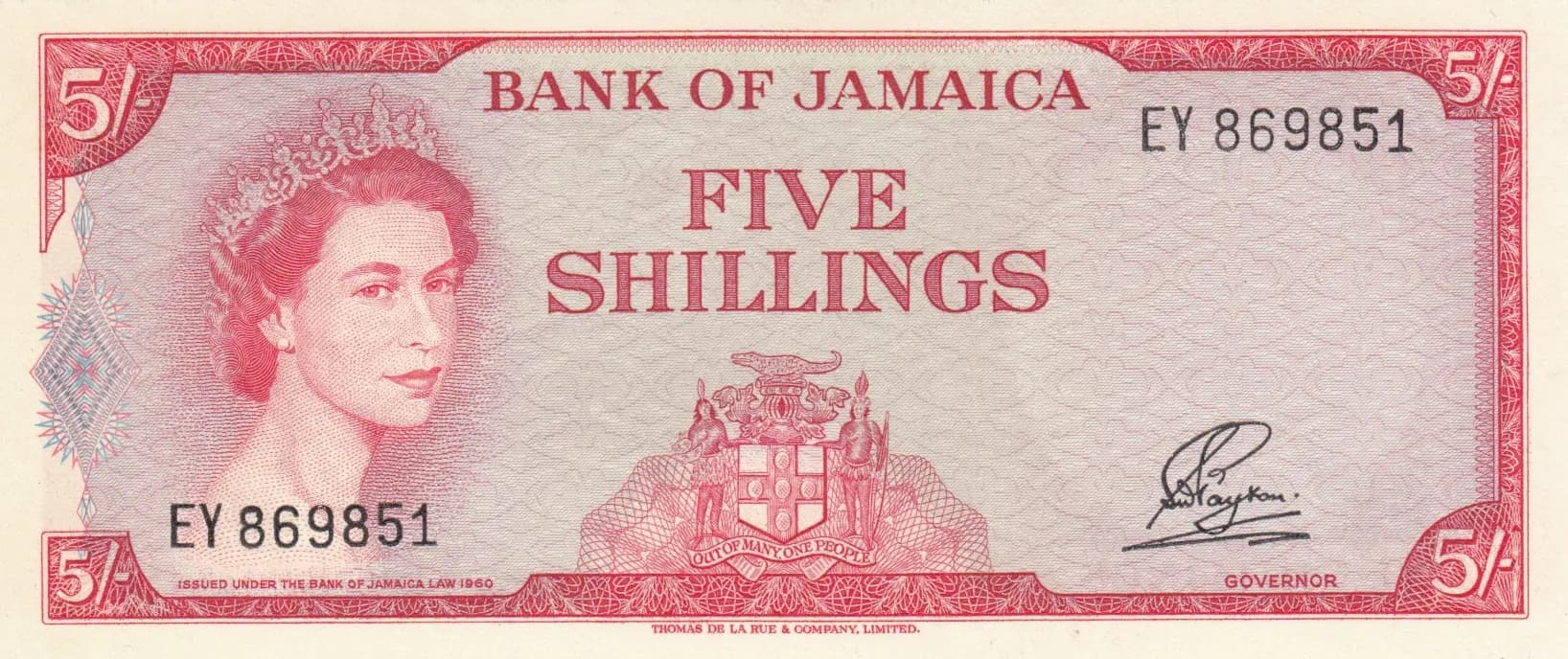
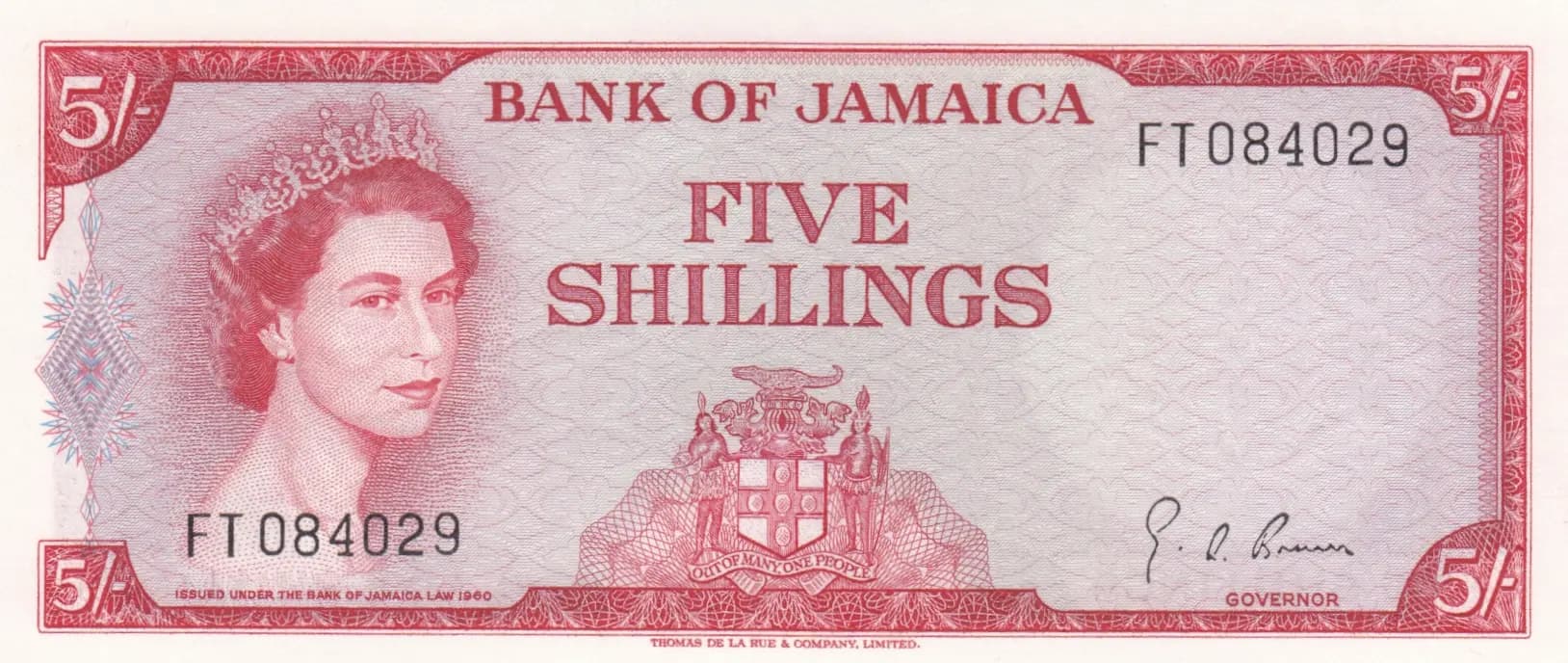
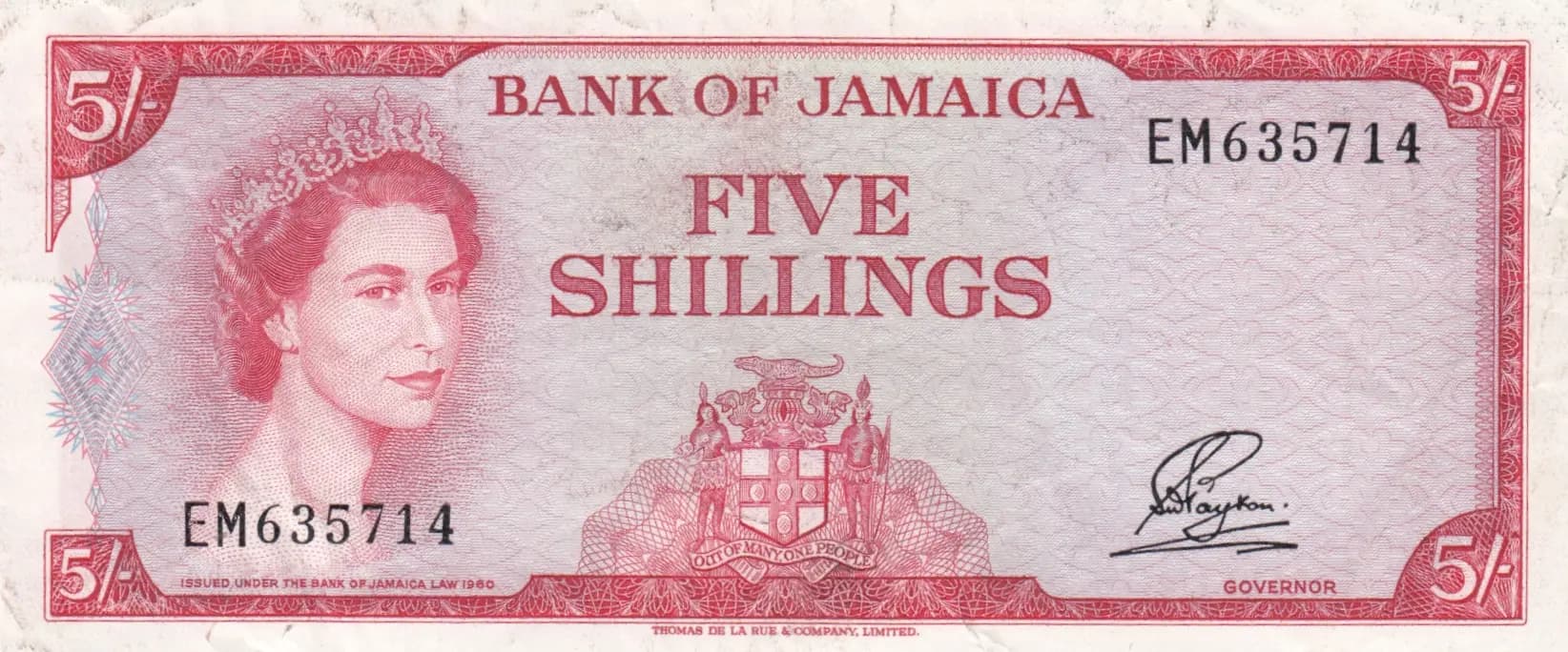
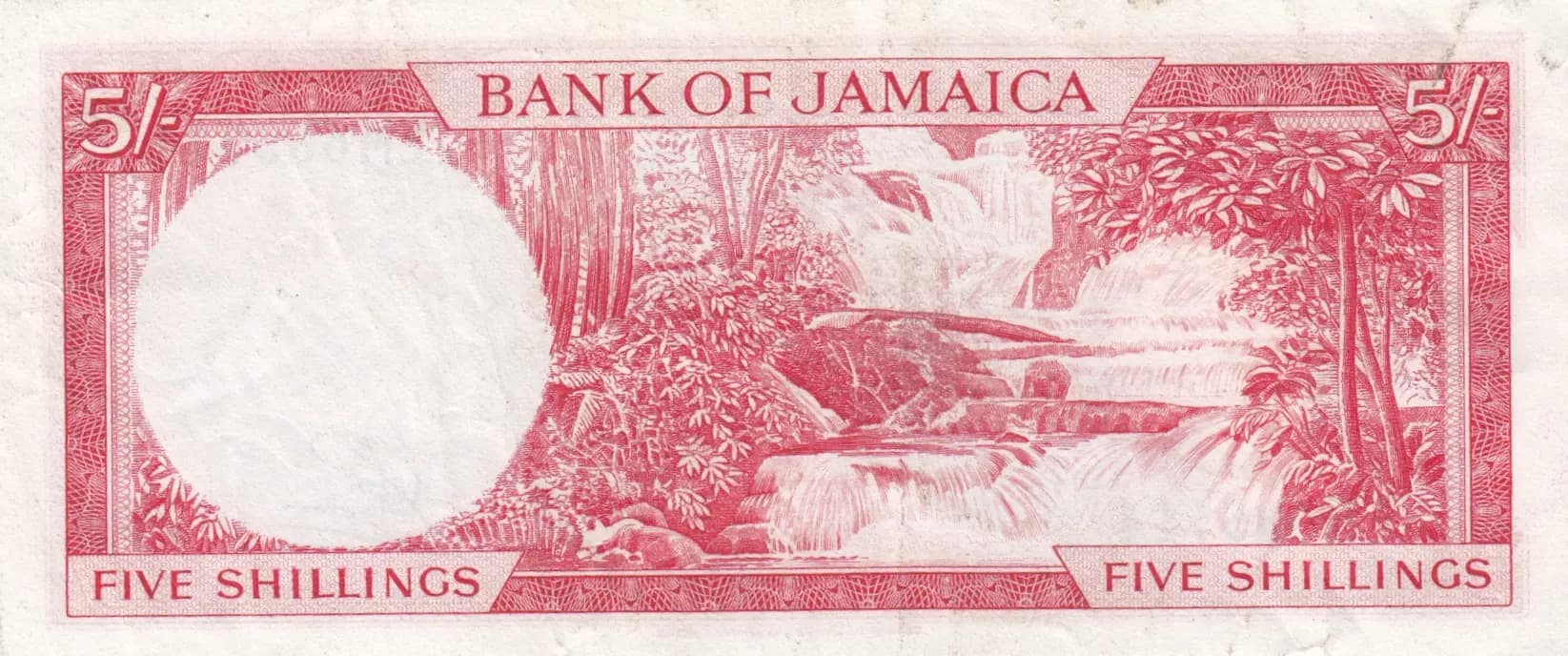
This is a Bank of Jamaica 5 Shillings note from 1964, issued under the Bank of Jamaica Law 1960, printed by Thomas de la Rue in London. The note features Queen Elizabeth II in profile on the obverse and a scenic waterfall landscape on the reverse, rendered in distinctive pink-red engraving on a cream background. In VF condition, the note shows expected signs of circulation with minor creasing, foxing, and edge wear, yet retains good clarity in the fine line engraving work that characterizes this classic British colonial design.
Common. This note comes from a regular issue series with substantial print runs. eBay market data shows VF-graded examples selling in the $25-$47 range (2014-2019 data), with ungraded Fine examples selling for under $25, indicating steady but not scarce availability in the market. The PMG population report lists this as one of several variants within the P-51 series, all produced in significant quantities by a major security printer. No evidence of limited print runs, early withdrawals, or scarcity factors applies to this variety.
This note was issued during Jamaica's transition period following independence in 1962, when the Bank of Jamaica assumed currency issuance responsibilities under the 1960 Law. The portrait of Queen Elizabeth II reflects Jamaica's continued membership in the Commonwealth, while the reverse depicts the island's natural landscape—specifically a waterfall scene representative of Jamaica's tropical environment and rivers. The use of English inscriptions and British security printing by Thomas de la Rue demonstrates the institutional continuity between colonial and post-independence monetary systems.
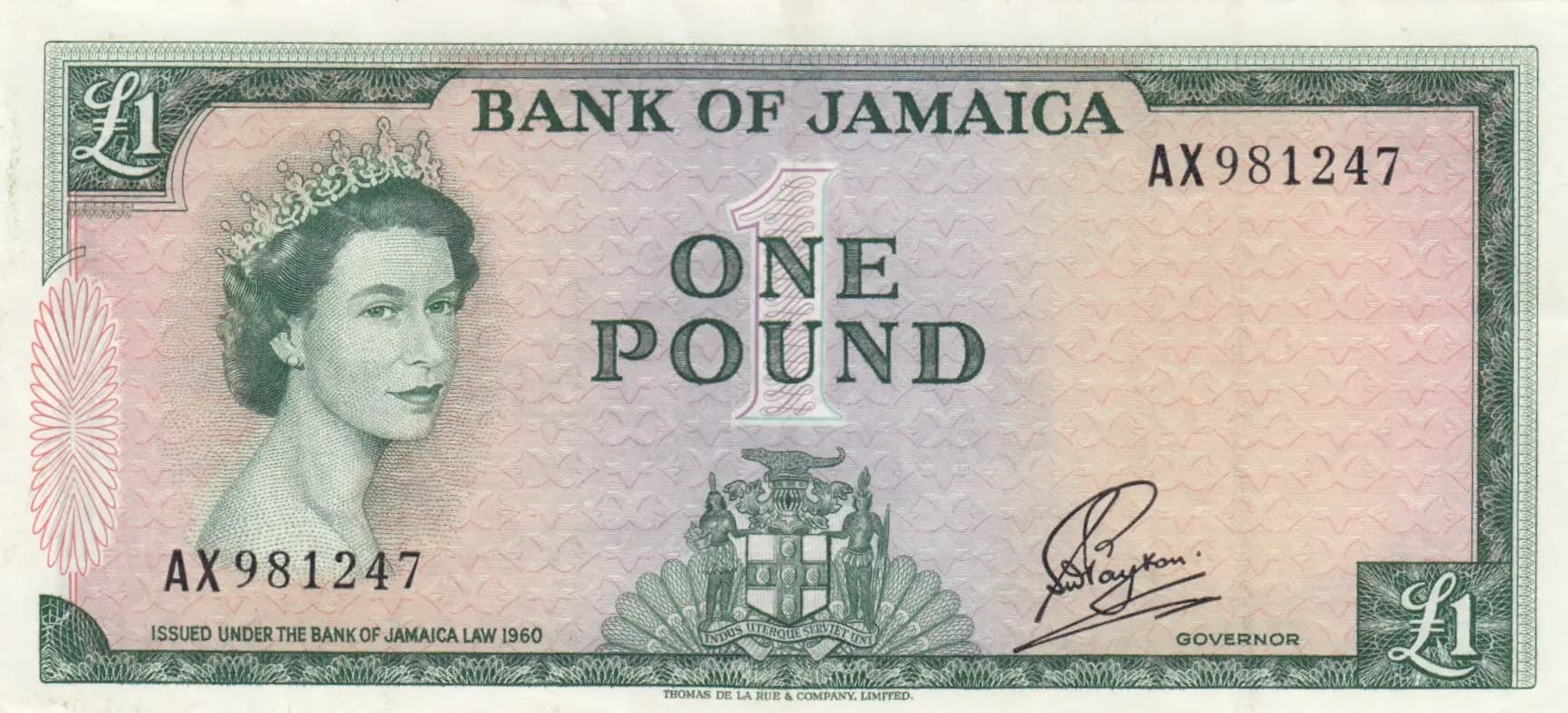
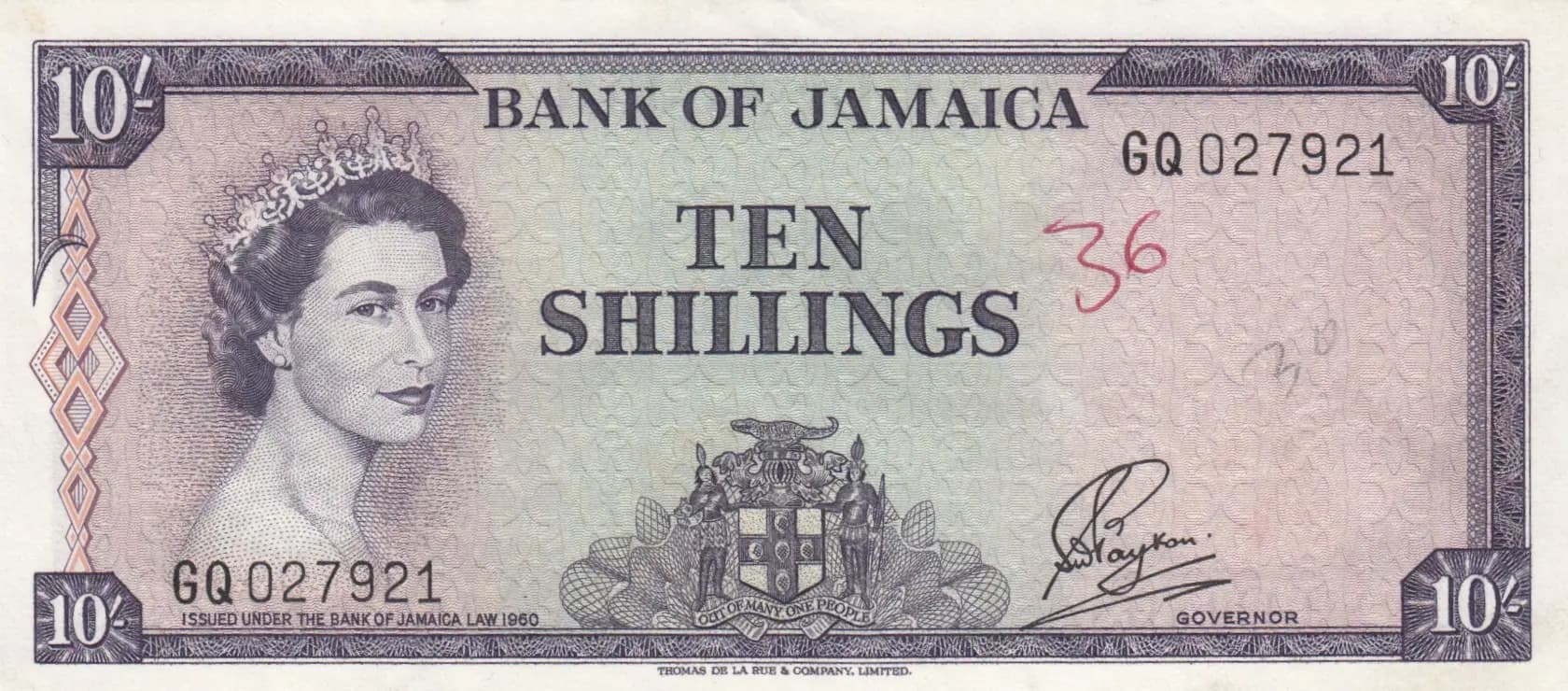
The obverse features a left-facing profile portrait of Queen Elizabeth II wearing a tiara, positioned at the left side of the note. The center displays the Jamaican coat of arms—a shield with heraldic divisions beneath a crown—flanked by decorative floral and ornamental corner elements. The reverse depicts a scenic landscape vignette of cascading waterfall and rapids surrounded by tropical vegetation and rocky terrain, rendered in fine line engraving characteristic of Thomas de la Rue's classical security printing style. The design employs predominantly pink and red tones on a cream background throughout both sides.
Front side: 'BANK OF JAMAICA' / 'FIVE SHILLINGS' / '5/-' (denomination indicators) / 'ISSUED UNDER THE BANK OF JAMAICA LAW 1960' (legal authority) / 'GOVERNOR' (signature line) / 'THOMAS DE LA RUE & COMPANY, LIMITED' (printer credit) / Serial number 'EM635714'. Back side: 'BANK OF JAMAICA' / 'FIVE SHILLINGS' / '5/-' (repeated denomination identifiers). All inscriptions are in English.
Intaglio engraving (line engraving), executed by Thomas de la Rue & Company, Limited, London. The visual analysis confirms the characteristic fine line work, complex geometric patterns, and detailed portrait rendering typical of high-security intaglio printing. The intricate vegetation and water feature rendering on the reverse demonstrates the sophisticated engraving capability required for this security printer's work during the mid-20th century.
This note is cataloged as P-51Ab (5 Shillings variant) within the larger P-51 series. Based on the visual analysis showing an English motto below the arms and the serial number format 'EM635714', this corresponds to the standard English motto variety. The catalog reference notes that later issues (P-51C) replaced the Latin motto with an English motto, confirming this as the English motto variant. The note exhibits a decimal serial number format rather than Roman numerals, distinguishing it from certain other variants within the P-51 series. No overprints or special markings indicating rare varieties are visible.