2 lire 1874
Market Prices
1 saleAbout This Note
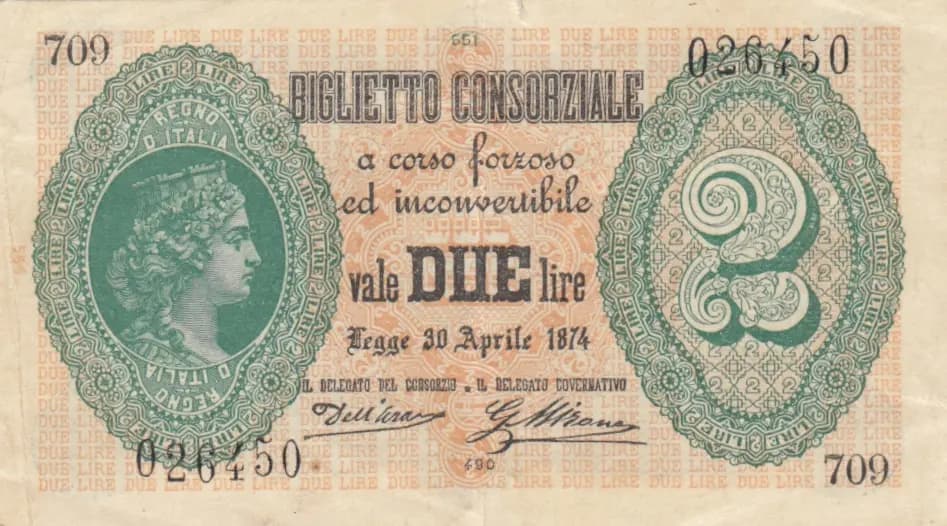
This is an attractive VF example of the rare 1874 Italian 2 Lire Biglietto Consorziale (Consortium Ticket), featuring bold green and black printing on a cream underprint. The note displays excellent eye appeal with crisp ornamental borders, a classical female profile medallion on the obverse, and a symmetrical dual-medallion reverse design. Age-appropriate creasing and foxing are consistent with 19th-century circulation, and the presence of handwritten official signatures adds authenticity and historical character.
Uncommon to Scarce. The catalog reference data (Pick P-3) and the nature of Italian consortium notes from this transitional monetary period suggest limited surviving examples. While 19th-century Italian notes are generally more available than earlier issues, consortium tickets were temporary fiscal instruments with smaller print runs than standard national bank issues. The VF condition grade is favorable for a note of this age, and market pricing is not extensively documented, but the specialized nature of the issuer (Biglietto Consorziale rather than the Bank of Italy) and the 1874 date support a scarcity assessment above 'common.' Related PMG-cataloged variants in this Pick series (P-31c, P-32a, P-32b) indicate multiple denominations existed, further suggesting limited quantities of each individual denomination.
This Biglietto Consorziale was issued under Italian law on 30 April 1874, during the early Kingdom of Italy period when consortium notes served as temporary forced-circulation currency (corso forzoso ed inconvertibile). The classical female profile—likely representing Italia or a classical virtue—reflects the neoclassical aesthetic favored in Italian state currency design of the Risorgimento era. The reverse's prominent legal warning against counterfeiting underscores the regulatory framework that governed 19th-century Italian monetary instruments.
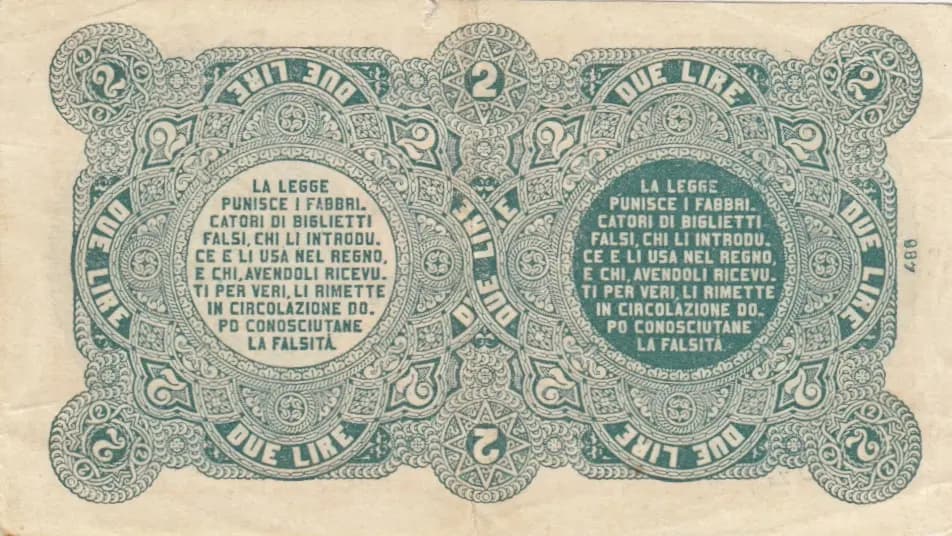
The obverse features a classical female profile portrait in green ink, positioned left-center within an ornate oval medallion frame, facing right—a common iconographic representation of Italia or national virtue in 19th-century Italian currency. The right side contains a complementary ornamental spiral/scrollwork design within an identical oval frame, maintaining bilateral symmetry. The denomination 'DUE LIRE' appears both as a text inscription and as a repeating background pattern. Elaborate geometric borders with floral and scroll motifs in green frame the entire note. The reverse displays a symmetrical composition of two large mirrored ornamental medallions, each containing the counterfeiting warning text, with circular '2' numerals at the corners. Throughout both sides, intricate decorative patterns serve dual purposes: aesthetic refinement and anti-counterfeiting protection. The handwritten signatures of authorized officials (Pellegrini and L'Illione) authenticate the issue.
FRONT: Serial numbers '709' (top left and bottom right), '0264550' (top right), '02450' (bottom left), and reference number '661' (center top). 'BIGLIETTO CONSORZIALE' (Consortium Ticket). 'a corso forzoso ed inconvertibile' (at forced circulation and inconvertible). 'vale DUE lire' (worth TWO lire). 'Regge 30 Aprile 1874' (Valid 30 April 1874). 'DUE LIRE' (repeated pattern). Official signatures 'Pellegrini' and 'L'Illione'. BACK: Denomination '2' (in circular medallions). 'DUE LIRE' (TWO lire). Legal warning: 'LA LEGGE PUNISCE I FABBRI, CATORI DI BIGLIETTI FALSI, CHI LI INTRODUCE CE E LI USA NEL REGNO, E CHI VENDE RICEVI TI PER VERI, LE RIMETTE IN CIRCOLAZIONE OD. PO CONOSCIUTANE LA FALSITA.' (The law punishes the makers [and] counterfeiters of false tickets, those who introduce them and those who use them in the kingdom, and those who sell and receive them as genuine, [and] those who put them back into circulation knowing about the falsity). Reference number '480' (right side).
Intaglio engraving (recess printing), evidenced by the crisp, deeply impressed ornamental borders, fine line work in the decorative patterns, and the dimensional quality of the portrait medallion visible in the visual analysis. The green and black color separation indicates multi-pass printing. The paper stock shows characteristic aging and fiber structure consistent with 19th-century currency paper, hand-finished with signature applications.
The observed signatures ('Pellegrini' and 'L'Illione'), the specific serial number configuration, and the reference numbers ('661' obverse, '480' reverse) identify this as a cataloged variant of the 1874 2 Lire issue. The Pick number P-3 designates this as the standard variety for the 2 Lire denomination from this issuer and date. No overprints or secondary varieties are evident in the visual analysis. The handwritten signature application was likely individualized for accounting purposes, so signature combinations may vary across extant examples without affecting catalog classification.