5 lire 1935
Market Prices
9 salesAbout This Note
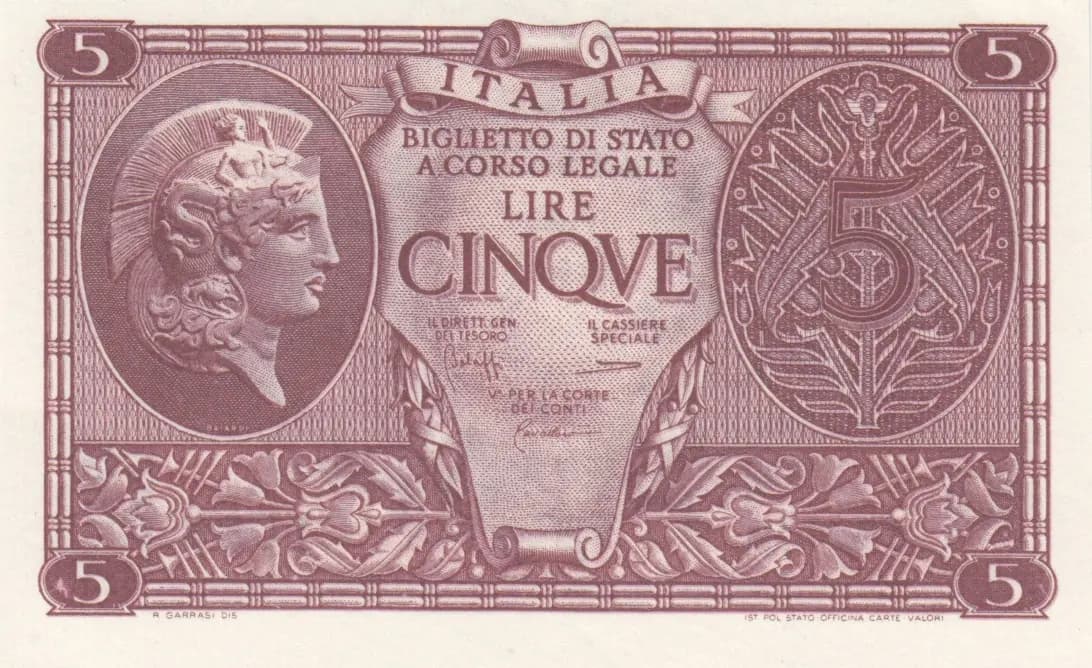
This is an uncirculated example of Italy's 5 Lire state banknote from 1935, issued under the Biglietto di Stato program. The note displays the characteristic mauve and tan color scheme with exceptional preservation and sharp engraving throughout, featuring classical design elements including a Roman-style male portrait bust and elaborate ornamental borders. As an UNC specimen, this note represents the finest condition grade for this catalog type and reflects the refined security printing standards of the Italian state printer.
Common. This note circulated widely from 1944 through the lira era and remains readily available in the collector market. Market evidence from eBay sales data shows consistent pricing in the $1-$38 range depending on grade, with UNC examples cataloging at approximately $3 (2016 values). Regular sales activity and modest valuations across multiple grades confirm this as a common, non-scarce issue despite its age. While numismatically interesting for Italian monetary history, it does not command premium pricing.
Issued under Royal Decree in 1935 but circulated from 1944 onward following the Ministerial Decree of November 1944, this banknote reflects Italy's mid-20th century monetary system during the Fascist period and immediate post-war era. The classical imagery—including the Roman-style portrait bust and elaborate neoclassical ornamental framing—evokes Italy's Imperial Roman heritage, a common theme in Fascist-era design propaganda. The legal tender designation ('A CORSO LEGALE') on the obverse emphasizes state authority over currency issuance during a period of significant political transition.
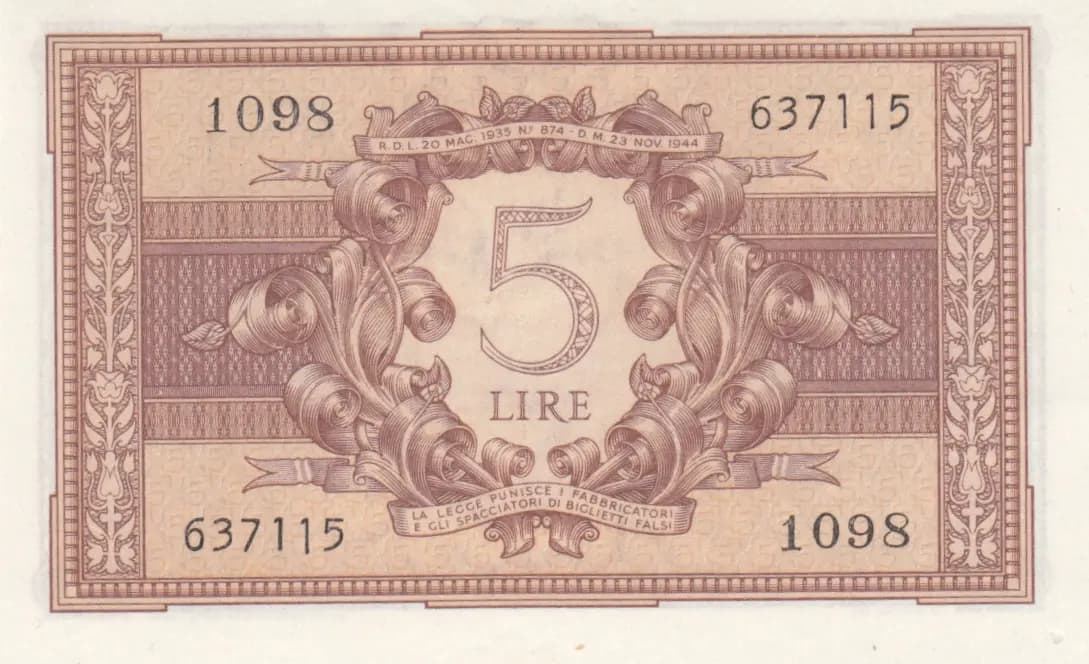
The obverse features a classical male bust in profile facing right, rendered in the neoclassical style typical of Italian state banknotes of this era—likely representing a historical or mythological Roman figure symbolic of Italian heritage. The design is framed by elaborate ornamental borders incorporating acanthus leaves, scrollwork, and geometric patterns characteristic of Renaissance revival engraving. The reverse displays a large symmetrical wreath or cartouche design with scrolling ornamental elements surrounding the central denomination numeral '5', with matching ornamental column frames on both sides. The denomination appears prominently in all four corners, and serial numbers are positioned in all corners of the reverse. The color palette of mauve, purple, and tan across both sides provides excellent contrast for security purposes.
FRONT SIDE: 'ITALIA' (Italy), 'BIGLIETTO DI STATO A CORSO LEGALE' (State Banknote at Legal Rate), 'LIRE CINQUE' (Five Lire), 'IL DIRITTO GEN.' (The Right General), 'IL CASSIERE SPECIALE' (The Special Cashier), 'V. PER LA CORTE' (V. For the Court), 'R CARRASSI G.IS' (signature: R Carrassi G.IS), 'IST POL STATO OFFICINA CARTE VALORI' (State Printing Institute, Security Papers Office). BACK SIDE: '5' and 'LIRE' (denomination), 'RDL 20 MAG 1935 N° 874 - 23 NOV 1944' (Royal Decree Law 20 May 1935 No. 874 - 23 November 1944), 'UNISCE I FABRICATORI E FABBRICATORI DI BIGLIETTI' (Unites the Manufacturers and Fabricators of Banknotes), 'LA LEGGE I FALSIFICATORI DI BIGLIETTI FALSI' (The Law Against Counterfeiters of False Banknotes). Serial numbers appear in all four corners.
This note was produced using traditional intaglio engraving, as evidenced by the fine line work, intricate geometric patterns, and complex multi-layered ornamental designs visible throughout both sides. The exceptional clarity of the engraved borders, wreath elements, and portrait indicate high-quality engraving plates. Produced by the Istituto Poligrafico dello Stato (State Printing Institute) in collaboration with the Officina Carte-Valori (Security Papers Office) in Rome, as noted in the imprint. The multi-color printing (mauve/purple and tan) was achieved through sequential intaglio passes, a standard technique for high-security banknote production of the 1935-1944 period.
This specimen is cataloged as Pick P-31b, with PMG records indicating the existence of at least one additional variant (P-31c) for this base Pick number. Varieties likely relate to signature combinations, serial number prefixes, or ministerial decree dates. The observed serial numbers (1098/637115) and signatures of 'R CARRASSI G.IS' should be cross-referenced with catalog authorities to confirm the specific sub-variety. The November 23, 1944 date visible on the reverse distinguishes this from the original May 20, 1935 Royal Decree issue.