3 lire 1848
About This Note
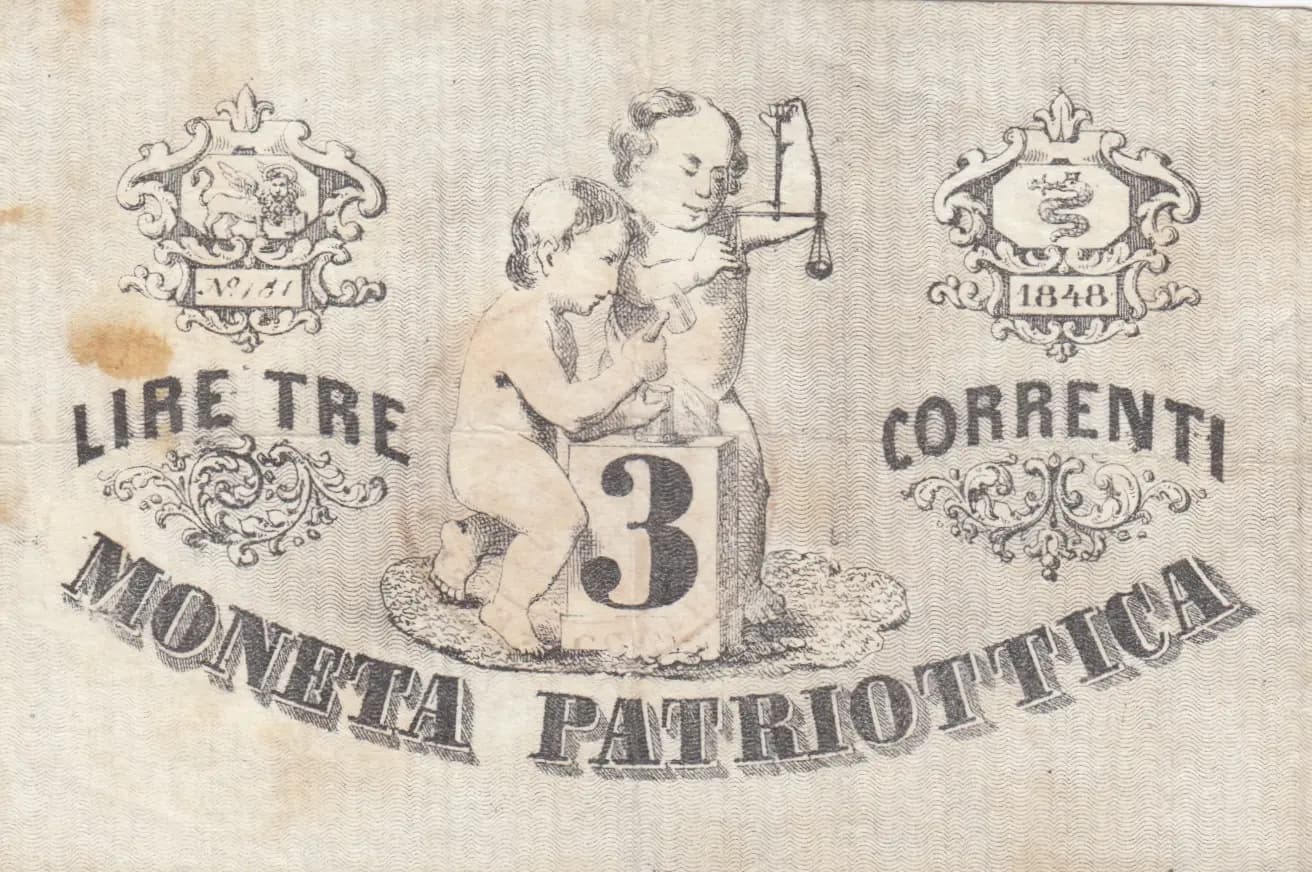
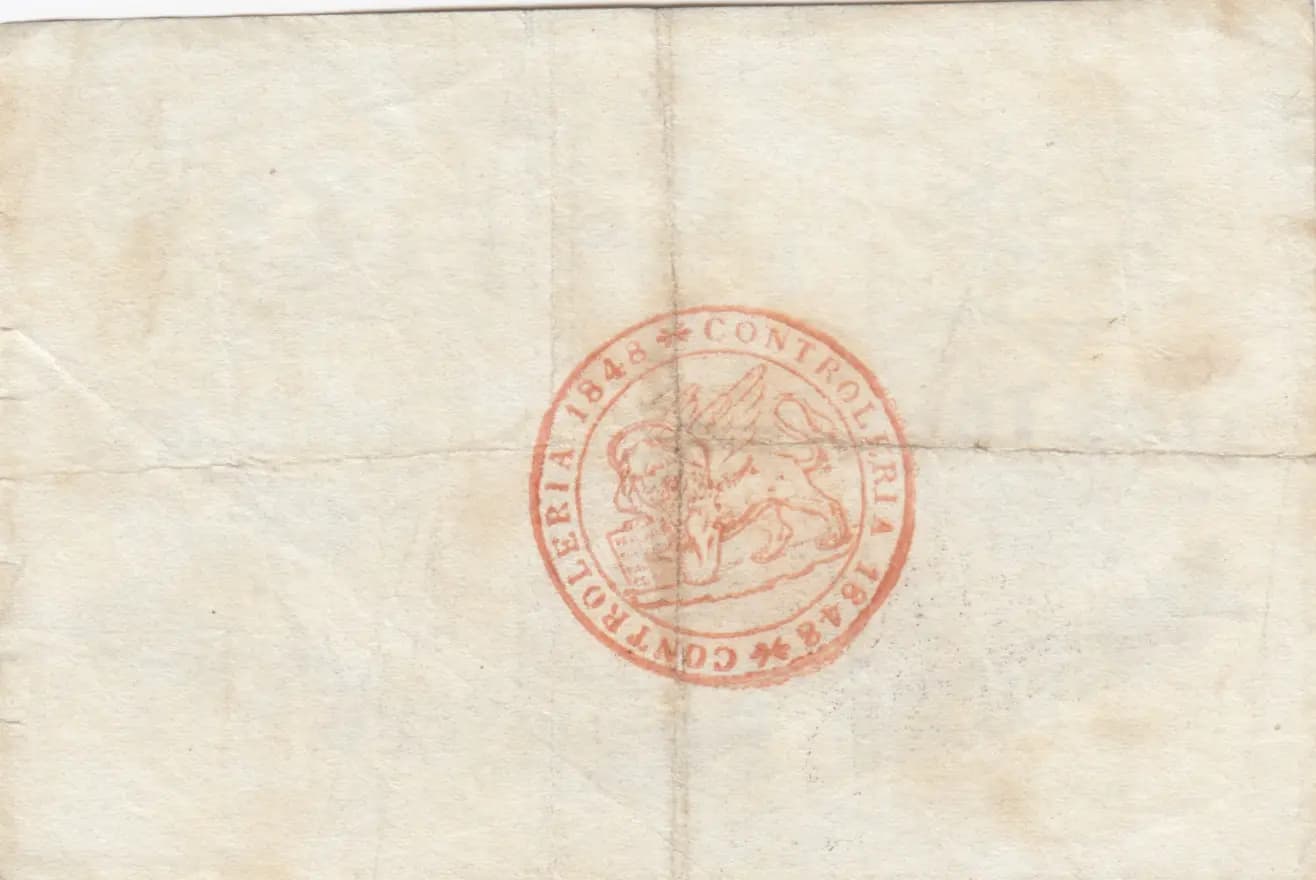
A scarce Italian 3 Lire banknote issued by the Banca Nazionale di Venezia in 1848, presented in Very Fine condition with characteristic age-related patina. The front features an elegant neoclassical design with two cherubs flanking a large numeral '3' within an ornate oval cartouche, labeled 'MONETA PATRIOTTICA' (Patriotic Currency), reflecting Venice's revolutionary period. The reverse displays a substantial red/orange heraldic seal, and the note shows expected period creasing and minor foxing, consistent with genuine 19th-century circulation.
Scarce. While the Banca Nazionale di Venezia operated during a brief and tumultuous period (1848-1849), this particular denomination and issue appears in Pick's catalog, indicating recognized numismatic significance beyond common circulation notes. The patriotic designation, limited print run associated with a revolutionary government's brief tenure, and survival rate of Venetian revolutionary currency from this period suggest scarcity rather than commonality. VF examples with intact seals and minimal damage command collector interest.
This note was issued during a pivotal moment in Italian history—the 1848 Revolutions that swept across the peninsula following the failed uprisings against Austrian and papal rule. The 'MONETA PATRIOTTICA' inscription and the prominent heraldic imagery underscore Venice's assertion of financial independence during the short-lived Republic of San Marco (1848-1849). The dual dates of 1841 and 1848 on the front suggest this design was authorized in 1841 but put into circulation only during the revolutionary period, making it a direct artifact of Venetian political resistance.
The obverse displays a neoclassical allegorical composition featuring two cherubs (putti)—one standing with what appears to be a surveying instrument or bow and arrow (symbolizing measurement, geometry, or martial virtue) and one seated below—framing a bold numeral '3'. This composition is enclosed within an ornate rococo-style oval cartouche. Flanking the central vignette are heraldic shields or coats of arms positioned at left (dated 1841) and right (dated 1848), serving as security elements and institutional markers. The text arrangement emphasizes both the denomination ('LIRE TRE') and the note's extraordinary patriotic status. The reverse features a substantial circular seal impression executed in red/orange ink, containing a heraldic lion or beast within a decorative border—a typical security feature of Venetian bank currency and a symbol of civic authority.
FRONT: 'LIRE TRE' (Three Lire) — denomination; 'CORRENTI' (Current/Circulating) — indicates legal tender status; 'MONETA PATRIOTTICA' (Patriotic Currency) — banner inscription below the cherubs; '1841' and '1848' — dates on left and right heraldic shields respectively. BACK: 'BANCA CENTRALE ITALIANA 1848' (Central Bank of Italy 1848) — inscribed on or around the heraldic seal impression.
Intaglio engraving (copper-plate printing), evidenced by the fine line work, precise detail in the ornamental cartouches, heraldic elements, and the clarity of the numeral and text. The red/orange seal on the reverse was applied separately, likely via stamping or embossing. This technique was standard for high-security banknote production in mid-19th-century Italian banking institutions.
This is the cataloged variety as Pick P-S187 (1848 issue). Known varieties of Venetian 3 Lire from this period may include differences in seal impressions or minor engraving variations, but without additional documented examples or serial number evidence visible in the current images, the primary identifying features are the MONETA PATRIOTTICA designation, the dual dates (1841/1848), and the heraldic seal type. The inscription 'BANCA CENTRALE ITALIANA' on the reverse, while anachronistic to modern Italian banking, reflects the aspirational terminology of the 1848 republican period.