10 lire 1935
Market Prices
12 salesAbout This Note
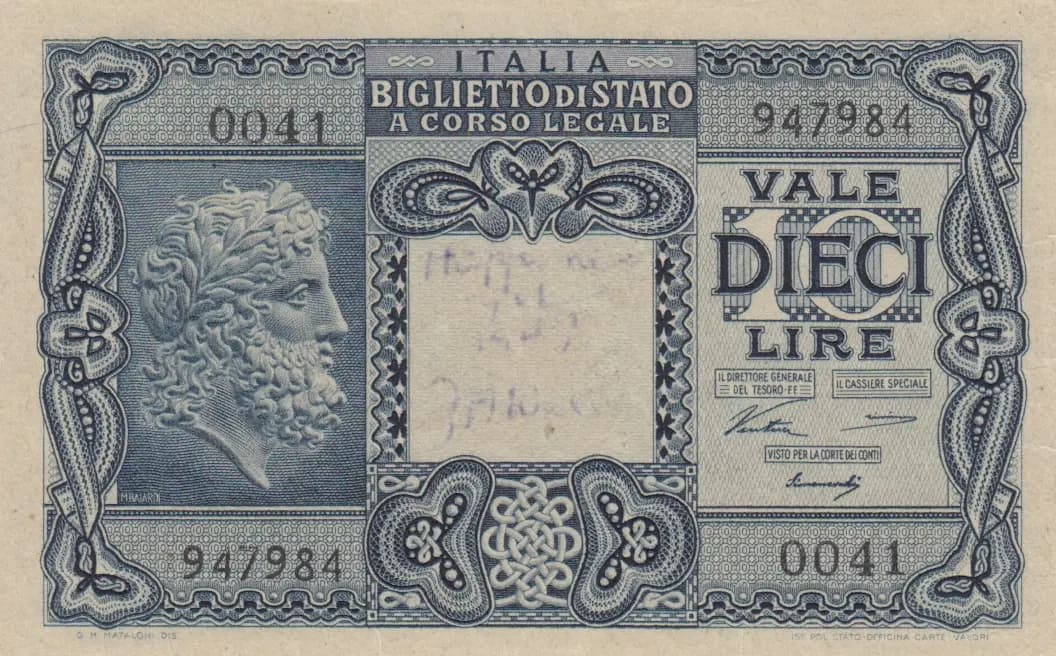
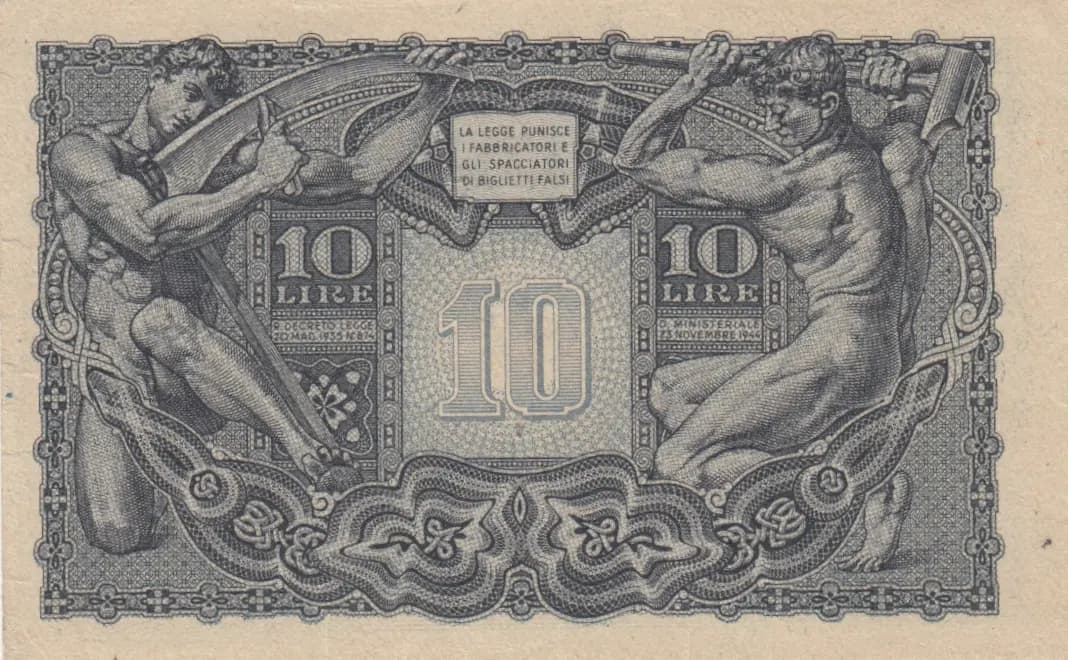
This is an AU-graded Italian 10 Lire banknote from 1935 (Pick-32a), issued by Biglietto di Stato under the Ministero del Tesoro. The note features a classical portrait of Jupiter on the obverse in blue-grey tones with intricate engraved detailing, while the reverse displays two allegorical winged male figures flanking a central '10' denomination circle. Despite age-related patina and minor foxing consistent with historical circulation, the engraving remains crisp and the note retains strong visual appeal characteristic of AU condition.
Common. The eBay price history provided shows consistent sales in the $0.75 to $41 range, with most AUNC/EF examples selling for $3–$8. Even PMG-graded specimens (63–67) rarely exceed $100, with the highest noted sale at $107.50. These prices indicate robust market supply and consistent collector demand at modest valuations, typical of common 20th-century European banknotes. Print runs were substantial, and the note was widely circulated, supporting the common classification.
This banknote was issued under Royal Decree of May 20, 1935, during the Fascist period of Italian history under Mussolini's regime, with the actual printing occurring in 1944 according to ministerial decree. The classical iconography—Jupiter representing divine authority and allegorical figures representing Agriculture and Industry—reflected the Italian state's desired projection of power, stability, and economic productivity during the turbulent 1930s-1940s era. The 'Biglietto di Stato' (State Banknote) designation and legal tender inscriptions underscore the sovereign authority of the Italian state in currency issuance.
The obverse features Jupiter (Roman king of the gods) depicted as a classical male head in profile with curly hair and beard, positioned prominently on the left side. The design is framed by elaborate ornamental borders incorporating classical motifs including serpent or snake designs in the corners, floral and geometric patterns, and wreath-like decorative elements. The center contains the denomination and legal inscriptions. The reverse displays two allegorical putti (winged cherubs) in classical style—representing Agriculture and Industry according to the external catalog—positioned symmetrically on either side of a large numeral '10' enclosed in a circular medallion. The entire composition is rendered in fine-line engraving with ornamental corner rosettes and wreath designs, following the neoclassical aesthetic popular in early 20th-century Italian state currency design.
FRONT SIDE: 'ITALIA' (Italy) | 'BIGLIETTO DI STATO' (State Banknote) | 'A CORSO LEGALE' (Legal Tender) | 'VALE DIECI LIRE' (Worth Ten Lire) | 'IL DIRETTORE GENERALE DEL TESORO' (The General Director of the Treasury) | 'IL CASSIERE SPECIALE' (The Special Cashier) | 'VISTO PER LA CORTE DEI CONTI' (Seen/Approved by the Court of Accounts) | Serial numbers: 94784 and 0041. BACK SIDE: '10 LIRE' (Ten Lire) | 'LA LEGGE PUNISCE I FABBRICATORI E GLI SPACCIATORI DI BIGLIETTI FALSI' (The law punishes the manufacturers and distributors of counterfeit banknotes).
Intaglio engraving, as evidenced by the fine linear details, crisp portrait work, and intricate decorative patterns visible throughout both sides. According to catalog data, printing was executed by Istituto Poligrafico dello Stato (Italian State Printing Institute) in collaboration with Officina Carte-Valori in Rome. The visual analysis notes reference to possible lithographed variants (P-32b) with blue line designs in watermark areas, but the specimen examined appears to be the engraved standard issue.
Two variants are cataloged under this Pick number: P-32a (the engraved version examined here) and P-32b (lithographed variant with blue line watermark design). The specimen shown appears to be P-32a based on the standard engraved technique and absence of the distinctive blue watermark line mentioned for P-32b. Serial numbers visible (94784 and 0041) are consistent with regular issue production.