10 lire 1874
Market Prices
About This Note
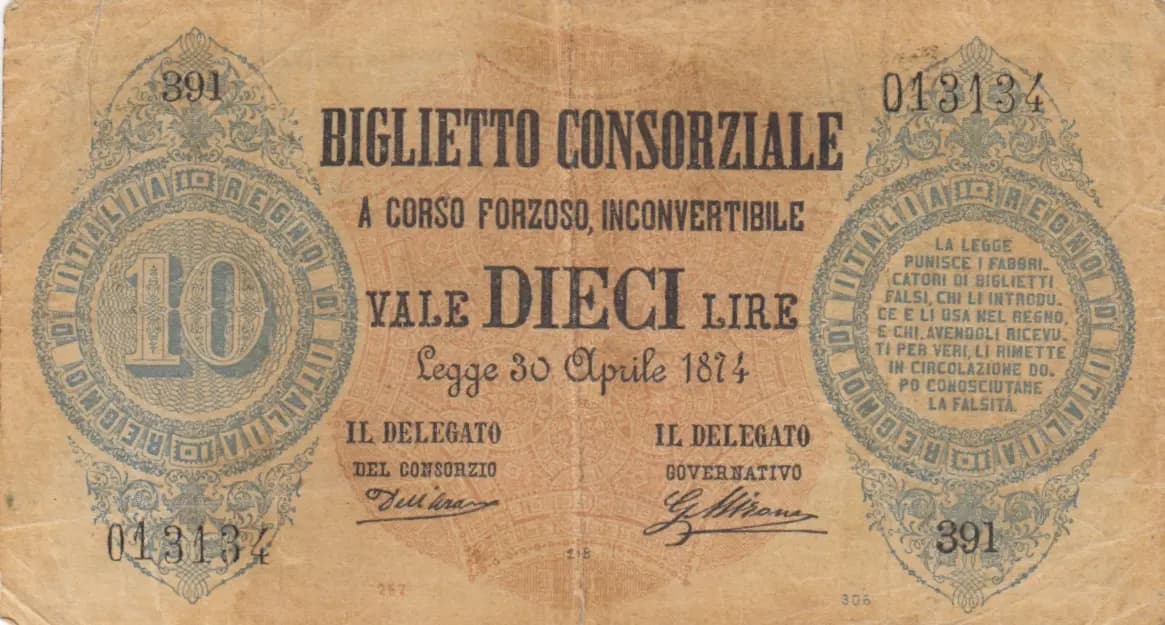
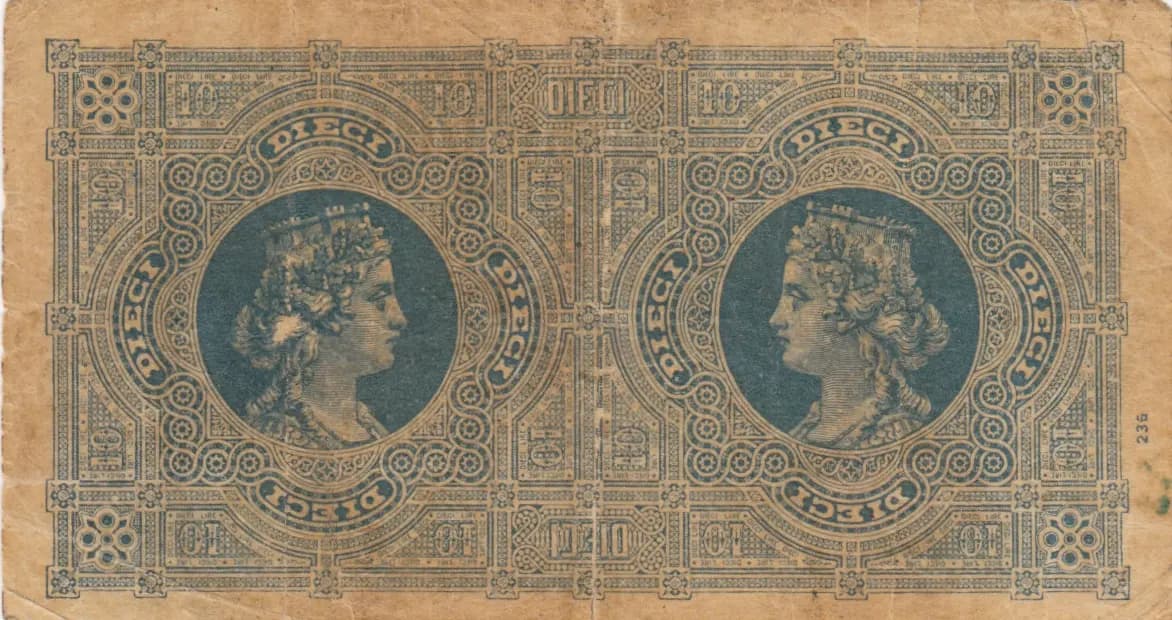
This Italian 10 Lire Biglietto Consorziale from 1874 represents an important piece of Italian monetary history issued under the Law of April 30, 1874. The note displays the characteristic tan and blue color scheme with ornamental circular medallions framing the denomination on the obverse and classical female profile portraits (representing Italia) on the reverse. In VG condition, the note shows significant age-related wear including foxing, discoloration, and creasing consistent with 150 years of circulation, yet the fine engraving details and security patterns remain visible.
Common. While this note dates to 1874 and shows significant age, eBay market data indicates prices ranging from $74.75 to $316.25 USD, with most sales in the $140-$195 range. The 2016 catalog valuation places VG condition at approximately $10, consistent with a widely-circulated historical issue. The Biglietto Consorziale series had substantial print runs to serve Italy's monetary needs during this period. No evidence of small print runs, recalled status, or issuing authority limitations suggests common classification.
This banknote was issued during the early consolidation period of the Kingdom of Italy, following Italian unification in 1861. The Biglietto Consorziale (Consortium Banknote) was specifically created under forced circulation and inconvertible status, as explicitly stated on the obverse ('A CORSO FORZOSO, INCONVERTIBILE'), reflecting the financial pressures Italy faced in the 1870s. The dual allegorical female portraits on the reverse represent Italia, emphasizing national identity during this formative period of the modern Italian state.
The obverse features a centered denomination area with large numerals '10' enclosed within ornate circular medallions with intricate geometric patterns, flanked by royal insignia or heraldic emblems. The design emphasizes symmetry and official authority through signature lines for both Consortium and Governmental delegates. The reverse displays two identical classical profile portraits of a woman (representing Italia in allegorical form) facing right with curled hair, each contained within ornamental circular frames with geometric and floral patterns. The entire design is framed by decorative borders with repeating guilloche motifs, typical of fine currency engraving from this period. The color palette uses tan/beige as the primary underprint with black text and ornamental work on the obverse, and blue/teal engraving on the reverse.
OBVERSE: 'BIGLIETTO CONSORZIALE' (Consortium Banknote); 'A CORSO FORZOSO, INCONVERTIBILE' (At Forced Course, Inconvertible); 'VALE DIECI LIRE' (Worth Ten Lire); 'Legge 30 Aprile 1874' (Law 30 April 1874); 'IL DELEGATO DEL CONSORZIO' (The Consortium Delegate); 'IL DELEGATO GOVERNATIVO' (The Governmental Delegate); Extended legal warning regarding counterfeiting penalties under Kingdom of Italy law. Serial numbers: 391 and 043134. REVERSE: Denomination '10' marked in ornamental circles at bottom corners; printing reference mark '238'.
Intaglio engraving (copperplate) printing, the standard security printing method for Italian banknotes of this era. The fine detail visible in the guilloche patterns, portrait medallions, and ornamental borders, along with the security features including geometric patterns and signature lines, indicates production by a specialized government security printer. The dual-color printing technique (brown underprint with black text on obverse; blue on reverse) required multiple plate impressions.
Pick number P-5 for the 10 Lire 1874 Biglietto Consorziale. Serial numbers observed: 391 and 043134 suggest standard sequential numbering without known overprints or signature variants. The printing reference mark '238' on the reverse may indicate a specific printing plate or production batch. No major varieties (such as signature substitutions or date variations) are apparent in this specimen. The specific combination of serial numbers and reference marks is unique to this individual note but does not constitute a cataloged variety.