50 lire 1943
Market Prices
9 salesAbout This Note
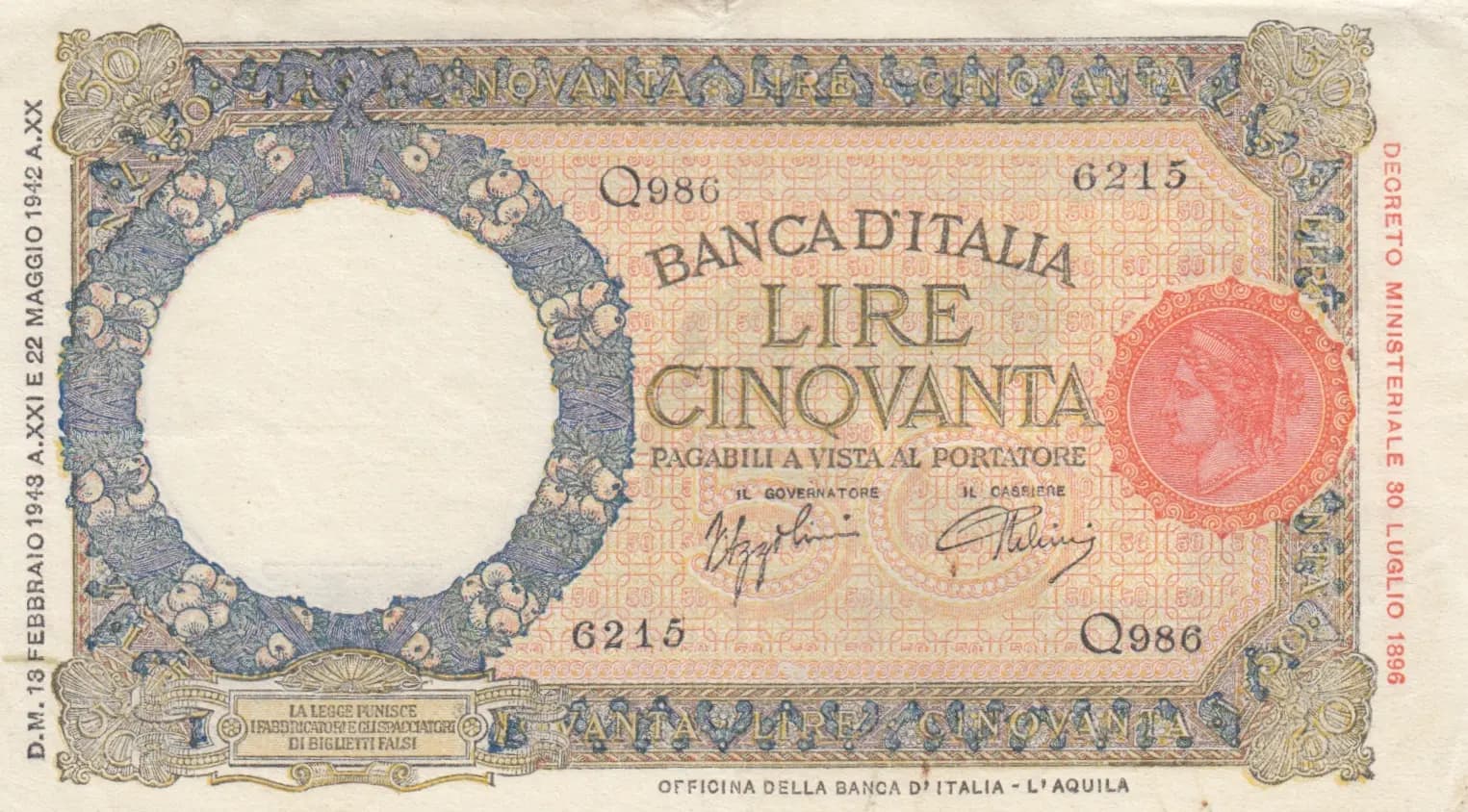
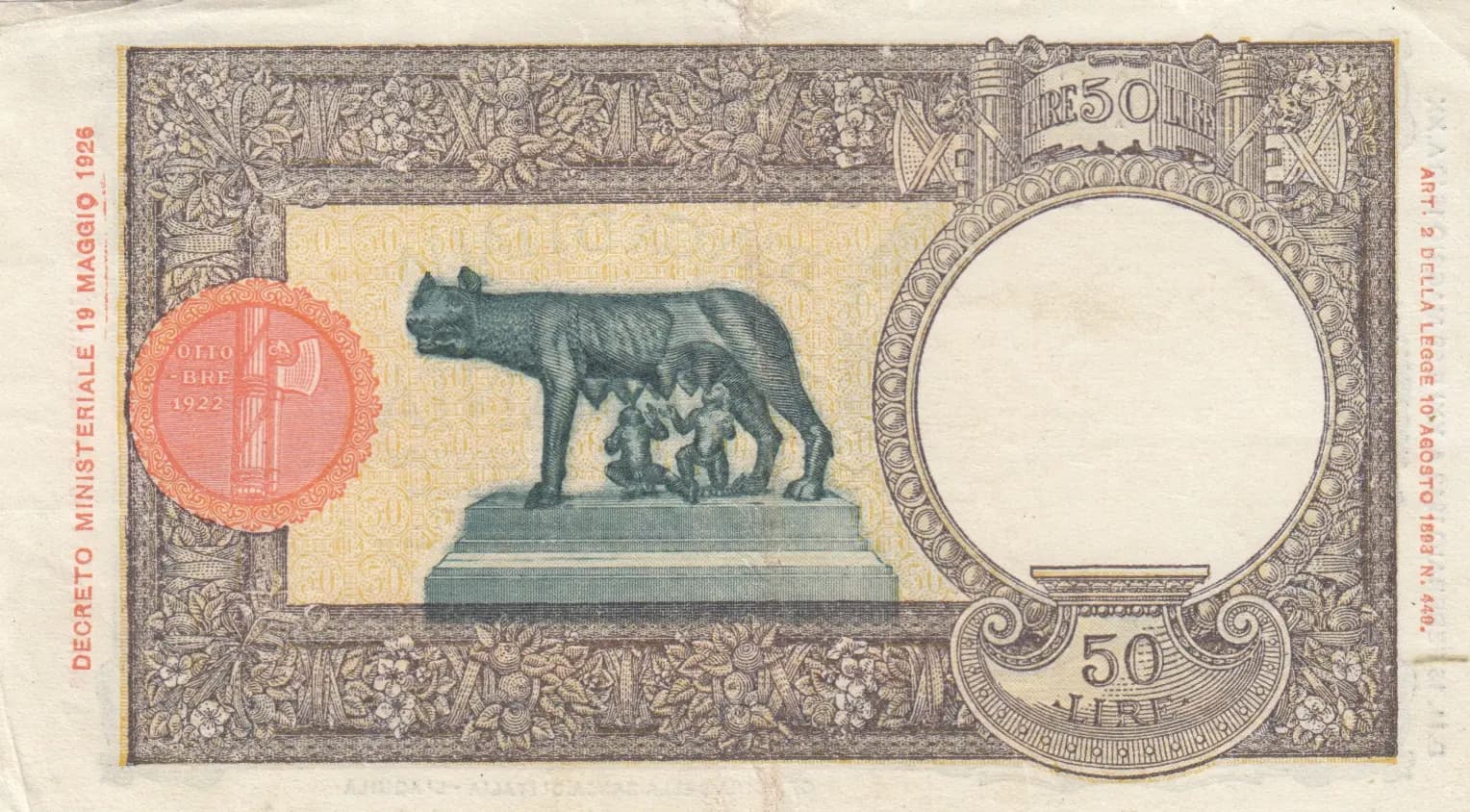
An Italian 50 lire banknote from 1943 (Pick P-58) in VF condition, featuring an ornate classical design typical of Fascist-era Italian currency. The front displays a female portrait in a red circular medallion against a cream and beige background with blue and gold decorative elements, while the reverse showcases an engraving of the famous Capitoline Wolf (Lupa Capitolina) with Romulus and Remus. This note exhibits the characteristic fine line work and intricate border patterns of the Officina della Banca d'Italia printing works in L'Aquila, with visible age-related foxing and light creases consistent with historical circulation.
Common. Market data from realbanknotes.com shows consistent sales of this note in VF condition averaging around $13.50–$22.50, with no evidence of supply scarcity. eBay transaction history over more than a decade demonstrates reliable availability at moderate prices. While 1943-dated notes from the final Fascist period have some historical interest, this Pick number was printed in sufficient quantities and survives in adequate numbers to be considered common in the collector market.
This banknote was issued during the final years of Mussolini's Fascist regime in Italy, with decree dates of May 22, 1942 and February 18, 1943 printed on the front. The reverse features the Capitoline Wolf, a potent symbol of Rome's founding mythology and imperial legacy—imagery deliberately emphasized by Fascist ideology to invoke Roman greatness. The note's production at L'Aquila reflects the decentralized printing of Italian currency during this tumultuous period, as World War II intensified and central authority fragmented.
The obverse features a female portrait (likely a personification of Italia or a classical muse) presented in profile within a prominent red circular seal or medallion, positioned on the right side of the note. The background employs a cream and beige palette with geometric patterns, framed by ornate decorative borders in blue and gold with classical scrollwork. Two serial numbers are visible (alphanumeric and numeric series). The reverse showcases a classical engraving of the Lupa Capitolina—the legendary she-wolf nursing the twin founders Romulus and Remus—a foundational Roman mythological scene mounted on a decorative pedestal. An ornamental circular frame appears on the right side of the reverse, with the overall design executed in cream and yellow tones with brown and gray decorative borders. Red seals appear on both sides, consistent with the 'Italia/Fascio' seal type noted in catalogs.
FRONT: 'BANCA D'ITALIA' (Bank of Italy); 'LIRE CINQUANTA' (Fifty Lire); 'PAGABILI A VISTA AL PORTATORE' (Payable on demand to the bearer); 'IL GOVERNATORE' (The Governor); 'IL CASSIERE' (The Cashier); 'D.M. 18 FEBBRAIO 1943 A.XXI E 22 MAGGIO 1942 A.XX' (Decree dated February 18, 1943 and May 22, 1942); 'DECRETO MINISTERIALE 30 LUGLIO 1926' (Ministerial Decree July 30, 1926); 'LA LEGGE PUNISCE L'IMITAZIONE E GLI ALTERAZIONE DI BIGLIETTI FALSI' (The law punishes imitation and alteration of counterfeit notes); 'OFFICINA DELLA BANCA D'ITALIA - L'AQUILA' (Office of the Bank of Italy - L'Aquila). BACK: 'LIRE 50' (50 Lire); 'OTTO BRE 1922' (October 1922); 'DECRETO MINISTERIALE 19 MAGGIO 1926' (Ministerial Decree May 19, 1926); 'ART. 2 DELLA LEGGE 10 AGOSTO 1942' (Article 2 of the Law of August 10, 1942).
Intaglio engraving, as evidenced by the fine line work, detailed shading, and crisp decorative border patterns visible throughout both sides of the note. The intricate classical imagery and security-focused ornamentation are characteristic of high-security intaglio production. Printed by the Officina della Banca d'Italia in L'Aquila, as stated in the imprint. The multi-color printing (blue-violet, yellow-brown, orange, yellow, red, and black) suggests a multi-pass intaglio process with careful color registration.
This example displays the L'Aquila printing variant (as indicated by 'OFFICINA DELLA BANCA D'ITALIA - L'AQUILA' in the imprint), distinguishing it from similar P-54 and P-57 notes printed in Rome. The seal type is documented as 'Italia/Fascio' rather than the later 'Italia/Monogram B-I' type seen on P-66. Serial numbers Q986 and 6215 appear on this specimen. The note bears decree dates of May 22, 1942 (A.XX in Fascist calendar reckoning) and February 18, 1943 (A.XXI), reflecting a late-period emission during the dissolution of Mussolini's government.