10 lire 1888
Market Prices
18 salesAbout This Note
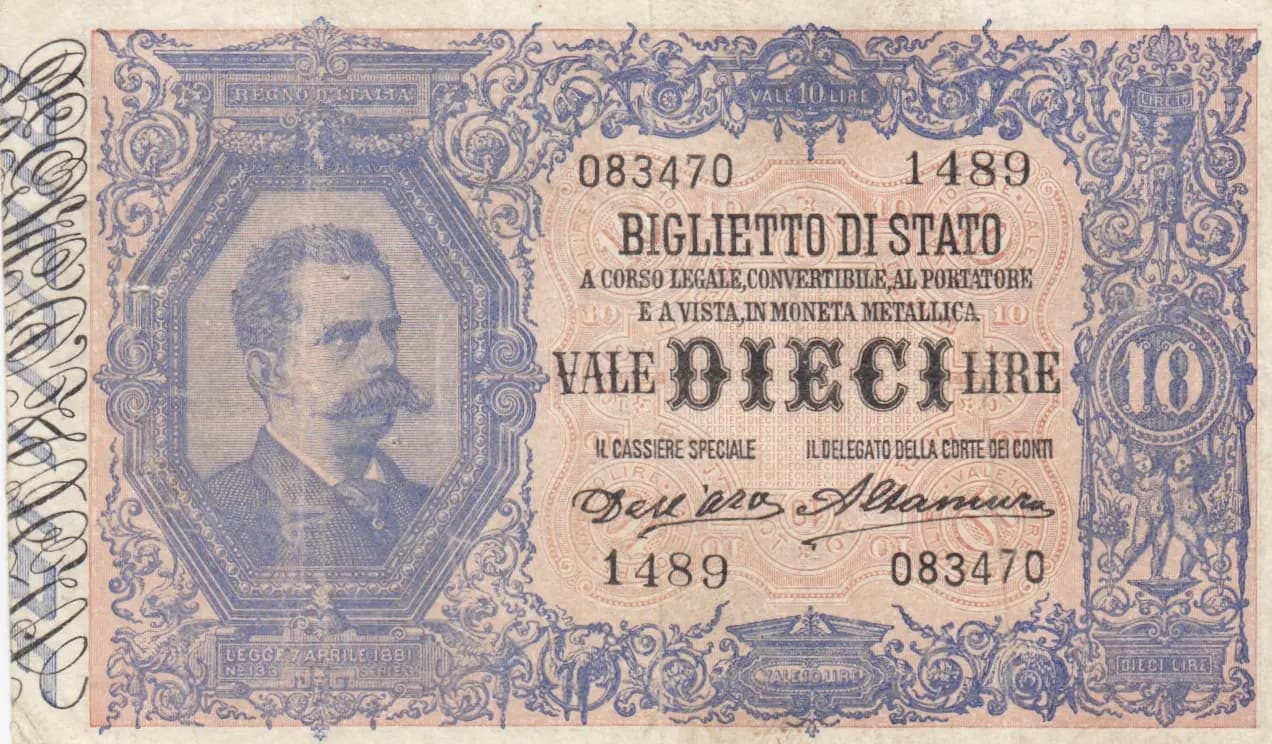
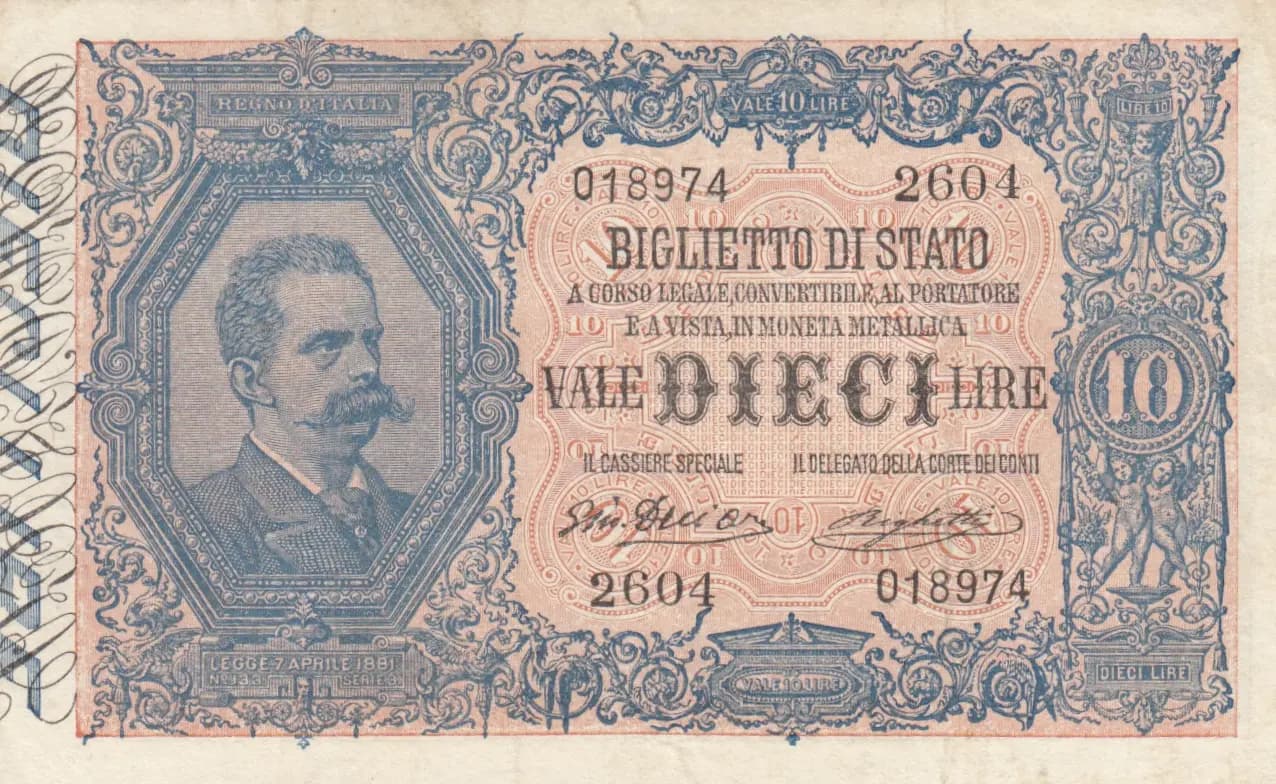
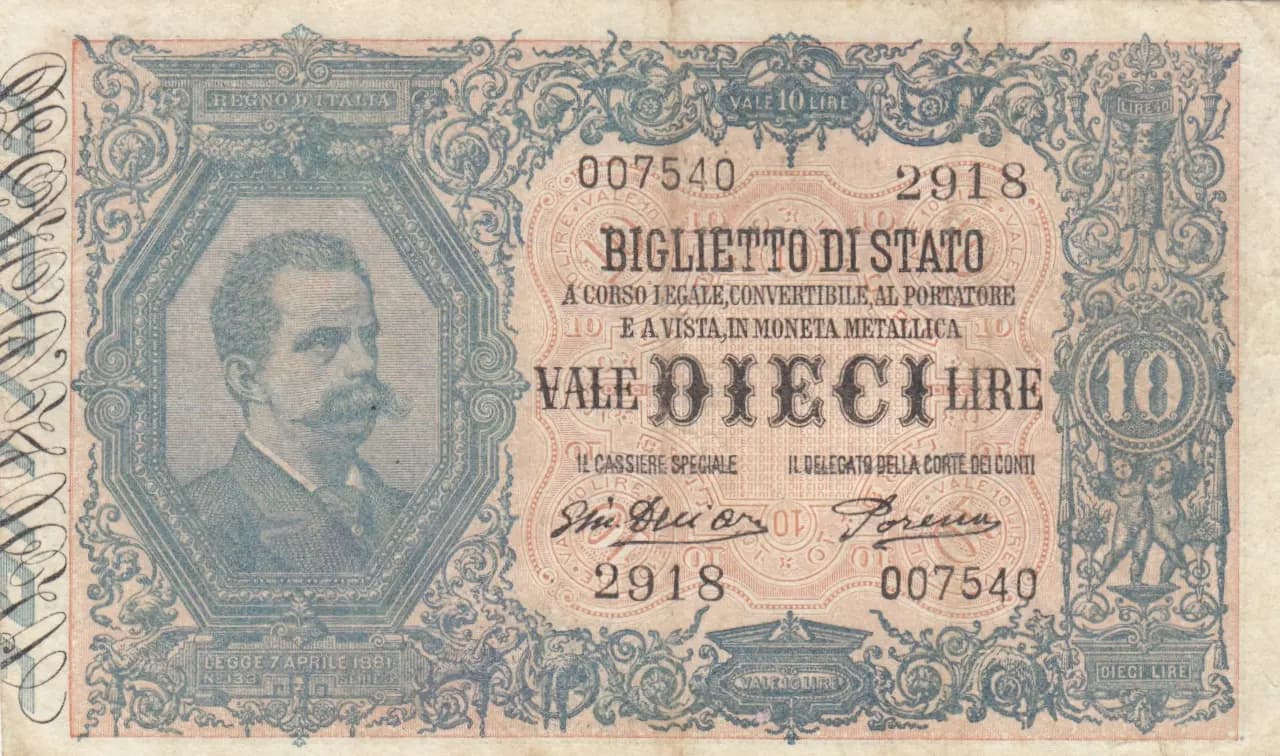
This is an 1888 Italian 10 Lire state banknote (Biglietto di Stato) issued under Royal Decree, featuring a portrait of King Umberto I in a hexagonal frame on the obverse. The note exhibits significant aging consistent with a 19th-century circulated banknote, with yellowed paper, visible creasing, and patina appropriate to its age and VF condition grade. The intricate engraved design with blue-green and pink tones, combined with its historical significance as an early Kingdom of Italy note, makes this a desirable example for Italian currency collectors.
Common. The eBay price data provided shows consistent market prices ranging from approximately $10-$46 for VF examples, with VF-graded specimens regularly selling in the $25-$35 range. The existence of established catalog values ($12 for VF in 2016) and the broad availability of sales records indicate this is a frequently traded note without significant rarity. While these are legitimate 19th-century banknotes of historical interest, the denomination and Italian Kingdom period produced substantial circulation quantities, resulting in common status even in higher condition grades.
This note was issued in 1888 during the reign of King Umberto I, representing the Kingdom of Italy's early monetary system following unification. The Royal Decree of February 5, 1888, and subsequent registration with the Court of Accounts (Corte dei Conti) on February 17, 1888, reflect the formal governmental and legal framework governing Italy's state banknotes during this period. The inscriptions referencing legal tender status and metallic currency convertibility demonstrate the gold standard monetary system still in effect during the late 19th century.
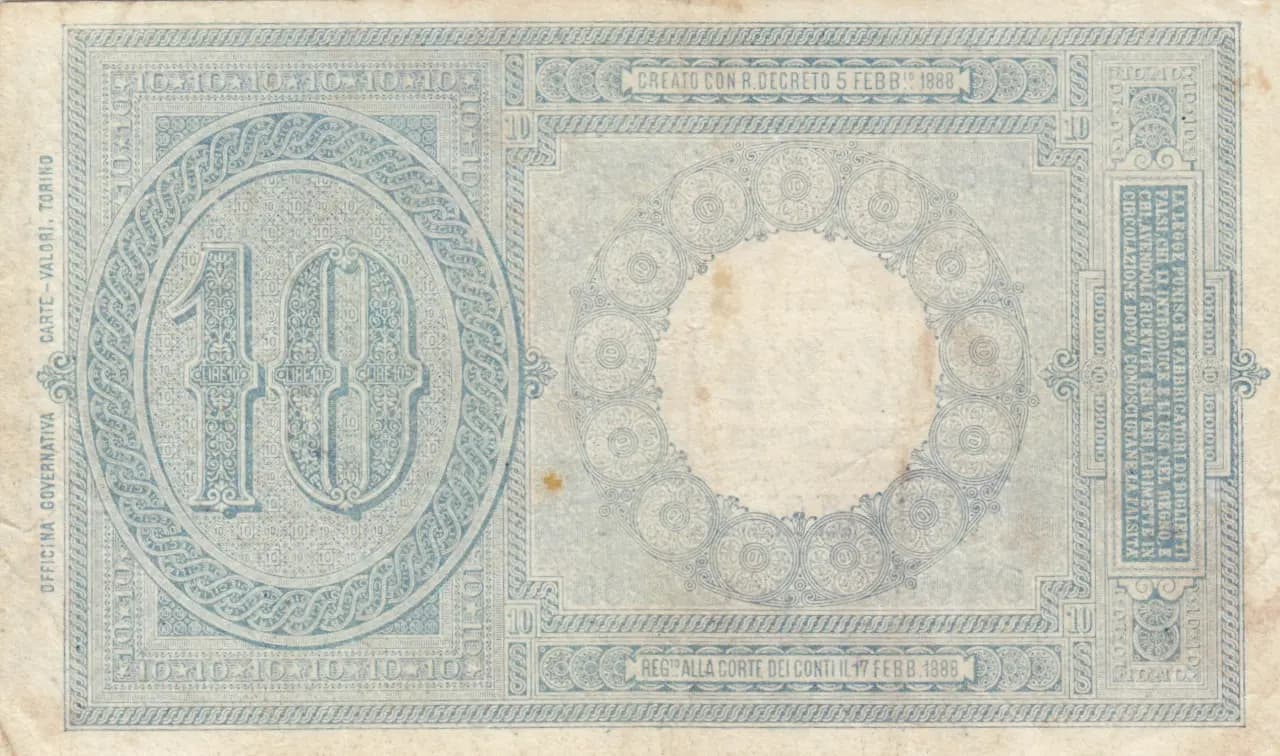
The obverse features a left-facing profile portrait of King Umberto I rendered in formal 19th-century style within an ornate hexagonal frame, surrounded by elaborate decorative scrollwork and flourishes in blue-green and pink tones. The center displays 'VALE 10 LIRE' with 'BIGLIETTO DI STATO' and legal tender declarations. The reverse presents a minimalist design with a large ornate numeral '10' enclosed in a decorative oval frame on the left, while the right side features a ring of twelve circular ornamental medallions surrounding a central oval area. Both sides employ fine engraved line work typical of high-security banknote production. The overall color scheme of blue-green on cream/beige background with pink underprinting demonstrates the sophisticated chromatic approach of Italian state banknotes in this era.
FRONT: 'REGNO D'ITALIA' (Kingdom of Italy) | 'VALE 10 LIRE' (Worth 10 Lire) | 'BIGLIETTO DI STATO' (State Banknote) | 'A CORSO LEGALE, CONVERTIBILE AL PORTATORE E A VISTA IN MONETA METALLICA' (Legal tender, convertible to the bearer and payable on demand in metallic currency) | 'IL CASSIERE SPECIALE' (The Special Cashier) | 'IL DELEGATO DELLA CORTE DEI CONTI' (The Delegate of the Court of Accounts) | 'LEGGE 7 APRILE 1881' (Law of April 7, 1881) | Serial numbers: 007540 and 2918. BACK: 'CREATO CON R.DECRETO 5 FEBR 1888' (Created with Royal Decree February 5, 1888) | 'REG.lla CORTE DEI CONTI 17 FEBB 1888' (Registered at the Court of Accounts February 17, 1888) | 'OFFICIO GOVERNATIVO CARTE VALORI TORINO' (Government Office of Security Papers, Turin) | Denomination: '10' (Ten Lire).
This note was produced by the Officina Governativa Carte-Valori (Government Office of Security Papers) in Turin using traditional intaglio (steel engraving) techniques, as evidenced by the fine line work, intricate ornamental patterns, and precise detail work visible throughout both sides. The multiple color application (blue-green, pink, and cream) suggests multicolor intaglio printing, the standard security printing method for banknotes of this period. The elaborate decorative borders, fine cross-hatching, and detailed medallion work are characteristic hallmarks of 19th-century government security printing.
This note is cataloged as Pick P-20g, part of a series with known variants (P-20d and P-20g are documented in PMG population reports for this denomination). The specific variety designation suggests this may represent a particular printing or signature variant within the 1888 10 Lire issue. The serial number format (007540 / 2918) and absence of visible overprints or signature variations in the visual analysis are consistent with regular-issue specimens. Further research into PMG census data and Pick catalog footnotes would be necessary to determine if this specific Pick-20g designation represents distinct printing characteristics or signature combinations versus the P-20d variant.