10 lire 1888
Market Prices
2 salesAbout This Note
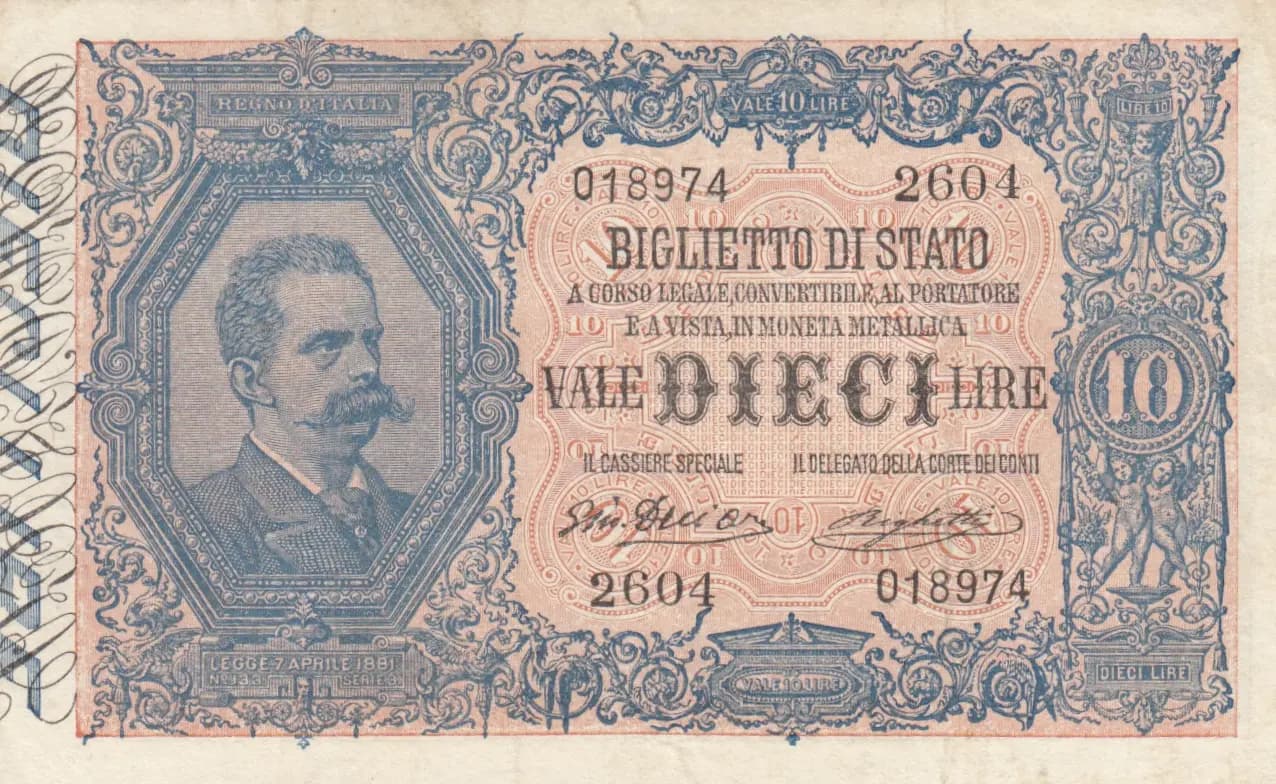
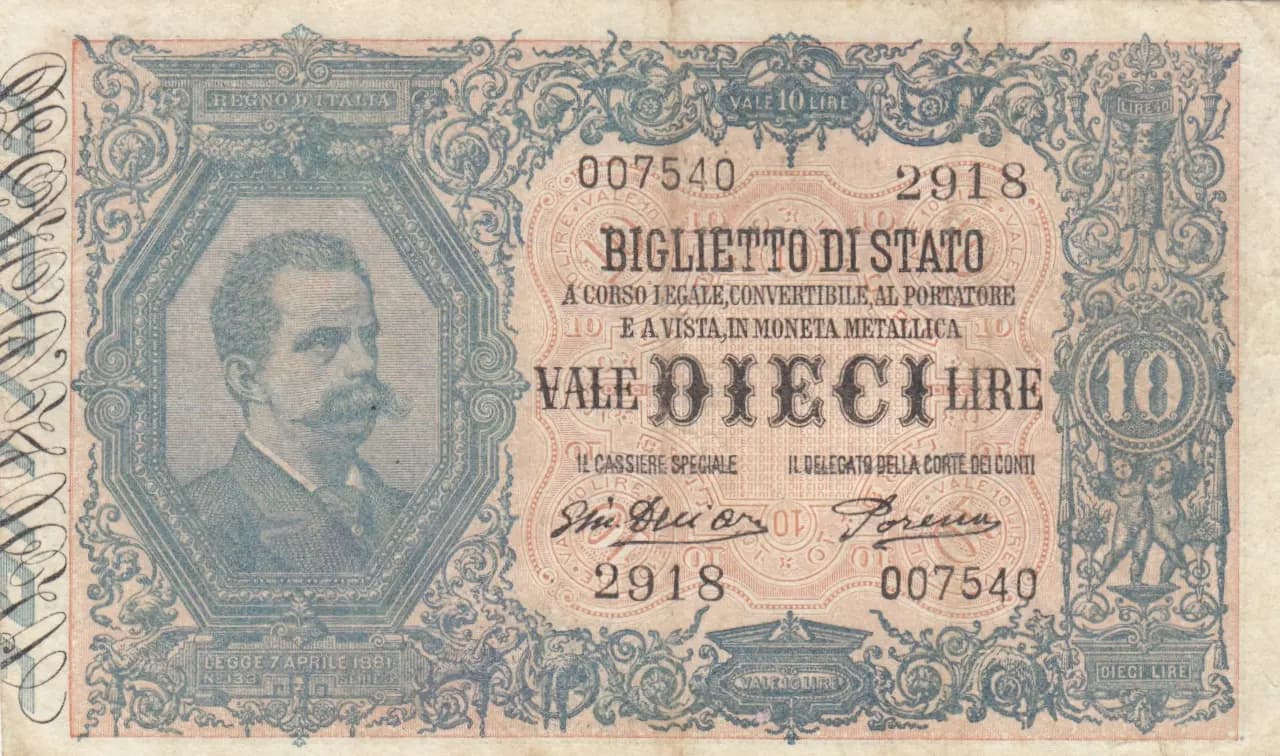
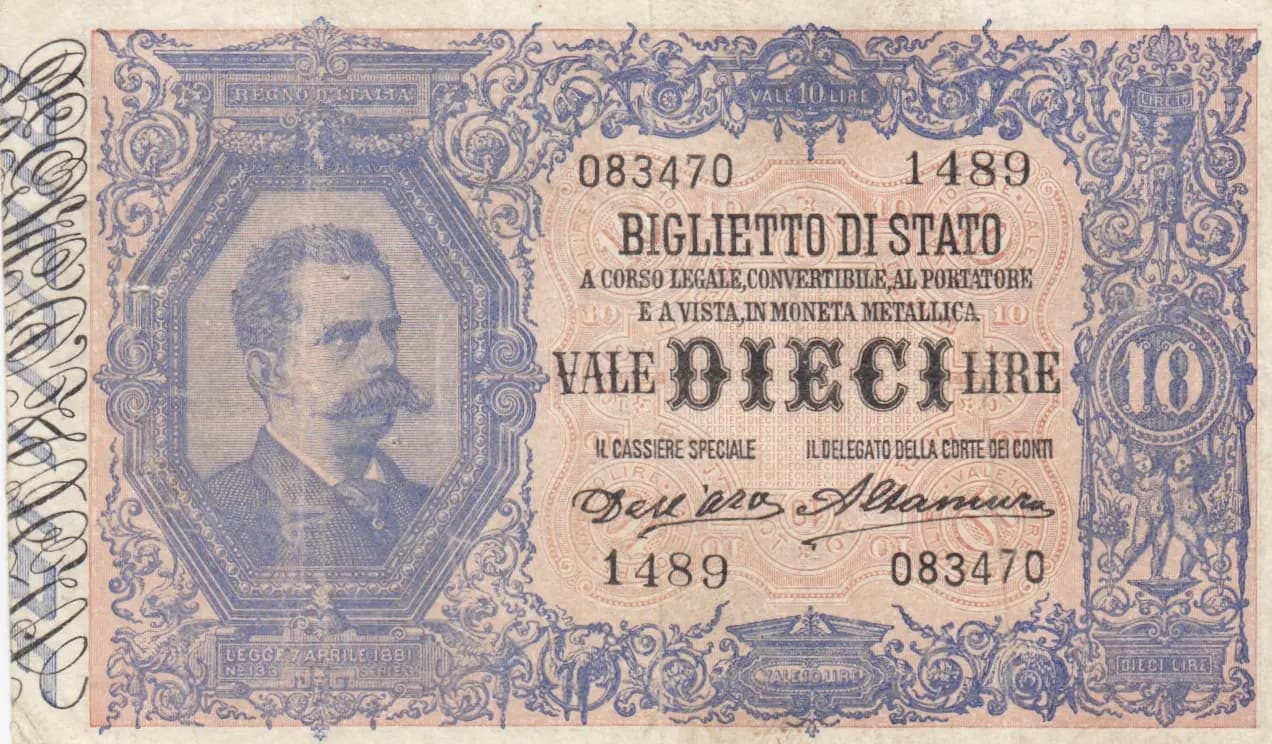
This is a VF-grade 10 Lire Biglietto di Stato from 1888, issued by the Kingdom of Italy under Royal Decree. The note features an elegant blue and cream color scheme with a portrait of King Umberto I in profile within an octagonal frame on the obverse, complemented by intricate ornamental borders typical of late 19th-century Italian engraving. Despite significant age-related foxing and creasing consistent with its 130+ year history, the note retains good structural integrity and strong visual appeal, making it a desirable example of early Italian state currency.
Common. The 1888 10 Lire Biglietto di Stato (P-20d) is a regularly issued denomination from a stable, long-running series. Reference catalog values from 2016 showing VF examples at $20 and eBay market transactions in the $3–$26 range confirm typical market pricing for common circulated examples. No evidence suggests limited print runs, recalls, or scarcity in this grade.
This Biglietto di Stato was decreed on February 5, 1888, and officially registered with the Corte dei Conti (Court of Accounts) on February 17, 1888, during the reign of King Umberto I. The note bears inscriptions referencing the Law of April 7, 1881, and was convertible on demand into metallic currency, reflecting Italy's adherence to metallic currency standards in the late 19th century. The prominent portrayal of the reigning monarch and the ornate engraved design exemplify the artistic and security standards of the Kingdom of Italy's treasury during this formative period of the unified Italian state.
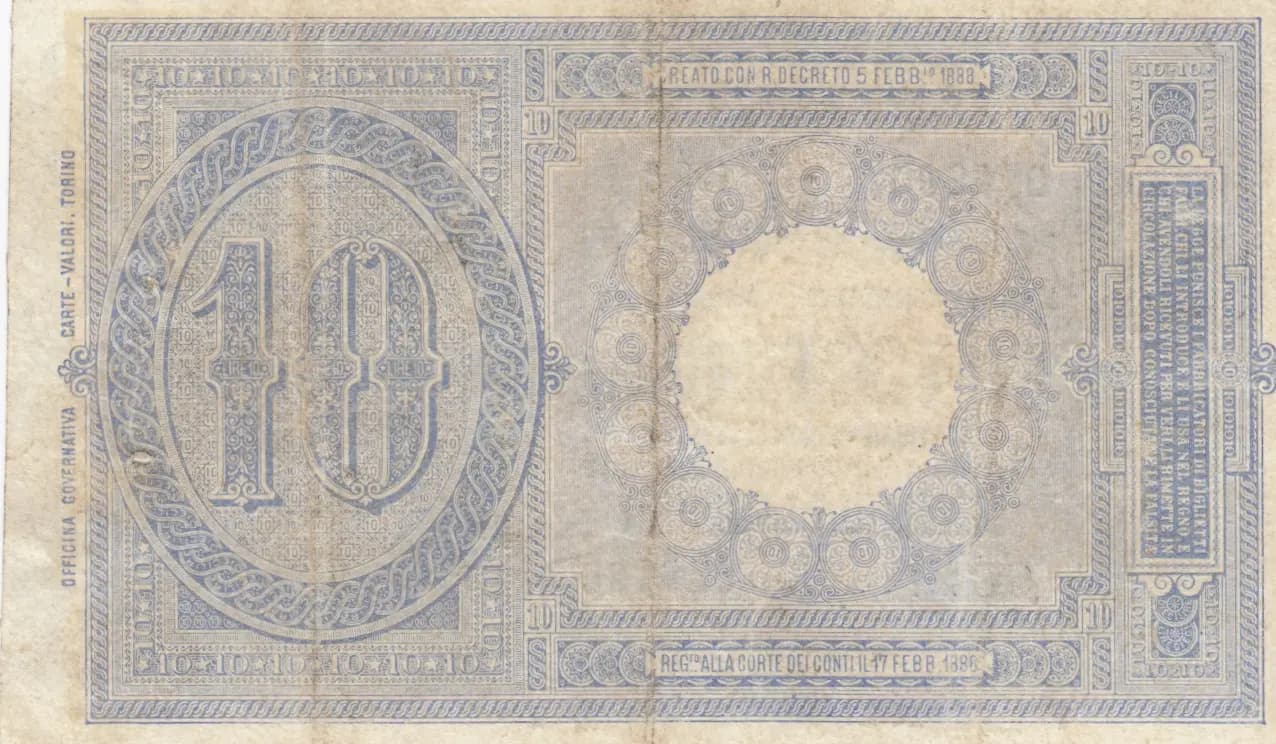
The obverse features a left-facing profile portrait of King Umberto I, the reigning monarch of Italy in 1888, presented within an ornate octagonal frame with classical decorative elements. The surrounding border is composed of elaborate floral scrollwork and geometric patterns in blue and cream, with circular denomination markers positioned in the corners. The reverse displays a large ornamental numeral '10' within a decorative circular frame on the left side, while the right side showcases a prominent scalloped circular vignette containing radiating circular denomination markers—a common anti-counterfeiting design element of the period. Both sides demonstrate the high-quality engraved craftsmanship characteristic of official Italian currency production.
FRONT: 'REGNO D'ITALIA' (Kingdom of Italy) | 'VALE 10 LIRE' (Value 10 Lire) | 'BIGLIETTO DI STATO' (State Banknote) | 'A CORSO LEGALE, CONVERTIBILE, AL PORTATORE E A VISTA, IN MONETA METALLICA' (At legal tender, convertible, to bearer and on sight, in metallic currency) | 'IL CASSIERE SPECIALE' (The Special Cashier) | 'IL DELEGATO DELLA CORTE DEI CONTI' (The Delegate of the Court of Accounts) | 'Della Alamanna' (signature) | 'LEGGE 7 APRILE 1881' (Law of April 7, 1881) | Serial numbers: 083470, 1489. BACK: 'DIREZIONE GENERALE DEI SERVIZI SPECIALI DELLA TESORERIA' (General Directorate of Special Treasury Services) | 'DECRETA CON R. DECRETO 5 FEBBRAIO 1889' (Decreed by Royal Decree February 5, 1889) | 'DIECI - VALORE NOMINALE' (Ten - Nominal Value) | 'REC.IA ALLA CORTE DEI CONTI IL 17 FEBBRAIO 1888' (Recorded at the Court of Accounts on February 17, 1888).
This note was produced using intaglio (engraved) printing, the standard security printing method for currency in the late 19th century. The fine line work visible in the ornamental borders, portrait rendering, and denomination markers are hallmarks of this technique. The note was printed by the Officina Governativa Carte-Valori (Government Office for Currency Production) in Turin, Italy's premier security printer for state currency at this time.
This note is cataloged as Pick P-20d, one of at least two documented variants (P-20d and P-20g) for the 10 Lire denomination. The observed signature of 'Della Alamanna' and serial numbers 083470 and 1489 are consistent with this variant. The reference date discrepancy (Royal Decree February 5, 1888, recorded February 17, 1888, but some sources cite 1889) reflects historical record-keeping variations but does not affect the Pick cataloging.