10 lire 1888
Market Prices
9 salesAbout This Note
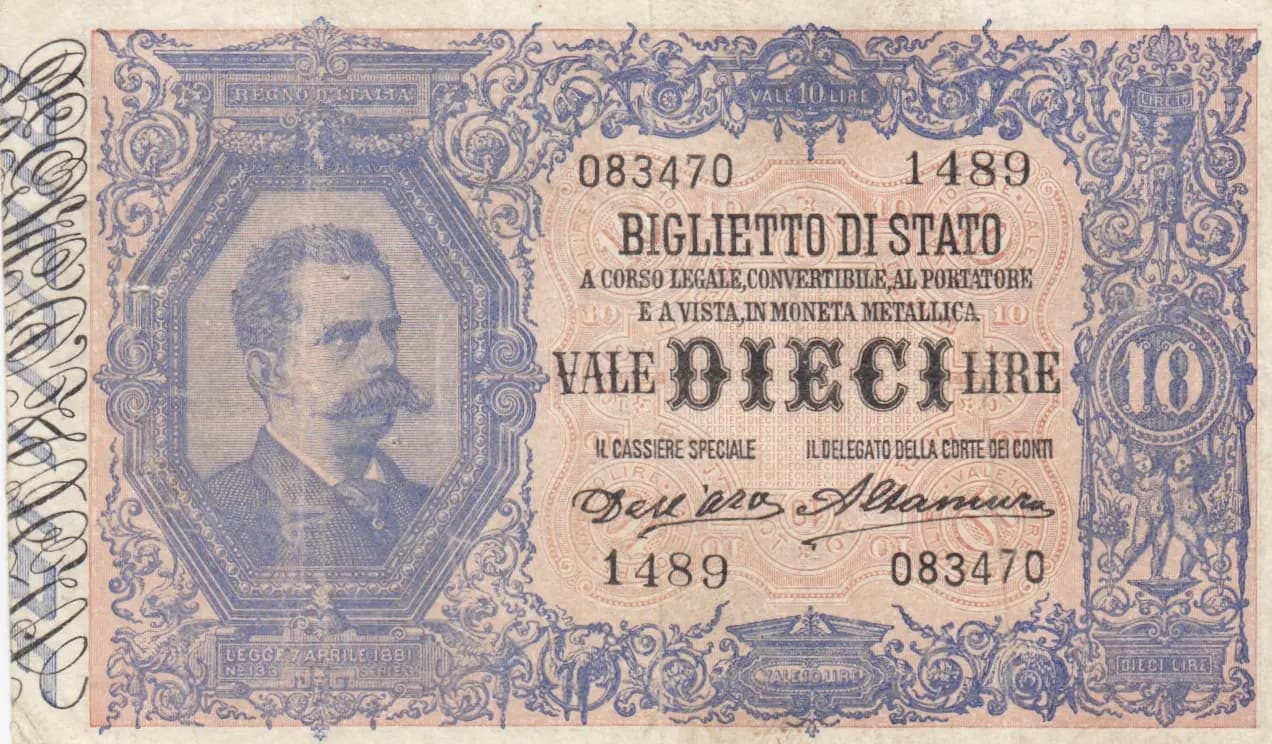
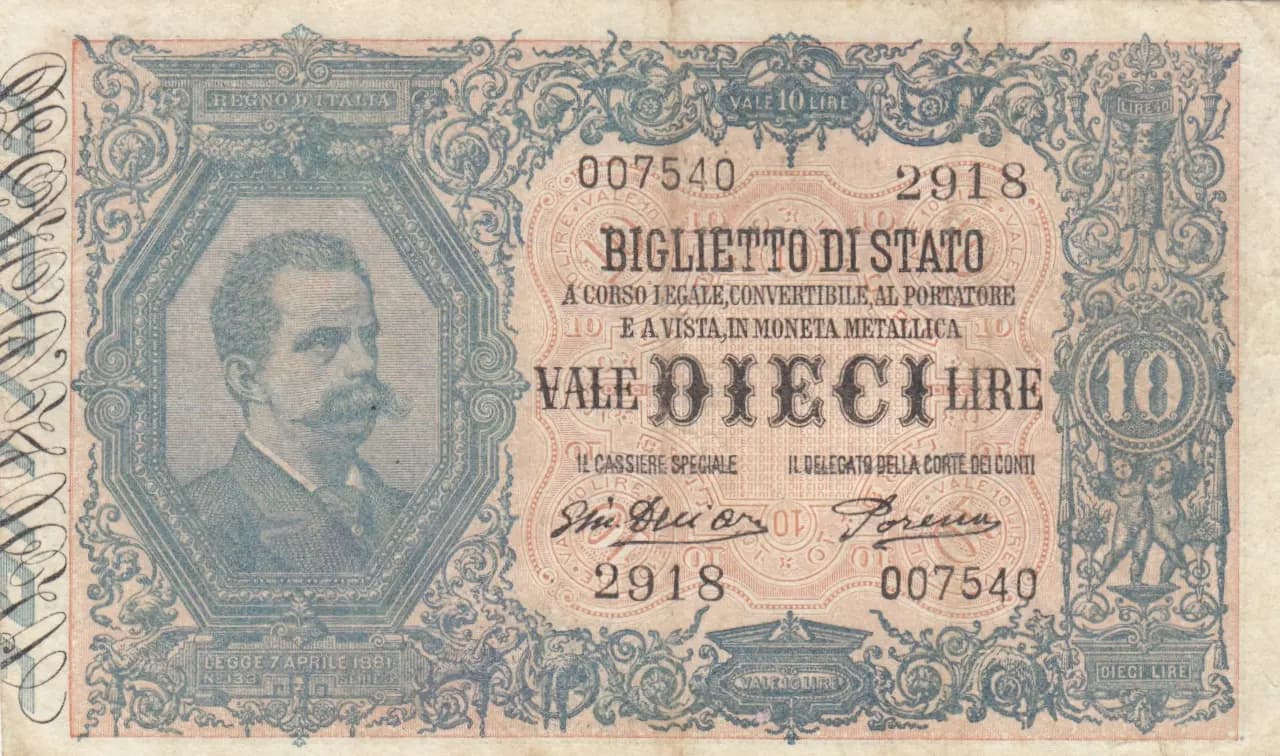
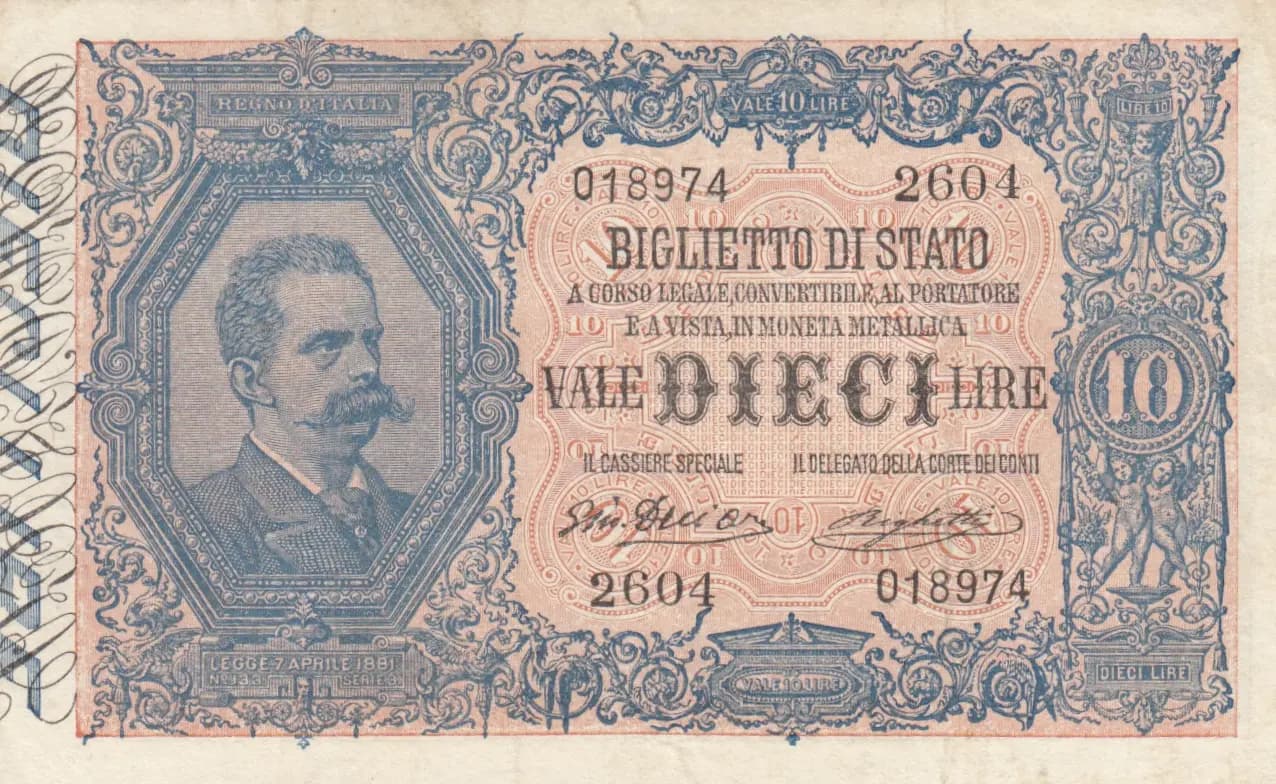
This is an Italian 10 Lire state banknote from 1888, issued under the authority of the Kingdom of Italy during the reign of King Umberto I. The note displays the characteristic blue and pink color scheme typical of this issue, with an excellent portrait of Umberto I in profile on the obverse within an ornate hexagonal frame, surrounded by elaborate baroque-style borders. In VF condition, the note shows appropriate age-related wear including folding marks and foxing consistent with 130+ years of age, while maintaining clear legibility of all design elements and inscriptions.
Common. While this note is over 130 years old and no longer in production, it remains common within the numismatic market. Market evidence from eBay sales data shows consistent availability with VF specimens typically trading in the $12-41 range, with multiple sales recorded over a 9-year period (2012-2021). The 2016 catalog value for VF is listed at $12, further supporting common status. The royal decree issue was substantial enough to support ongoing circulation and collect activity without scarcity. Only significant variants (P-20d, P-20g) or exceptional condition grades (UNC at $90) command notable premiums.
This banknote was issued under Royal Decree of February 5, 1888, registered with the Italian Court of Accounts (Corte dei Conti) on February 17, 1888, during the reign of King Umberto I. The note represents the Kingdom of Italy's state currency system during the late 19th century, inscribed with the legal tender declaration 'A CORSO LEGALE' and guarantee of convertibility into metallic currency. The baroque ornamental design reflects the artistic standards of late 19th-century Italian securities printing, with the government printing office (Officina Governativa Carte-Valori) in Turin producing these notes under strict governmental control.
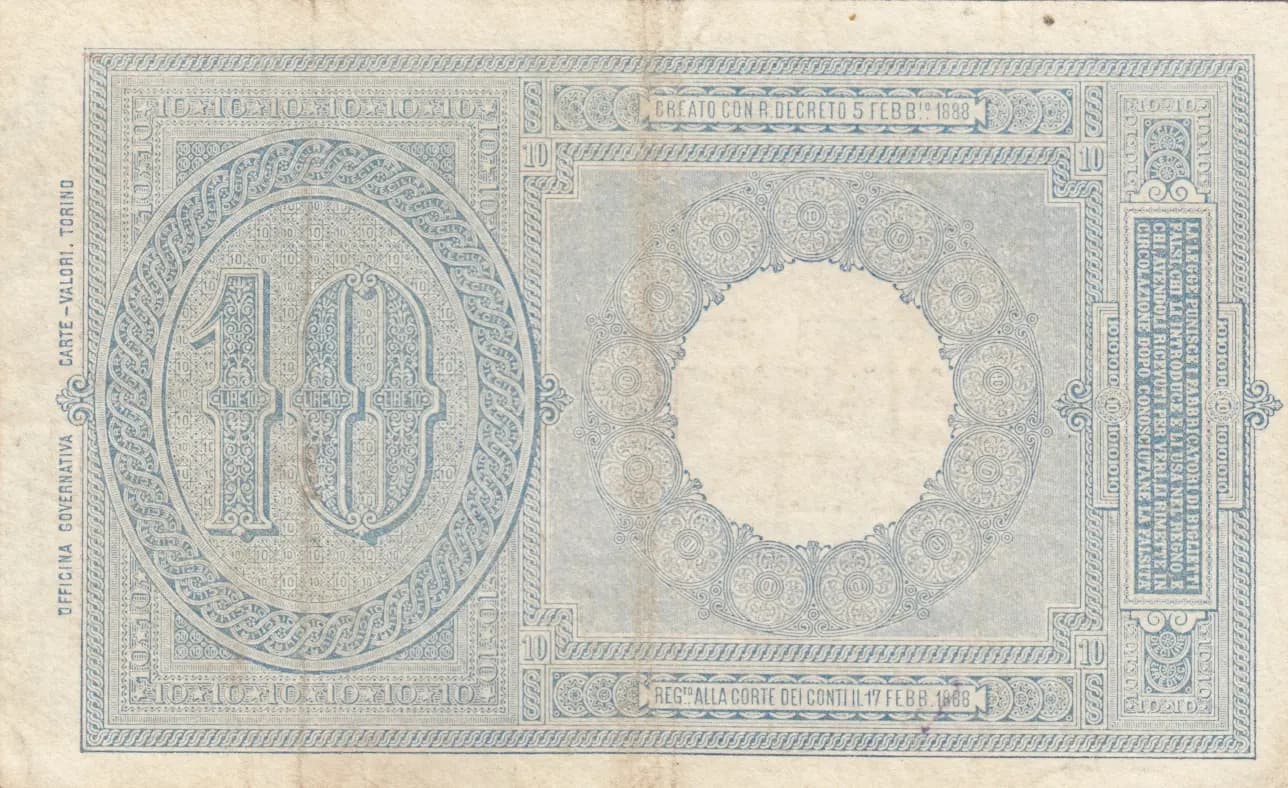
The obverse features a left-facing profile portrait of King Umberto I, rendered in classical engraving style with fine detail of his bearded visage, positioned within a decorative hexagonal frame. The denomination 'VALE 10 LIRE' appears in an ornate cartouche on the right side of the obverse. The entire front is surrounded by elaborate baroque-style ornamental borders featuring scrollwork, geometric patterns, and heraldic elements characteristic of late 19th-century Italian state securities. The reverse displays a large ornamental wreath encircling the numeral 10 on the left side, with a symmetrical circular rosette pattern frame in the center-right, all within matching baroque border treatment. The color scheme of blue engraving on pink/salmon underprint was standard for this series. The note measures standard banknote dimensions and features fine-line engraving throughout as its primary anti-counterfeiting measure.
{"front":{"REGNO D'ITALIA":"Kingdom of Italy","VALE 10 LIRE":"Worth 10 Lire","BIGLIETTO DI STATO":"State Banknote","A CORSO LEGALE, CONVERTIBILE, AL PORTATORE E A VISTA IN MONETA METALLICA":"Legal tender, convertible, to the bearer and payable on sight in metallic currency","IL CASSIERE SPECIALE":"The Special Cashier","IL DELEGATO DELLA CORTE DEI CONTI":"The Delegate of the Court of Accounts","LEGGE 7 APRILE 1881":"Law of April 7, 1881","Serial numbers":"018974 / 2604"},"back":{"BANCA GENERALE A DECRETI STECCBI 1888":"General Bank by Royal Decrees 1888","REG.ª ALLA CORTE DEI CONTI IL 17 FEBB. 1888":"Registered with the Court of Accounts on February 17, 1888","OFFICINA GOVERNATIVA A CARTE VALORI TORINO":"Government Printing Office for Securities, Turin"}}
Intaglio (steel engraving) printing, as evidenced by the fine line detail, intricate ornamental borders, and geometric/floral pattern work visible throughout both sides. The sharp definition of the portrait, wreath details, and rosette patterns confirm the use of steel plate engraving. The note was produced by the Officina Governativa Carte-Valori (Government Printing Office for Securities) in Turin, Italy's official government security printer of the period.
This note is cataloged as Pick P-20f, indicating it is one of several varieties of the 1888 10 Lire issue. PMG population reports confirm at least two other cataloged variants exist (P-20d and P-20g), suggesting varieties may exist based on signature combinations, serial number prefixes, or minor design elements. The observed serial number 018974/2604 should be noted for variety identification purposes. The inscription reference to 'LEGGE 7 APRILE 1881' (Law of April 7, 1881) and registration date of February 17, 1888 are consistent with this P-20f classification.