5 pounds 1974 specimen
Market Prices
2 salesAbout This Note
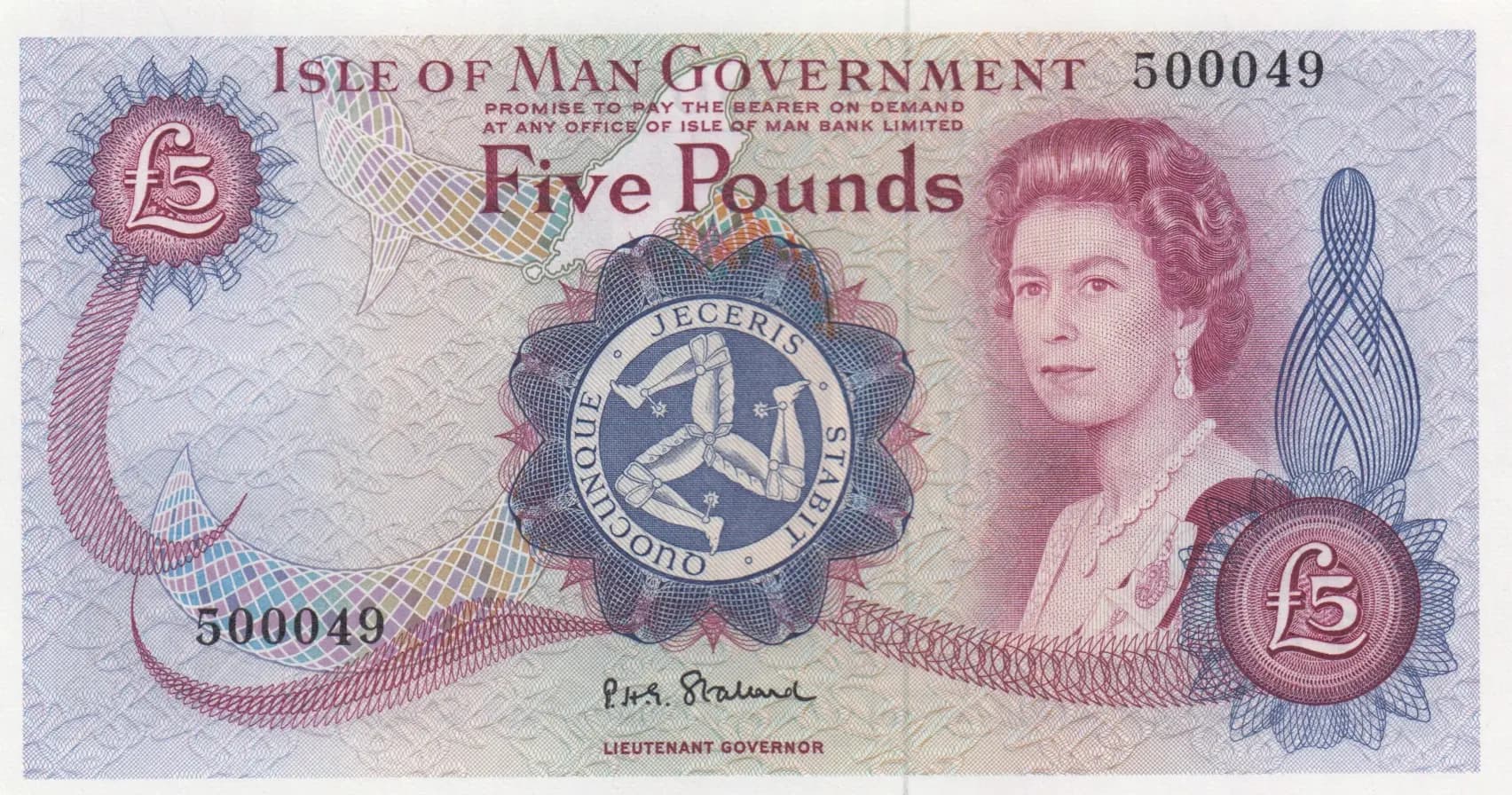
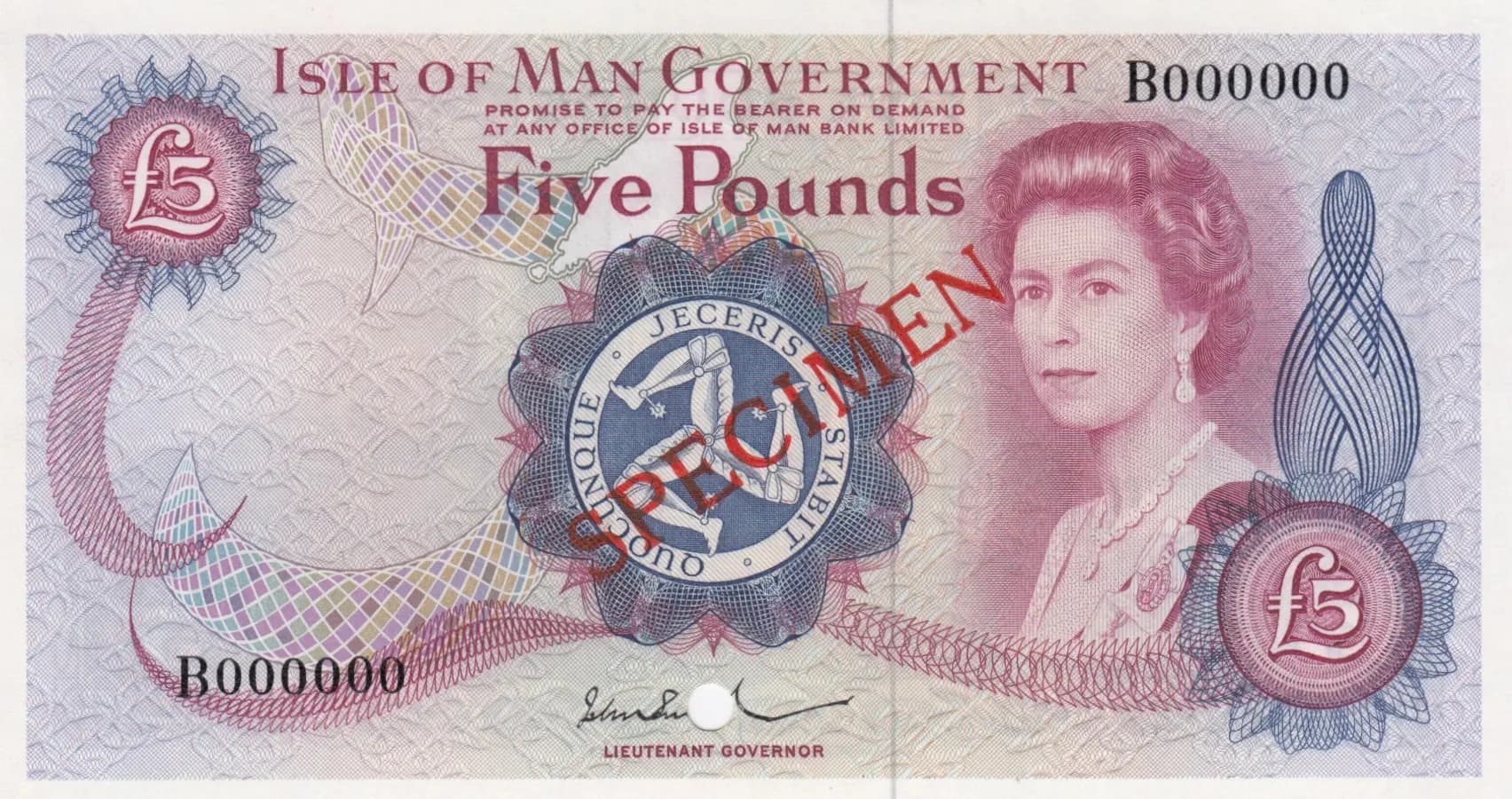
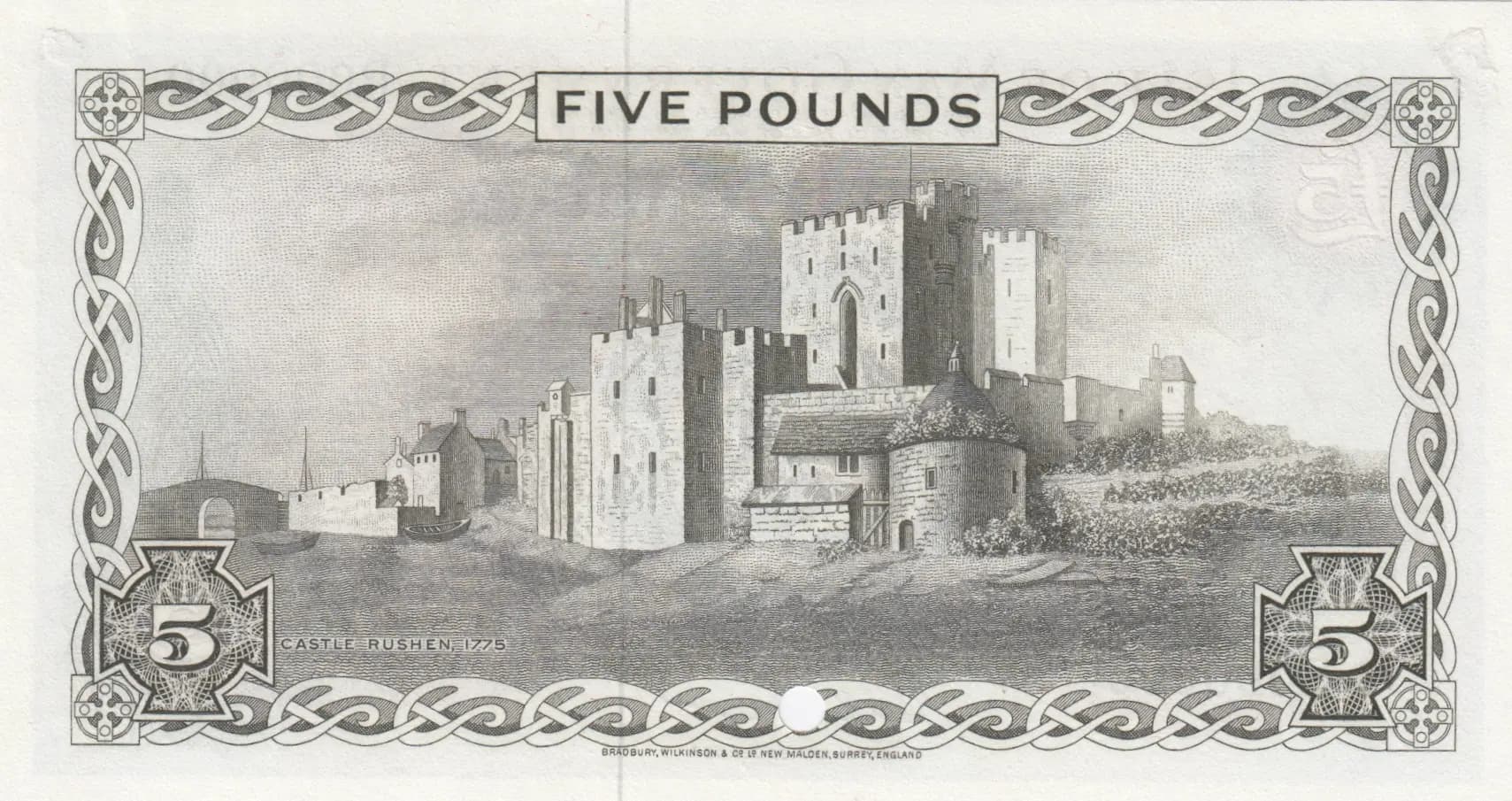
This is a specimen note of the 1974 Isle of Man Government Five Pounds, graded UNC and representing an early example of the island's distinctive currency design. The front features an elegant portrait of Queen Elizabeth II rendered in pink and magenta tones, alongside the triskele-based coat of arms overprinted with bold red 'SPECIMEN' text. The reverse displays a finely-detailed black and white engraving of Castle Rushen (1775), the historic medieval fortress, framed by Celtic knotwork borders—elements that define the aesthetic of this series and make it a prized example for Commonwealth currency collectors.
Common. The 1974 Isle of Man Government Five Pounds is a widely-issued banknote from a modern currency series with substantial print runs. The eBay market data provided shows EF-grade examples selling in the $50–$82 range (2017–2020), which is typical pricing for common mid-grade Commonwealth regional notes. Specimen notes, while slightly less common than circulation examples, were produced in meaningful quantities for bank distribution and institutional purposes. The catalogue valuation of $500 for UNC applies primarily to finest-grade circulation examples; specimen notes command a modest premium over worn examples but remain readily available in the collector market.
Issued during the early 1970s by the Isle of Man Government in partnership with Isle of Man Bank Limited, this note reflects the island's assertion of fiscal autonomy while maintaining Commonwealth connections through the portrait of Queen Elizabeth II. Castle Rushen, depicted on the reverse, is one of the most significant medieval fortifications in the Irish Sea region, chosen to represent the territory's historical heritage and strategic importance. The specimen designation and zero serial number indicate this was a presentation or archival example created for distribution to banking institutions and collectors at the time of currency introduction.
The obverse presents Queen Elizabeth II in right-facing profile, depicted in formal attire with pearl necklace, rendered in fine-line engraving with pink and magenta coloration. The central design features the triskele-based coat of arms of the Isle of Man within a decorative rosette border, flanked by stylized £5 denominational symbols in corner frames. The reverse showcases Castle Rushen, the 13th-century fortress located in Castletown, rendered as a detailed architectural engraving depicting multiple towers, crenellated walls, and surrounding fortification structures in monochrome. Elaborate Celtic knotwork borders frame all four sides of both surfaces, serving dual purposes as decorative and security elements. Geometric and wave-pattern fills, along with ornamental border designs, provide additional security printing layers characteristic of Bradbury Wilkinson's work.
FRONT: 'ISLE OF MAN GOVERNMENT' (issuing authority), 'PROMISE TO PAY THE BEARER ON DEMAND AT ANY OFFICE OF ISLE OF MAN BANK LIMITED' (legal tender declaration), 'Five Pounds' and '£5' (denomination), 'LIEUTENANT GOVERNOR' (signature authority), 'SPECIMEN' (overprinted designation), Serial number 'B000000' (specimen zero serial). BACK: 'FIVE POUNDS' (denomination), 'CASTLE RUSHEN, 1775' (landmark identification and date), '5' (denomination numeral), 'BRADBURY, WILKINSON & CO LTD, NEW MALDEN, SURREY, ENGLAND' (printer identification).
Intaglio engraving combined with multi-color lithographic underprint, executed by Bradbury, Wilkinson & Co Ltd of New Malden, Surrey—a renowned British security printer specializing in banknote production. The fine-line engraving visible throughout, particularly in the portrait, castle architecture, and decorative borders, represents classic intaglio technique. The polychromatic front (blues, violets, pinks, magentas, greys) indicates underprinting layered beneath the engraved security elements, while the monochromatic reverse (black on cream) employs pure engraved lines without color underprinting.
This note is catalogued as Pick P-30bs, where the 'bs' suffix indicates a 'specimen' variant of the base P-30 design. The PMG population report identifies four catalogued variants: P-30a, P-30as, P-30b, and P-30s, all sharing Bradbury Wilkinson & Co Ltd as printer. The specimen designation is confirmed by the red diagonal 'SPECIMEN' overprint on the coat of arms and the zero serial number (B000000) characteristic of non-circulating presentation notes. No date appears on the note itself; the 1974 dating reflects the issue date assigned by catalog authorities, with the series having been issued across 1972–1974.