1 pound 1950
Market Prices
1 saleAbout This Note
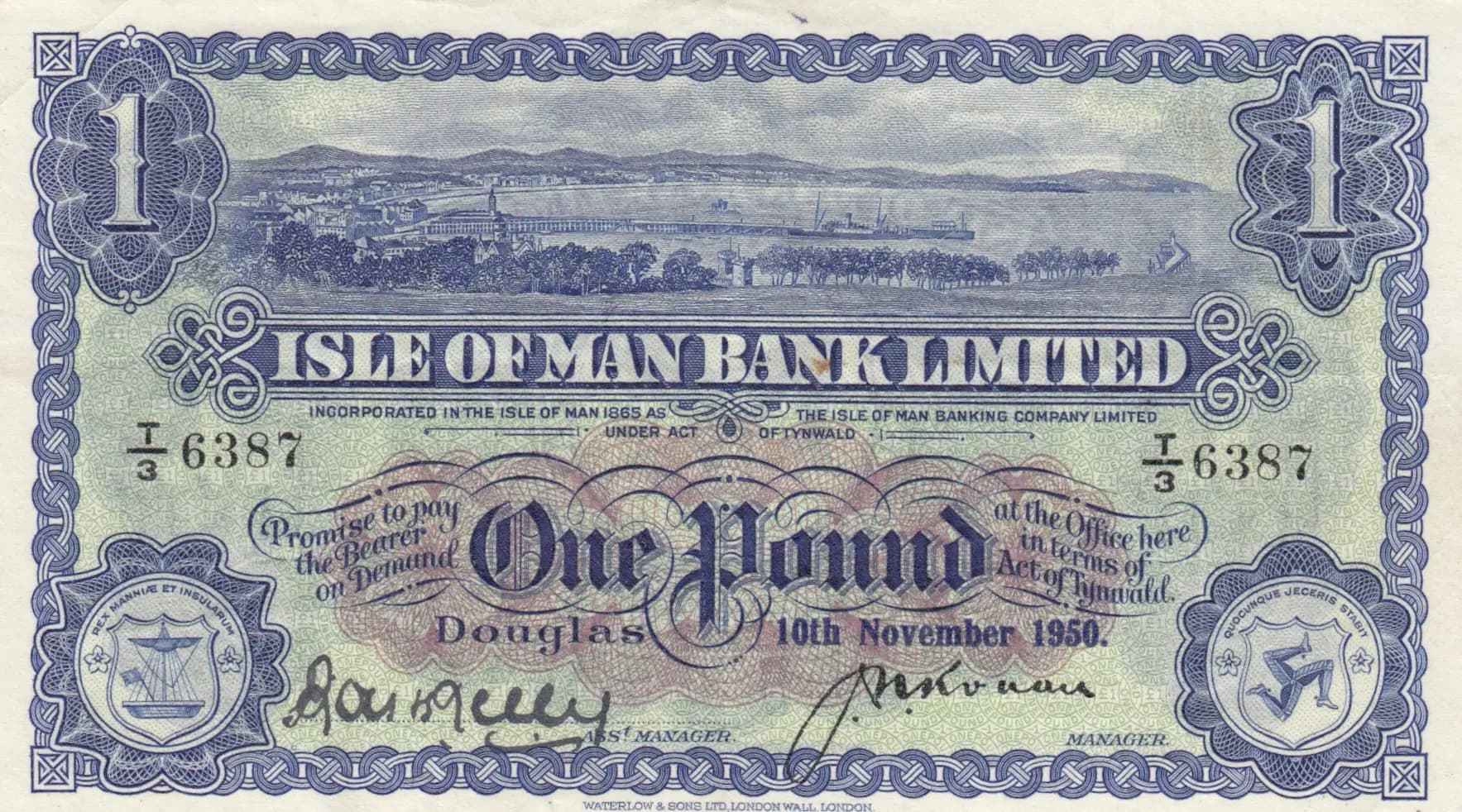
A handsome example of the Isle of Man Bank Limited's 1950 one pound note (Pick P-6b), featuring vibrant blue and green coloring with intricate Celtic knotwork borders and a detailed coastal landscape vignette. The note shows honest circulation wear consistent with VF grade, including visible creases, age-related foxing, and faded signatures, reflecting its 70+ years of handling since issue on 10th November 1950. The ornate design and historical significance as an early post-war Isle of Man banknote make this a solid addition to British Commonwealth currency collections.
Common. The Pick P-6b one pound denomination from the 1950 issue was part of a regular circulation series by Isle of Man Bank Limited and saw significant circulation on the island. The catalog reference prices from 2016 show F grade notes at $50 and EF at $120, with observed eBay pricing indicating steady but modest demand typical of common Commonwealth notes. No evidence of a limited print run, recall, or short-lived issuing period. The VF grade example observed here, while attractive, falls within expected market pricing for circulated examples of this standard issue.
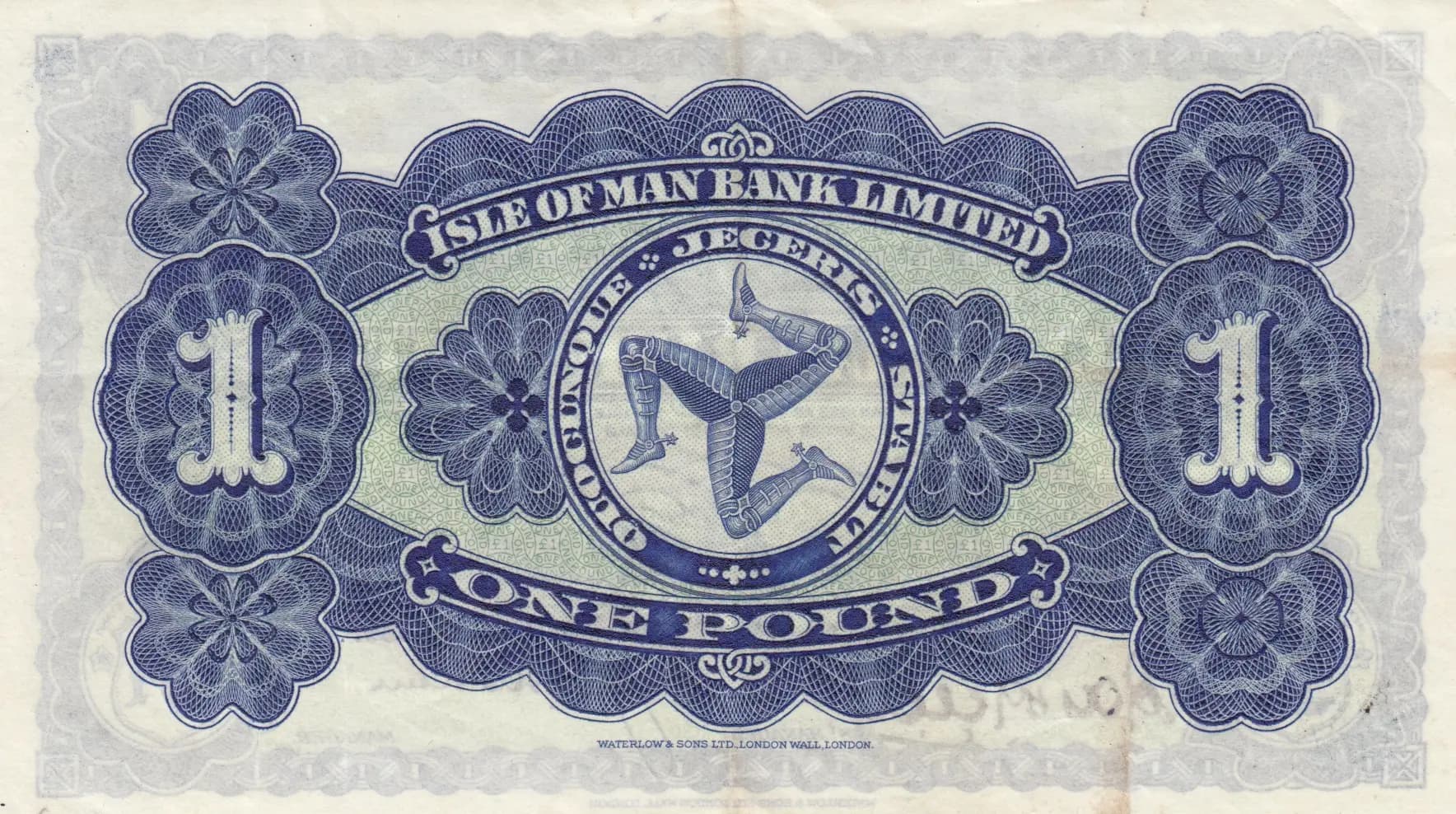
Issued in 1950 by the Isle of Man Bank Limited (chartered in 1865), this note reflects the island's post-war economic stability and its distinctive monetary autonomy within the British Isles. The coastal landscape vignette with port facilities and the prominent three-legged triskele (Manx national symbol) on the reverse underscore the island's maritime heritage and cultural identity during the early post-war period. The note's ornate Celtic design and references to Tynwald (the Manx parliament) emphasize the island's separate legislative and monetary authority.
The front features a classical banknote design centered on the denomination 'One Pound' in decorative script, flanked by an elaborate coastal landscape vignette depicting a waterfront scene with buildings, trees, and port facilities—likely representing Douglas or another important Manx maritime center. The design is framed by an ornate Celtic knotwork border with geometric and floral patterns in the corners, reflecting Manx cultural heritage. The reverse displays a bold, symmetrical composition centered on the three-legged triskele (triskelion) within a circular seal, the ancient national symbol of the Isle of Man, surrounded by matching decorative cartouches containing large numeral '1' marks. The entire design utilizes intricate engraving with blue and green inks on cream stock, typical of 1950s British Commonwealth security printing.
FRONT: 'ISLE OF MAN BANK LIMITED' (issuing authority); 'INCORPORATED IN THE ISLE OF MAN 1865 AS THE ISLE OF MAN BANKING COMPANY LIMITED' (charter history); 'UNDER ACT OF TYNWALD' (legislative authority); 'Promise to pay the Bearer on Demand One Pound at the Office here in terms of Act of Tynwald' (negotiable promise); 'Douglas' (location); '10th November 1950' (issue date); '1st MANAGER' and 'MANAGER' (signatures); 'T 6387' (serial number); 'WATERLOW & SONS LTD LONDON WALL LONDON' (printer). BACK: 'ISLE OF MAN BANK LIMITED' and 'ONE POUND' (issuer and denomination); 'WATERLOW & SONS LTD. LONDON WALL, LONDON.' (printer); Large decorative '1' numerals in cartouches (denomination markers).
Intaglio engraving (line engraving and steel plate printing), as evidenced by the fine detail, crisp line work, and intricate geometric patterns visible throughout both sides. Printed by Waterlow & Sons Ltd of London Wall, London—one of the premier British security printers of the era, known for high-quality banknote production for Commonwealth issuers. The complex border designs, vignette engraving, and fine linework are characteristic of Waterlow's craftsmanship during the mid-20th century.
This note is cataloged as Pick P-6b, one of five recognized variants under the base P-6 designation (including £5 variants P-6Aa and P-6Ab, and £1 variants P-6a and P-6d). The specific P-6b variety represents the 1950 £1 issue. Serial number T 6387 and the signatures of the 1st Manager and Manager as printed on this example are consistent with the standard issue parameters. No overprints or unusual features are noted that would indicate a special variety or error note.