1 pound 1955
Market Prices
1 saleAbout This Note
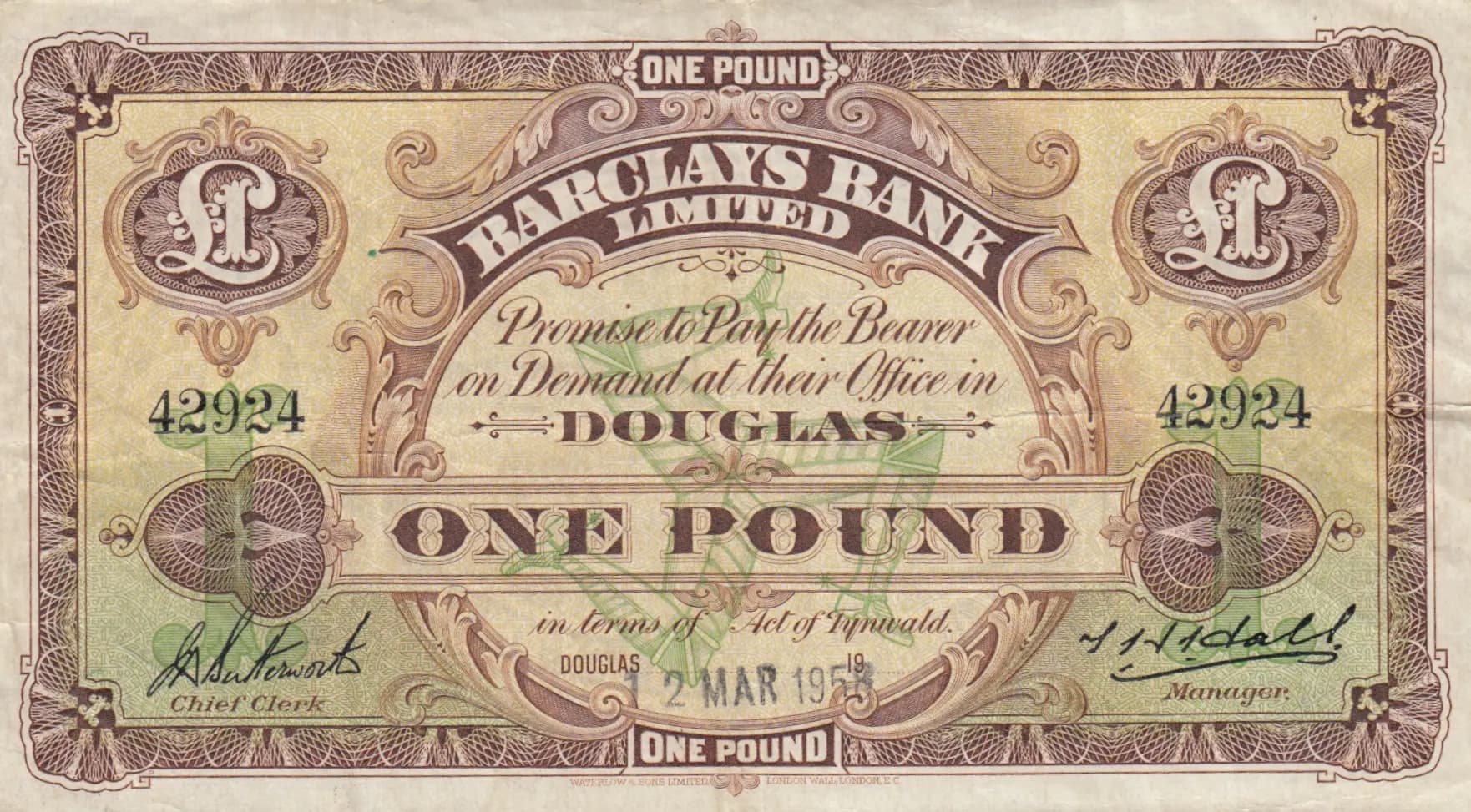
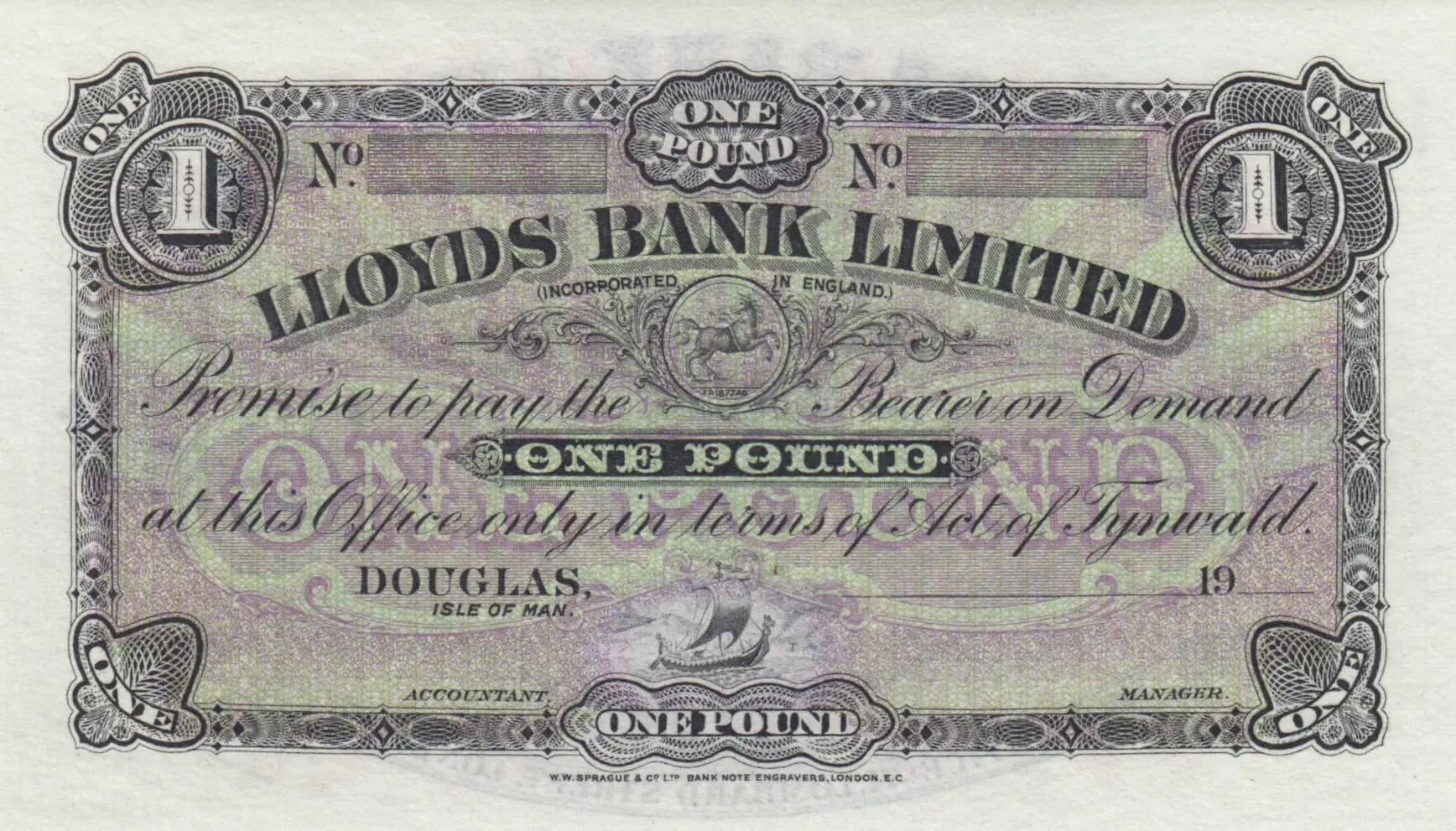
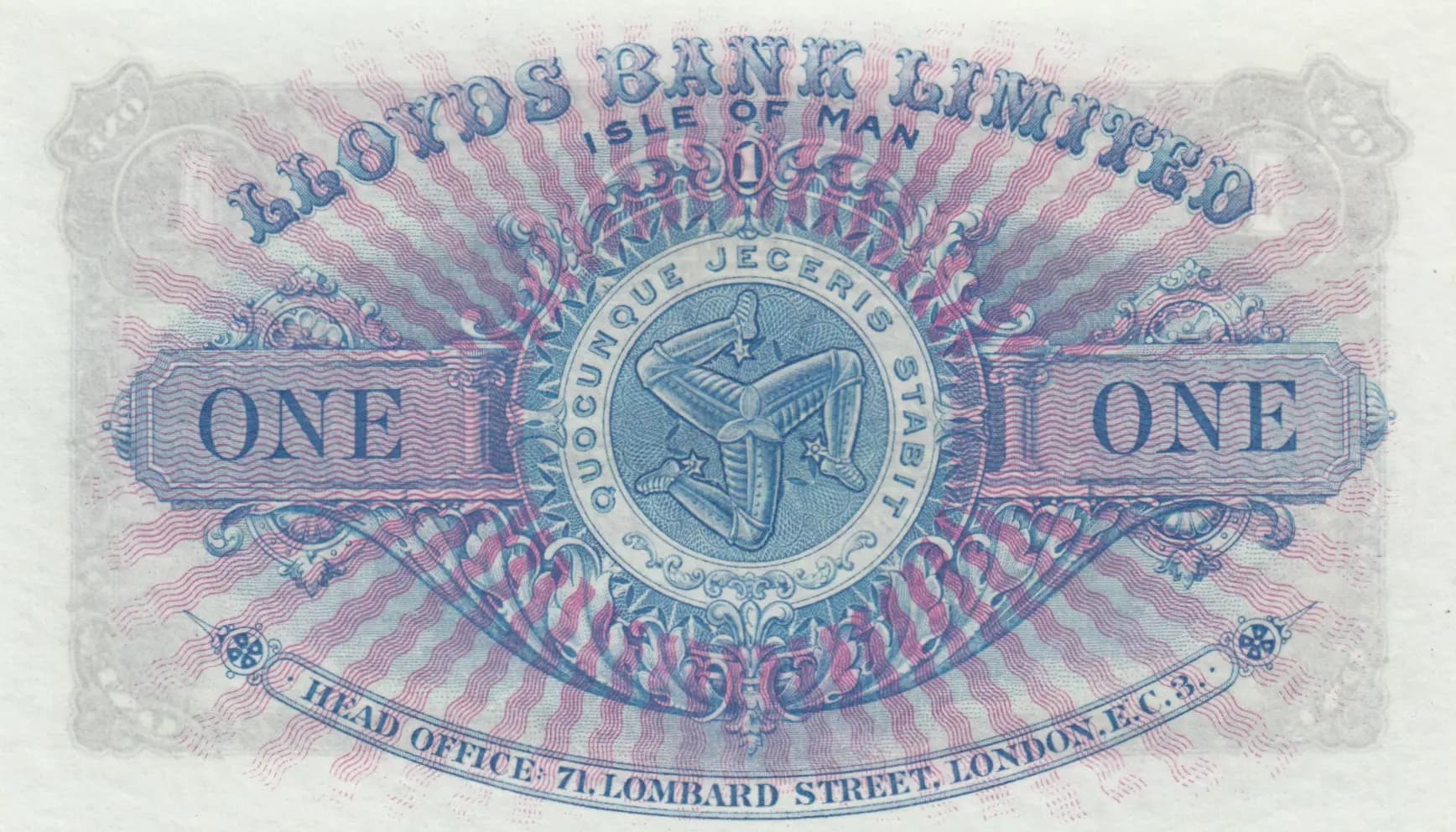
This is a 1955 Lloyds Bank Limited one pound note from the Isle of Man, a remainder banknote (unsigned) in well-preserved condition with attractive period engraving. The note displays the characteristic ornate Victorian-style design typical of mid-20th century British banking currency, featuring the bank's heraldic arms on the obverse and an elaborate central seal on the reverse rendered in blue and pink/red. While showing age-related patina and foxing consistent with storage over decades, the note exhibits no major tears or creasing, making it a desirable example of this regional British currency.
Common. While this is a regional banknote from a specific issuer and jurisdiction, the Pick catalog recognizes at least 2 variants (P-13a and P-13r), and eBay market data from 2019 shows catalog values of approximately $200 for EF condition, with a 2018 sale at PMG 65 bringing $191.40. These modest market prices indicate regular availability in the collector market. Lloyds Bank notes from this period were produced in quantities sufficient to satisfy regional circulation demands, and this note's remainder status (unsigned) suggests it was among unissued bank stock. No evidence of limited print runs, recalls, or short-lived issuance justifies a rarity designation above common.
This banknote represents the era when British clearing banks, particularly Lloyds, maintained regional currency-issuing privileges under the Banking Act, with the Isle of Man being a distinct jurisdiction. The ornate engraving style and classical heraldic imagery reflect the formal banking traditions of the 1950s, while the Douglas, Isle of Man location and specific promise-to-pay language demonstrate the localized nature of this issue. The note's design—featuring the bank's coat of arms prominently displayed with elaborate geometric borders—exemplifies the security printing standards of W.W. Sprague & Co Ltd during the post-war period.
The obverse features Lloyds Bank's coat of arms—a heraldic emblem incorporating a lion—positioned at center, surrounded by ornate decorative corner ornaments with shell-like designs characteristic of classical bank note engraving. Circular denomination markers reading '1' appear in all four corners. The color scheme employs black primary engraving on a green underprint with purple/lilac tints and cream paper. The reverse presents a more elaborate design centered on the bank's sealed emblem rendered with intricate scrollwork, surrounded by symmetrical radiating decorative patterns executed in blue and pink/red inks, creating a complex multi-color composition. The design reflects the formal, security-conscious aesthetic of Lloyds Bank during the 1950s.
FRONT: 'Lloyds Bank Limited' (top center); '(Incorporated in England)' (beneath bank name); 'Promise to pay the Bearer on Demand' (classical banking promise); 'ONE POUND' (denomination, appears multiple times); 'at this Office only in terms of Stock Applied' (redemption clause); 'Douglas, Isle of Man' (location); 'Accountant' and 'Manager' (signature lines); '19' (partial year indicator); 'W.W. Sprague & Co Ltd Bank Note Engravers, London, E.C.' (printer attribution); BACK: 'Lloyds Bank Limited' (top); 'Isle of Man' (jurisdiction); 'ONE' (denomination markers); 'Head Office 71 Lombard Street, London, E.C.B.' (bank headquarters reference); Central seal contains heraldic inscription (specific text difficult to verify with certainty from image).
Intaglio/line engraving throughout, executed by W.W. Sprague & Co Ltd Bank Note Engravers of London. The security features include fine line engraving patterns, intricate geometric background work, and complex multi-color overprinting on the reverse. The elaborate decorative elements and fine line patterns would be extremely difficult to reproduce without specialized security printing equipment, reflecting standard practices for British regional currency of this period.
This note is cataloged as Pick P-13r, identifying it as a 'remainder' banknote—specifically, an unsigned specimen from unissued bank stock. The Pick catalog recognizes P-13a as a separate issued variety, suggesting signature and possibly other variations exist between variants. The visual analysis confirms the unsigned state (blank signature lines for Accountant and Manager). Serial number details are not clearly visible in the provided images, preventing identification of specific number sequences or prefixes that might indicate additional varieties within the P-13r classification.