5 pounds 1927
Market Prices
About This Note
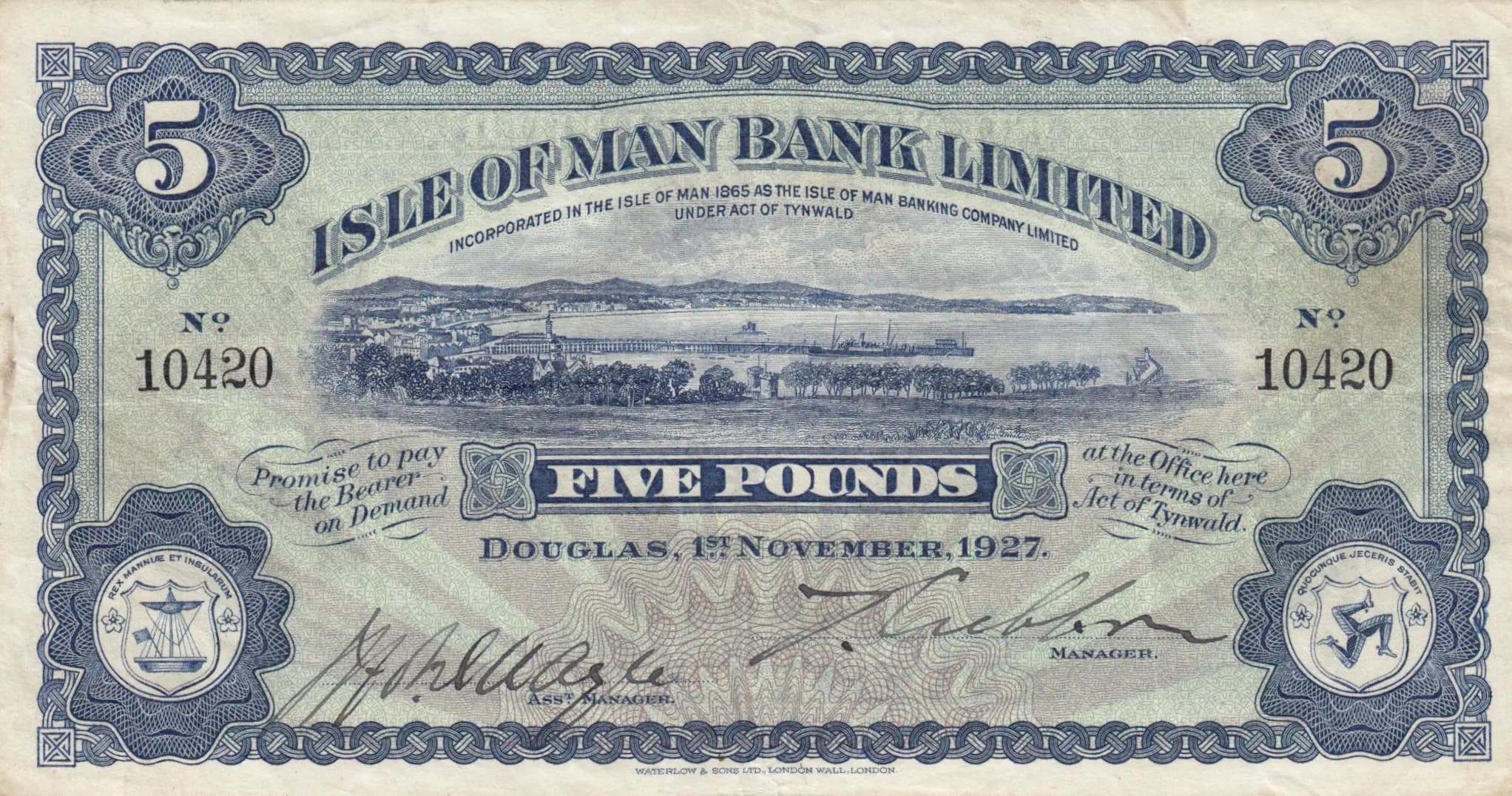
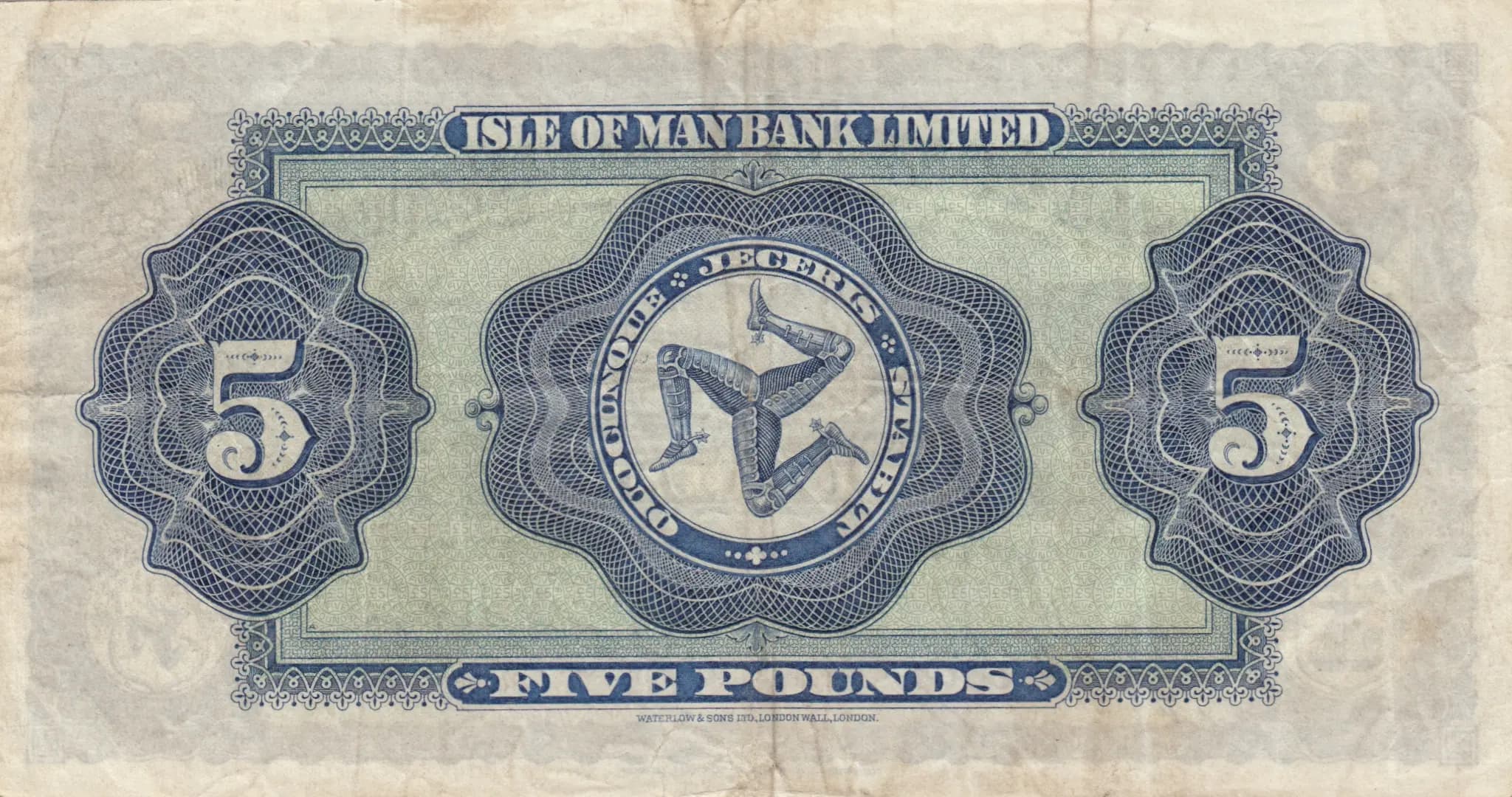
This is a 1927 Isle of Man Bank Limited £5 note (Pick P-5) in Fair condition, representing an important early example of Manx currency from the post-WWI era. The note displays the characteristic dual-design layout with a detailed coastal harbor scene featuring Douglas on the obverse and the iconic Manx triskelion symbol on the reverse, printed by Waterlow & Sons of London. Despite visible aging with cream discoloration, creasing, and foxing consistent with circulation, the engraving remains clear and the Celtic ornamental borders are well-preserved, making this a historically significant example of early 20th-century Isle of Man banking.
Common. This is a regular issue note from 1927 with no documented short print run or rarity designation. The catalogue value for Fine condition is approximately $175 USD (2016), which places it in the moderate price range for early 20th-century British Isles notes. eBay market data shows numerous listings across various grades ranging from $16.99 to $1290.00 USD, indicating adequate supply in the collector market. No population rarity is evident from PMG records. The note's age (nearly 100 years) and the historical significance of early Isle of Man currency provide collector appeal, but it is not a scarce or rare variant.
Issued on 1 November 1927, this note was produced during the Isle of Man Bank Limited's operation under its 1865 charter as the Isle of Man Banking Company Limited, reflecting the island's assertion of financial independence in the post-WWI period. The prominent depiction of Douglas harbor and its coastal architecture celebrates the island's maritime economy and the seat of its financial authority, while the three-legged triskelion symbol—the ancient emblem of the Isle of Man—reinforces Manx sovereignty and cultural identity on the reverse design. This early banknote exemplifies the decorative Celtic revival aesthetic popular in early 20th-century British Isles currency design.
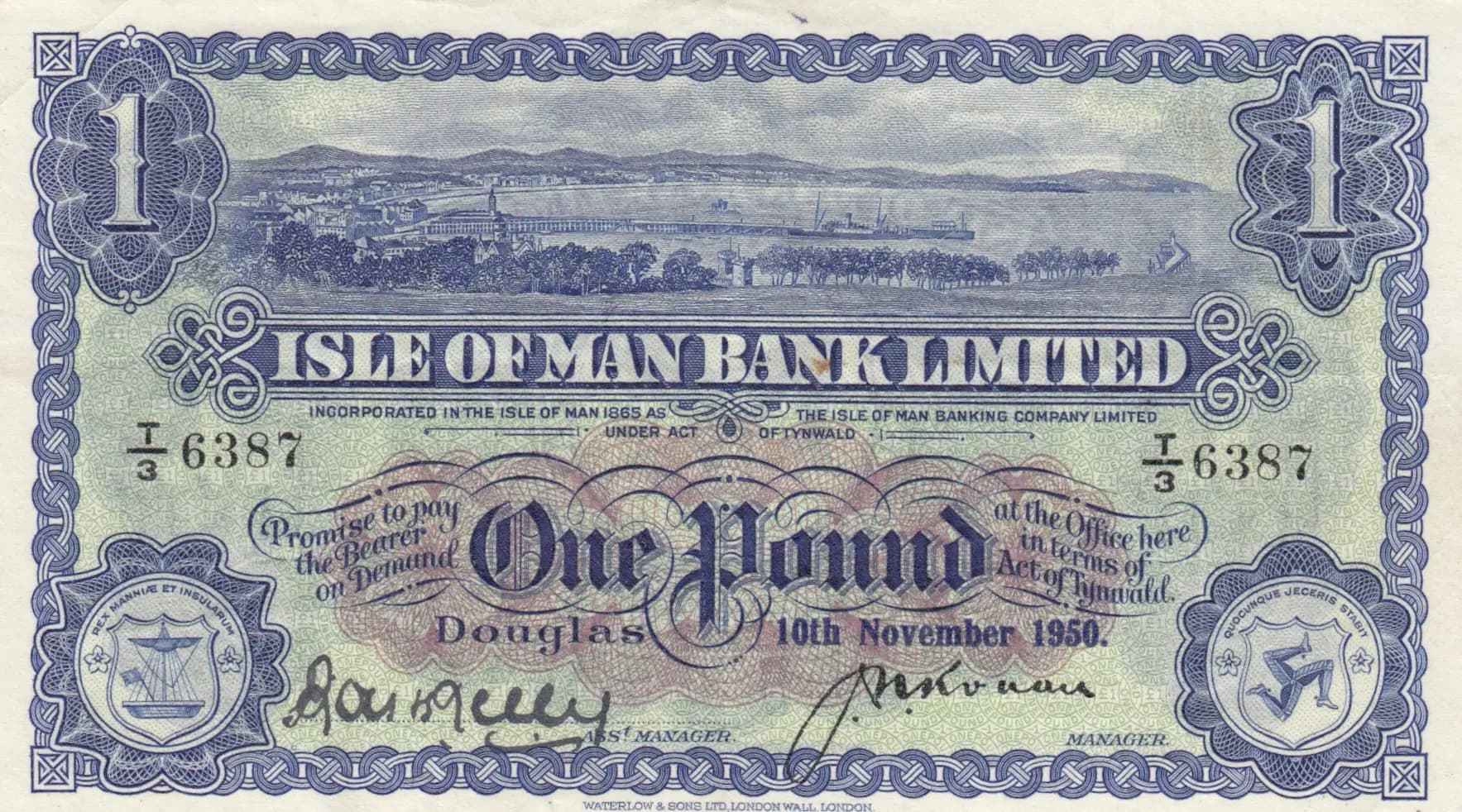
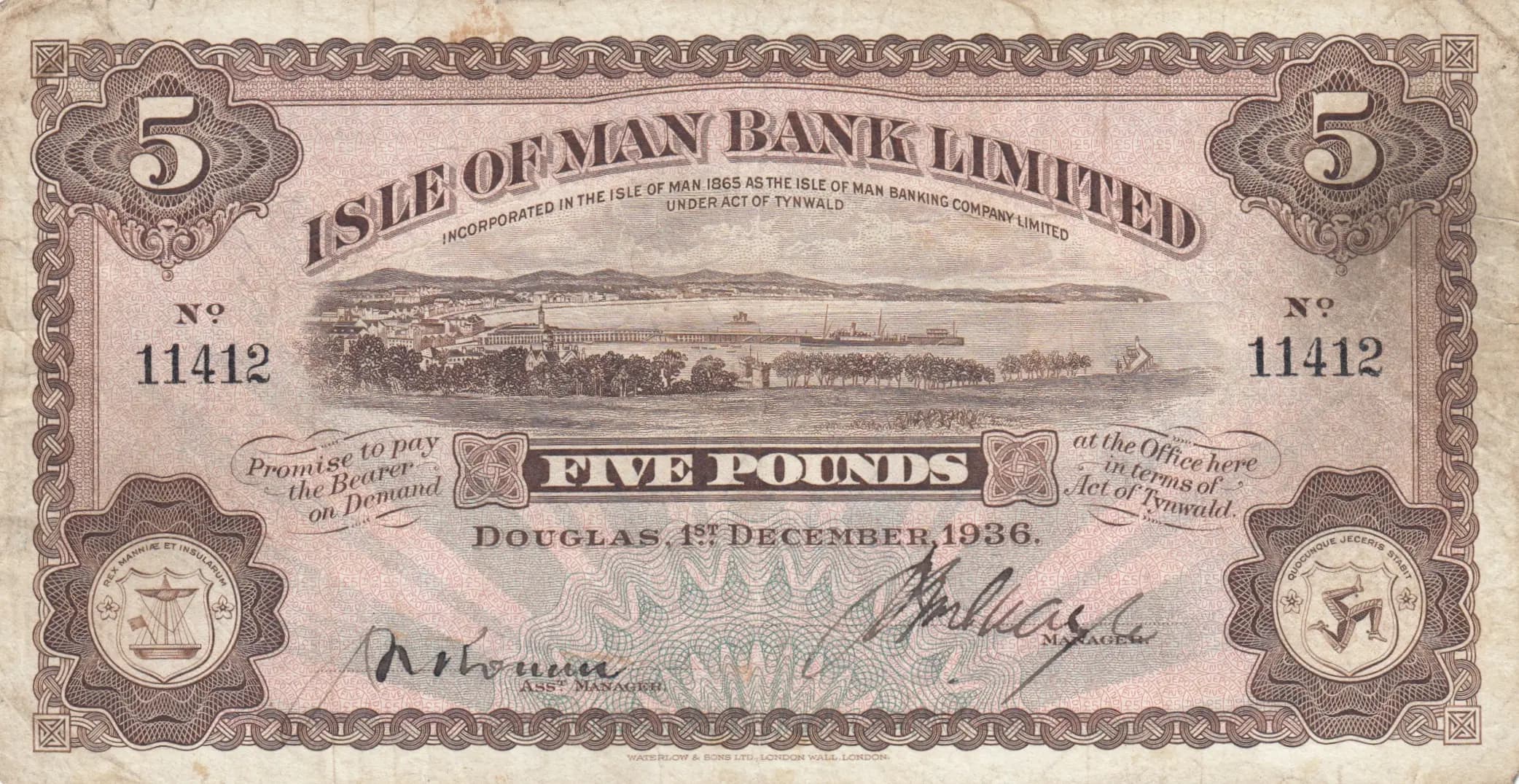
The obverse features an ornate Celtic-inspired border framing a seascape engraving of Douglas harbor, the capital of the Isle of Man, depicting period architecture, waterfront buildings, trees, and a sailing vessel on the water with mountains in the distant background. Large ornamental numerals '5' appear in decorative frames at the upper corners. Two heraldic seals flank the central vignette: a scale/balance emblem on the left and the three-legged triskelion on the right, both traditional Manx symbols. The reverse presents a minimalist but elegant design with a large circular medallion at center containing the three-legged triskelion (the Manx national symbol representing the island's ancient Celtic heritage), flanked by ornamental frames containing large numerals '5'. The entire design employs fine Celtic knotwork patterns and intricate geometric ornamentation typical of Waterlow's high-security engraving standards. The color scheme features dark blue and light green/cream on white, consistent with contemporary British banknote aesthetics.
FRONT: 'ISLE OF MAN BANK LIMITED' (Institution name); 'INCORPORATED IN THE ISLE OF MAN 1865 AS THE ISLE OF MAN BANKING COMPANY LIMITED UNDER ACT OF TYNWALD' (Legal charter reference); 'FIVE POUNDS' (Denomination); 'Promise to pay the Bearer to pay at the Office here in terms of let of Tynwald' (Promise clause); 'DOUGLAS, 1ST NOVEMBER, 1927' (Issuing location and date); 'MANAGER' and 'ASST MANAGER' (Signature lines); 'NO 10420' (Serial number); 'WATERLOW & SONS LTD., LONDON WALL, LONDON' (Printer attribution). BACK: 'ISLE OF MAN BANK LIMITED' (Institution name); 'FIVE POUNDS' (Denomination); 'WATERLOW & SONS LTD., LONDON WALL, LONDON' (Printer attribution).
Intaglio engraving by Waterlow & Sons Ltd., London Wall, London, a world-renowned security printer specializing in banknote production. The fine line work, intricate geometric patterns, complex Celtic borders, and detailed circular medallion engraving are characteristic of high-quality intaglio process work. The security features include the complexity of the decorative border patterns, fine background line work, and the detailed engraving of the harbor vignette and triskelion symbol, all designed to prevent counterfeiting through the difficulty of reproducing the fine lines and intricate details.
This example bears serial number 10420, with no visible overprints or modifications observed. The note is dated 1st November 1927 (the initial issue date for this series). No signature varieties, date varieties, or color variations have been identified in the visual analysis. PMG catalogues one variant for Pick P-5, and this note appears to be a standard example of that single variety without distinguishing features that would classify it as a notable sub-variety.