20 pounds 1979 specimen
Market Prices
2 salesAbout This Note
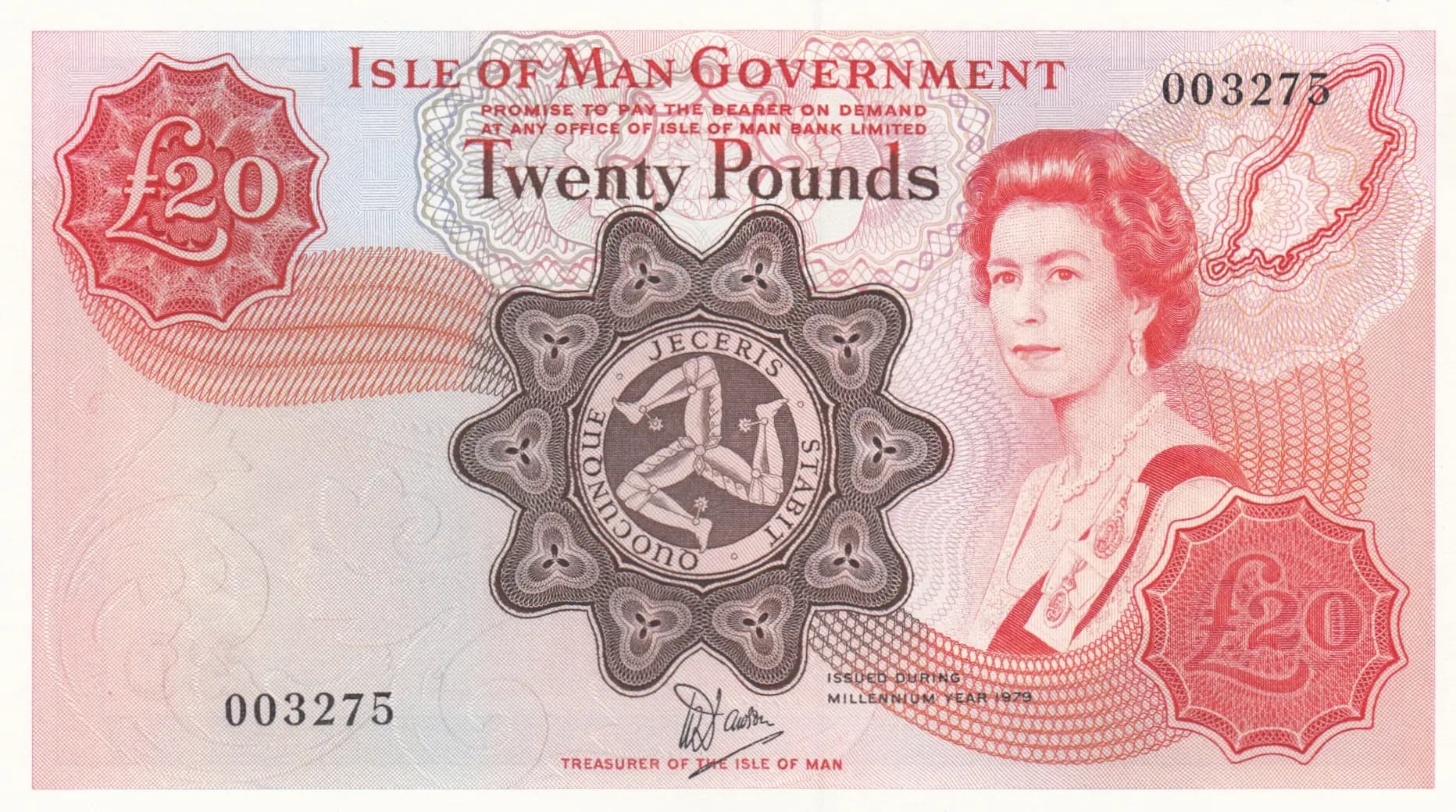
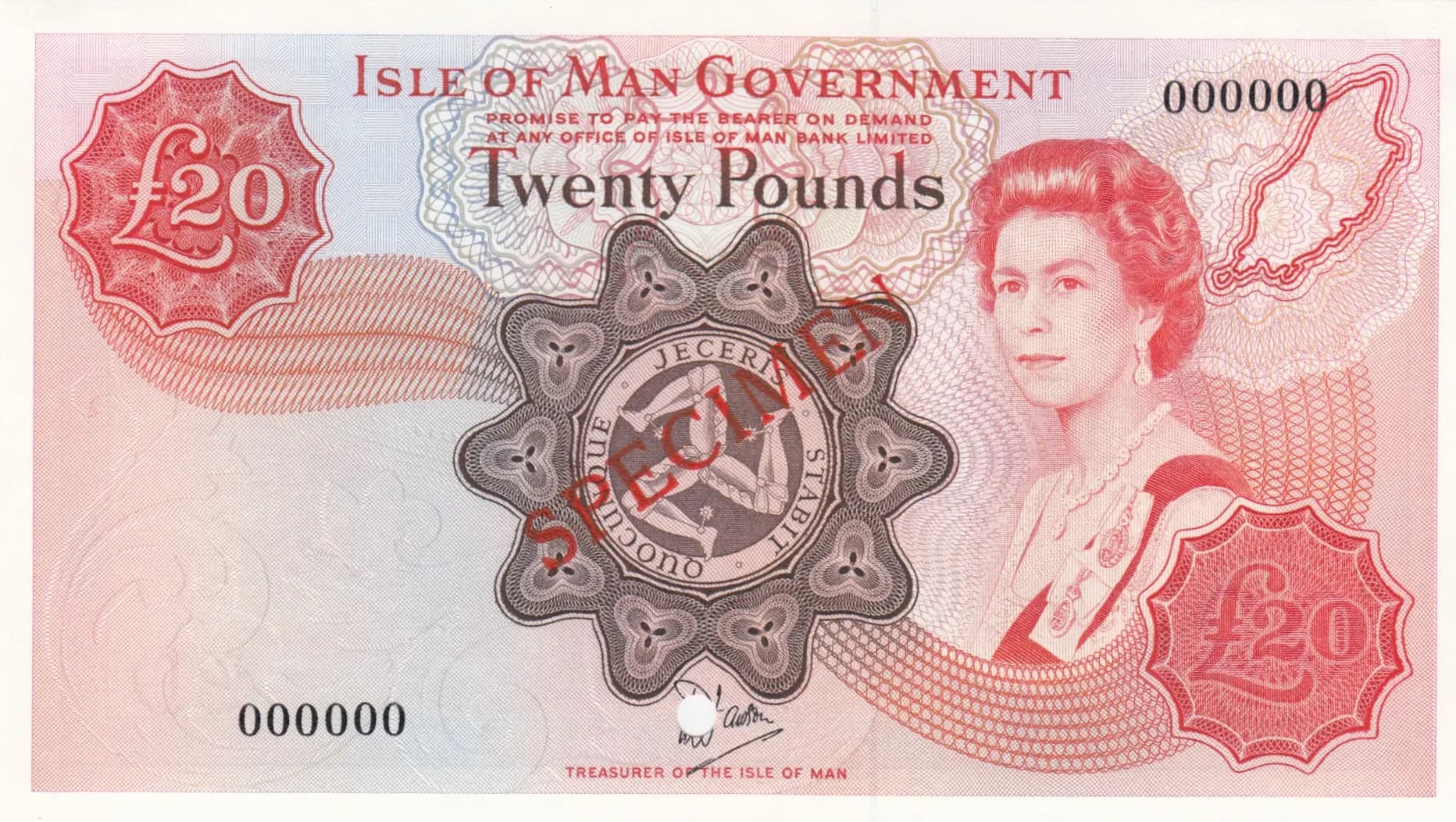
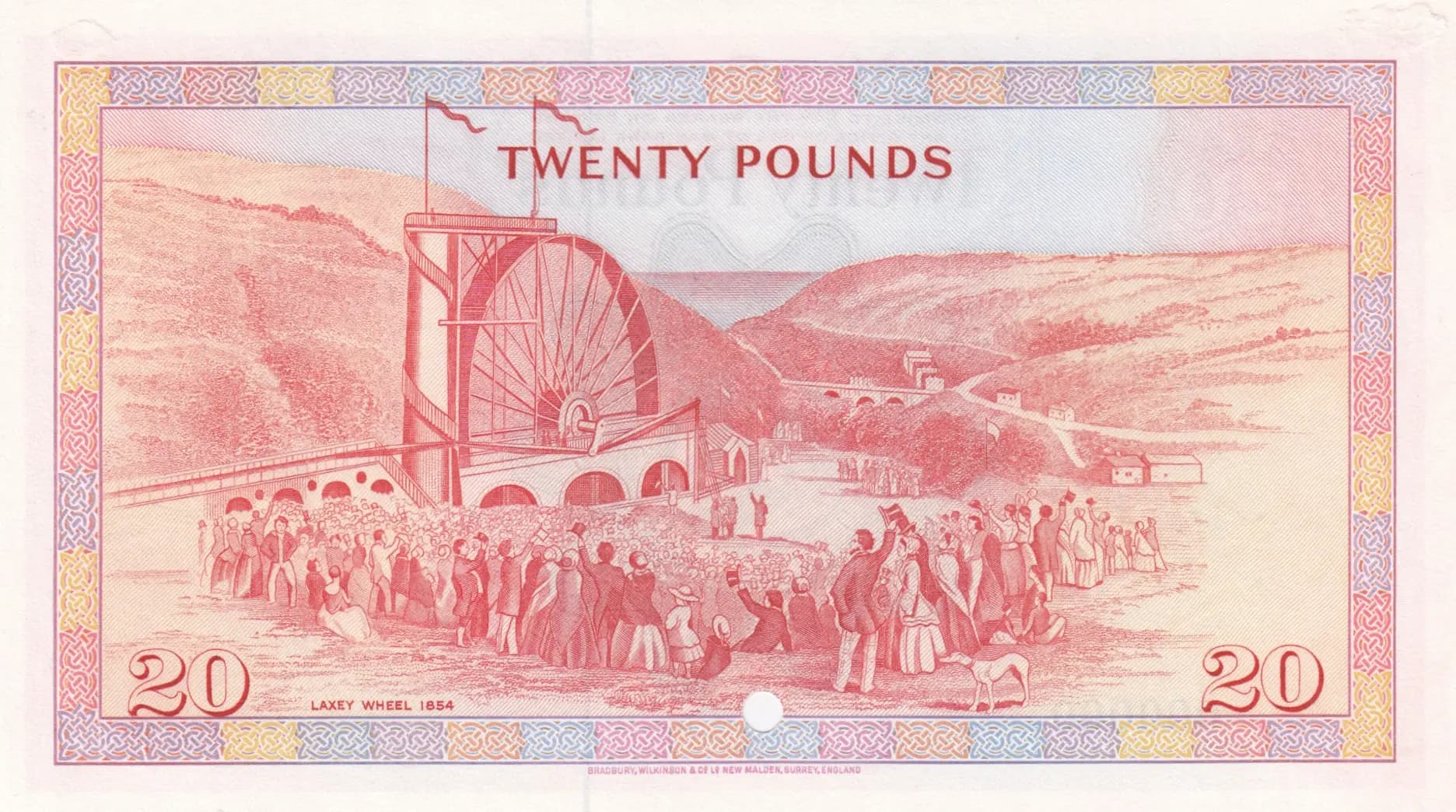
This is a 1979 Isle of Man Government £20 specimen note commemorating the Millennium of Isle of Man (979-1979), printed by Bradbury Wilkinson in uncirculated condition. The obverse features Queen Elizabeth II in profile with a prominent Triskelion emblem and decorative Celtic patterns, while the reverse showcases a detailed engraving of the historic Laxey Wheel (1854) surrounded by period-dressed crowds and Isle of Man landscape. The specimen marking (000000 serial numbers) and pristine condition without wear, creases, or folds make this an exemplary example of this commemorative issue.
Uncommon. Specimen notes (marked with 000000 serial numbers) are typically produced in smaller quantities than regular circulation issues, reserved for distribution to banks, archives, and numismatic institutions. Market data from realbanknotes.com indicates catalogue values of $550 for UNC condition (2019) and recent eBay transactions showing PMG 66-graded examples selling in the $586-$711 range, suggesting modest collector demand and a limited but accessible secondary market. This is well above the sub-$20 threshold that would indicate commonality, but below the $1000+ range that would signal true rarity. The commemorative nature and specimen designation elevate its collector interest beyond regular circulation notes of the same period.
Issued in 1979, this note commemorates a millennium of recorded Manx history (979-1979) and represents the Isle of Man Government's assertion of monetary sovereignty through its own banknote series. The Laxey Wheel, depicted on the reverse, is a symbol of Isle of Man's industrial heritage—a 72-foot water wheel constructed in 1854 to pump water from lead and zinc mines, reflecting the island's 19th-century economic importance. The inclusion of Queen Elizabeth II acknowledges the Crown dependency status of the Isle of Man while the Triskelion (three-legged symbol) on the obverse emphasizes distinct Manx cultural identity.
The obverse (front) features a right-facing portrait of Queen Elizabeth II rendered in classic intaglio style, positioned on the right portion of the note. The central focal point is an ornate governmental seal containing the Triskelion (three-legged symbol), the heraldic emblem of the Isle of Man, surrounded by elaborate Celtic knotwork and decorative borders. A large denomination shield marked '£20' in decorative script appears on the left, with fine line work and geometric security patterns filling the background. The reverse (back) depicts the Laxey Wheel as the dominant central vignette—a detailed engineering drawing of the 72-foot diameter water wheel with its iron framework, support structures, and flags, surrounded by a gathered crowd of 19th-century figures in period dress. The landscape background shows rolling hills and buildings characteristic of Isle of Man's topography. Both sides feature tricolor decorative borders incorporating red, blue, and gold/yellow elements with interlocking Celtic patterns. The note employs fine line engraving throughout with no visible security threads or modern anti-counterfeiting features, consistent with 1979 printing standards.
Front side: 'ISLE OF MAN GOVERNMENT' (issuing authority); 'PROMISE TO PAY THE BEARER ON DEMAND AT ANY OFFICE OF ISLE OF MAN BANK LIMITED' (legal tender declaration); 'Twenty Pounds' and '£20' (denomination); '000000' (specimen serial number); 'TREASURER OF THE ISLE OF MAN' (authorizing official title). Back side: 'TWENTY POUNDS' (denomination); '20' (numeric denomination); 'LAXEY WHEEL 1854' (landmark identification with date of construction); 'BRADBURY, WILKINSON & CO LTD NEW MALDEN, SURREY, ENGLAND' (printer identification).
Intaglio (line engraving) printing executed by Bradbury, Wilkinson & Co Ltd, a renowned security printer based in New Malden, Surrey, England. The fine, intricate line work visible throughout both sides—particularly in the portrait, the Triskelion emblem, the Laxey Wheel landscape, and decorative borders—is characteristic of traditional intaglio methodology. Multicolor printing was achieved through separate color passes for the red/pink, blue, and gold/yellow elements in the decorative borders and design elements.
This note is identified as Pick P-32s, with the 's' suffix denoting specimen status. The PMG population report confirms one catalogued variant for the base P-32 Pick number. The serial number '000000' is standard for specimen notes and confirms this is not a regular circulation issue. No signature variations, date variants, or additional overprints are apparent from the visual analysis. Regular circulation versions (P-32) would carry different serial numbers and lack the specimen marking.