5 dollars 1866
About This Note
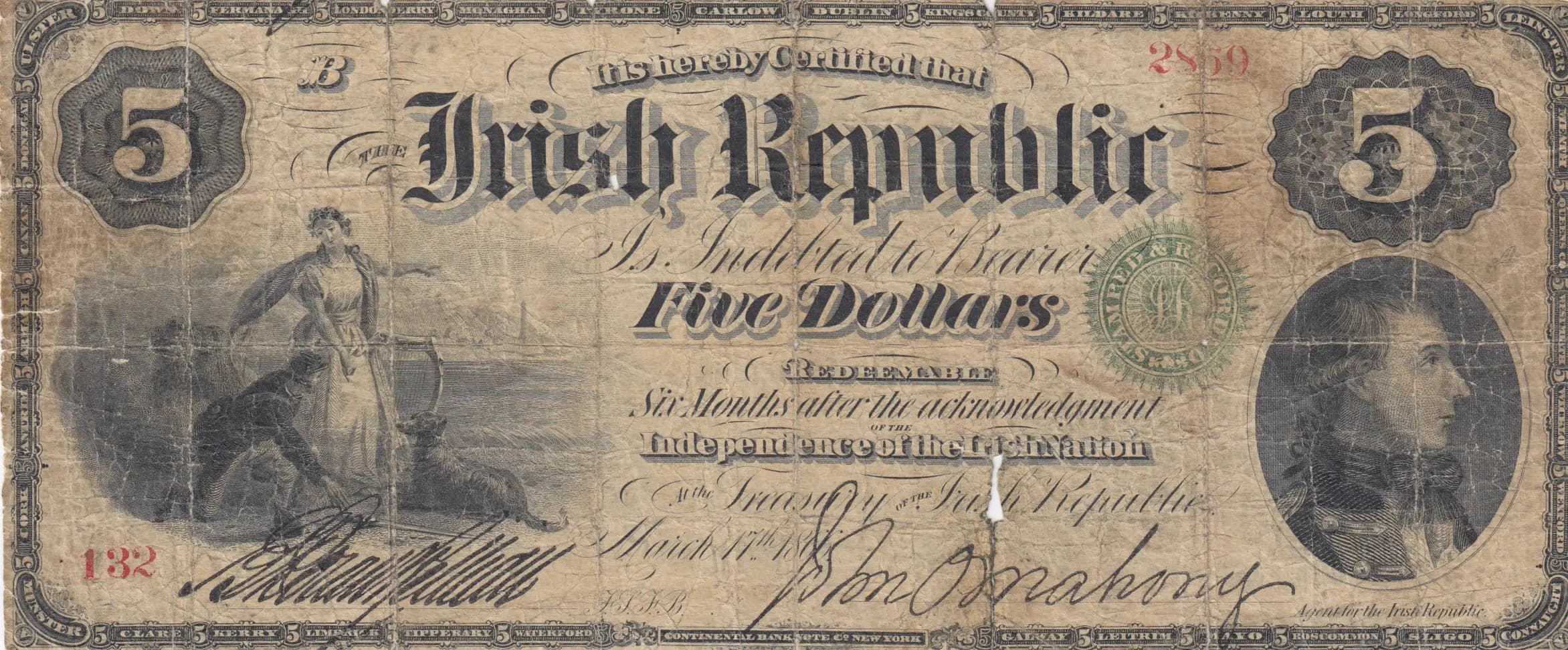
This is a historically significant 1866 Irish Republic 5 Dollar note (Pick S101), an early currency issued during the Fenian Brotherhood's attempted rebellion. The note exhibits heavy circulation wear with prominent creasing, foxing, and age-related discoloration throughout, consistent with a Grade G condition assessment. As one of the earliest and rarest issues of Irish nationalist currency, this example represents an important artifact of 19th-century Irish independence movements, with the visible handwritten signatures and March 17th, 1866 date marking it as a contemporary piece from that pivotal moment in Irish history.
Rare. The Fenian Brotherhood's 1866 currency is extremely scarce in all grades, as the insurrection failed and these notes were never widely circulated or formally redeemed. The print run appears to have been severely limited, with very few examples surviving. The Pick S101 catalog designation indicates this is a specialized issue from a non-national authority attempting currency issuance, and PMG records show limited professional grading activity for this type. Most examples would have been lost to time, destruction, or recall after the failed uprising. Even in Grade G condition, this represents a significant historical rarity with strong collector demand among Irish numismatic specialists.
This note was issued by the Irish Republic during the Fenian Brotherhood's 1866 uprising attempt, a pivotal moment in Irish nationalist struggle for independence. The inscription 'Six Months after the acknowledgment of the Independence of the Irish Nation' reflects the aspirational nature of this currency—issued with the expectation that Irish independence would be formally recognized within that timeframe. The classical allegorical imagery of Liberty and the prominent St. Patrick's Day date (March 17th, 1866) underscore the deep patriotic symbolism embedded in what was ultimately a failed but historically resonant attempt at currency issuance.
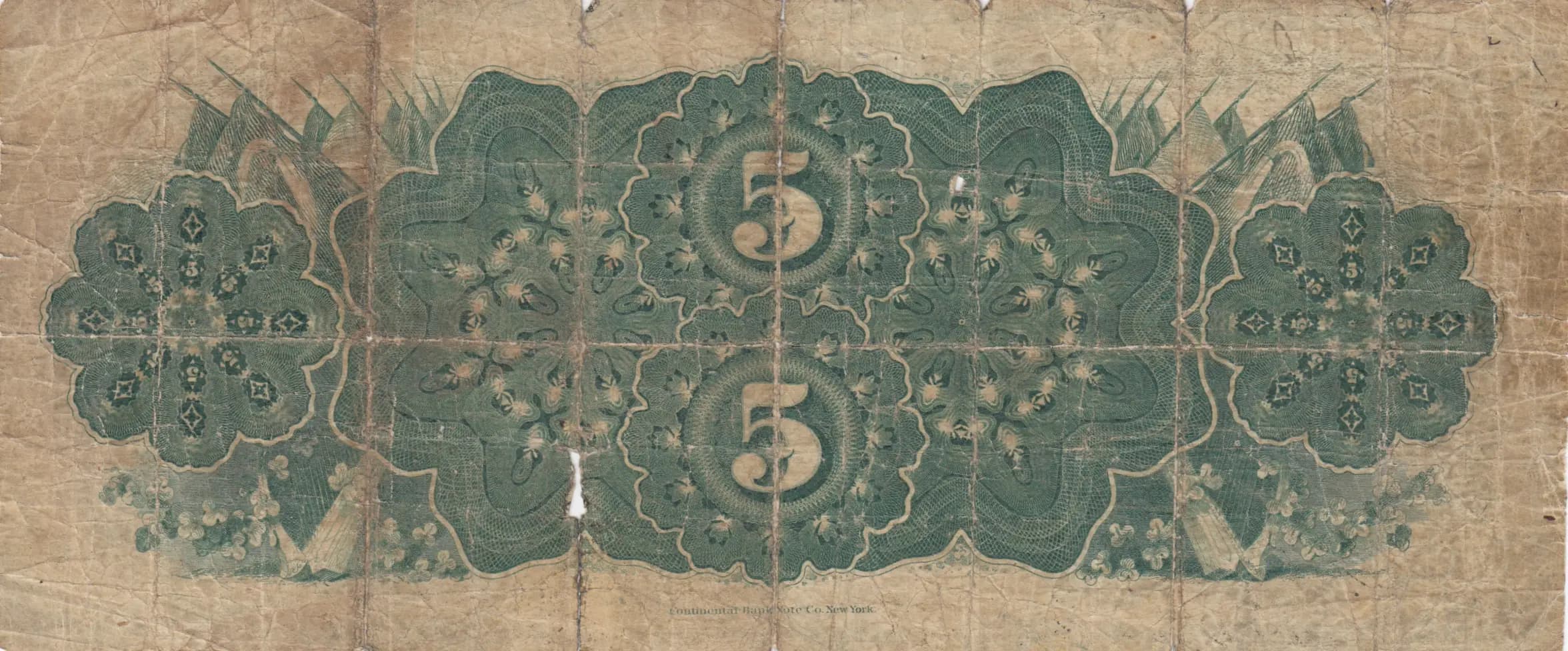
The front design presents a sophisticated nationalist composition: a portrait of an Irish historical figure (likely a nationalist leader) appears in profile on the right side, while the left side features a classical allegorical female figure in flowing robes representing Liberty or Hibernia, the personification of Ireland. The center is dominated by bold text declaring 'Irish Republic' and 'Five Dollars,' framed by ornamental borders with repeated text and decorative corner elements featuring the numeral '5' in all quadrants. A circular seal or emblem appears on the right side, adding official gravitas. The reverse presents an elegant symmetrical design with a large decorative rosette or medallion centered on the note, containing the numeral '5' at its core, surrounded by elaborate floral and leaf motifs arranged in a quatrefoil geometric pattern. The color scheme combines black, tan/beige, red, and green tints on the obverse, with the reverse rendered primarily in green and teal.
FRONT SIDE: 'Irish Republic' and 'Five Dollars' — primary denomination identifiers. 'This is hereby Certified that [the holder is entitled to] U. Indebtedness Bearing [interest, and is] Redeemable Six Months after the acknowledgment of the Independence of the Irish Nation' — redemption clause. '182[?]' and '2890' — likely serial number components. 'With promise of the Irish Republic' — issuing authority attestation. 'March 17th 1866' — date of issue (St. Patrick's Day). BACK SIDE: 'Printed at Haly. Phot. Co. New York' — printer attribution indicating the note was produced by the Haly Photographic Company in New York.
This note was produced using steel engraving and intaglio printing methods, as evidenced by the detailed ornamental border work, fine line patterns in the allegorical figures, and the complex geometric and floral designs on the reverse. The printer was the Haly Photographic Company of New York, as stated on the reverse. The precision of the engraving work and the quality of the impression are consistent with the highest standards of 19th-century banknote production. The use of multiple color plates (evidenced by the red serials, green reverse, and black primary imagery) indicates a sophisticated multi-pass printing process typical of security currency production of the era.
This example is catalogued as Pick S101 with printer attribution to CONB (likely referring to the Continental Note/Bank Company or similar entity, though the reverse specifically credits Haly. Phot. Co. New York). The visible serial number elements ('182' and '2890') and the handwritten signatures suggest this is from the original 1866 issue. The March 17th, 1866 date is a known characteristic of this issue. No substantial variety differentiation has been noted in PMG's population report for this Pick number, suggesting the catalogued variant represents the standard type. The presence of handwritten authentication marks indicates these were individually endorsed as part of the issuance process.