500 rials 1951
Market Prices
4 salesAbout This Note
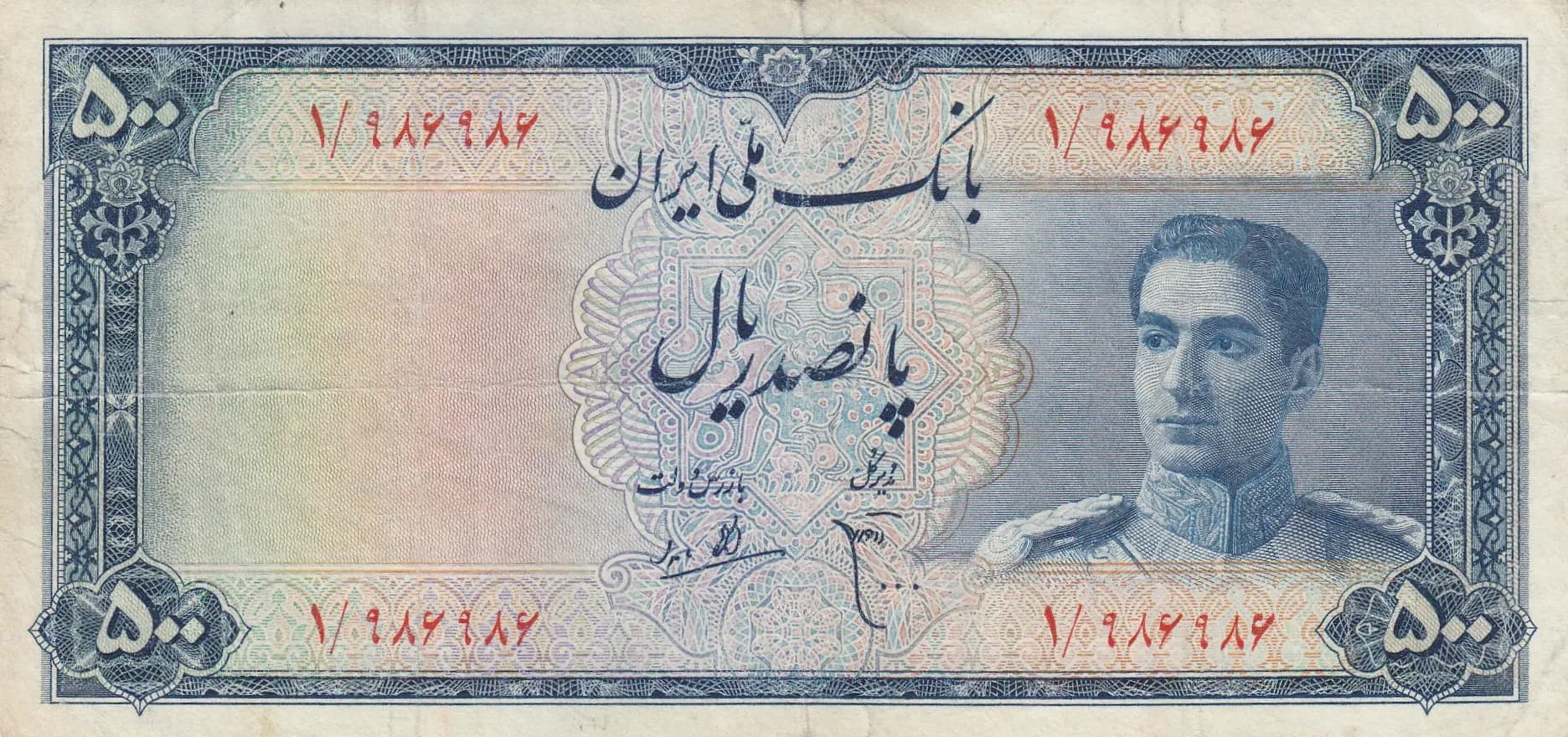
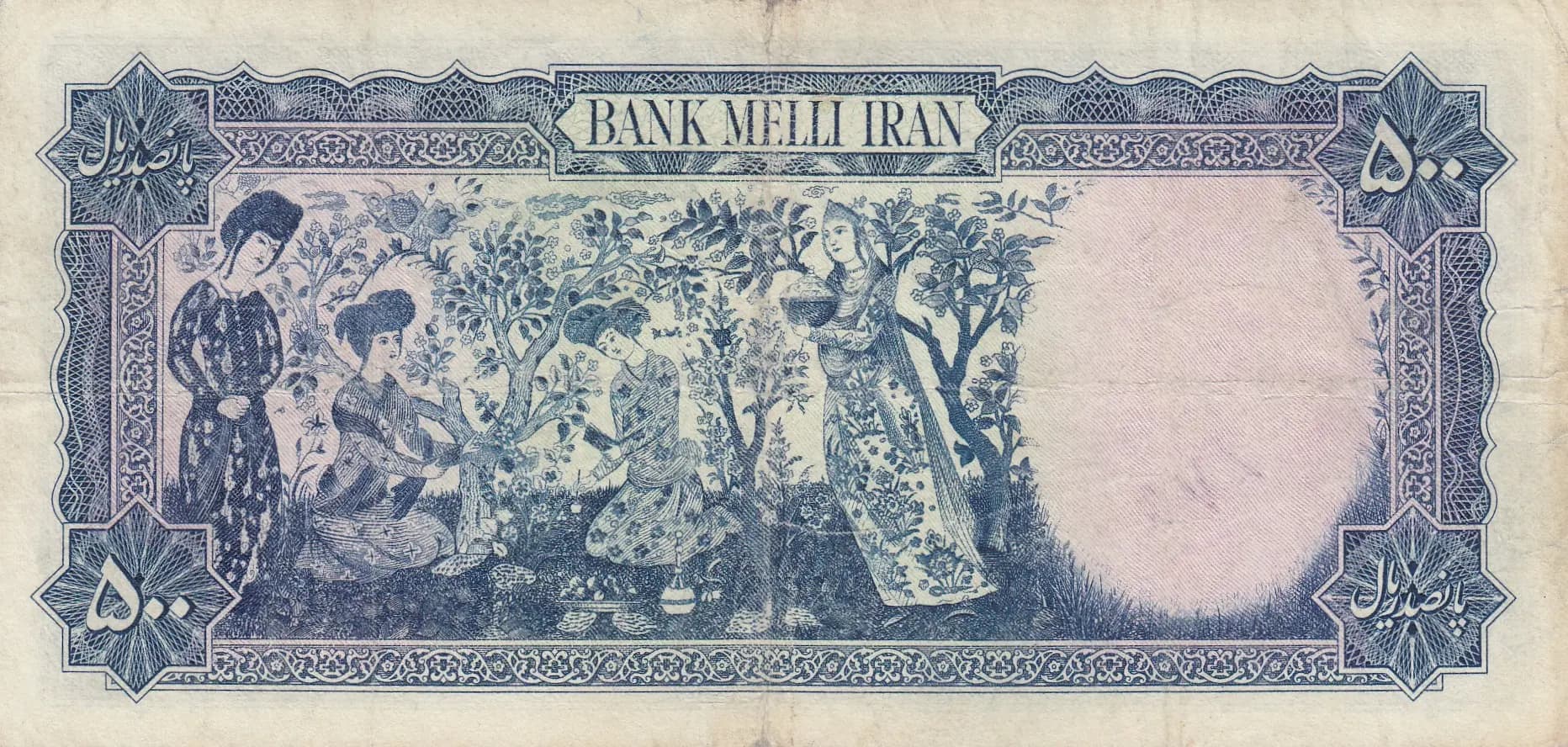
This 500 Rials note from 1951 represents Bank Melli Iran's early post-war currency, featuring Shah Mohammad Reza Pahlavi in military dress on the obverse alongside an ornate central medallion with intricate Islamic geometric and floral patterns. The reverse depicts a romantic garden scene with multiple figures in traditional Persian dress among trees and flowering plants, characteristic of mid-20th century Iranian numismatic art. The note exhibits moderate circulation wear with visible creases, foxing, and age-related yellowing consistent with its VF condition grade and 70+ year age.
Common. The 1951 500 Rials (P-52) is a regular-issue, high-denomination note from the early Pahlavi period with presumably substantial print runs. eBay market data shows examples in lower grades (F, PMG 30, PMG 35) selling for $31–$165 in the 2011–2020 period, indicating steady collector interest but no scarcity premium. VF examples are valued at $300 in 2016 catalogs, reflecting age and condition factors rather than rarity. The note remains readily available to collectors.
Issued in 1951, this banknote reflects the early Pahlavi era under Mohammad Reza Shah, a period of modernization and national consolidation in Iran following World War II. The military portrait of the Shah emphasizes his role as supreme commander, while the reverse's depiction of women in an idealized Persian garden setting reflects the era's cultural nationalism and romanticization of Iran's pre-Islamic and Islamic heritage. Bank Melli Iran, as the central bank, used such imagery to reinforce state authority and national identity during a critical period of post-war reconstruction.
The obverse features Shah Mohammad Reza Pahlavi in military uniform (second portrait type), shown in right-facing profile on the right side of the note, rendered in traditional engraved style. The dominant design element is a large ornate central medallion showcasing complex Islamic geometric patterns, arabesques, and floral motifs characteristic of Persian decorative arts. The color scheme employs cream, beige, and deep blue tones with navy security printing. The reverse presents an elaborate garden or orchard scene—likely depicting a Safavid-era Persian garden—populated with five or more figures in traditional Islamic court dress among cypress trees, flowering plants, and lush vegetation, all contained within an ornate rectangular border with floral corner elements.
Front: 'بانک ملی ایران' (Bank Melli Iran) appears at top; denomination '۵۰۰' (500 Rials) displayed in Persian numerals; date notation '۱/۱۴۶۹/۱۶' (1/1469/16 in Persian calendar). Back: 'BANK MELLI IRAN' in English across top; denomination '۵۰۰' (500 Rials) shown in Persian numerals repeated in lower corners.
Steel engraving by Harrison & Sons (H&S), a world-renowned London-based security printer. The visual analysis confirms the sophisticated multi-layer fine-line engraving, complex guilloche patterns, intricate crosshatching, and moiré effects characteristic of H&S's security work. The precision of detail in both portraiture and the ornamental medallion, along with the fine rendering of the garden scene, is consistent with premium intaglio security printing of the era.
PMG population reports one cataloged variant for P-52 (printer: H&S). The visual analysis does not reveal any distinctive overprints, special serial number prefixes, or signature varieties that would distinguish this note as a specific sub-variety. Standard 1951 issue with no known rare varieties reported.