50 rials 1979
Market Prices
15 salesAbout This Note
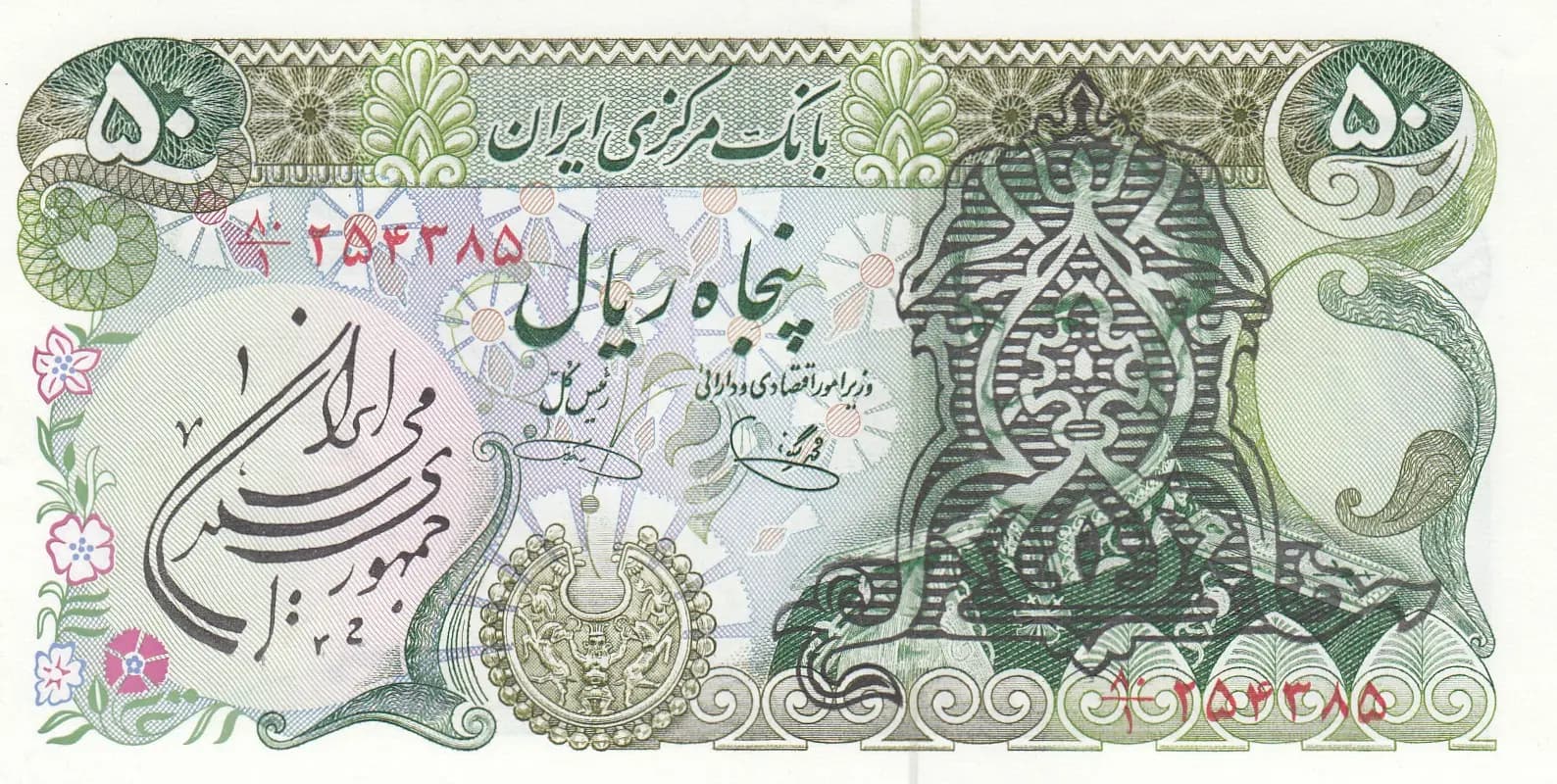
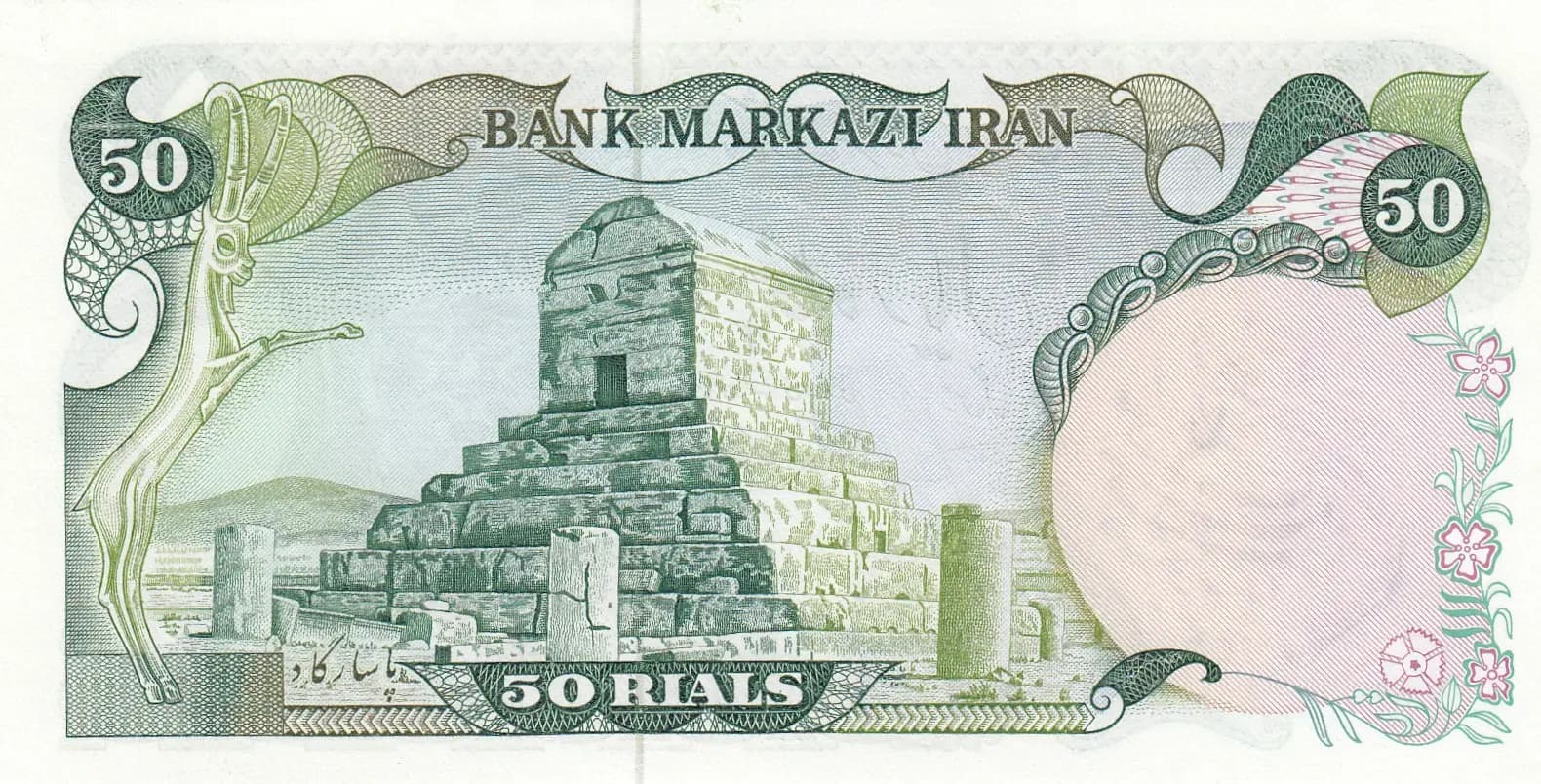
This Iranian 50 Rials note (P-123b) from 1979 is an overprint variety issued by Bank Markazi Iran following the Islamic Revolution, featuring striking green and cream tones on the front with elaborate Persian geometric and floral designs. The reverse showcases the iconic Tomb of Cyrus the Great at Pasargadae in pink and green. While the note shows visible aging with a horizontal center crease and some foxing consistent with natural patina, the intricate engraved details and security elements remain well-preserved, making it a historically significant example of immediate post-revolution Iranian currency design.
Common. eBay market data shows consistent sales in the $4–$18.50 range across multiple condition grades (VF–UNC) over a decade-long period, with typical UNC specimens selling for $7–$11. The 2019 catalogue value of $10 UNC further confirms this as a readily available note. The print run appears to have been substantial given the circulation evidence and consistent availability in the secondary market. This is a standard post-revolution issue with no documented rarity characteristics.
This 50 Rials note represents a pivotal moment in Iranian currency history—issued in 1979 following the Iranian Islamic Revolution, it overwrites the previous Shah-era design (P-101) with new Islamic Republic iconography and Persian calligraphy reading 'JUMHURI-YE ISLAMI-YE-IRAN.' The reverse's prominent display of the Tomb of Cyrus the Great at Pasargadae, the ancient capital of the Achaemenid Empire, reflects the new regime's effort to reclaim pre-Islamic Persian historical and cultural symbolism while establishing revolutionary credentials through overprinting existing currency stocks.
The front features an elaborate coat of arms or heraldic emblem—likely the Lion and Sun symbol modified for the Islamic Republic—positioned prominently on the right side, surrounded by intricate Persian geometric and floral patterns in green and cream. The left margin displays a vertical floral border with pink and rose-toned flowers. Decorative spade symbols (♠) appear in circular frames at the top corners. The reverse presents a detailed engraving of the Tomb of Cyrus the Great at Pasargadae, depicted as a stepped stone monument with characteristic rectangular construction and cylindrical supporting pillars, set against a pink/lavender background with green accents. Ornamental scrollwork and leaf designs frame the entire composition. The visual composition represents both revolutionary ideology and ancient Persian heritage.
Front Side: 'بانک مرکزی ایران' (Bank Markazi Iran / Central Bank of Iran); 'پنجاه ریال' (Fifty Rials); 'جمهوری اسلامی ایران' (Islamic Republic of Iran); 'SAFADAR' (possibly a security or design element). Back Side: 'BANK MARKAZI IRAN' (Central Bank of Iran in English); '50 RIALS' (denomination in English); 'پنجاه ریال' (Fifty Rials in Persian); numerical denomination '50' appearing in corner ornaments.
Intaglio engraving (recess printing), as evidenced by the fine line work, geometric mesh patterns, detailed architectural rendering of the tomb, color gradations, and subtle shading throughout. The security features include intricate engraved patterns and fine line work typical of high-security banknote production. Printer: TDLR (identified in PMG records for P-123b variant).
This is catalogued as P-123b variant per Pick and PMG records, representing an overprint issue on the previous P-101 design. The specific variety is the 'Arabesque black type D design overprint' containing the new Islamic Republic designation (JUMHURI-YE ISLAMI-YE-IRAN) applied over the Shah Mohammad Reza Pahlavi portrait area. The red stamp or overprint visible in the upper central area of the obverse may represent a secondary marking or security feature specific to certain production batches. Without visible serial numbers or signatures in the provided images, sub-variety determination would require additional documentation, though this appears to be the standard P-123b regular issue variant from the 1979 printing cycle (with actual distribution/circulation dates extending into 1981).