20 rials 1954
Market Prices
9 salesAbout This Note
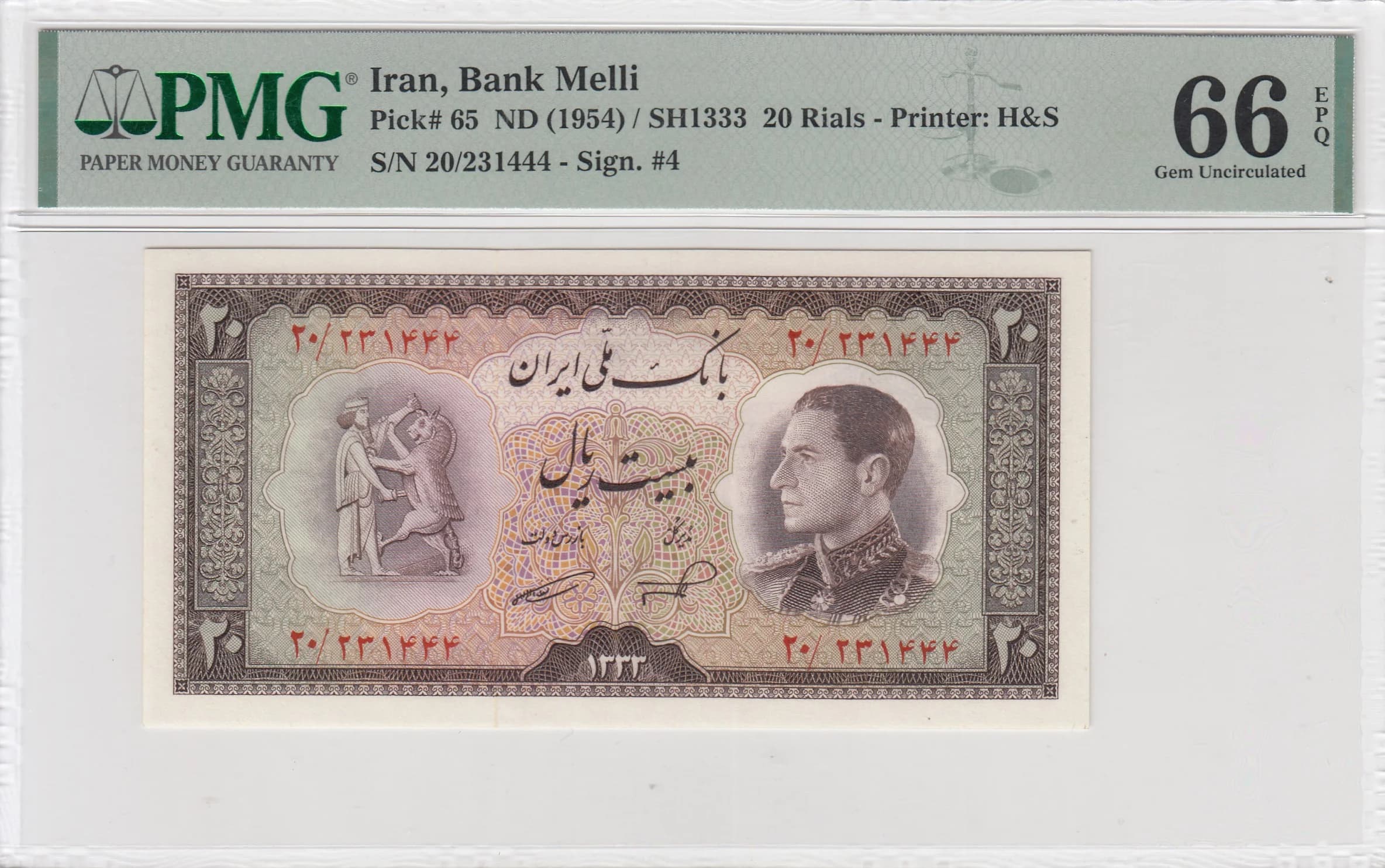
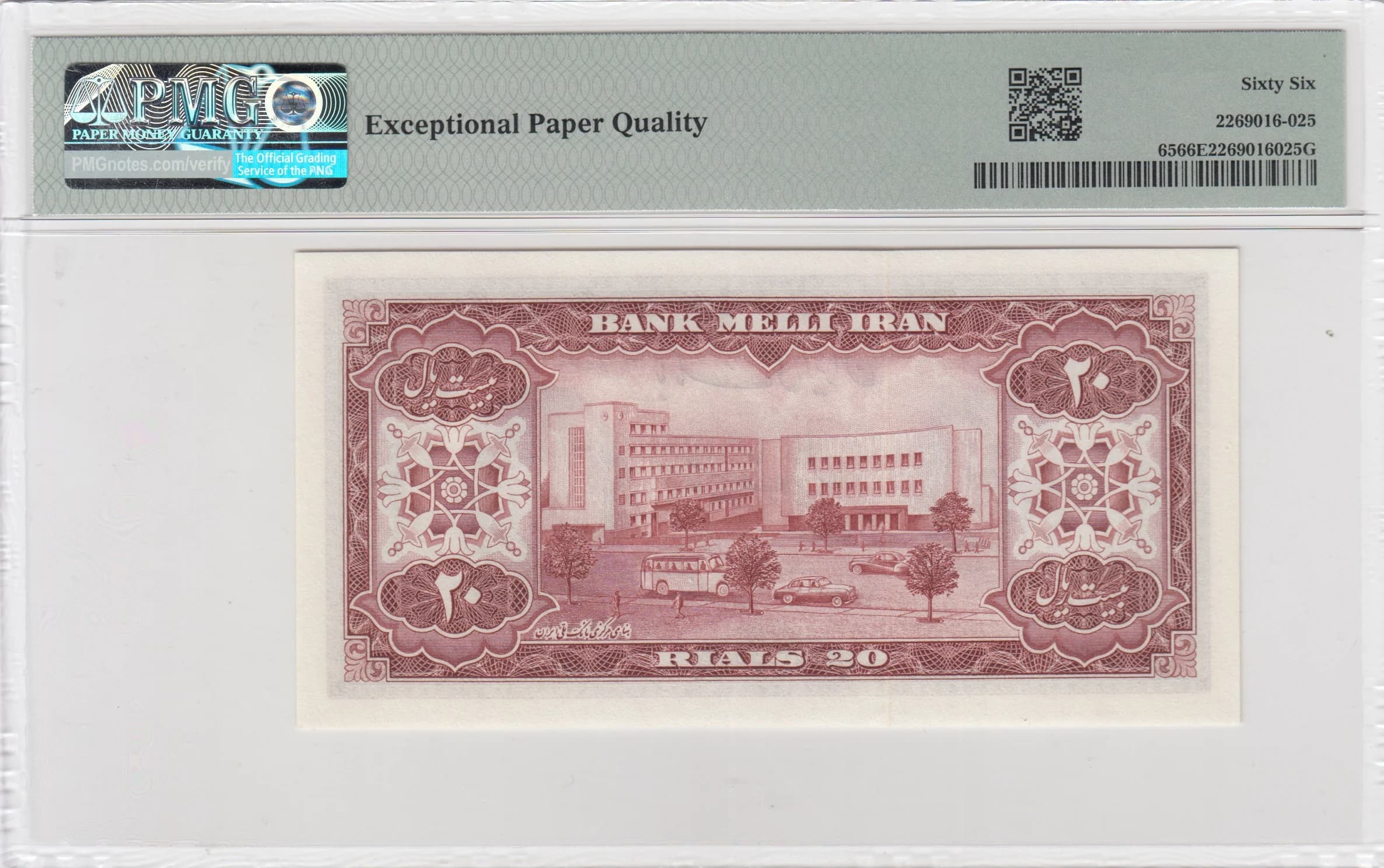
This is a pristine PMG 66 EPQ example of Iran's 1954 20 Rials note (Pick P-65), issued by Bank Melli Iran during the reign of Shah Mohammad Reza Pahlavi. The note exhibits exceptional uncirculated condition with sharp printing, vibrant multicolor design, and no visible wear, creases, or defects. The obverse features a classical allegorical figure with a globe and the Shah's formal portrait, while the reverse showcases the modernist Bank Melli building in Tehran, making this an important document of mid-20th century Iranian monetary and institutional history.
Common. eBay market data shows consistent sales in the $10-36 range across multiple condition grades (VF to AUNC) between 2012-2017, with catalog values pegged at $3 (VG), $12 (VF), and $25 (UNC) as of 2016. The regular issue status and historical circulation volumes suggest robust availability. Even this high-grade PMG 66 EPQ example, while desirable, commands prices consistent with a common note in premium condition rather than a scarce or rare issue.
Issued in SH 1333 (1954), this note represents the early decade of Shah Mohammad Reza Pahlavi's reign, a period of modernization and centralization of Iran's financial system under Bank Melli Iran. The reverse's depiction of the Bank Melli building in Tehran reflects the institutional pride and modernist architectural ambitions of the Pahlavi era, while the classical allegorical figure on the obverse symbolizes Iran's historical and cultural heritage. The use of Harrison printing (a leading British security printer) underscores Iran's international financial connections during this period of economic development.
The obverse features an ornate design with fine floral and geometric corner medallions in green, pink, brown, and beige tones. The left side depicts an allegorical classical figure seated with a globe, symbolizing knowledge, commerce, or civilization. The right side displays a formal profile portrait of Mohammad Reza Pahlavi in dignified pose wearing military dress with a decorated collar, establishing the Shah's authority and modernist credentials. The reverse is executed in warm pink, red, and burgundy tones and prominently features the Bank Melli Iran headquarters building in Tehran—a substantial multi-story modernist structure with trees and period vehicles (cars and buses) depicted in front, conveying the institution's contemporary significance and urban importance.
Front side: 'بانک ملی ایران' (Bank Melli Iran) in Persian calligraphy; serial number '20/2213444' in numerals. Back side: 'BANK MELLI IRAN' and 'RIALS 20' in English script. The bilingual presentation reflects Iran's engagement with international banking standards of the 1950s.
Steel engraving with multicolor offset printing, characteristic of high-security banknote production. The printer is identified as Harrison & Sons (H&S) in the PMG population report. The intricate line work, fine detail in architectural rendering, decorative borders, and sharp color registration throughout both sides evidence professional security printing standards of the era. A yellow security thread is noted running vertically through the note.
Pick P-65 with Harrison & Sons as printer. The note displays the standard SH 1333 (1954) date. Serial number observed: 20/2213444. No notable varieties, overprints, or signature variants are apparent in this example. This represents the standard regular issue variety for this Pick number.