100 rials 1976
Market Prices
21 salesAbout This Note
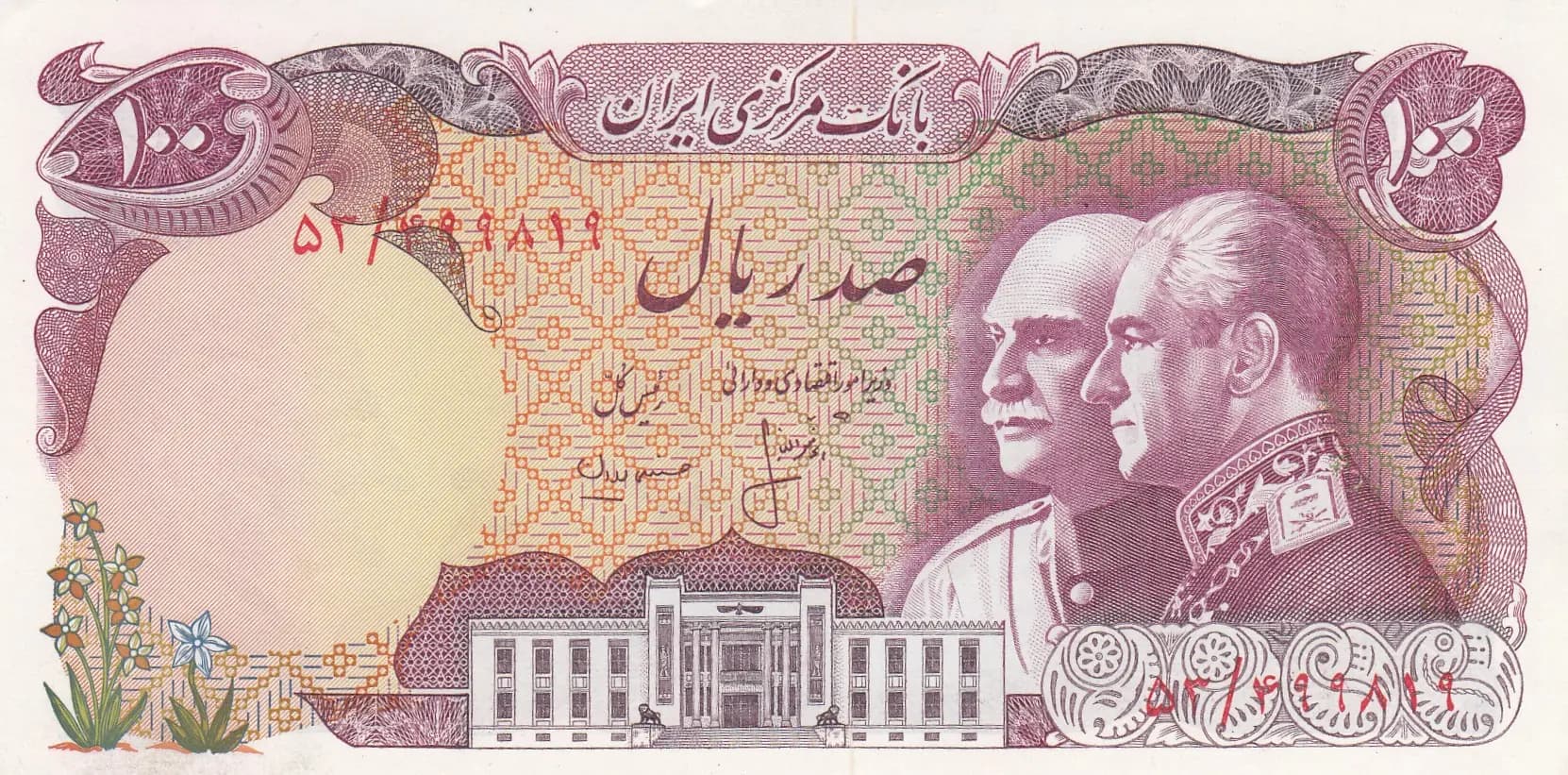
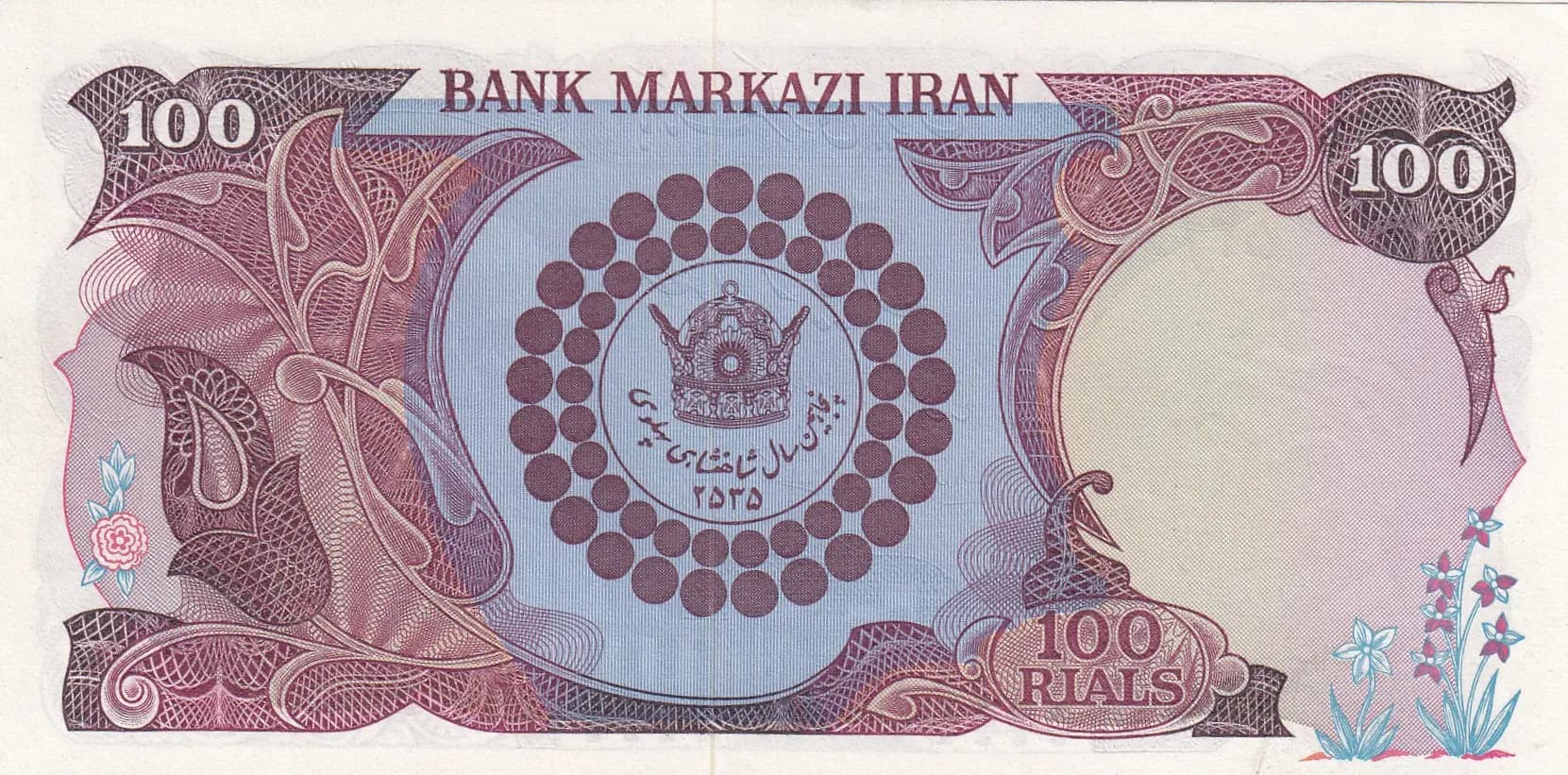
This 100 Rials commemorative note from 1976 celebrates the 50th anniversary of the Pahlavi Dynasty and is presented in uncirculated condition with vibrant, crisp printing throughout. The obverse features dual portraits of Reza Shah Pahlavi and Shah Mohammad Reza Pahlavi in formal military dress alongside the neoclassical Bank Melli Iran building, while the reverse displays an ornate central emblem featuring a Pahlavi crown surrounded by approximately 50 circular medallions representing the 50-year anniversary. This commemorative issue represents an important piece of late-period Pahlavi numismatic history and remains highly collectible, with recent market sales of UNC examples commanding $13.50-$21.06.
Common. Despite being a commemorative issue, this note was produced in substantial quantities for circulation and is frequently encountered in the collector market. eBay transaction data spanning 2009-2021 shows consistent sales volume with UNC examples averaging $13.50-$21.06, VF examples at $5-$10, and lower grades at $2.50-$6.50. These modest price points and regular market availability indicate this is not a scarce or rare note. The 2019 catalog valuation of $25 UNC further supports a common classification, as truly rare notes command significantly higher values.
Issued by Bank Markazi Iran in 1976, this note commemorates the 50th anniversary of the founding of the Pahlavi Dynasty by Reza Shah in 1926, marking a significant milestone in Iran's modern history under the Pahlavi regime. The dual portraiture of Reza Shah (founder) and Mohammad Reza Shah Pahlavi (reigning monarch) on the obverse symbolizes the dynasty's continuity and legitimacy. The reverse's distinctive crown surrounded by 50 suns/medallions served as the official anniversary emblem, making this a specially designed commemorative currency of considerable historical and political significance.
The obverse features a sophisticated composition with the two Pahlavi sovereigns—Reza Shah Pahlavi (left, founder of the dynasty) and Mohammad Reza Shah Pahlavi (right, the reigning Shah in 1976)—rendered in fine engraved profile portraits showing them in formal military dress with decorative regalia. Below the portraits is an architectural rendering of the historic Bank Melli Iran building in Tehran, identifiable by its neoclassical design with columned portico and symmetrical facade. The left side contains a large blank cream-colored oval area, with ornamental Persian carpet motifs and decorative floral elements throughout the border. The reverse is dominated by a large circular emblem containing the Pahlavi crown at its center, encircled by approximately 50 small circular medallions or 'suns' representing the anniversary milestone, rendered on a light blue background panel. Ornamental scrollwork, floral motifs in purple/maroon and colored accents occupy the corners. The overall design employs intricate geometric and floral patterns as security elements throughout both sides.
OBVERSE: 'بانک مرکزی ایران' (Bank Markazi Iran / Central Bank of Iran) and 'صد ریال' (One Hundred Rials) in Persian. REVERSE: 'BANK MARKAZI IRAN' and 'RIALS' in English, with '100' in numerals. The central emblem on the reverse contains Persian/Farsi text forming part of the royal seal, though specific text is not clearly legible in the image. All inscriptions are rendered in ornate calligraphic and typographic styles consistent with official Iranian bank currency of the period.
This note was produced using intaglio (engraved) printing, the traditional security printing method for currency, as evidenced by the fine line work, intricate detail, and dimensional quality visible in the ornamental borders, portraits, and architectural elements. The printer is recorded as TDLR (Tabapress, Demirel, Lüke, Reuther—a European currency printing consortium). Multiple color printing layers were employed, utilizing maroon, orange, green, purple, lavender, light blue, and cream inks to create the multicolored design. The incorporation of complex geometric and floral background patterns, fine engraved line work, and the yellow security thread visible in the design specifications represent the security printing standards of the mid-1970s.
The PMG Population Report indicates a single cataloged variant for Pick-108 with printer designation TDLR. No variations in signatures, date overprints, or serial number prefixes are evident from the visual analysis. The note is cataloged as ND (No Date) with the year 1976 assigned based on the historical commemoration. Collectors should note that while this is a commemorative issue marked by the 50th anniversary design elements (particularly the 50 suns/medallions on the reverse), it remains a single standard variety within the Pick catalog system, with no known significant sub-varieties or error notes reported for this denomination and year.